Religious Ecologist and Associate Professor of Sociology at Whitworth University, disseminating scientific research to congregations and religious leaders
Guess who are all those people watching online church services?
People who are already going to church on a regular basis.
Just 6% of people who never attend in-person worship report watching online.
About half of weekly church goers also watch church services online.
If you’re trying to figure out what’s going on with declining church attendance and the rise of the Dones, then you got to read Reorganized Religion! Smietana does a great job of capturing all the theories of congregational vitality that I write about. https://t.co/1nYQWnDgV0
"in addition to tracking the standard “three b’s”—belonging, belief, and behavior—it also tracks a fourth b—branding."
New research on how "symbolic pollution" is a big part of religious change: https://t.co/DTWxlmlFUR
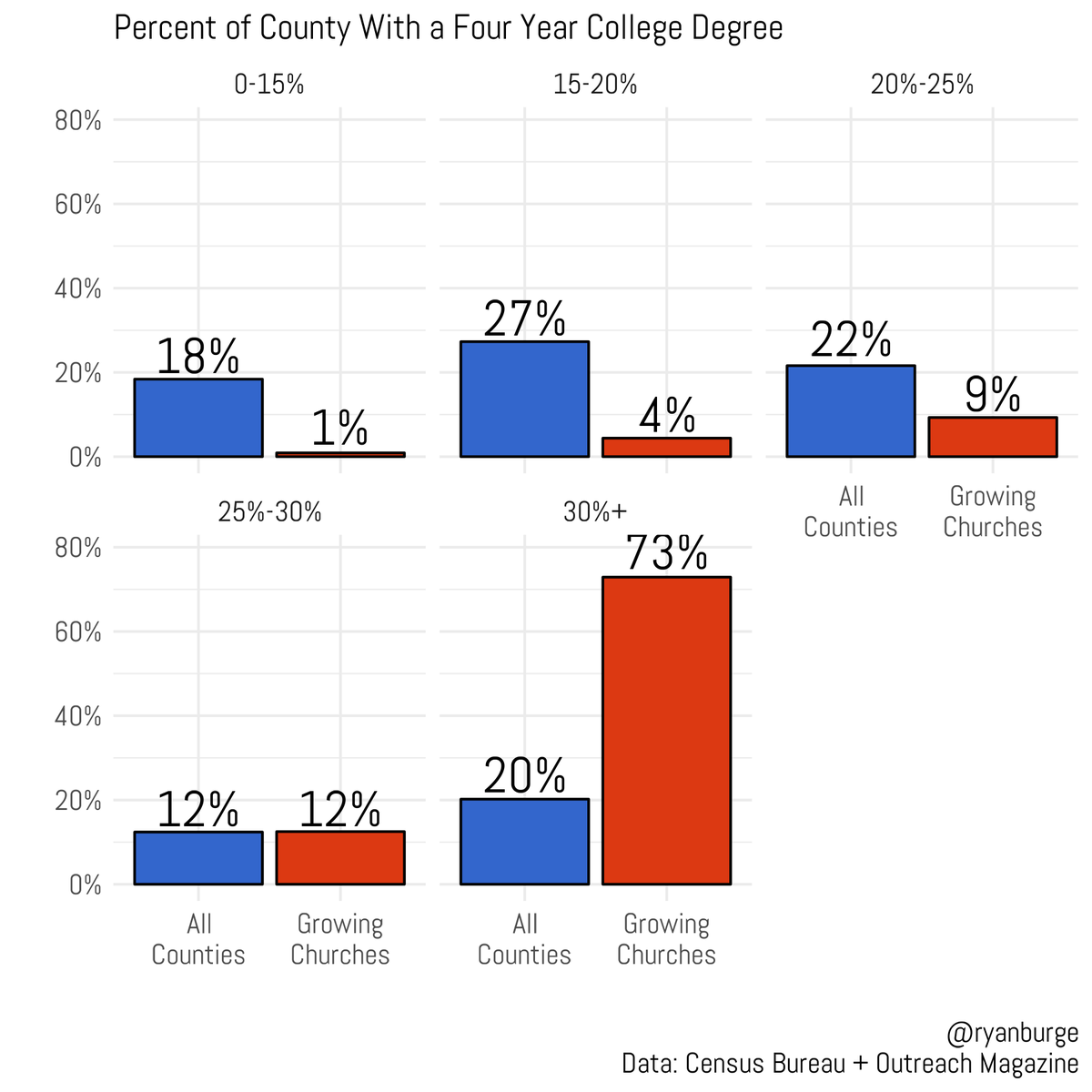
I analyzed the areas around the 455 fastest growing churches in America.
Here's a stunning fact.
% of all counties where 30%+ of the population has a four year college degree: 20%
Among those counties with fast growing churches, 73% of them have a 30%+ college degree rate.
"Explaining the reasons—while not the causes—behind religious decline is a central issue for sociologists interested in secularization processes."
In new work, Molteni reviews what we know about the theory that religion declines with more security: https://t.co/5mEReVP98Z
Hate to be a tease, but...
New data is here.
"I don’t want to be too hyperbolic. But I am a preacher and it runs through my blood. This really may be the end of an era in American religious demography."
Coming on Monday.
ADVANCE ACCESS
In a forthcoming article, @socofthesacred examines the relationship between religious texts and power through a study of how complementarian gender ideology became inserted into one the of most popular English Bible translations today.
https://t.co/Voj8wSWOfQ
While the share of Christians who are biblical literalists is unchanged over the last 35 yrs, the percentage of weekly church goers who believe that the Bible should be taken literally has gone up 10 points.
Devout Christianity is become exclusively theologically conservative.
I put together a really simple linear model to project what American religion will look like in the next decade.
The results indicate that the "nones" will unequivocally be the largest group in America in 2029, and that's largely a result of more mainline decline (10.8%->4.4%).
CURRENT ISSUE
New research by @mich_oyakawa reveals how racial reconciliation can function as "a suppressive frame that precludes discussions about racial inequality and discourages collective action to promote racial justice."
https://t.co/qrQjKEzhyS
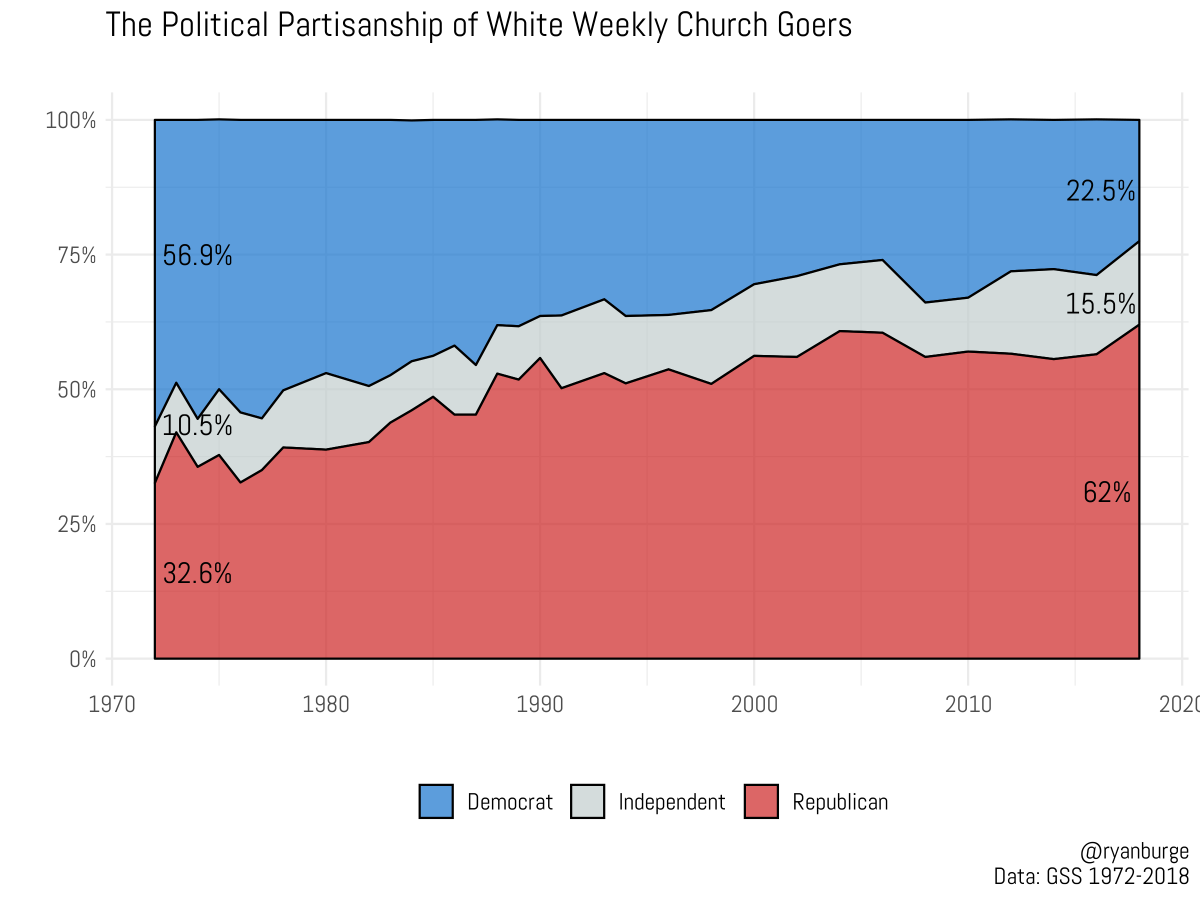
In 1972, 56.9% of white weekly church goers were Democrats. Now, it's 22.5%
The Republican share of this subgroup has basically doubled, going from 32.6% in 1972 to 62% in 2018.
I wrote something for @edstetzer that questions where religious decline is inevitable in the United States. The short answer is no, younger age cohorts who gain more education don't become more secular. @PhilipSchwadel informed this piece a lot.
https://t.co/KzKbrlGEGb
Young adults who attend religious services more than once a month are about 40 percent more likely to report that they are very happy https://t.co/S9r2SxMU5Y @WilcoxNMP@FamStudies@TheAtlantic
Leah Drakeford (2018) "One factor that may be important for inmate mental health is religion." Society & Mental Health @SAGE_News https://t.co/uJOyjva58O @ASAnews