@inside_exercise Would training be different if he could tell his young(er) self about todays evidence? Both in terms of performance (implimenting resistance training, gels, training intensity distribution) and health (afib, overuse injuries, diminishing health benefits with more training volum)?
@inside_exercise@TLexercise Your guess: 1) will concurrent training be implementet more in sports and health? 2) what questions remain unanswered about concurrent training both physiological and in terms of treating/prevent diseases?
@inside_exercise@TLexercise Some data suggests resistance training (RT) increases arterial stiffness even in healthy. Is there lesser decreases in arterial stiffness from concurrent training vs. aerobic bc of the RT component? And why does RT decrease cvd outcomes when it may increase arterial stifness?
@inside_exercise@TLexercise What mediates the combined effects of concurrent training on health markers, morbidity,mortality? Are the effects of aerobic - and resistance training additive or synergistic? Why?
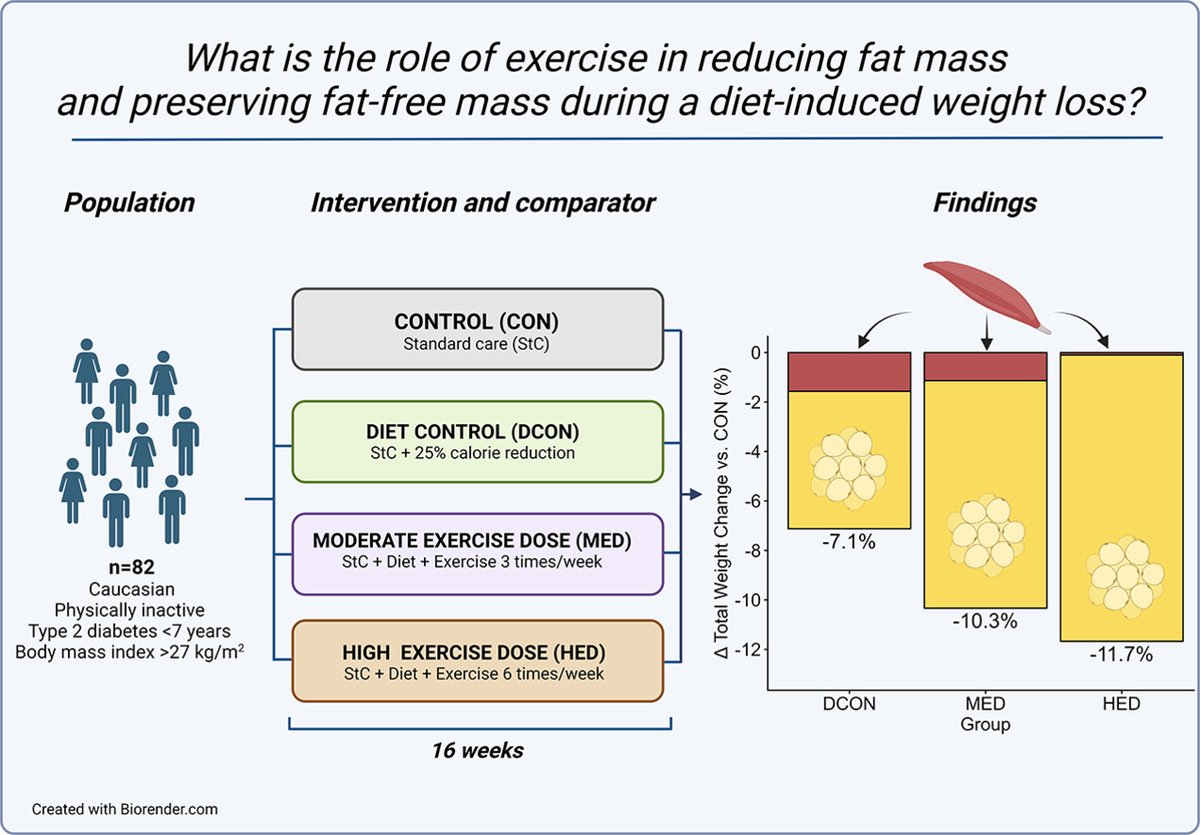
@PrimaryCarePAC Very nice breakdown of the study👌Our recent analyses also suggests a dose-respons effect of exercise on fat loss (with minimal additionel weight loss) when undertaking a dietary caloric deficit.
https://t.co/JMzMB03Hpx
@JSHS_MedHealth@DDEA_Denmark @CFAS_dk @trygfonden I hope perceivable quantification of exercise doses (i.e., set volume/week in resistance training and intensity- and minutes in aerobic training) will fasciliate more realistic expectations regarding body composition outcomes in ppl looking to lose fat
@jensjakobsendk@DDEA_Denmark @CFAS_dk @trygfonden Thanks! That would also be my guess. I hope perceivable quantification of exercise doses (i.e., set volume/week in resistance training and intensity minutes in aerobic training) will fasciliate more realistic expectations regarding bodycomp outcomes in ppl looking to lose fat
What is the dose-response effect of exercise on fat loss during caloric restriction in people living with type 2 diabetes and overweight/obesity?
And can you guess the exercise - and diet program?
https://t.co/C8Dmd73oL7
@DDEA_Denmark @CFAS_dk @trygfonden
Effects of caloric restriction with different doses of exercise on fat loss in people living with type 2 diabetes: A secondary analysis of the DOSE-EX randomized clinical trial
https://t.co/1DzwyC2xpp
@inside_exercise Any medication/supplements that augments cardiac benefits of aerobic exercise? eg. RAAS blockage, lipid-lowering drugs? Do the benefits of additional medication depend on the comorbidities?
@inside_exercise Your opinion vs current evidence: What societal changes would facilitate more physical activity e.g.better sociostructural changes (better bikes lanes/pavements, free sportclubs for kids) or more focus on individual health literaricy (fitness apps, tv shows, GP visits)?
@inside_exercise@KevinMurachPhD What kinds of exercise modalities gives the most “muscle memory” and how much exercise is needed to create muscle memory?
@inside_exercise@Barnes_Lab What are the main proposed mechanisms to how ex decrease the risk of cognitive decline? What type and amount of ex is most/not effective?
@inside_exercise@dr_guess@DrJonLittle In T2D: Will diets that promote increased insulin secretion (high carb or high protein) exaust the betacell (like sulfonylurea drugs) more than diets promoting less insulin secretion (keto, low carb)? Any human evidence?