So, you matched into psychiatry! Now what?
Relax, unwind, enjoy… but if you MUST do a little prep to ease your mind, how about a podcast?
Psychiatry Boot Camp is specifically designed to help you feel confident on day 1! #FOAMed#psychtwitter
https://t.co/kFL4s4C6Sc
One notable thing to me about the BPD discourse I’ve been seeing here over the last couple of days, vast majority of it from non-clinicians, there is just no tiptoeing around BPD as a diagnosis, no the-diagnosis-that-must-not-be-named vibes; it is refreshing in its own way, a collective step away from toxic denial that has often characterized activism around this. I don’t know what the future holds for BPD as a diagnosis; quite possibly the terminology will look different in 2 decades, but the experiential and behavioral patterns that are indexed by BPD need clear-eyed recognition, and that need will not change.
@PaulKunnath@AllenFrancesMD Training in CBT, supportive psychotherapy, and psychodynamic psychotherapy are required by the ACGME.
In practice, the depth of that training varies widely.
I doubt most psychiatry residents ever do CBT-I specifically. It’s evidence & indications are maximally drilled though.
Superiority of #Clozapine for #Schizophrenia is most robust finding in all psychiatry.
Clozapine would be considered a wonder drug if only it were new/highly priced/& if our society cared a damn about helping sick psych patients.
But it isnt/we dont/so its badly neglected.
Psychotherapy training can improve good therapists, but not make them great.
And sometimes it makes them worse (narrow/self- conscious/inflexible).
Great therapists have warmth/wisdom/goodness/ empathy/strength/common sense/acceptance/ authenticity/optimism that cant be taught.
Whenever severe psychiatric illness is combined with a need for urgent treatment, I hope every psychiatrist in the world considers ECT, one of the best and quickest ways to help in severe catatonia, psychosis, depression or bipolar mania.
I'd be delighted by US campaign to reduce overuse of psych meds if it weren't led by RFK Jr who says;
1)they're like heroin
2)keto diets can cure Schizophrenia
3)vaccines cause autism
His antipsychiatry badly overshoots & discourages meds for those who desperately do need them.
Diet exercise and the Bible do not treat serious mental illness, but I encourage diet, exercise, and community/faith activities for most of my patients regardless, both for preventative and adjunctive treatments.
Important to know, however, that all three can be overdone and cause disorders/issues of their own.
In meaningful psychotherapy, we help patients move from the general to the specific, from the abstract to the personal. We encounter resistance along the way, which itself becomes the focus of our attention and curiosity.
👉Tell me what you mean
👉Can you give me an example
👉Say more
👉I notice you didn’t mention
👉Something makes it hard to talk about this
👉Perhaps there’s a reason you left that out
👉What more comes to mind
👉I notice you looked sad when you said
👉Perhaps it’s easier to focus on this than that
👉Can you put words to those tears
👉I notice we quickly got away from the topic of
👉Help me connect the dots
These comments are made in a spirit of non-judgmental curiosity, intended to invite the patient to *be curious* with us, without blame or shame.
They help create space for the patient to notice, attend to, and begin to put words to areas of experience that were previously unknown or unacknowledged.
This approach to psychotherapy takes account of unconscious mental life: we do not fully know our own hearts and minds, there are multiple layers of experience, and emotional life is complex and often contradictory.
This is how we become more self-aware and more whole.
The therapeutic stance of *finding out together* is very different from providing tips, tools, worksheets, advice, or solutions.
It is also very different from automatically affirming or validating whatever is on the surface, before we could possibly understand what we’re validating.
The starting point of in-depth psychotherapy is recognizing there is more than meets the eye, and working to develop a relationship in which patient and therapist can discover it together.
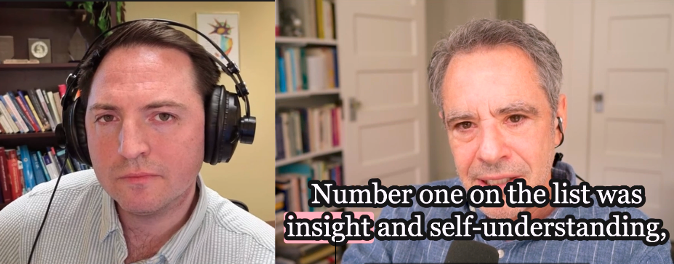
🎙️ Interview: What Makes Psychotherapy Meaningful?
I discuss psychiatry, psychotherapy, therapy-speak, and what gets lost when mental health treatment becomes a procedure.
On the Psychiatry Boot Camp podcast with Dr. @MarkRMullen
listen free 👇
https://t.co/TnHP6DbDYu
✍️Today’s post highlights my recent podcast interview with @MarkRMullen for Psychiatry Boot Camp
“Psychotherapy is the art of helping people see and hear and think about things that might be quite uncomfortable, without feeling blamed or shamed.”
Free 👇
https://t.co/0anmJ0I2sC
This was an excellent podcast. There were many important points. Something that resonated strongly with me about our current culture was the observation that "making an effort to understand is assumed to be pointing a finger of blame" and the pattern of "conflating curiosity with blame". It has been especially scary, and destructive, to see this pattern in our medical institutions and "professional" organizations.
Jonathan hits another home run. He has a unique talent of saying things that get to the core. If you're a therapist, take the time to listen to or read any of his work. It will be worth every second.
Always trying to make sure I “own the book so I can throw it away” and be fully present with my patients.
Listening to Jonathan helps. Highly recommend this one!
An eye opening conversation & cutting critique of current trends in the practice of psychotherapy.
Eternally grateful for @JonathanShedler’s generosity.
This convo has been on my aspirational list since I started the pod in 2023.
Find it wherever you get podcasts!
I'm a bit annoyed that NYT has settled on the title “Here’s What Psychiatrists Mean When They Say You Have A.D.H.D.” (presumably because it got more engagement) rather than the prior title “We’re Thinking About Mental Health Diagnoses All Wrong,” because the piece isn't really about ADHD. It's just an example I used in one passage.
Best summary of what psychiatric diagnosis is/& what it is not.
Should be read (& often reread) by every clinician/patient/trainee/family member.
Congratulations @awaisaftab https://t.co/D3faLVpGtq
I hate the phrase "dopamine hit" - dopamine is about incentive salience and prediction error, not a literal "shot of pleasure" every time you see a notification or eat a cupcake.
Let’s stop turning complex neurobiology into a buzzword. DOPAMINE DOESNT WORK THAT WAY.