Roosevelt stole all US citizens' savings in January 1934 with one simple trick.
The Gold Reserve Act handed all gold held by the Federal Reserve to the Treasury, then let Roosevelt reprice gold from $20.67 to $35 per ounce by executive proclamation. That single move cut the dollar's gold content by 41%. Every dollar you held lost 41% of its backing overnight.
Roosevelt needed to inflate debt away and fund New Deal spending without going to you directly. Devaluation is taxation without a vote. The purchasing power comes from somewhere, and it came from every American holding dollars or dollar-denominated savings.
The government had already made private gold ownership a crime under Executive Order 6102 in April 1933, forcing citizens to surrender gold at $20.67. Then, once the government held all the gold, Roosevelt repriced it upward by 69%. The profit, roughly $2.8 billion, went straight to the Exchange Stabilization Fund, a Treasury slush fund Congress never directly controlled.
Inflation is a transfer mechanism. The first spender captures real value; every subsequent holder absorbs the loss. In 1934, the Treasury was the first spender. Your parents and grandparents were not.
Sound money constrains government, and governments destroy it for that reason.
Every government-issued paper currency in history has collapsed. Every single one.
Rome debased the denarius until it held almost no silver. Weimar Germany printed the mark into oblivion by 1923, destroying middle-class savings in under four years. The Continental dollar, the French assignat, the Zimbabwean dollar, the Venezuelan bolivar. The list runs long and the ending never changes.
Central banks manage fiat currency to fund government spending that tax revenue cannot cover, not to protect your purchasing power. Inflation is a tax. Every dollar created without corresponding production transfers purchasing power from savers to first spenders, which is always the government and its connected institutions.
The dollar has lost over 97% of its purchasing power since the Federal Reserve opened for business in 1913. That loss did not happen accidentally; the Fed ran the printing press, and you absorbed the damage.
Defenders will argue that modern central banking is more sophisticated than Weimar. The math remains identical: spend beyond revenue, monetize the gap, dilute the currency. Sophistication only determines the speed of the destruction.
No fiat currency has ever survived indefinitely. Not one government has voluntarily relinquished the power to inflate. Given those two facts, the current dollar's long-term trajectory requires no guesswork.
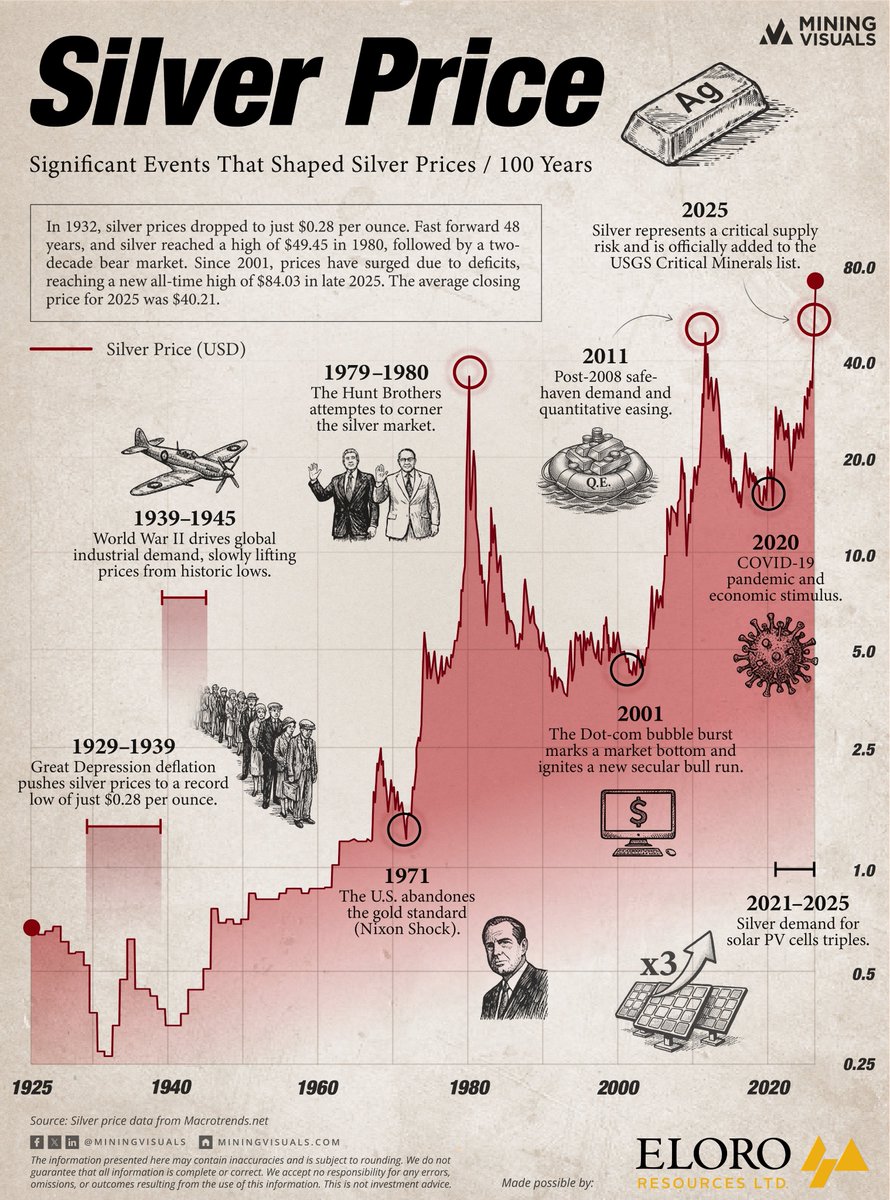
Anyone looking at the long-term silver price chart always asks one question: WTF happened in 1980?
The answer is one of the most interesting stories in modern financial history.
Nelson Bunker and William Herbert Hunt accumulated roughly 100 million ounces of silver between 1979 and 1980, driving prices from $6 to $50 per ounce. They believed, correctly, that fiat currency expansion under the Federal Reserve made hard assets the rational hedge. They acted on that belief aggressively and legally.
Washington panicked. Big banks and trading houses simply did not have the silver they sold in the futures market to deliver, and stood to lose an indefinite amount of money. To put it plainly, the Hunt brothers owned most of the physical silver and also owned the futures contracts. To deliver physical silver on the futures date, the firms who sold the futures had to buy it from somewhere, and that somewhere was the Hunt brothers themselves. Checkmate.
Naturally, the Commodity Futures Trading Commission and the Chicago Board of Trade changed the rules mid-game in January 1980, issuing "Silver Rule 7," which restricted new silver futures purchases and forced liquidation of existing positions, forcing the Hunt brothers to sell by law. The exchanges moved the goalposts while the Hunts were already on the field.
Prices collapsed. The Hunts faced margin calls they couldn't meet. On March 27, 1980, silver dropped 50% in a single day, now called "Silver Thursday." The brothers eventually declared bankruptcy in 1988.
The entire apparatus, the CFTC, the Fed, the major banks holding short positions on silver, had direct financial interests in stopping the Hunts. The banks short on silver lobbied the government and got the rules changed in their favor. You never hear that part emphasized.
Property rights mean nothing if regulators can rewrite market rules the moment a private actor threatens well-connected institutions. The Hunt brothers didn't destabilize the monetary system. They exposed how fragile a debt-based system looks when real money starts moving.
H/T to @MiningVisuals for this excellent graphic.
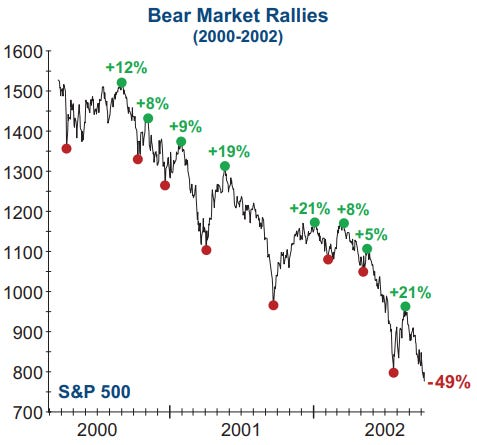
Right before the 2000 dot-com crash, the S&P rallied 12% to reclaim its previous highs... Those who went max long because “the internet is the future” were right, but still lost 50% over the next 2 years.
To make sure every last bull stayed in (and then got wiped out), we had 3 separate 20% bear market rallies... Only after everyone was fully shaken out did we bottom in 2002.
It then took ~14 years just to break even on a nominal basis... And by that point, most were too scarred to fully participate in the next bull run.
Lesson: Don't participate in historically overvalued markets, especially not when that overvaluation coincides with the biggest crisis in human history
Imagine being instructed NOT TO speak with the pilot during a low-altitude emergency…
September 6 1985: Midwest Express Airlines Flight 105, a DC-9, takes off from Milwaukee Airport, Wisconsin.
The jet had just reached 700 ft when the left engine exploded due to a mechanical issue; inquiry later concluded that this did not damage the controls.
In the first seconds after the explosion, even though the aircraft was stable, the Captain – likely suffering a type of spatial disorientation – began control inputs that set up the aircraft into a rapid, rolling dive.
As expected in an emergency, the Captain began enquiring the First Officer (who was more experienced on the DC-9) about what was happening. However, the FO did not respond.
As this was unfolding, the aircraft went into an irrecoverable loss of control and hit the ground at high speed, killing all 31 aboard instantly.
The whole flight lasted less than 45 seconds.
As evidence showed that the jet was controllable after the engine explosion, it was clear that improper use of flight controls during the emergency led to the accident. As such, it was apparent that there was a breakdown of teamwork in the cockpit (of what we now know as CRM)
So why did the FO stay silent during the emergency?
While Investigators suggested that the Co-Pilot was confused by the situation, it is also possible - and likely - that he was influenced by an unwritten Midwest Express policy known as the “silent cockpit” rule.
Under this policy, pilots were expected to maintain focus on the takeoff after 100 knots, avoiding unnecessary callouts or discussion of an emergency until reaching 800 ft. The emergency on Flight 105 began at roughly 700 ft, meaning the “silent cockpit” rule was still in effect.
If the FO was indeed following the “silent cockpit” rule, the crew’s ability to work together effectively was compromised from the outset.
The final report said this rule conflicted with FAA regulations and should never have been approved, noting inadequate oversight of the company´s operations.
🎥 Mayday S25E7 - "Deadly Climb"
Voyager hit a 90,000°F wall at the solar system’s edge.
NASA’s Voyager 1 spacecraft crossed one of the most dramatic frontiers in the cosmos: the heliopause, the tenuous boundary where the Sun’s influence finally gives way to interstellar space. What the probe discovered there was astonishing, a turbulent zone of superheated plasma with temperatures soaring between 30,000 and 90,000 °F (roughly 17,000–50,000 °C).
This wasn’t a physical wall or barrier, but a dynamic transition region where the outward-flowing solar wind abruptly slows, compresses, and piles up against the incoming pressure of interstellar material. That compression converts kinetic energy into thermal energy, driving the plasma to extreme heat levels far beyond anything found inside the heliosphere.
Remarkably, despite the blistering temperatures, this “wall of fire” would pose no danger to a hypothetical astronaut. The plasma is extraordinarily diffuse, far less dense than the best vacuums achievable in Earth laboratories, so there are simply too few particles to transfer meaningful heat. The region is hot in temperature but cold in practical effect.
Voyager’s instruments captured clear signatures of the crossing: a sudden plunge in solar wind particles, a sharp rise in galactic cosmic rays, and faint plasma oscillations that revealed the density and temperature of this exotic boundary layer for the first time. These vibrations, analogous to ripples on an unseen sea, provided direct measurements of conditions in a realm previously known only through theory.
The heliopause itself serves as a vital shield. The entire heliosphere, the vast bubble carved by the Sun, deflects most of the galaxy’s high-energy cosmic radiation, helping protect life on Earth from constant bombardment. Beyond this protective envelope lies the harsher, unfiltered radiation environment of the interstellar medium.
Today, more than 15 billion miles (24 billion kilometers) from home, Voyager 1 remains the farthest human-made object ever sent into space. Still operational and transmitting precious data, it continues to reveal the secrets of this distant frontier.
At the outer limit of our solar system, space is neither empty nor serene. It is a violent, glowing threshold: and humanity has only begun to map its mysteries.
A major housing headwind is about to hit.
And that's the Baby Boomer exodus from the U.S. Housing Market.
In the next decade, the share of U.S. population above 75 will skyrocket.
Meaning Baby Boomer owners who fueled the housing market over the last 20 years will turn into sellers they age out.
And Gen X, the next generation in line to buy up those homes, won't be able to absorb it. As they are 20% smaller in population than the Baby Boomers.
The result is that by 2037, there will be more 75+ aged Americans than 55-64 aged Americans. Which will be a first in modern U.S. History.
This will lead to lower homebuyer demand, more supply, and lower prices in retirement destinations.
Especially across Florida and Arizona.
To see how this demographic data for your area, check https://t.co/zlKe2138Ij.
How do the Dodgers carry an unlimited payroll?
Filings uncovered by @NickNemo17 show roughly $1.45 billion in debt for American Media Productions, the entity behind SportsNet LA and the Dodgers' 25-year, $8.35 billion Charter deal, sitting on the balance sheets of 5 life insurance companies tied to or controlled by the Dodgers' own ownership group.
i.e. the Dodgers get a sweetheart deal on their TV rights from a media company their owners co-own, financed by insurance companies those same owners control.
Because ownership sits on both sides, as borrower and lender, the setup functions as a closed loop:
-When RSNs hit turbulence, banks enforce covenants or force restructuring. Here the lenders are insurers the owners manage, so the capital stays patient and cash flow to the team never gets choked.
-MLB taxes net local revenue at 34% but allows deductions for debt service and interest tied to running the network. Carrying $1.45 billion in media debt on AMP's balance sheet generates interest expense that shrinks reportable net TV income and the resulting revenue-sharing bill.
Then there's the payroll itself. Over $1 billion of it is deferred, owed to 9 players through 2047. Pushing that cash out frees up money today, some of which is going toward servicing that same debt, and kicks the actual bill to a stretch of decades many of today's owners won't be around for.
LA built a (seemingly illegal) structure that captures its own interest yield, shelters TV income from league revenue sharing, and helps fund payroll dominance in the process.
Here's a well deserved comedic break. The work day is either over or almost over and it's time to kick back and enjoy the weekend. Start with a good laugh from This brilliant and hilarious man. He was absolutely one of a kind.
🤣🤣🤣🤣🤣🤣🤣🤣🤣🤣🤣🤣🤣🤣🤣🤣🤣
A magical moment: Bruce dances with his mom, Adele, then brings his sister Pam onstage for the finale of “Dancing in the Dark.”
It’s moments like this that remind you why you love the Boss.
🎬 London — 2013
#BruceSpringsteen#DancingInTheDark#LiveMusic#Springsteen
Housing Affordability Will Return the Hard Way
New homes selling for less than existing homes means builders are being forced to respond to the market before homeowners are.
Builders carry construction loans, land costs, payroll and unsold inventory. They cannot wait indefinitely, so they cut prices, reduce square footage and offer mortgage rate buydowns. Existing owners with 3% or 4% mortgages can simply refuse to sell. Price discovery is therefore appearing first in new construction while resale prices remain supported by restricted supply.
The comparison is not perfectly equal because new homes are increasingly smaller and concentrated in lower-cost regions. Even so, the reversal matters. A market that historically placed a premium on new construction now requires discounts to move inventory.
Mortgage Demand Has Collapsed
The deeper signal is mortgage activity. The purchase application index is roughly 35% below its long term average and about 70% below its 2005 peak. Application volume has fallen toward levels last seen around 1995 even though the U.S. population is nearly 29% larger.
Measured per person, purchase application activity is therefore about 22% lower than it was three decades ago. In practical terms, a much larger country is producing nearly one quarter fewer mortgage applications per capita.
This is not a lack of interest in owning a home. It is a failure of affordability. Mortgage rates were around 7.5% to 8% in 1995, but the median new home cost roughly $133,000. Today rates are somewhat lower, yet home prices are more than three times higher. Monthly payments have risen much faster than household incomes, while down payments, taxes and insurance have become larger barriers of their own.
Transactions Usually Break Before Prices
The historical pattern is that housing volume weakens before home prices fully adjust. That happened during the 2006 to 2008 downturn. Buyers disappeared first, inventory accumulated later, and prices fell more decisively once unemployment rose and forced selling increased.
Today the mortgage lock in has delayed that process. Owners with low rates are holding properties off the market, preventing inventory from rising enough to clear prices. Builders do not have that luxury, which is why they are cutting first.
Why Lower Rates May Not Be Enough
Lower mortgage rates alone could bring sidelined buyers back and place another floor under prices. Real affordability requires both lower financing costs and lower home prices relative to income.
That combination usually appears when the economy is weakening. Rising unemployment reduces household formation, forces some owners to sell and breaks the lock in effect. Inventory rises just as demand falls. Mortgage rates decline because growth and inflation are deteriorating, but lending standards tighten and fewer people feel secure enough to buy.
That is the cruel part of the housing cycle. Homes become more affordable only after buyers become scarcer. The people who benefit most are those who retain employment, liquidity and access to credit through the downturn.
Hormuz Could Accelerate The Reset
A sustained Strait of Hormuz disruption would intensify this process with a lag. Higher oil prices raise gasoline, freight, airline, food and production costs. Households lose discretionary income, businesses see margins compressed and hiring slows.
At first, the inflation shock could keep long term yields and mortgage rates elevated even as demand weakens. Later, if unemployment continues to rise and consumption deteriorates, rates would fall because the economy is breaking beneath the surface.
That is the most likely path back to affordability. Not a painless return to cheap mortgages, but a recessionary reset in which employment weakens, forced supply increases and falling rates arrive too late to protect everyone.
This may be the last time k see @rushtheband live so I am soaking up the moments and the sights and staying off my phone. I had to get footage of on of my top 5 Rush deep tracks tonight.
Here. Is. (Most of). Dreamline.
For fifty years the economic establishment has told you that deflation is a disease. Falling prices, they warn, freeze spending, crush wages, spiral the economy into a tomb. Then there's Switzerland, which has spent decades doing the forbidden thing and somehow refuses to die.
The Swiss franc bought you roughly 0.23 dollars in 1970. Today it buys you about 1.20. The currency appreciated against the dollar by a factor of five while Swiss living standards rose to among the highest on earth. Consumer prices in Switzerland have repeatedly turned negative: 2015, 2016, 2020. Each time the Keynesian commentariat predicted catastrophe. Each time the Swiss kept buying watches, building tunnels through the Alps, and running a current account surplus that would envy any German.
Here's what a strong currency actually does to you. Your savings grow without you lifting a finger. The chocolate bar that cost five francs holds its value or gets cheaper as Lindt's productivity improves. You are not robbed in your sleep by a central bank printing your purchasing power into the pockets of the politically connected. A Swiss worker who stuffs francs under the mattress is rewarded for thrift, the oldest bourgeois virtue, the one Washington and Frankfurt have spent a century punishing.
Free market thinkers explained this generations ago. Prices fall because production rises. When a factory makes more shoes per hour, shoes get cheaper. This is not a malfunction. This is the entire point of an economy. The "deflationary spiral" the IMF dreads requires people to indefinitely postpone eating, heating, and clothing themselves in anticipation of a 0.8 percent price drop. Humans don't do this. The Swiss certainly don't.
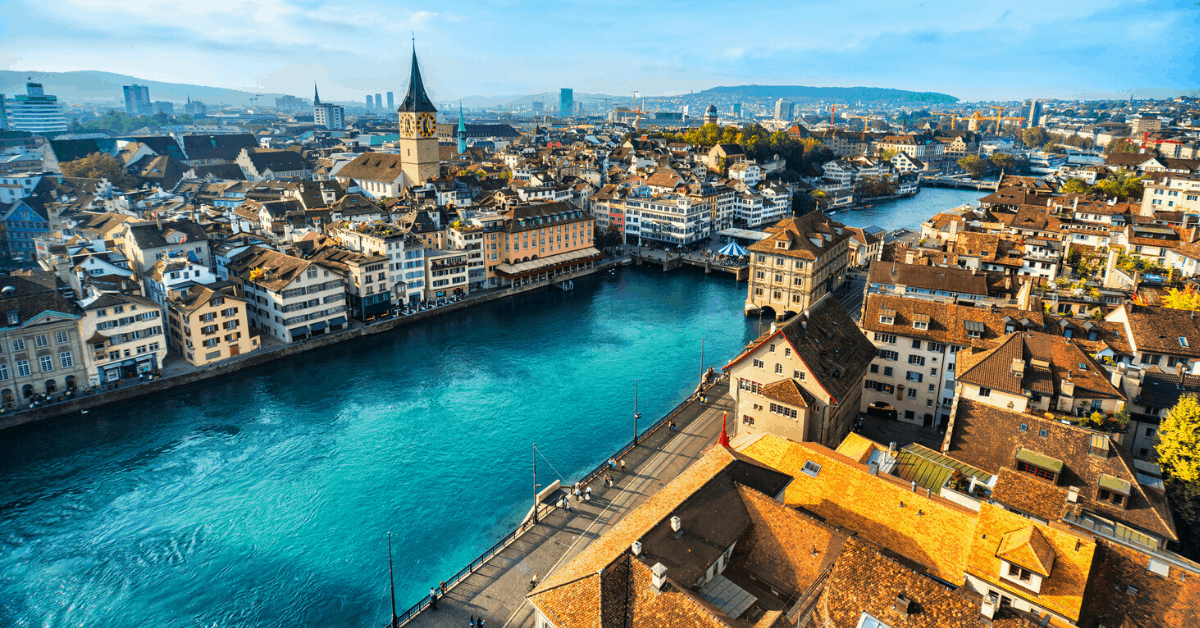
So when the European Central Bank tells you it must hit two percent inflation forever to keep you employed, understand what it is confessing. It needs your money to lose value because its entire model depends on debtors outrunning savers, on stimulus over thrift, on the quiet transfer running underneath the floorboards. The Swiss declined the offer. Their reward sits in every vault in Zurich, getting heavier while everyone else's gets lighter.