🧬 Imagine your biological age changing overnight without you aging a day.
Epigenetic clocks promise to quantify how fast we’re aging. But are their “ticks” reliable?
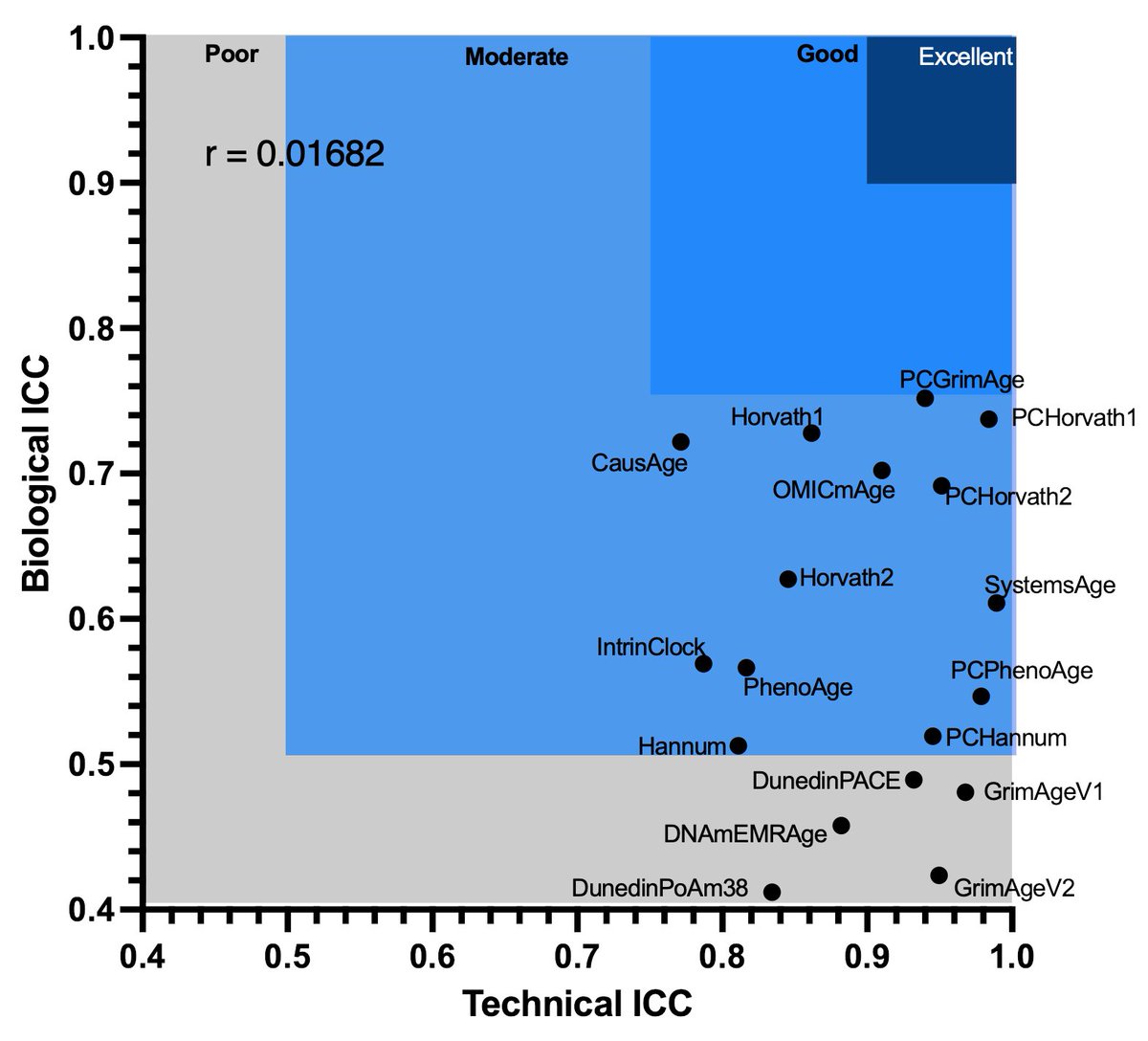
In our latest study using the TranslAGE platform built at @Yale , we systematically evaluated the technical and biological reliability of 18 leading DNA methylation–based aging biomarkersm including chronological clocks, mortality predictors, pace-of-aging measures, and explainable next-generation models.
🔹 Technical reliability:
Across four independent datasets on EPIC and 450K arrays, nearly all clocks achieved excellent reproducibility under standard conditions. Yet, subtle factors such as DNA extraction protocol and slide position introduced significant variation for some models.
🔹 Biological reliability:
When tested across repeated samples collected hours or days apart before and after meals, under acute stress, and across environmental exposures most clocks showed only moderate stability. Only PCGrimAge maintained good biological reliability (ICC > 0.75).
🔹 Key insight:
Technical precision ≠ biological reliability.
Clocks that were technically flawless often fluctuated within the same individual.
🔹 Why it matters:
Reliable clocks yielded consistent prognostic associations (e.g., with cognitive decline) and stable responsiveness to interventions (e.g., a vegan diet). Unreliable ones produced noisy or spurious results.
Bottom line:
To translate aging biomarkers into clinics, we must prioritize biologically reliable clocks those that measure aging, not short-term noise.
A big thanks to all the co-authors for their help Daniel Borrus, John Gonzalez, Yaroslav Markov and my mentor Albert Higgins-Chen!
A huge thanks to everyone involved — and especially to my first advisor @DrMorganLevine, under whose mentorship this project began, and to Dr. Albert Higgins-Chen, who has guided and supported me in bringing it to this stage 🙏
🧠 New preprint from my PhD work at Yale!
We explored how the APOEε4 allele — Alzheimer’s strongest genetic risk factor — shapes molecular pathways across DNA methylation & proteomics in the brain.
https://t.co/qOJnpAjDij
This joins two more preprints from our lab this week led by @rv_sehgal & @Dansb95 — the TranslAGE platform for benchmarking epigenetic aging biomarkers.
If you’re into aging clocks, reproducibility, or translational biomarkers — check them out!
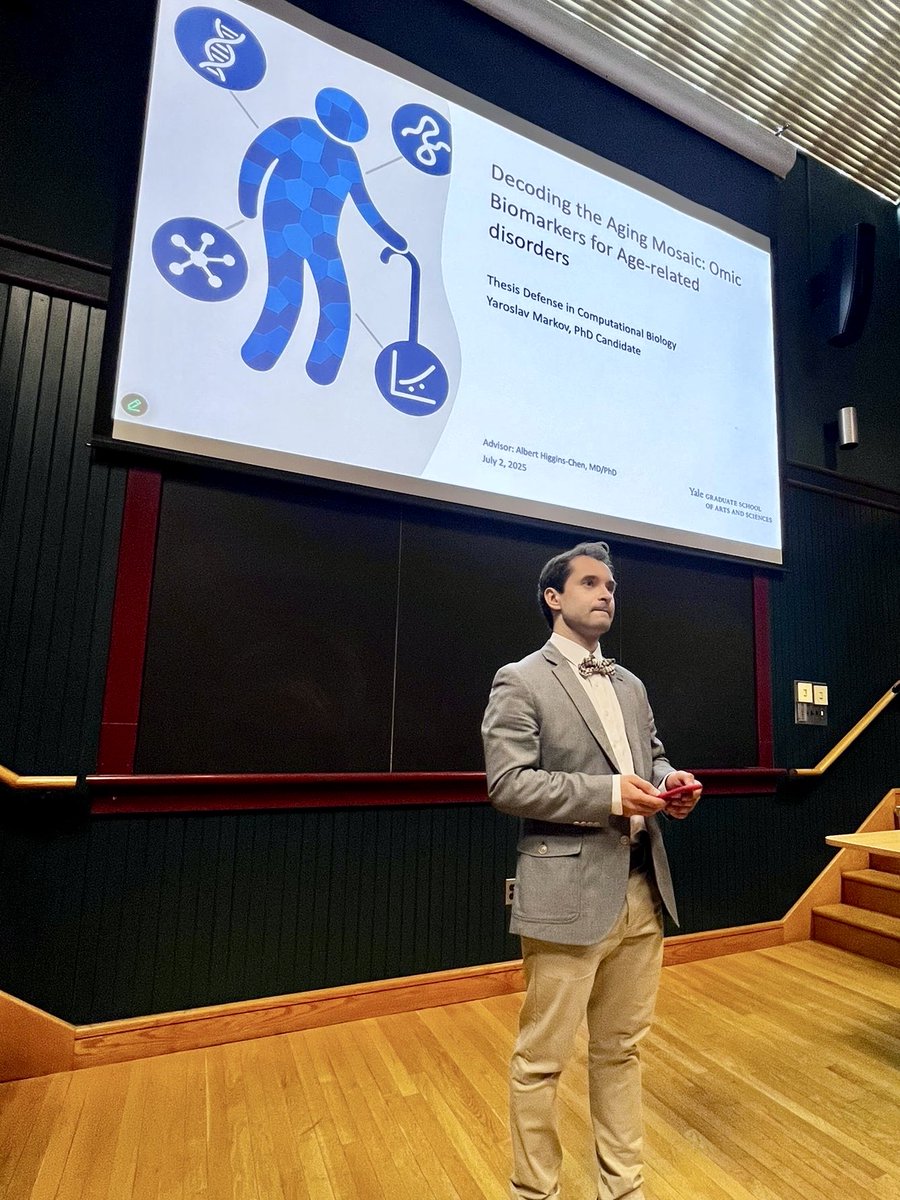
Successfully defended my PhD in Computational Biology at Yale! 🎓@YaleCBB@yalegsas
Thanks to my committee, labmates, and everyone who supported me through the aging process -- both scientific and personal 🙂
This week will be all about pre-prints, kicking off with my debut as a corresponding author on a paper titled, "Epigenetic aging biomarkers are responsive: Insights from 51 longevity interventional studies in humans."
This study is the first of its kind, bringing together clinical trials and intervention studies focused on longevity to evaluate which interventions might systematically reduce epigenetic age. It examines 110 epigenetic aging biomarkers to identify those consistently responsive across various interventions. We hope this work encourages the aging biomarker field to rigorously test these biomarkers for responsiveness—since not all DNAm aging biomarkers respond to interventions, even if they may be prognostic. Additionally, it aims to shift the field toward using multiple responsive biomarkers together to assess whether an intervention genuinely reduces epigenetic age, potentially impacting healthspan or lifespan.
Interventional study DNA methylation data for this study was compiled at @Yale in the Albert Higgins-Chen lab in the @YaleCBB program using publicly available resources such as @NCBI GEO and @embl as well as private sources such as @TruDiagnostic , thanks to @RyanSmithEpiAge ,@VarunDw and Natàlia Carreras Gallo!
And this was a huge team effort which could have been complete with help from support from my amazing colleagues and co-authors @Dansb95, @JessicaKasamoto , Jenel Fraij Armstrong, John T. Gonzalez, @MarkovYaro and Ahana Priyanka!
Check out more details at the link below!
https://t.co/ha90nvEcSa
And just like that, the summer has flown by, and I’m already celebrating the end of my internship with the best fellow interns! It's been an amazing experience stepping out of my comfort zone diving into #celltherapy and exploring new #NGS tools! @YifanZ_123@TakedaPharma
Just started as a computational biology intern at Takeda! Looking forward to leveraging their single cell datasets to further develop my skills and contribute to Cell Therapy research 🧬
Excited to have presented on biomarkers of aging and introduced our new R package, SEMdetectR, designed to capture Stochastic Epigenetic Mutations in bulk DNA methylation data, at the @NIHAging Biomarker Network meeting. Grateful for the support from their pilot award! @YaleCBB
Help save the Dog Aging Project.
Despite being one of the most influential, productive and impactful NIH supported projects over the past 5 years, the National Institute on Aging has inexplicably chosen to withdraw support for the Dog Aging Project. For now, I’m won't get into the details of the process or my personal feelings about it, as the important thing is to ensure the Dog Aging Project doesn’t end. If you believe that the Dog Aging Project has value and should continue, I have three requests of you:
(1) Please consider signing the petition to the NIH Director here: https://t.co/Y1XarAgIcq
(2) Please consider sending an email to your elected representatives here: https://t.co/npr3rkNTXt
(3) Please share this message with your network as broadly as you can
Thank you!!!
Excited to share our latest research! We delve into SEM detection reliability & discover their novel links to age-related heart health. Big thanks to my advisors @DrMorganLevine, @AlbertHC28, @YaleCBB, and funding support from @PNGumich & @NIHAging. Below is a quick summary:
6/6 🙏 Thanks for reading! We believe this research is a step towards a deeper understanding of the role of epigenetics in aging and welcome feedback and collaborations!