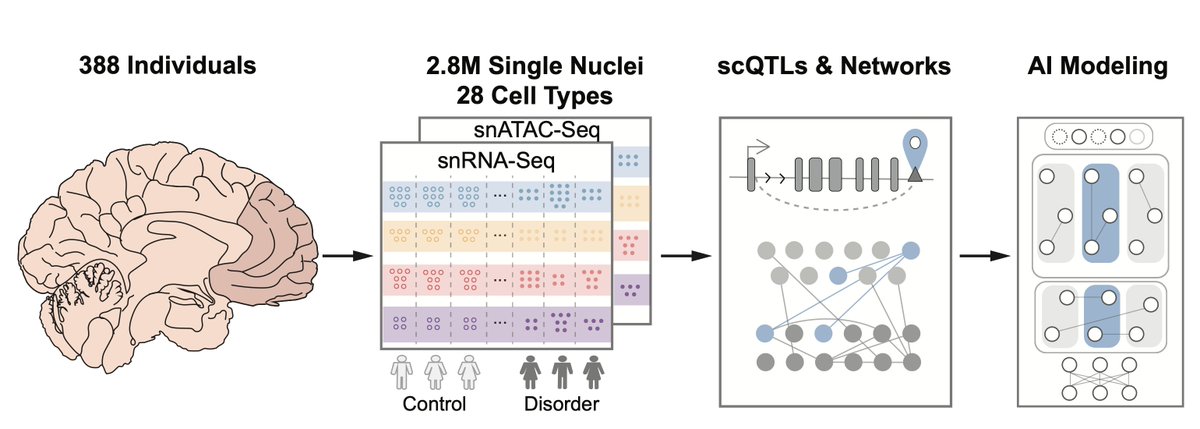
New study conducted by our lab in collaboration with #PsychENCODE has made significant discoveries linking genetic variants to genes and cell types in human brain. #psychencode24
For more details, refer to our original thread: https://t.co/dz0P7ddEWP
https://t.co/WT4QDUGJl4
New paper on single-cell genomics & regulatory networks for 388 human brains just out in @ScienceMagazine. Neat stuff on single-cell QTLs, cell-to-cell communication, & DL models simulating drug effects (https://t.co/4paOy63nOu) #PsychENCODE24
New @naturecomms paper by @katerbowie@MarkGerstein@jordan_peccia@H2O_Hannah. We study how disinfection shapes microbes in hospital sink drain biofilms. Biofilms regrew in 4 days, enriched for carbapenem-resistant bacteria and multidrug efflux pump genes https://t.co/WvAhxtAHwA
In our @NatMachIntell paper, we introduce a framework to analyse interpretability in deep learning by drawing on a formal notion of model semantics from the philosophy of science. We illustrate our framework with examples from biomedicine. Read here: https://t.co/tOSkNL3Gmz
Curious how pseudogenes are transcriptionally regulated? Our new @genomeresearch paper shows processed pseudogenes break the rules: they’re transcribed without classic epigenetic marks, linked to enhancers, and enriched for YY1 motifs. Study co-led by @YunzheJ and @beaborsari
🔐 New open-access paper in Cell Reports Methods!
We show that fully homomorphic encryption enables privacy-preserving polygenic risk scores (PRS), allowing secure computation directly on encrypted genomes with near-zero accuracy loss.
📄 https://t.co/rwBfwwKcmD
🚀 New paper in Bioinformatics!
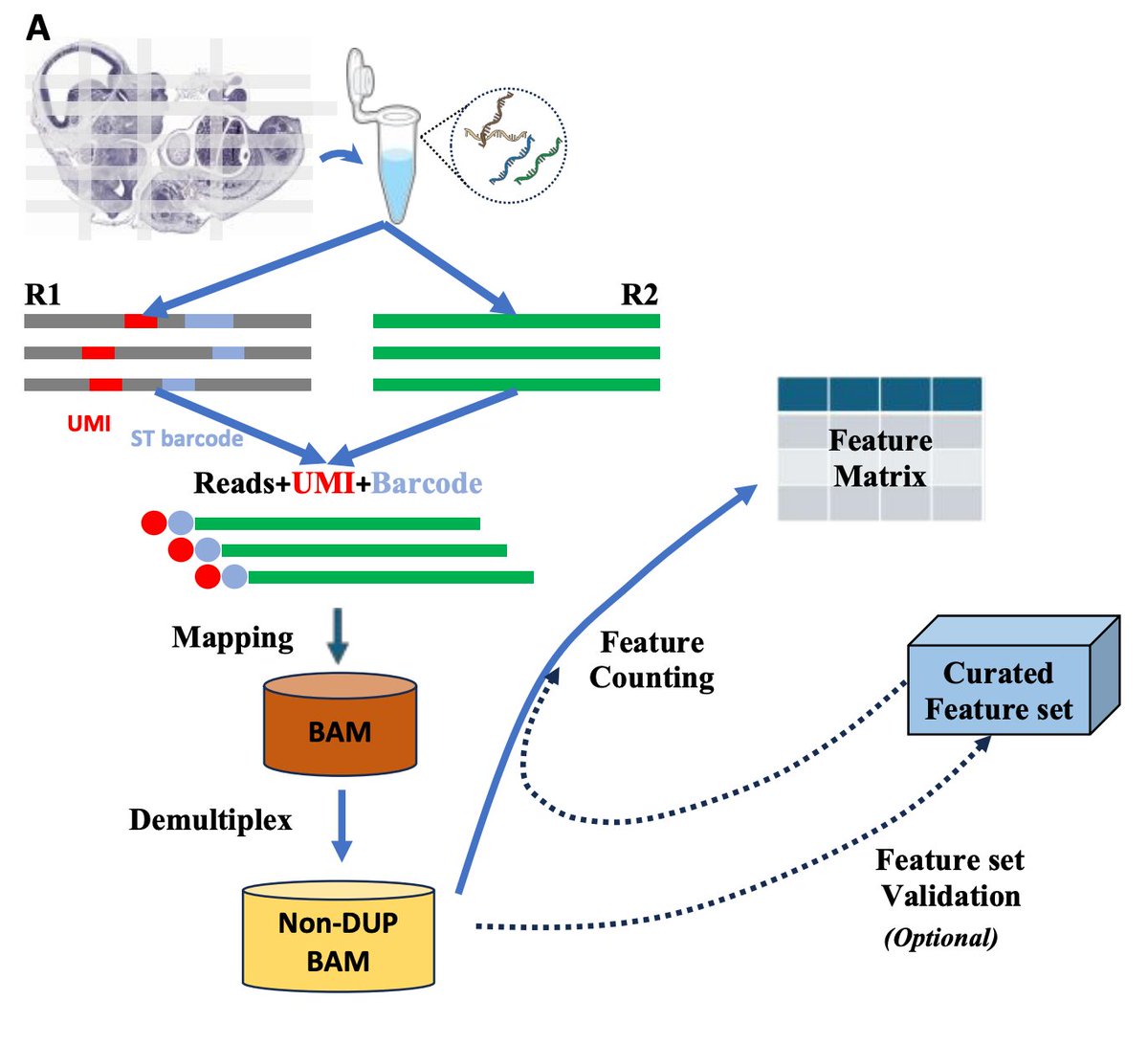
Our #ASTRO work led by @dingyao_zhang introduces "ASTRO: Automated Spatial-Transcriptome whole RNA Output", an automated pipeline optimized for whole-transcriptome spatial analysis, especially in challenging FFPE samples.
🔗 https://t.co/ecr2No1BHv
@NeurIPSConf@_YunyangLI This work is a close collaboration with colleagues previously at Microsoft Research (@MSFTResearch) and currently at Ubiquant and various other places. Huge thanks to them for the ideas and computational resources.
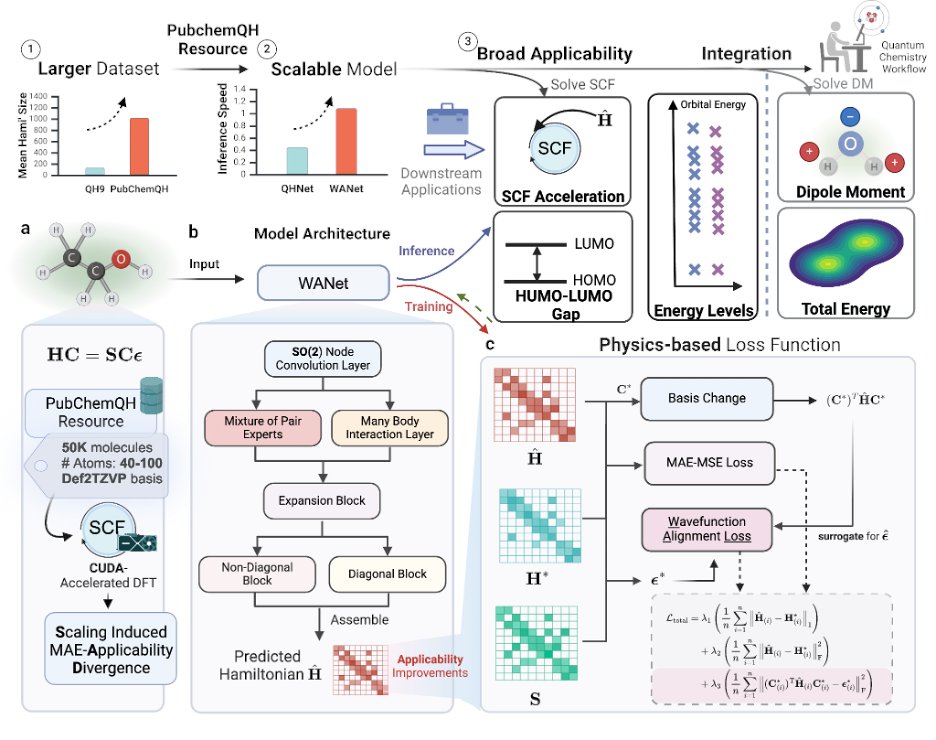
Our @NeurIPSConf work led by @_YunyangLI “E2Former: An Efficient and Equivariant Transformer with Linear-Scaling Tensor Products” was selected as a spotlight (with score ranked ~17 / 21k submissions).
Poster: Thur Dec 4, Exhibit Hall CDE #5512
Online: https://t.co/q8tKBleaF9
🆕Our new PNAS study bridges histology and genomics!
Using deep learning and imageQTL analysis, we show how tissue images reflect gene expression and aging — making histology more interpretable with AI.
https://t.co/y75uzar2g6
📚 Yale students have returned to campus, so time for a roster meeting!
We again made our Nobel Prize predictions (given how accurate we were last year 😉)
🥇Our top prediction is Habener & Knudsen (GLP-1) with 28.5% of the vote!
🥈 In second is Rothberg & David Klenerman (NGS)
Curious how your favorite gene changes when and how during a biological process?
Want to dive into the kinetics of chromatin + gene expression?
Meet chronODE, our new tool to model multi-omic time-series with logistic equations + ML!
https://t.co/E9Xu5sOqQn
3/3 The test yielded a p-value of 4.91 × 10⁻⁸, which is far below the conventional significance threshold of 0.05. This indicates a statistically significant deviation in personality type distribution within the lab.
🧠 At our recent Gerstein Lab roster meeting, we took a detour into… personality science!
Turns out we’re INT Central 🧪
📌 70% Introverts
📌 83% Intuitives
📌 57% Thinkers
Analysts (INTP, INTJ) dominate, far more than the U.S. baseline.
#MBTI#INTP#INTJ
2/3 In contrast, within the Gerstein Lab, there are 26 Analysts, 20 Diplomats, 6 Sentinels, and 4 Explorers. A chi-square goodness-of-fit test was conducted to evaluate whether the MBTI distribution in the lab significantly differs from that of the general population.
1/4 🚀 New #ICLR2025 SPOTLIGHT ALERT
Gerstein Lab presents “Enhancing the Scalability & Applicability of Kohn-Sham Hamiltonians”—led by @_YunyangLI & Z Xia & L Huang & J Zhang & @MarkGerstein. Joint work with @MSFTResearch.
@_YunyangLI@MarkGerstein@MSFTResearch 4/4 ⚡ WANet + WALoss ⇒ 18 % faster SCF convergence & 1 000 × energy-error reduction vs. SOTA. One model, many properties—HOMO/LUMO, dipoles, electron densities—all from a single predicted Hamiltonian.