@LeifInvests the interesting part isn’t that ai beat the s&p
its that it did it by ignoring the narratives everyone else was trading
@liquidtrading co-invest takes it further
you trade directly through claude or chatgpt, not just watch the portfolio
everyone calls it uptober but btc is still grinding below $65k while the narrative runs ahead of price
the gap between “historically bullish month” and actual setup is where people get wrecked
been watching the levels on @liquidtrading
crypto perps, no waiting for market open when the move finally happens
the real tell isnt revenue, its gross margin trajectory.
if hbm costs keep eating into that 75% gm, the whole ai capex narrative gets questioned
and when nvda sneezes, btc usually catches a cold too everything correlated now
moments like this are where perp traders actually have an edge on @liquidtrading
@CoinMarketCap 5% risk-free rate repricing everything simultaneously equities, crypto, real estate
volatility like this is where perp traders eat. been positioning through @liquidtrading
crypto + equity perps
@ralliesarena claude picking emcor and still beating the s&p is sending me
no hype, no narrative just boring infrastructure play that prints. maybe that's the lesson
@liquidtrading co-invest lets you actually trade with claude in real time btw, not just watch from the sidelines
5% on the 10y and the fed still signaling more hikes
this isnt a blip, this is a regime shift. cost of capital repricing everything from mortgages to startup valuations
personally been positioning around rate-sensitive assets on @liquidtrading crypto perps + stock perps, no waiting for market open
@WhizzTrades people are still debating whether ai can trade
the question already shifted
ts not can it, its which interface wins
@liquidtrading plugged real markets directly into сlaude and сhatgpt.
you ask, it researches, you confirm. tried it, the ux gap vs manual is jarring
parallax: numbers, not just a concept
when @Gradient_HQ rolled out parallax, they didnt just say "it's faster"
they tested it on 14 interconnected machines and got concrete results: 3.6x higher throughput and 2.6x lower latency compared to leading local inference frameworks
this isnt a synthetic benchmark in a vacuum.
parallax was run on real hardware - nvidia gpus mixed with apple silicon, over 40 open-source models, running on windows, macos and linux simultaneously.
the difference isnt that the hardware was more powerful the difference is in how parallax distributes the model across disparate devices and balances the load.
why is this important?
usually, "run a model locally" means on a single machine, with its memory and performance limitations.
parallax removes this limitation: multiple devices operate as a single service and do so faster than most local hosting tools, even when each device individually is weaker than a single powerful server.
decentralization here isn't a compromise for privacy, but a real speed boost.
echo-2: actor and learner, the separation that holds everything together
in conventional rl learning, the same hardware first generates data (the model plays, responds and tries)
then, on the same machines, calculates gradients and updates weights.
the hardware constantly switches between these two different tasks and is idle most of the time.
echo-2 from @Gradient_HQ breaks this into two independent roles.
the actor is a swarm of many, often unstable and cheap machines that only generate data: they run the current version of the model and collect trajectories.
the learner is a single centralized process that takes these trajectories and calculates weight updates.
they dont have to work synchronously. the actor can lag slightly behind the latest policy version, usually by 3-6 steps.
this is called bounded staleness.
however, at 11 steps behind, the system diverges and learning breaks down, so this isnt infinite freedom, but a controllable parameter.
the actor can be scattered across cheap, unstable gpus around the world, while the learner can be kept in one place.
on the 30b, this dropped the training cost from $4,500 to $425 (10 times cheaper for the same result)
@KaitoAI has been a crypto content program for a long time, but axis's works a little differently than the usual post a thread, get points
@axisrobotics launched a content creator program through kaito. the first epoch runs from august 19th to september 18th. the prize pool is 0.2% of the entire future supply of axis tokens
divided equally between the top 1-100 and top 101-500 positions in the kaito rankings.
in other words, there's no fixed reward per post. rather, your ranking is everything: the higher your score in kaito studio, the larger your share of the 0.2% you'll ultimately receive. payouts up to the 500th position are still paid, just less.
you apply through the kaito studio campaign page, then publish content about axis in x and upload links there, up to 10 posts per epoch.
an important detail: the specific size of the axis supply hasnt been officially disclosed yet, so 0.2% is currently a share, not a number in tokens.
the real value will only be known after the project publishes its tokenomics.
if youre already writing about physical ai, this is exactly the case when content and farming coincide.
Axis Robotics x @BinanceWallet is live.
1,500,000 Axis Points. 30 days. Reserved exclusively for Binance Keyless Wallet users.
Teach robots. Sign your data on Base. Get paid in Points from a pool that's entirely separate from the main product.
How it works:
gAxis
a little bit late, but wanna share my stats
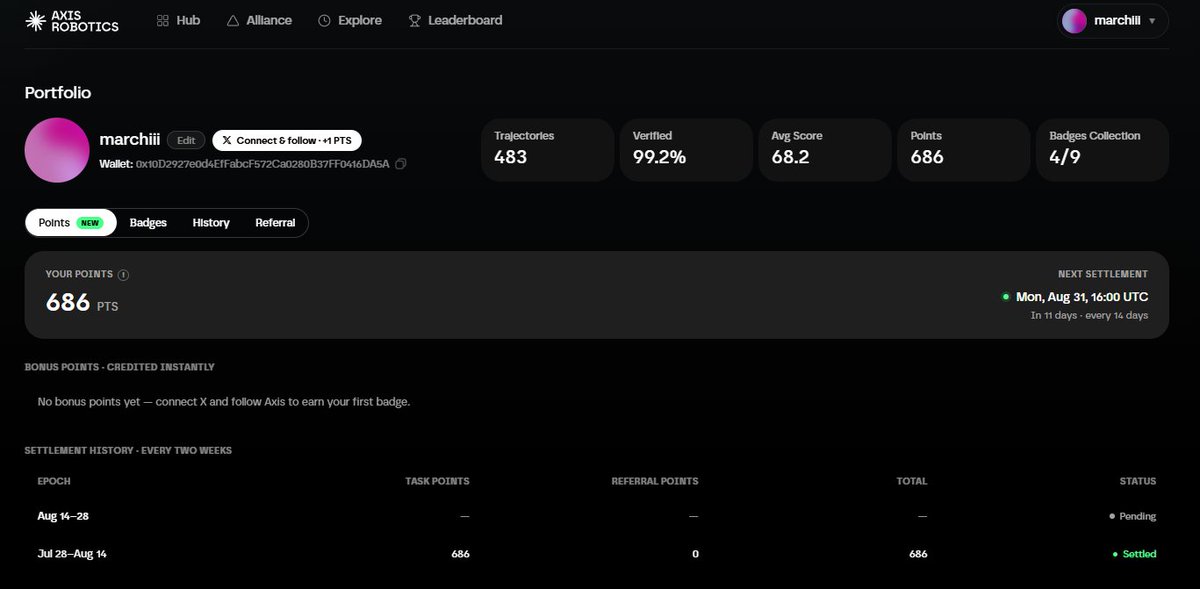
Jul 28–Aug 14 was first my epoch in @axisrobotics and i get 686 points for 483 trajectories
not bad result, on 28th august will be another epoch will see what i will get
keep manage
@BSCNews@Grayscale 3x leveraged etf through a broker with commissions, restrictions and a 4pm est close
vs 40x leverage on eth rn
decentralized perps solved this problem long ago. wall street is just late
if you're interested in trying it out, check out @liquidtrading
I went through Horizon’s signup to see what the 1,000-credit thing actually was
the whole onboarding takes around 20 seconds.
goal → markets → holding period → experience → starting capital
then you’re dropped into the platform with 1,000 credits to start testing ideas.
what I like is that it doesn’t ask the usual useless profile questions - everything is trading-specific from the start.
the credits are nice, but the interesting part is getting from a new account to actually experimenting with AI strategies this quickly.
full signup is in the video ↓
language models had a ready-made ocean of data
the entire internet, billions of pages, free and immediately available
robots dont have such an ocean.
for a robot to learn to pick up a cup, someone has to actually place the cup in front of it and demonstrate how to pick it up over and over again.
this cant be downloaded with a single request, it requires hardware, a room, an operator and hours of work.
because of this, the entire world has collected not billions, but at most a couple million robot demonstrations and half of them are tied to a specific manipulator model in a specific lab.
apply the same task to a different arm or in a different room and the data is practically useless.
this creates a paradox: language models learned to write before the simplest robot learned to reliably pour water into a glass
not because the task is physically more difficult, but because theres no physical place to obtain training data on the required scale.
this is precisely the gap that axis is trying to fill, but more on that in the next article.
prismax isnt just about operators and data
when people talk about @prismaxai, they usually focus on one aspect: the operator gets behind the wheel of the robot, generates data and earns points.
but theres a second aspect, which is less talked about
the official prismax website clearly states: the platform "brings human skills to robots, enabling robots to do real work while simultaneously collecting valuable data"
so its not just about "collecting data for the sake of data", its also a working infrastructure where robots actually perform tasks and data emerges as a valuable byproduct.
the network connects operators, robot owners and robotics companies through a single protocol.
that is, the demand is coming not only from researchers who need datasets, but also from those who need the task to be physically completed.
this changes the way we view the project: not just a "farm for collecting training data", but an emerging labor market, where on one side are operators with skills and on the other, those who need real manual labor (albeit remote for now)
in this sense, the data flywheel is simply a side effect of real, useful work.