Genome length strongly correlates with cell size; even more than cell complexity, number of protein-coding genes, etc. This was extremely surprising to me.
Initially, I expected that genome size would correlate with protein-coding genes. Although there is a linear relationship in prokaryotes (which have compact genomes with fewer regulatory elements), there is a logarithmic relationship in eukaryotes. A eukaryote called Edhazardia aedis, for example, has a genome with ~51 million nucleotides that only encodes 4,200 proteins. Some bacteria have genomes that are about an order-of-magnitude smaller in length, yet encode more proteins than this!
And what of cell complexity? Surprisingly, there is no relationship between genome length and complexity. Eukaryote genomes range in size by 200,000-fold. There are amoebas, salamanders, and small plants with genomes much larger than our own. An onion’s genome is five times larger than a human’s.
The closest correlation — and one that scales across kingdoms of life — is between genome length and cell size. Many papers on this subject have been written by T. Ryan Gregory, a Canadian biologist, who has collected thousands of examples of genome sizes and cell sizes. Gregory also maintains a database on genome sizes across the tree of life, at genomesize[dot]com.
In a 2007 paper, Gregory plotted this relationship for red blood cells taken from various organisms, such as fishes, amphibians, reptiles, and birds. (Red blood cells were selected so that each “type” of cell would be standardized across the organisms.) See chart #1 below.
Many recent papers continue to show the same relationship. I downloaded raw data from a 2023 paper, for example, that lists genome sizes and cell volumes for thousands of bacteria and eukaryotes. 53 organisms in this dataset have both a recorded cell volume *and* genome size, and those points are plotted in the second chart below.
The question is why this relationship exists at all. What does genome size have to do with cell size?
Many biologists argue for some kind of physical scaling. The size of a cell’s nucleus corresponds closely with its overall size, and most cells keep their “nuclear-to-cytoplasmic volume ratio” at a constant level. The more DNA a cell has, then, the more space it occupies, and the larger its nucleus (and overall cell size) must be to maintain this ratio.
This explanation is unsatisfying. For one, bacteria don’t have a nucleus, so why does this scaling apply to them? And second, the genome typically occupies less than 1% of the total nucleus volume, so why would a larger genome lead to a bigger nucleus mechanistically? There is plenty of space in there!
(Sidebar: A tiny fern from a South Pacific island has the world’s largest genome: 160.45 billion bases, more than 50-times larger than a human genome. If stretched out, this genome would be longer than the Statue of Liberty is tall; and yet, it occupies only a small portion of the fern’s nucleus.)
The reality seems to be that biologists don’t really understand (to a satisfying degree) why this relationship is true. Simple questions in biology often yield exceptionally complex answers.
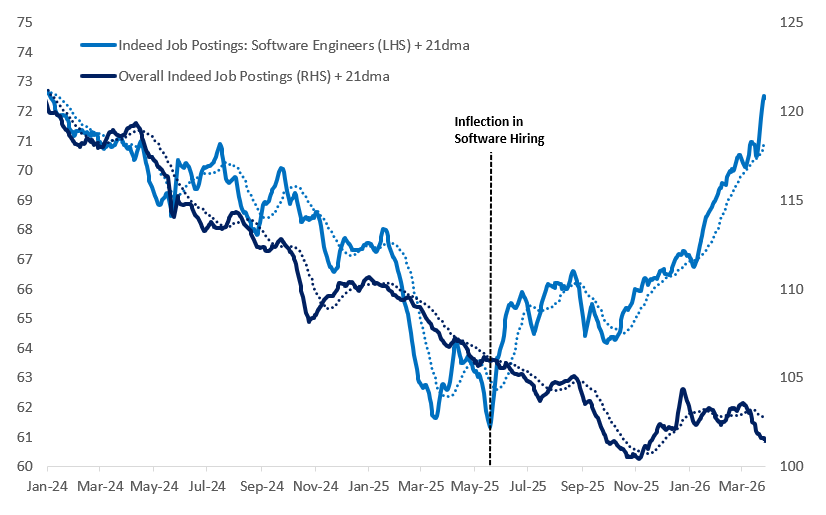
Narrative violation and great insight from the latest Citadel Securities banger by Frank Flight: "We illustrated back in February that demand for software engineers, the most AI exposed occupation was accelerating higher, which we argued violates the displacement narrative. Indeed the acceleration in software job postings has continued, now up 18% from the inflection point in May last year."
AI will create more jobs than any other technology in history.
The doomers' fundamental error isn't just the lump of labor fallacy. It's deeper than that.
They assume a finite problem space.
This is the fundamental error of AI and job doomers. They look at the economy and see a fixed amount of work to be done, a pie that can only be sliced thinner as machines take bigger bites. They see humans a competitive resource for a finite amount of work and a finite amount of problems to solve that must be eliminated.
This is fundamentally, totally and completely wrong.
The pie isn't fixed. It never was. And the reason it isn't fixed is baked into the very nature of technology itself.
Technology is nothing but abstraction stacking. And abstraction stacking is infinite. Therefore the work is infinite.
The hammer didn't reduce the amount of work. It moved the work up the stack. And the new work was more complex, more varied, and more interesting than the old work.
Complexity breeds more complexity and more variety.
Once you have houses instead of mud huts, you have a cascade of new problems that didn't exist before. Plumbing. Wiring. Insulation. Roofing materials that don't rot. Drainage systems so the foundation doesn't flood. Fire codes so your neighbor's bad wiring doesn't burn down the whole block.
Each of those problems becomes a job. A plumber. An electrician. An insulator. A roofer. A civil engineer. A building inspector. None of those jobs existed when we lived in mud huts.
They exist because we solved the mud hut problem.
Think of all of human technological development as a stack of abstraction layers, each one built on top of the ones below it.
At the bottom: raw survival. Finding food. Building shelter. Making fire. These are the base-layer problems.
Each major technology wave solved a base-layer problem and in doing so created an entirely new layer of problems above it:
Agriculture solved "how do we reliably eat?" — and created problems of land ownership, irrigation, crop rotation, storage, trade, taxation, and governance.
Writing solved "how do we remember things across generations?" — and created problems of literacy, education, record-keeping, law, bureaucracy, and literature.
The printing press solved "how do we spread knowledge at scale?" — and created problems of intellectual property, censorship, journalism, publishing, public opinion, and democratic discourse.
The steam engine solved "how do we generate mechanical power without muscles?" — and created problems of factory design, worker safety, urban planning, railroad engineering, coal mining, labor relations, and environmental pollution.
Electricity solved "how do we deliver energy anywhere?" — and created problems of grid design, power generation, appliance manufacturing, electrical safety codes, utility regulation, and an entire consumer electronics industry.
The Internet solved "how do we connect all human knowledge?" — and created problems of cybersecurity, digital privacy, online commerce, content moderation, network infrastructure, cloud computing, social media dynamics, and an entire digital economy that employs tens of millions.
Notice the pattern?
Each solution didn't just solve a problem.
It created an entirely new problem space that was larger, more complex, and more varied than the one it replaced.
The stack grows. It never shrinks.
It's turtles all the way down and all the way up.
Cellular changes linked to depression related fatigue https://t.co/5W9ae9BGqf
Depression may start with an energy problem in brain cells https://t.co/FCGoOw101K
Auf Deutsch: Depressionen bringen Mitochondrien ans Limit https://t.co/gcOJvloKNa
Free, open-access full paper here: https://t.co/spIo3BRZTY
We’re hiring a Group Leader!
Join us to lead a transformative initiative in human systems neuroscience.
Find out more and apply ⤵️
https://t.co/yQRtJdMfEd
How most people think DNA is organized in the nucleus vs. how it’s actually organized. Structured illumination microscopy (SIM). Z sections shown from bottom to top of the nucleus. Think beyond the double helix. #CellBiology
My first co-authored Journal cover using SPICE for high-resolution metabolic spectroscopy of the brain on the IEEE-TBME December Issue! https://t.co/I4R1tGmJmW
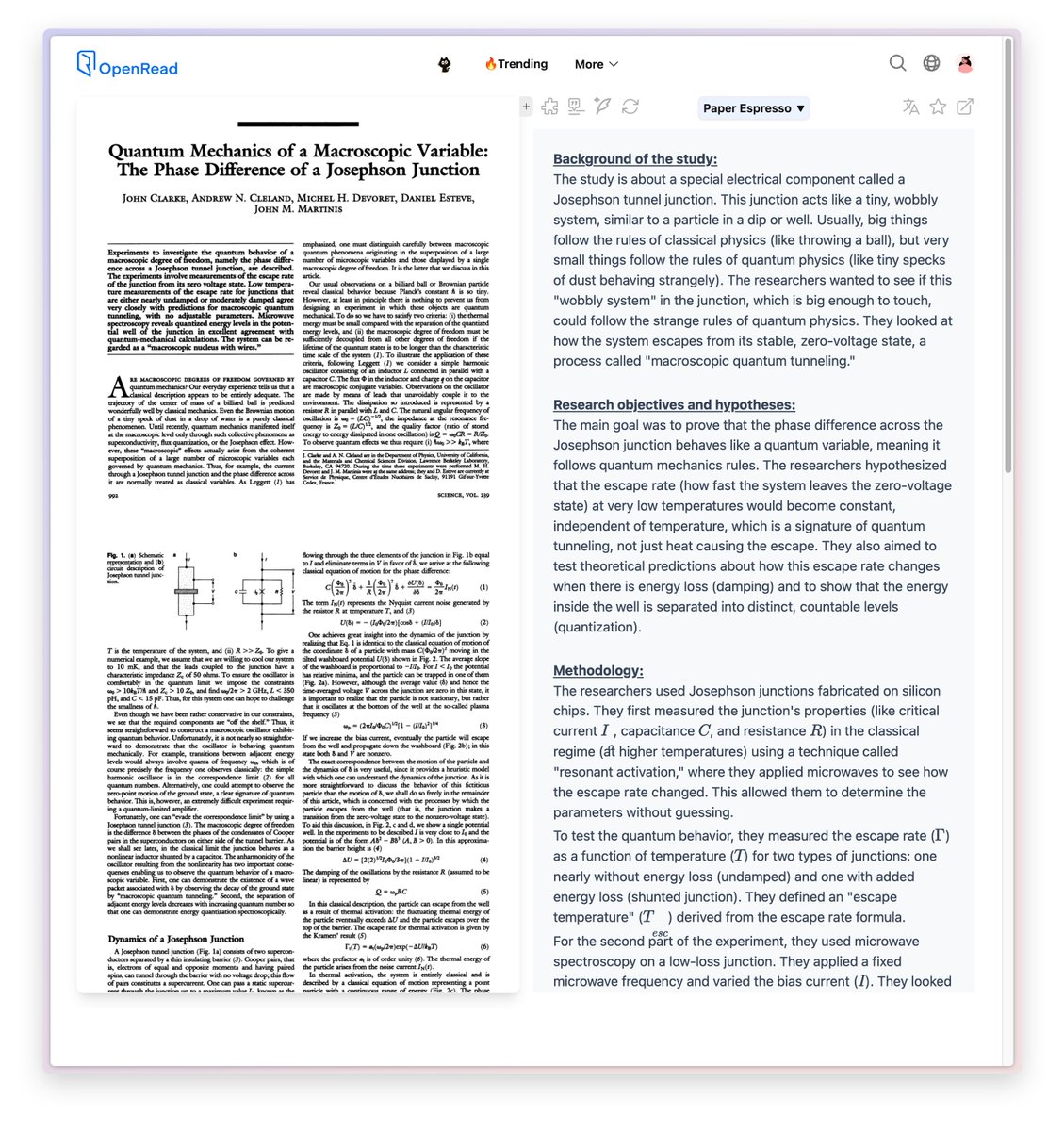
The research paper behind the Nobel Prize:
Title: Quantum Mechanics of a Macroscopic Variable: The Phase Difference of a Josephson Junction
Their most renowned paper:
Title: Energy-Level Quantization in the Zero-Voltage State of a Current-Biased Josephson Junction
Bad news for AI-based radiology. 🤔
It checks if chatbots can diagnose hard radiology images like experts.
Finds that board-certified radiologists scored 83%, trainees 45%, but the best performing AI from frontier labs, GPT-5, managed only 30%. 😨
Claims “doctor-level” AI in medicine is still far away.
The team built 50 expert level cases across computed tomography (CT), magnetic resonance imaging (MRI), and X-ray.
Each case had one clear diagnosis and no extra clinical history.
They tested GPT-5, OpenAI o3, Gemini 2.5 Pro, Grok-4, and Claude Opus 4.1 in reasoning modes.
Blinded radiologists graded answers as exact, partial, or wrong, then averaged scores.
Experts beat trainees, and trainees beat every model by a wide margin.
More reasoning barely helped accuracy, but it made replies about 6x slower.
Models did best on MRI and struggled more on CT and X-ray.
To explain mistakes, the authors built an error map covering missed or false findings, wrong location or meaning, early closure, and contradictions with the final answer.
They also saw thinking traps like anchoring, availability bias, and skipping relevant regions.
General purpose models are not ready to read hard cases without expert oversight.


![NikoMcCarty's tweet photo. Genome length strongly correlates with cell size; even more than cell complexity, number of protein-coding genes, etc. This was extremely surprising to me.
Initially, I expected that genome size would correlate with protein-coding genes. Although there is a linear relationship in prokaryotes (which have compact genomes with fewer regulatory elements), there is a logarithmic relationship in eukaryotes. A eukaryote called Edhazardia aedis, for example, has a genome with ~51 million nucleotides that only encodes 4,200 proteins. Some bacteria have genomes that are about an order-of-magnitude smaller in length, yet encode more proteins than this!
And what of cell complexity? Surprisingly, there is no relationship between genome length and complexity. Eukaryote genomes range in size by 200,000-fold. There are amoebas, salamanders, and small plants with genomes much larger than our own. An onion’s genome is five times larger than a human’s.
The closest correlation — and one that scales across kingdoms of life — is between genome length and cell size. Many papers on this subject have been written by T. Ryan Gregory, a Canadian biologist, who has collected thousands of examples of genome sizes and cell sizes. Gregory also maintains a database on genome sizes across the tree of life, at genomesize[dot]com.
In a 2007 paper, Gregory plotted this relationship for red blood cells taken from various organisms, such as fishes, amphibians, reptiles, and birds. (Red blood cells were selected so that each “type” of cell would be standardized across the organisms.) See chart #1 below.
Many recent papers continue to show the same relationship. I downloaded raw data from a 2023 paper, for example, that lists genome sizes and cell volumes for thousands of bacteria and eukaryotes. 53 organisms in this dataset have both a recorded cell volume *and* genome size, and those points are plotted in the second chart below.
The question is why this relationship exists at all. What does genome size have to do with cell size?
Many biologists argue for some kind of physical scaling. The size of a cell’s nucleus corresponds closely with its overall size, and most cells keep their “nuclear-to-cytoplasmic volume ratio” at a constant level. The more DNA a cell has, then, the more space it occupies, and the larger its nucleus (and overall cell size) must be to maintain this ratio.
This explanation is unsatisfying. For one, bacteria don’t have a nucleus, so why does this scaling apply to them? And second, the genome typically occupies less than 1% of the total nucleus volume, so why would a larger genome lead to a bigger nucleus mechanistically? There is plenty of space in there!
(Sidebar: A tiny fern from a South Pacific island has the world’s largest genome: 160.45 billion bases, more than 50-times larger than a human genome. If stretched out, this genome would be longer than the Statue of Liberty is tall; and yet, it occupies only a small portion of the fern’s nucleus.)
The reality seems to be that biologists don’t really understand (to a satisfying degree) why this relationship is true. Simple questions in biology often yield exceptionally complex answers.](https://pbs.twimg.com/media/HL6SHzpaoAE9U1y.jpg)










![NikoMcCarty's tweet photo. Genome length strongly correlates with cell size; even more than cell complexity, number of protein-coding genes, etc. This was extremely surprising to me.
Initially, I expected that genome size would correlate with protein-coding genes. Although there is a linear relationship in prokaryotes (which have compact genomes with fewer regulatory elements), there is a logarithmic relationship in eukaryotes. A eukaryote called Edhazardia aedis, for example, has a genome with ~51 million nucleotides that only encodes 4,200 proteins. Some bacteria have genomes that are about an order-of-magnitude smaller in length, yet encode more proteins than this!
And what of cell complexity? Surprisingly, there is no relationship between genome length and complexity. Eukaryote genomes range in size by 200,000-fold. There are amoebas, salamanders, and small plants with genomes much larger than our own. An onion’s genome is five times larger than a human’s.
The closest correlation — and one that scales across kingdoms of life — is between genome length and cell size. Many papers on this subject have been written by T. Ryan Gregory, a Canadian biologist, who has collected thousands of examples of genome sizes and cell sizes. Gregory also maintains a database on genome sizes across the tree of life, at genomesize[dot]com.
In a 2007 paper, Gregory plotted this relationship for red blood cells taken from various organisms, such as fishes, amphibians, reptiles, and birds. (Red blood cells were selected so that each “type” of cell would be standardized across the organisms.) See chart #1 below.
Many recent papers continue to show the same relationship. I downloaded raw data from a 2023 paper, for example, that lists genome sizes and cell volumes for thousands of bacteria and eukaryotes. 53 organisms in this dataset have both a recorded cell volume *and* genome size, and those points are plotted in the second chart below.
The question is why this relationship exists at all. What does genome size have to do with cell size?
Many biologists argue for some kind of physical scaling. The size of a cell’s nucleus corresponds closely with its overall size, and most cells keep their “nuclear-to-cytoplasmic volume ratio” at a constant level. The more DNA a cell has, then, the more space it occupies, and the larger its nucleus (and overall cell size) must be to maintain this ratio.
This explanation is unsatisfying. For one, bacteria don’t have a nucleus, so why does this scaling apply to them? And second, the genome typically occupies less than 1% of the total nucleus volume, so why would a larger genome lead to a bigger nucleus mechanistically? There is plenty of space in there!
(Sidebar: A tiny fern from a South Pacific island has the world’s largest genome: 160.45 billion bases, more than 50-times larger than a human genome. If stretched out, this genome would be longer than the Statue of Liberty is tall; and yet, it occupies only a small portion of the fern’s nucleus.)
The reality seems to be that biologists don’t really understand (to a satisfying degree) why this relationship is true. Simple questions in biology often yield exceptionally complex answers.](https://pbs.twimg.com/media/HL6SH_SaMAAOkmy.png)