Building computer models of cellular systems to predict complex behaviors. And having fun doing it! Also department chair and #1 fan, @bioe_stanford ❤️
How would we go about spearheading a Human Cell Project? By request I’ll post some thoughts on this topic over the next few weeks.
First, we need a clear idea of what the goals are. For the sake of discussion, let me suggest two: (1) we want at least one *strong* annotation for 95% of the known functional (coding and non-coding) regions of the genome, and (2) the totality of this information needs to be made openly available, machine readable and encoded in a computational model that can make actionable predictions about cell behavior, including in response to different environmental or genomic conditions. As in the Human Genome Project, it makes sense to start with simpler (microbial) cells to develop the tech and intuition, and keep moving forward in complexity.
Today I’ll offer some thoughts on annotation and the data challenge, which is a huge effort that I think is sometimes misdirected. Specifically, a unified experimental effort would need to be more specifically directed to what is unknown – that’s where the uncharacterized functional regions lie.
For example, we and others have shown that a large fraction of the unknown genes in bacterial cells are related to interactions with other biological entities. Viruses, other microbes and mammalian cells or factors – adding any of these to the culture media will cause a number of uncharacterized genes to be upregulated and expressed. In order to characterize and annotate this large set of genes, we need new, more complex means of recreating the full spectrum of what cells experience in the wild!
This will help us to annotate, even across species -- for example, a few years ago we reported a system in which we prompted mammalian macrophages (part of the immune system) to swallow bacteria which were themselves harboring a virus called lambda phage. Around a quarter of the bacteria in your gut right now contain viruses like this.
The mammalian cells didn’t kill the bacteria directly. Instead, they released a peptide that activated the lambda phage, which then went on a rampage and killed all of the engulfed bacteria (as they say, "the enemy of my enemy is my friend"). This unexpected finding led to a number of novel annotations that you would never find in experimental data derived using simple media conditions, or interpolate from a model generated from such data.
So one thing we need to think about is how to systematically capture these interactions, ideally at scale but definitely quantitatively and over time. Innovators wanted, we need ideas here!
Maybe in the future I can talk more about dynamics, quantification, causality, curation and a detailed strategy for annotating those 95% of genes in future posts if people are interested.
https://t.co/S897V06Aus
Very true - it's time to call for a Human Cell Project, analogous to the Human Genome Project, to systematically and comprehensively characterize and model first the simplest and then the most complex cells. A moonshot to catapult biology to the next era🦠🚀💪 - let's go!!
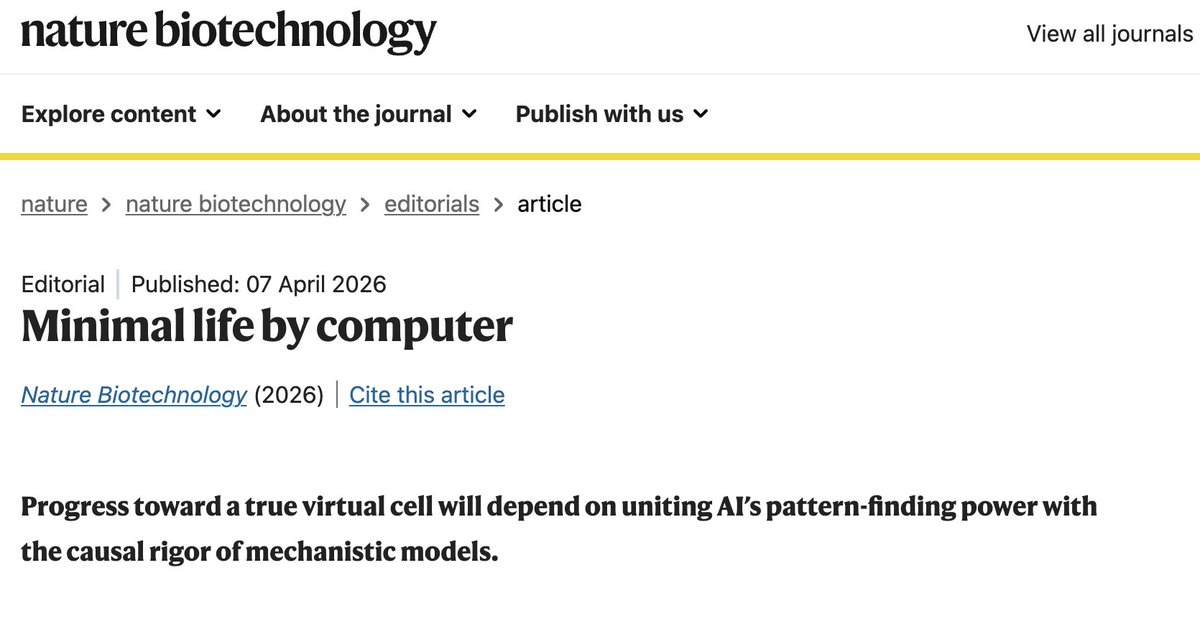
Really enjoyed @NatureBiotech's new commentary "Minimal life by computer": the road to a true virtual cell is not just bigger AI models.
It’s AI + mechanistic biology.
Pattern recognition can get you far. But if we want to simulate life, predict interventions, and actually understand cells, we need models with causal structure beyond just correlations.
paper: https://t.co/aflELgSiXJ
@OmicsOmicsBlog As a starting point, how about "95% of the coding regions in the cell have at least one defined functional/mechanistic annotation?" We could ramp up in complexity from there.
Walk With Me: Seung Kim studies pancreatic biology and insulin-producing cells to advance regenerative approaches for diabetes. Hear what still inspires him about science -- and why Elvis Presley is on his lab walls.
https://t.co/stqWH1uOe2
A terrific article -- this one takes it even further, applying neuroscientist wet-lab techniques to try and understand the microprocessor "brain" of an old Atari game console. (Spoiler: they fail) Fun to think about in the context of AI and simulation! https://t.co/vA6jVr0plE
Great take from @NikoMcCarty on a terrific cell modeling study that came out in Cell this week. I was asked to comment for a news piece about it in Nature; here's the full text of what I wrote (with thoughts on AI-driven models vs more mechanistic models) in case it sparks further discussion:
Dear Ewen, thanks for reaching out and very exciting to see Zan and Zane's newest work! This work is a significant advance - the key part is including the kinetics, which most of the all-molecule simulations are not able to do. With regard to AI virtual cells, so far they are mostly promise and very little actual product, so it's hard to go into too much detail.
That said, one way to think about Zan's accomplishment is in the context of artificial life, or AL. Her lab and mine, and others, are focused on actually trying to build detailed representations of a living cell in silico. They are dynamic, holistic, and mechanistic, all of which adds many distinct advantages in contrast to what is being considered with AI.
For example, AL model simulations are explainable (that is, the simulated behaviors can be explained in terms of their mechanistic underpinnings), they actually require less data (but well-targeted, and of several different kinds), they are better suited to extrapolation, and interestingly, transfer learning is achieved through evolutionary theory (matching E. coli to a mycoplasma, for example), instead of (or in addition to) the traditional transfer learning methods that would be used for AI.
I anticipate that in the future, some of the best things we learn from AI and this next generation AL (first generation would be Conway's Game of Life, and stuff like that - but these new models move far beyond that) will be integrated, and that is an interesting future to consider. As my lab is currently demonstrating (to appear soon), these models can lead us to scientific questions that were never considered before, and making an impact in basic as well as applied science. Very exciting times!
* Note that several of these ideas came up in discussions with my lab members, they didn't all originate with me. Lucky to have a great team❤️
Count me in here - other seminal mathematical and statistical approaches have been invented while pursuing large-scale modeling goals (ie chaos theory and data assimilation in predicting weather) but biology has the most potential. What will we discover, and what will it enable?
Many physicists have come to believe that a mystery is unfolding in every microbe, animal, and human—one that could redefine the field for the next generation, @AdamFrank4 writes. https://t.co/Nyd8T3b8ia
So honored to receive this award, can't wait to visit @UniMelb! And thanks a million to my incredible lab, a brilliant and wonderful group of people who inspire me every day ❤️🦠💻
Markus Covert has been awarded the University of Melbourne’s 2025 Grimwade Medal! 🌟 The honor recognizes his pioneering work for constructing the first "whole-cell" computational model. @MarkusCovertLab@UniMelb https://t.co/6Vh3soyTCl
Somehow the term "virtual cell" has been co-opted to mean only AI-driven or foundation models, but the OG "Virtual Cell Project" was an ambitious effort by @lesloew and @jcschaff to facilitate building mechanistic models of cells. 1/2 https://t.co/a1vjo3Rjrd
@anshulkundaje We ran a virtual cell challenge 10 years ago, exciting idea and outstanding teams - but again, participants found a workaround. As they say in experimental biology, "you get what you screen for" 🙃 Agreed @anshulkundaje, we need to more focus on design! https://t.co/jIsFPHgz58
@ElowitzLab@NikoMcCarty Wait... "intrinsically" more interesting? Or do you mean "extrinsically"? 🤣 but in all seriousness, an awesome paper - catalyzed lots of great follow-on work as well @ElowitzLab
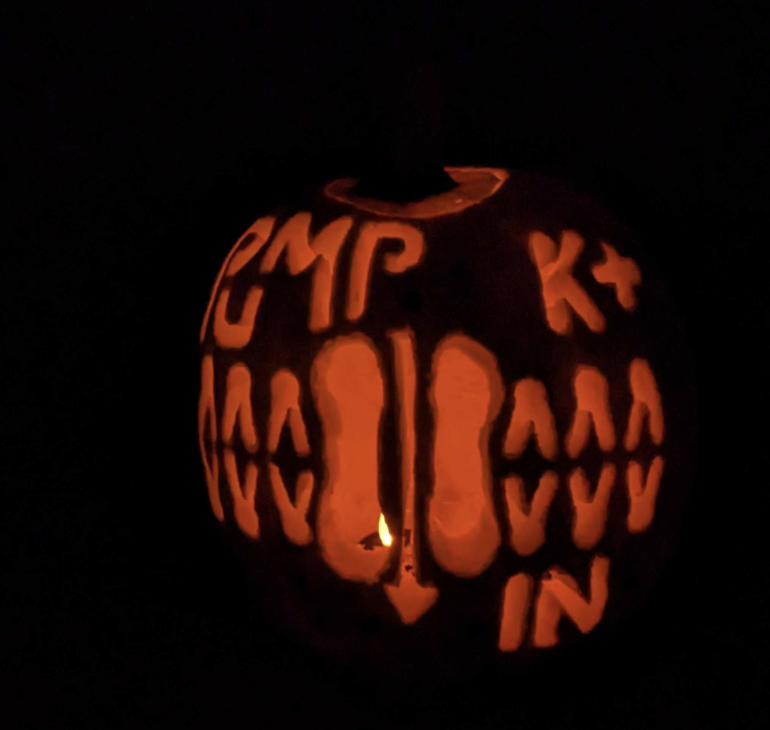
@NikoMcCarty Great article @NikoMcCarty! Since it's apropos and Halloween is coming up, I'll share my lab's amazing jack o'lantern, carved in the shape of a potassium channel, or "PUMP K+ IN." Aren't they the best?!? 🧡🎃🧡