I've met so many entrepreneurial rare disease parents over the years that I’ve lost count.
They have moved or are moving medical mountains to save their kids and others like them.
But rare parent founders get no love from institutional players.
Those days are done.
Science, talent and compute are no longer limiting.
Priority Review Voucher alpha makes the economics work.
The missing spark is access to cure capital.
That's why I’m incredibly pumped to relaunch @1000cures with my cofounder @ryan_1000cures!
Ryan and I teamed up to create a “YC for Rare” that unites our biotech houses with complementary expertises, experiences and networks.
1000 Cures is an accelerator for lean startups led by parents on mission to cure pediatric rare diseases.
We ride at dawn.
Let’s go!
@rsg@Trace_Cohen I should have specified VCs, not operators turned investors like you, my bad. This convo gets very triggering, understandably given the stakes.
I know you’re one of the good guys, I just think VCs should be adult enough to explain themselves
No disrespect but are founders supposed to feel sorry for you?
Investors have the most cush job on earth. Please tell me otherwise.
With that privilege comes some modicum of professionalism, no?
Don’t take the meeting if you don’t have the capacity to followup or be adult enough to say no.
Seems pretty simple to me but what do I know 🤷
Founder-Mode Medicine: The Antidote to Rare Diseases
Every waking moment, a bolt of genetic lightning strikes an unsuspecting family. It strikes indiscriminately, without regard for background, income, or geography. A long tail of more than 10,000 rare diseases afflicts roughly 400 million people worldwide. Most families, understandably, are overwhelmed and unequipped to respond to a devastating diagnosis in time to matter.
Traditional pharmaceutical companies and life science investors have little appetite for small, fragmented markets when global blockbusters beckon. Most rare diseases are ultra-rare, affecting fewer than 1,000 patients worldwide. Some have patient populations you can count on both hands. But to the industry, the long tail is invisible.
Market failures fester. The rare disease community yearns for a pharma white knight but settles for Sir Ghost-a-Lot. It’s time to introduce the long tail to the invisible hand. Turns out the matchmakers—dare I say kingmakers—have been flying under the radar all along.
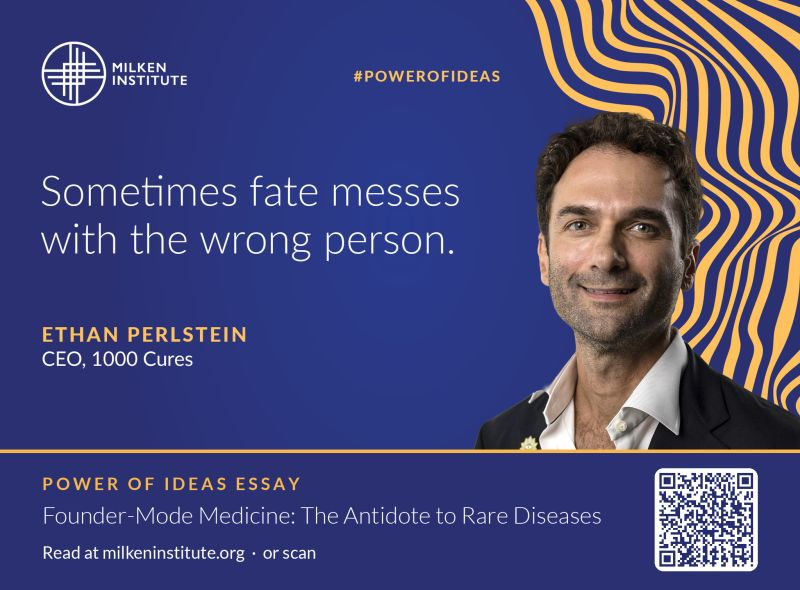
Sometimes fate messes with the wrong person.
A subset of rare disease parents are natural-born entrepreneurs: constitutionally incapable of taking no for an answer and unintimidated by uncertainty. Few have biotech operating experience or scientific training. By conventional wisdom, they’re the last people for the job.
The industry ignores them at its peril. These parents are relentless autodidacts, reading papers past midnight, cold-emailing researchers, organizing patient communities and, of course, fundraising. They somehow do it all with a capital efficiency and speed that would make Chinese biotech blush.
They look nothing like standard-issue biopharma management teams. But they share the rare, much-coveted traits—high-agency chief among them—of the most successful founders in any industry. The résumé is unconventional, but the founder DNA is not.
Investors prize founder-led companies because the founder is the beating heart of the organization and the embodiment of its mission. @paulg, co-founder of @ycombinator, the world’s most successful start-up accelerator, calls this hands-on style “founder mode.” Inspired by YC’s model for backing overlooked, undervalued founders, I’d extend Graham’s concept to medicine. After all, who embodies a mission more completely than a parent trying to save their child?
After more than a decade operating in rare disease, I’ve had the honor of working alongside dozens of parents going founder mode on their kid’s disease. Faced with a ticking clock and limited resources, they have spearheaded N-of-1 medicines time and again. In 2018, Julia Vitarello (@stopbatten) and @timyu MD, PhD, created milasen—the first drug custom-built for a single patient, Julia’s daughter Mila—in less than a year.
That was nearly nine years ago! Many parents have achieved medical firsts since, but the market discounts them as one-offs. A few, most notably John Crowley (@IAmBiotech), have turned a parent’s determination into commercial success. Yet the chasm between the Julia Vitarellos and the John Crowleys still yawns. How do we close it?
All the necessary conditions are in place. The science is no longer limiting. The talent most certainly isn’t. There’s even a market incentive: the Priority Review Voucher (PRV), created by Congress in 2012 to spur rare pediatric disease drug development.
Companies that win approval for a rare pediatric disease drug earn a voucher that entitles its holder to a priority review—shortening the standard 10-month @FDA review clock to six months—for any future drug application. Because four months can be worth hundreds of millions to billions in revenue—think GLP-1s—the vouchers can be sold to bigger drugmakers racing blockbusters to market.
According to @PRVWatch, recent sales have topped $200 million. The very appetite for blockbusters that left rare disease behind can now help bankroll the long tail at essentially zero cost to taxpayers.
The rate-limiting step for too many promising rare disease programs is access to cure capital. We should back parents as founders, not just applaud them as advocates. It should not fall to families to make medicines for their children. But when they step forward, we should meet them with the resources to create treatments and cures at scale.
The founders are locked in. It’s time for the capital to catch up.
We're proud that our CEO, @eperlste , contributed to the Milken Institute's Power Of Ideas series. Read his essay on backing rare disease parents as founders, "Founder-Mode Medicine: The Antidote to Rare Diseases," ahead of MIHealthSummit.
Read the full essay here: https://t.co/nOJ5wVcoUr
@JasonFord6 You mean they’re rare?! Yes, indeed. Which is why rare communities that have founder parents make more progress and move faster than those that don’t
And in 5-7 years you’ll be wondering why nothing’s changed when you didn’t hire a MPS founder parent. Trad playbook, predictable outcome.
Also you’d waste a huge opportunity not hiring someone AI native.
I don’t envy you in this search. Would be so much easier if a founder parent was already on the scene and wasn’t pushed out by trad thinking
I still think it’s the wrong strategy to recruit an outsider, especially a career nonprofit person who will use the same old playbooks. Worse still a former pharma person riding into the sunset of their career.
The only sustainably winning strategy in rare is when a founder parent is in the driver’s seat