> Yukio Mishima
> born 1925, Tokyo
> real name Kimitake Hiraoka
> 29 days after he was born, his grandmother took him from his mother
> she kept him until he was 12
> she was from a samurai bloodline connected to the Tokugawa family (the dynasty that ruled Japan for 250 years)
> she had been raised in the household of an imperial prince
> she locked the boy in her sickroom
> no sunlight, no play, no sport
> he played with female cousins and their dolls
> he was frail, pale and tiny
> while other boys were outside, he was reading French literature in a sickroom
> then he started writing his own stories
> his teachers were so stunned they had his work published in one of Japan's most prestigious literary journals
> he was 16
> he chose a pen name (Yukio Mishima) so his anti-literary father would not know he was writing
> got into the Peers School (the school of the imperial family and the nobility)
> graduated top of his class
> emperor Hirohito attended his graduation ceremony
> then the war came
> he was drafted
> showed up to his army medical with a cold
> the doctor misdiagnosed him with tuberculosis and sent him home
> he later hinted in his writing that he may have faked the whole thing
> spent the rest of the war building aircraft in a factory
> watched Japan get destroyed from the ground
> graduated from the University of Tokyo in 1947
> got a job at the Ministry of Finance (the most elite institution in the country)
> quit within a year
> he chose writing instead
> published Confessions of a Mask in 1949, aged 24
> it was a sensation overnight
> a 24 year old nobody had just written one of the greatest novels in Japanese history
> he didn't stop
> wrote 40 novels, 18 plays, hundreds of essays
> nominated for the Nobel Prize in Literature five times
> then something shifted
> he looked in the mirror and hated what he saw
> the body of a man who had never fought
> he was 30 years old
> he started bodybuilding three times a week and never stopped
> trained for 15 years straight
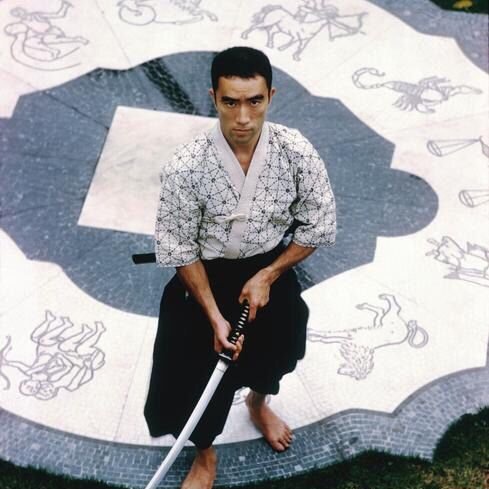
> went from the sickroom boy to a man photographed standing in a loincloth with a sword in the snow
> in 1967 a Japanese magazine ran a reader poll for Most Stylish Man in Japan
> Mishima won with 19,590 votes
> he beat the legendary actor Toshiro Mifune by 720 votes
> the next poll was Most International Man
> he came second behind Charles de Gaulle
> he also acted in films, sang his own theme songs, mastered kendo and kenjutsu
> he trained with the Japanese Self-Defence Forces
> then built his own private army of 100 men
> in 1960 he wrote a short story about a soldier who commits ritual suicide
> in 1966 he directed and starred in a film version of the same story
> nobody knew he was rehearsing
> November 25, 1970
> he woke up and finished the final pages of his four-volume masterpiece The Sea of Fertility
> delivered the manuscript to his publisher
> then drove to army headquarters in Tokyo with four followers
> they walked in and took the commanding general hostage
> Mishima stepped onto the balcony in full military uniform
> below him, a thousand soldiers
> he gave a speech urging them to rise up, restore the Emperor, take Japan back
> they jeered at him
> some laughed
> he went back inside
> sat down
> and did exactly what he had written, filmed and rehearsed
> committed seppuku with a 16th century sword
> he was 45
> his mentor Kawabata (the only Japanese writer to win the Nobel Prize) said Mishima was a talent that comes along once every 300 years
He spent his whole life writing about beautiful deaths, then he went and had one..
1979.
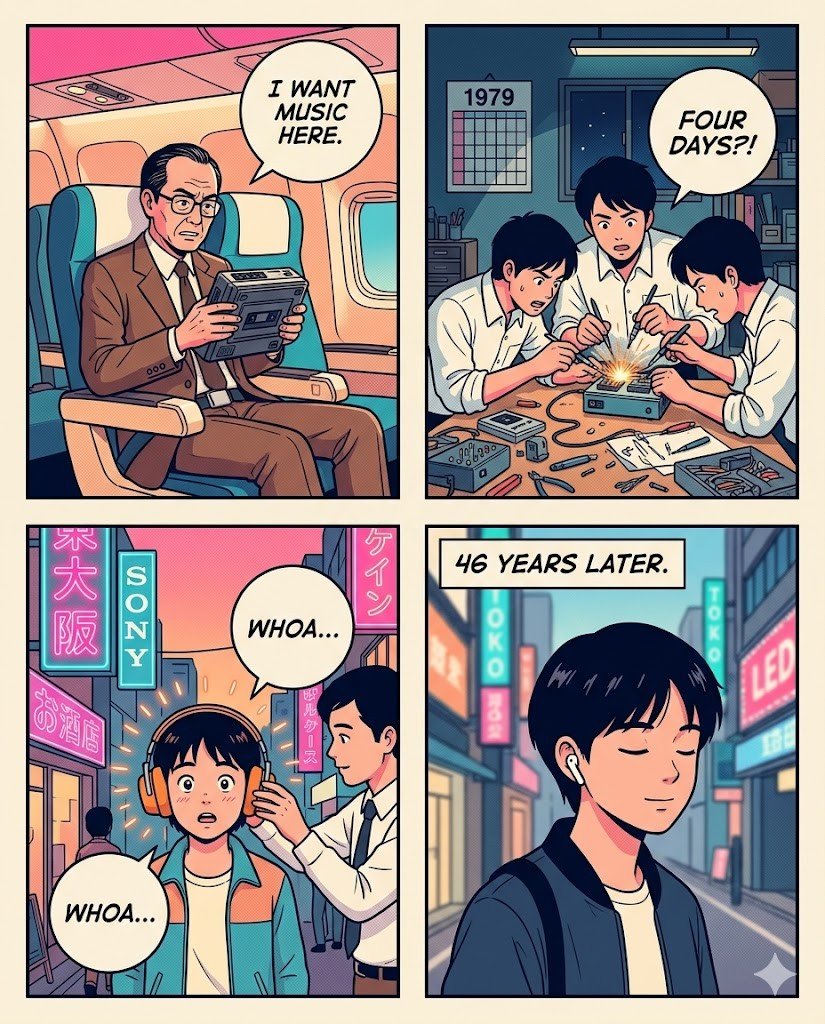
A 71-year-old Japanese man wanted to listen to music
on a plane.
So he asked his company's engineers to build something.
In 4 days, they ripped the recorder out of an old
cassette machine, added headphones, and handed it to him.
Nobody believed it would sell.
"A cassette player that can't even record? Who needs that?"
Even Sony's own marketing team had doubts.
First month: 3,000 units. A flop.
Then Sony did something insane.
They went to Tokyo's busiest streets,
walked up to strangers,
and put the headphones on their ears.
That's when it happened.
People stood there. Frozen.
Hearing music nobody else around them could hear.
Walking through the city with their own soundtrack.
By August, 27,000 units. Sold out.
By 1989, 50 million sold.
The man was Masaru Ibuka, co-founder of Sony.
The product was called the Walkman.
It didn't just sell music.
It invented a new way of being alone in public.
46 years later, you're wearing his invention right now.
Forget the $100,000 investing courses.
In 1998, Warren Buffett gave a one-hour masterclass on how to never lose money.
The company built on that thinking is now worth nearly $1 trillion.
Save this before it disappears from your feed.
Liftoff.
The Artemis II mission launched from @NASAKennedy at 6:35pm ET (2235 UTC), propelling four astronauts on a journey around the Moon.
Artemis II will pave the way for future Moon landings, as well as the next giant leap — astronauts on Mars.
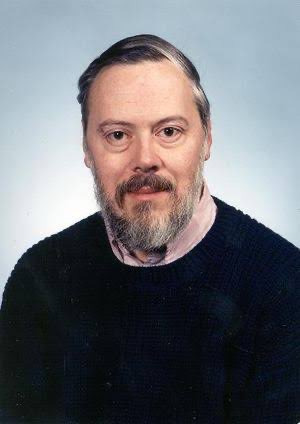
Dennis Ritchie created C in the early 1970s without Google, Stack Overflow, GitHub, or any AI ( Claude, Cursor, Codex) assistant.
- No VC funding.
- No viral launch.
- No TED talk.
- Just two engineers at Bell Labs. A terminal. And a problem to solve.
He built a language that fit in kilobytes.
50 years later, it runs everything.
Linux kernel. Windows. macOS.
Every iPhone. Every Android.
NASA’s deep space probes.
The International Space Station.
> Python borrowed from it.
> Java borrowed from it.
> JavaScript borrowed from it.
If you have ever written a single line of code in any language, you did it in Dennis Ritchie’s shadow.
He died in 2011.
The same week as Steve Jobs.
Jobs got the front pages.
Ritchie got silence.
This Legend deserves to be celebrated.
• be Morris Chang
• survive WWII in China, escape to America in 1949
• go to MIT, fail the PhD qualifying exam twice
• decide academia is a trap, join Texas Instruments
• spend 25 years climbing the ranks, building their entire semiconductor division into a global powerhouse
• get passed over for the CEO job because of corporate politics
• 1985: you are 54 years old. Most executives are buying golf clubs and preparing to retire.
• the Taiwanese government begs you to move to a tiny island and build their tech sector from scratch
• you look at the global chip industry and see a massive, glaring inefficiency
• the industry rule at the time: "Real men have fabs" (if you want to design chips, you have to spend billions to build the factory to make them)
• Chang realizes: "What if a factory just prints everyone else's designs, and promises never to compete with them?"
• 1987: founds TSMC (Taiwan Semiconductor Manufacturing Company) at age 56
• invents the "pure-play foundry" model
• traditional hardware giants like Intel and IBM laugh at him for just doing the "dirty work"
• suddenly, a guy named Jensen Huang (NVIDIA) and companies like Apple realize they can design world-class chips without spending $10 Billion on a factory
• TSMC single-handedly births the entire "fabless" technology industry
• scales the physics down to the atomic level, printing circuits smaller than a biological virus
• becomes an absolute, unbreakable monopoly on advanced human technology
• accidentally builds a "Silicon Shield" around Taiwan
• the US and China both realize that if Morris Chang's factories go offline for a single week, the entire global economy (smartphones, fighter jets, AI, car manufacturing) instantly collapses
• steps down, comes out of retirement at age 78 during the 2008 financial crisis to ruthlessly fire the CEO, doubles R&D spending while everyone else is panicking, and permanently crushes Intel
• 94 years old, smokes a pipe, plays competitive bridge, and controls the single most important bottleneck on planet Earth
"We do not compete with our customers. We are everybody's foundry."
Basil Poledouris’ score for Conan the Barbarian (1982) feels like a character in its own right. Poledouris wrote it as a full operatic narrative, which is why scenes like the opening and the Battle of the Mounds play almost entirely through music.
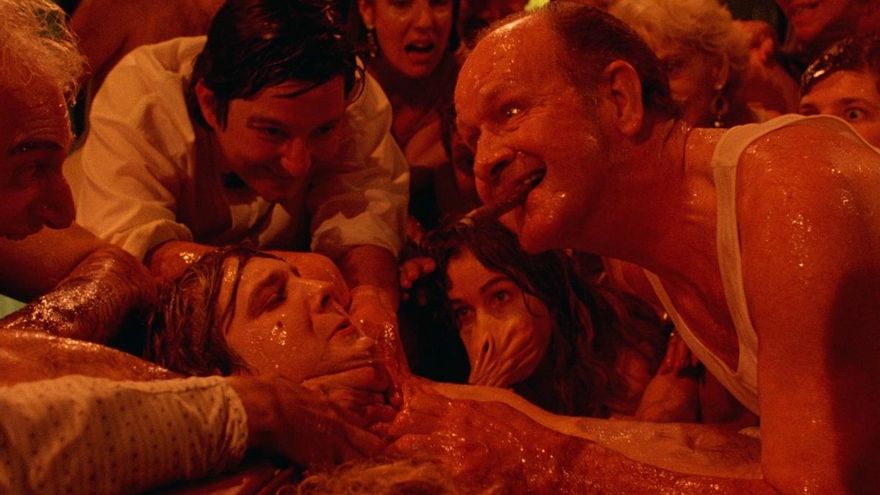
En 1989, una perturbadora película de terror nos mostró unas macabras fiestas privadas donde la élite devoraba literalmente a los más vulnerables. Treinta años después, el caso de Jeffrey Epstein mostró al mundo que la realidad puede ser aún más aterradora. Tira del hilo 🧵👇🏽👇🏽👇🏽
Ha fallecido Tom Noonan a los 74 años.
Nos aterrorizó como Ripper en “El último gran héroe, y en “Manhunter” como The Tooth Fairy, pero también tuvo un enorme rango actoral en otros papeles dramáticos.
Descanse en paz.
Kung Fu Hustle (2004) looks like a goofy slapstick comedy at first, then casually turns into a love letter to classic kung fu cinema. Cartoon physics, brutal fights, perfect timing, and genuine craft underneath the madness. Way smarter than it lets on.
En 1942, en un pequeño taller de Santiago, dos hermanos gallegos lograron lo imposible: superar la tecnología de Philips. Cuando el gigante holandés vino con un cheque en blanco para comprar su invento, ellos dieron una respuesta que nadie esperaba: NO. Tira del hilo 🧵👇🏽👇🏽👇🏽
TIL that digital on-set production sound entered Hollywood in 1989, when production sound mixer Jeff Wexler recorded Ghost using a consumer Sony D-10 DAT recorder 🤯
Ray Harryhausen animated 7 skeletons in Jason and the Argonauts (1963), moving 35 appendages per frame to match the actors. Some days he managed just 13 or 14 frames. It took 4 & a half months to create this 3 mins scene.