Witness to the Clash of Religions and Global Civilizations
From the Kingdom born in 1025, land of the Winged Hussars and stronghold of Catholicism since 966
When the war began, German forces indiscriminately killed civilians during the September Campaign while beginning a systematic effort to dismantle Polish society. They targeted political leaders, teachers, clergy, veterans, officials, and members of the intelligentsia, along with anyone considered capable of resistance. Between 1939 and 1941, ethnic Poles faced an especially high risk of arrest, deportation, forced labor, and execution, while most Polish Jews were being forcibly confined to ghettos.
Emanuel Ringelblum, the Jewish historian who documented life in occupied Warsaw and whose own survival was prolonged through Polish assistance, recorded on May 8, 1940, that Polish civilians were being seized for deportation to Germany. Jewish barbers were ordered to shave their heads before transport. Another Jewish historian noted that Poles fleeing German roundups sometimes found “an odd ally: the Jewish badge.”
Some borrowed or purchased armbands in desperate attempts to avoid capture because German patrols were then often searching specifically for Poles to deport or punish. Before the mass deportation of Jews to extermination centers began, an OSS informant reported that, at that stage of the occupation, German treatment of Poles could be even more immediately violent than the treatment then imposed on Jews.
Hans Frank made no effort to conceal his contempt for Poles. On January 19, 1940, he compared his relationship with them to that of an ant and a plant louse and warned that he would not hesitate to impose the most draconian measures. His words reflected the central logic of the occupation: Poles were to be exploited, terrorized, deprived of leadership, and punished collectively.
This policy was demonstrated in atrocities such as the killings at Zielonka, near Warsaw. German forces detained eleven people, and when two escaped, the remaining nine were executed. Among the victims were three Polish Boy Scouts, only sixteen and seventeen years old. The killings were justified as retaliation for a handmade poster bearing words from Maria Konopnicka’s patriotic poem: “No German will spit in our faces or make Germans of our children.”
A similar atrocity occurred at Wawer, where German forces murdered more than one hundred men. Among them was Daniel Gering, a forty-year-old bank employee of German ancestry who could have saved himself by claiming German nationality. Instead, he insisted that he was Polish. When asked whether he understood the consequences, he replied, “Yes, but I am a Pole.” He was given more than one opportunity to change his answer, but refused and was brutally beaten before his execution.
The policy of mass reprisal continued throughout the occupation. In 1944, Hans Frank openly declared that as many as one hundred Poles should be shot whenever a German was killed. In practice, reprisals sometimes exceeded even that ratio. Entire villages were burned, populations deported, and civilians executed for actions they had not committed. According to SS General Erich von dem Bach-Zelewski, officers of relatively modest rank could order the execution of dozens of Poles for each German killed without seeking approval from higher command.
By late 1942 and throughout 1943, terror intensified further. Mass street roundups, deportations for forced labor, public executions, and retaliatory killings became increasingly common. On January 21, 1943, General Stefan Rowecki, commander of the Home Army, warned the Polish government in London that “a new wave of terror embraces the entire country.”
Understanding this aspect of the occupation is essential. German rule in Poland was not merely military control. It was a deliberate assault on the nation’s leadership, culture, independence, and ability to survive. Poles lived under racial contempt, forced labor, collective punishment, and the constant threat of arbitrary death. Their suffering should be understood on its own terms.
🚨 AMERICA FIRST RED ALERT: House votes TODAY & TOMORROW to MERGE U.S. military tech & supply chains with Israel with NO DEBATE ALLOWED!
TODAY: H. Res. 1438 vote rams the NDAA to the floor without letting Congress vote to kill Section 219.
TOMORROW: Full NDAA passage with the merger locked in.
Section 219 creates a permanent Pentagon bureaucracy to fuse American weapons systems, AI, cyber, drones, missiles, and manufacturing with Israel’s.
For America: We lose sovereignty.
Future presidents & Congresses will be handcuffed.
U.S. troops and taxpayers tied to endless foreign conflicts.
For Israel: They get deep integration into our military without the hassle of treaty ratification.
This should require a TREATY - 2/3 Senate vote, full transparency.
Instead, they’re sneaking it into the must-pass NDAA like cowards.
Conservatives fought forever wars and blank-check foreign policy.
This is more globalist entanglement dressed up as “alliance.”
HAVE YOU CALLED YOUR REP & SENATORS YET?
Demand they vote NO on the NDAA rule today and kill Section 219.
America’s military serves AMERICA, NOT forever foreign mergers.
Przegląd zakurzonej prasy.
“Ażeby bezczelnemu zachowywaniu się pewnej części ludności polskiej zapobiec, zarządzam co następuje” - tak rozpoczyna się obwieszczenie naczelnika niemieckiej policji państwowej Herr Weberstedta opublikowane 27.10.1939 roku w toruńskim dzienniku Thorner Freiheit.
Dalej Der staatliche Polizeiverwalter nakazuje:
" 1. Obywatele polscy obojga płci mają obowiązek przed reprezentantami władzy niemieckiej - jak dalece ci ostatni rozpoznawalni są przez mundur czy opaskę na ręku - ustępować z drogi. Ulica należy do zwycięzców a nie do zwyciężonych.
2. Obywatele polscy płci męskiej mają obowiązek kłaniania się przez zdejmowanie nakrycia głowy wszystkim przewodzącym osobistościom Państwa, Partii i Sił Zbrojnych.
3. Niemieckie pozdrowienie przez podniesienie prawej ręki i pozdrowienie “Heil-Hitler” jest Polakom wzbronione.
4. W składach i na targach obsługiwani muszą być najpierw przedstawiciele władzy niemieckiej, członkowie ich rodzin i wszyscy obywatele niemieccy; po nich dopiero - zwyciężeni.
5. Noszenie polskich mundurków szkolnych, czapek z odznakami itd., jak również noszenie przez polskich urzędników kolejowych i pocztowych polskich odznak państwowych jest wzbronione.
6. Zakazuje się - szczególnie młodocianym - gromadzenia się na ulicach i skrzyżowaniach ulic.
Ci Polacy, którzy jeszcze nie zrozumieli, że są zwyciężonymi - a zwycięzcami my, i którzy przeciwdziałać będą powyższym rozporządzeniom, podlegają najsurowszemu ukaraniu."
Tak było. Czy ma to powrócić?
Catherine Austin Fitts describes the Covid era as a "financial coup"—designed to transfer economic power to large corporations by deliberately bankrupting small businesses while large retailers were allowed to stay open.
"What you do is you shut down the small businesses and small farms, you leave the publicly traded companies open... and then they're in a position to consolidate the market share of the small businesses and buy up assets cheap."
"It's an incredible way to pick up market share because you don't have to buy it or compete for it. You just shut them down."
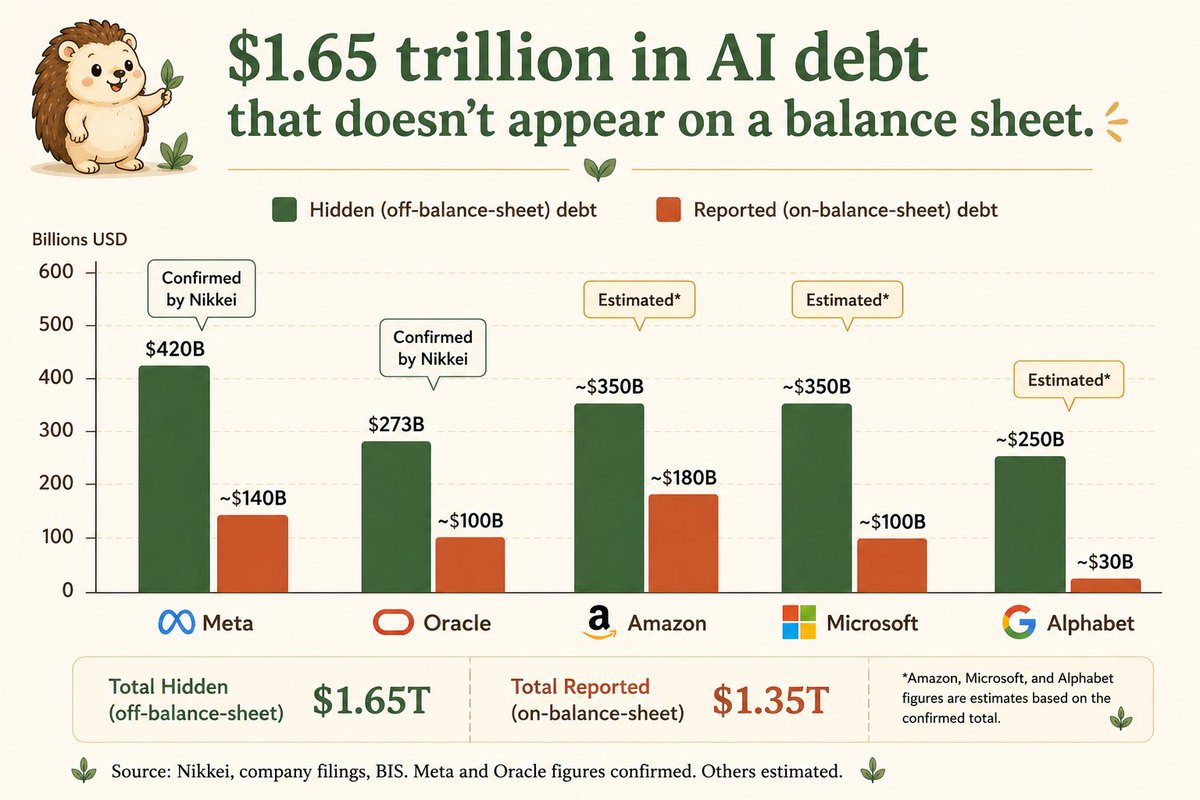
🦔A Nikkei investigation found that Alphabet, Microsoft, Amazon, Meta, and Oracle have $1.65 trillion in debt that doesn't appear on their balance sheets, more than the $1.35 trillion they officially report. These are GPU contracts, data center leases, and joint ventures that don't count as debt under accounting rules until the facilities go live. Meta's hidden debt is $420 billion, triple its reported debt. Oracle's grew 30-fold in four years. All five declined to comment.
My Take
Nikkei examined the actual filings and put a number on something the BIS already flagged as "shadow borrowing" back in March. These companies owe more off their balance sheets than on them, and the accounting rules let them keep it that way until the data centers go live. That's legal, but it means investors looking at quarterly earnings this week are seeing less than half the picture.
Four of these five report earnings in the next two weeks. The reported debt will look manageable. The $1.65 trillion in footnotes won't make the headlines. But when those data centers start operating, the leases hit the books all at once. If AI demand comes in below projections, those facilities get marked down and the losses land on the investors and insurance policyholders who funded the construction through private credit and project bonds without realizing how much total exposure they were carrying.
Hedgie🤗
“Polskę należy traktować jako kolonię. Polacy mają być niewolnikami Wielkoniemieckiego Imperium Światowego” - wyjaśniał generalny gubernator Hans Frank oficerowi Zarządu Uzbrojenia wojsk niemieckich, który argumentował, że z polskich zakładów zbrojeniowych trzeba utworzyć zaplecze dla niemieckich fabryk.
Podczas spotkania w Poznaniu 3 października 1939 roku Frank tłumaczył, że demontaż maszyn i urządzeń polskich fabryk i wywóz ich do Rzeszy, a potem zburzenie budynków to decyzja polityczna, albowiem tylko “zniszczenie polskiego przemysłu utrudni, jeśli nie uniemożliwi jego odbudowę po wojnie”. Wskutek takiej destrukcji “Polska zostanie zredukowana do jej właściwej roli rolniczego kraju uzależnionego od importu wyrobów przemysłowych z Niemiec” - dowodził generalny gubernator, a mnie cytat ten przypomniał się kiedy chciałem kupić w supermarkecie temperówkę oraz pineski i okazało się, że mają etykietki niemieckiej firmy.
Źródło: Report by Captain Dr. Varain for General Thomas on “German Armament Economy in Poland” 1939-40, w: Nazi Conspiracy and Aggression, t. VII, Office of US Chief of Counsel for Prosecution of Axis Criminality, Waszyngton, US Government Printing Office, 1946, str. 420-421.
Before 1986, no American historian had written a systematic account of the Polish people under the German occupation. Prior to that time, the story of ethnic Poles had been subsumed by the genocide of the Jews. Jewish historians, American and Israeli were and still are the foremost interpreters of the Polish wartime experience to American audiences -Poles were effectively silenced.
Their view of the Poles followed an astonishingly simplistic narrative, unfortunately that Poles were anti-Semitic and their hatred resulted in collaboration with the Germans against the Jews. This kind of history could only gain currency in a country where knowledge of World War II had been limited largely to the American role in fighting Germany and Japan on several military and naval fronts.
Americans had a better understanding of Western Europe and Italy, where American GIs fought and died, than eastern Europe, which was terra incognita. The flood of Holocaust literature in the United States in the decades following the war, which today has turned into an avalanche so huge that it eclipses the volume of writing on the American Civil War.
Since Poland was the principal site where the Germans implemented the Final Solution of the Jews, Holocaust writers saw Poles primarily as anti-Semites who at best were callously indifferent to the plight of the Jews, and at worst were collaborators with the Germans in eliminating them. The consequence was that Americans formed a negative impression of the Polish people.
Writers on the Holocaust made no serious attempt to understand the magnitude of the tragedy that Christian Poles had experienced.
If Poles had been placed within that contextual framework, a more objective, balanced, and mature historical writing of the Holocaust of the Jews and the genocide of the Poles and other ethnic groups would have resulted. This has been the major issue faced by the Polish in the United States and how they are viewed.
There are Holocaust museums in every major city and all schools have mandatory curriculum to educate students on what Jewish administrators from the state Holocaust departments demand. In view of the negative image of Poland in Holocaust literature, the American media continued to peddle the insulting stereotypes of the 1970s in television specials in the 1980s and 1990s. Claude Lanzmann's Shoah, which ran a mind-numbing nine hours in length, appeared in 1985 and was followed by Marian Marzynski's Shtetl in 1996.
Erroneously described by their producers as "documentaries," both productions depicted Poles as stupid, boorish, and anti-Semitic. Worse were those like Jerzy Kosinski who literally smeared the entire nation, turning them into savages, although he was alive because of Poles.
Even “Schindlers List” is full of fallacies and deceptions about the Polish and considering how many stories there are about Poles saving Jews, the stories we know are about Germans saving Jews.
Historian Norman Davies gave his own example about his time in university on how he was taught that Poles were to be treated and described as “bystanders”, but now we witness them being labeled as victimizers.
Many of you witness this in the media and years of historical revisionism and lack of objective writing has taken its toll in the minds of the public. One of greatest writers on this subject, Richard Lucas has been repeatedly ignored and recently defamed.
In the last sentence of F. Scott Fitzgerald's novel, The Great Gatsby, the narrator reflects on Gatsby's untimely death, saying;
"So we beat on, boats against the current, borne back ceaselessly into the past."
In other words, we try to move ahead but the current of life flows backward and always into the past. That is it is an awesome responsibility for historians to treat the life experiences of ALL people who lived before us with sensitivity, fairness, objectivity, and respect.
That is the best we can do.
Added reference: Richard Lucas
This post was not intended for those who understand the closeness of citizens of both nations - but rather to those who don't and to those who engage in political maneuvering to undermine the role of Poland and ongoing attempts to sideline it.
Ukraine faces a strict geographical limit to how much it can sideline Poland as Poland carries a role of the key gateway (as below👇) for many allies to provide military assistance - but yet some are willing to sabotage Poland-Ukraine relationship. The response that the Ukraine's govt has delivered was a genuine theatrical explosion of emotions dividing the people of both nations. Why create smoke and mirrors to shift international and Ukrainians' attention to Bandera and Wolyn genocide (which is pending resolution since Ukraine's independence from the Soviets)? rather than bilaterally address critical issues and challenges that Ukraine faces in relations with Poland - like the issue of agriculture and other risks to Poland that need to resolved before Ukraine can join the EU?
"Beyond direct military assistance, Poland became the principal gateway through which Western aid entered Ukraine. Around 90 percent of military equipment destined for Ukraine reportedly passed through Polish territory, making Poland’s roads, railways, airports, warehouses, and border crossings essential to Ukraine’s defense."
Since Russia’s full-scale invasion began in February 2022, Poland has provided Ukraine with extraordinary military, humanitarian, and logistical support.
Poland has sent hundreds of tanks and armored vehicles, artillery systems, fighter jets, helicopters, ammunition, drones, communications equipment, and thousands of Starlink terminals. It also supplied Polish-made Piorun, or “Thunderbolt,” hand-held anti-aircraft missile launchers, which have been praised by military experts for their effectiveness and are often regarded as more advanced than the American Stinger systems. Poland has also trained approximately 25,000 Ukrainian soldiers and organized hundreds of military training courses.
Beyond direct military assistance, Poland became the principal gateway through which Western aid entered Ukraine. Around 90 percent of military equipment destined for Ukraine reportedly passed through Polish territory, making Poland’s roads, railways, airports, warehouses, and border crossings essential to Ukraine’s defense.
Poland also welcomed more than three million people fleeing Ukraine during the first months of the war. Many later returned home or continued to other countries, while nearly one million remained under protection in Poland in 2025. Millions received food, accommodation, healthcare, schooling, transportation, and emergency assistance.
The total value of Poland’s military, humanitarian, and refugee support has been estimated at more than €25 billion. Some military deliveries remain undisclosed, meaning the true scale of Poland’s contribution may be even greater.
Whatever political disagreements may exist, this history should not be forgotten. Poland did not merely express solidarity with Ukraine, it opened its borders, shared its resources, accepted enormous costs, and became one of Ukraine’s most important lifelines. Ukrainians should recognize this sacrifice and remain deeply grateful to the Polish people for the extraordinary support they provided during Ukraine’s darkest hour.
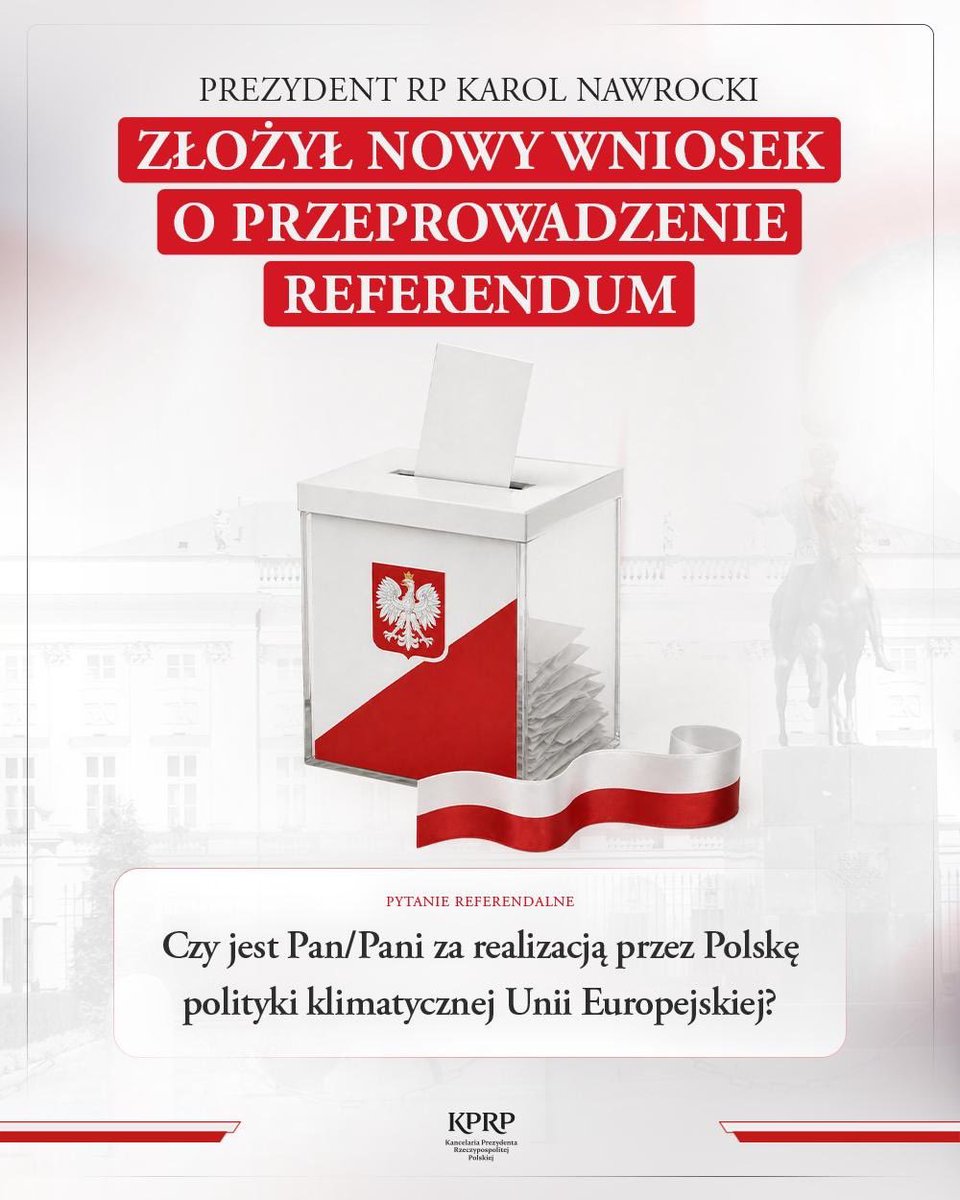
Prezydent RP @NawrockiKn , w nadchodzącym tygodniu ponownie złoży do Senatu wniosek o referendum w sprawie przyszłości unijnej polityki klimatycznej‼️
„Referendum to jest głos Narodu. To nie jest dyskusja ekspertów, profesorów o tym, jak wygląda Zielony Ład i jak wygląda ETS, jakie zagrożenia przyniesie. [Polacy] wiedzą, co przynosi Zielony Ład, co przyniesie ETS, jak zniszczy polskie przedsiębiorstwa, jak niszczy polskie rolnictwo. To wie polski rolnik, to wie polski przedsiębiorca, to wiedzą wszyscy ci, którzy płacą rachunki za energię elektryczną.
To nie jest dyskusja tylko ekspertów. To jest głos narodu polskiego, a naród polski w referendum ma prawo powiedzieć: nie chcemy europejskiej polityki klimatycznej, nie chcemy Zielonego Ładu”.
🚨🇭🇺Chaos in Hungary after new government led by Peter Magyar rewrote the constitution and ousted the country's legitimate president.
Hungarian President Tamás Sulyok was removed from office despite his mandate from the Hungarian people.
Viktor Orbán wrote on his official X account:
"If they can do this to the President of the Republic, they can do it to anyone."
@ekonomat_pl Jak zaczynaliśmy i jak transformacja wyglądała przed wejściem Polski do UE. Z takim sąsiadem nie tylko należy postępować konsekwentnie, ale należy również narzucić konsekwencje wobec siebie. Zero free ride.
To potwierdza, ze w okresie Cesarstwa Niemieckiego przed wybuchem I wojny światowej władze niemieckie traktowały śląszczyznę z pozycji siły, traktując ją jako podrzędne narzędzie domowe lub formę języka polskiego, którą należy bezwzględnie zastąpić niemczyzną (nie polszczyzna bo ta rowniez nalezalo poddac germanizacji)
W świetle polskiego i niemieckiego prawa śląski nigdy nie posiadal oficjalnego statusu języka regionalnego
Niemcy wyśmiewali Polaków, pokazywali, jak polscy żołnierze będą przed nimi uciekać. Ponad 10 000 niemieckich najemników przeciwko ok. 2000 polskich żołnierzy. Po stronie polskiej 60 zabitych i 127 rannych, po stronie niemieckiej 4416 zabitych i 1000 jeńców. 17 kwietnia 1577 roku, bitwa pod Lubiszewem #HistoriaPolski
@EwaP48044703@ewairmina@Jary1644779@drsajgon@malgorzata0710@AgataAgatellaa@cezarykrysztopa@IrekMatak