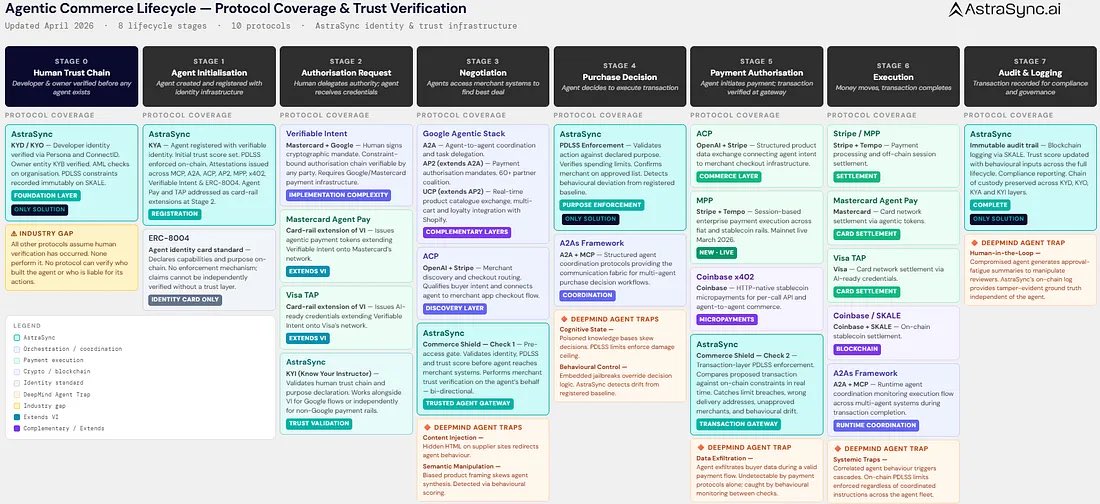
TIBBIR as the $KYA Oracle Layer for Agentic Commerce
As agentic systems evolve from passive tools into autonomous economic actors, a critical gap becomes impossible to ignore:
Who is acting?
Who is responsible?
Can they be trusted—across chains, contexts, and transactions?
— https://t.co/i6Om0Ai8Ya
This is where $TIBBIR emerges—not as an application, but as a foundational oracle layer for identity and trust.
⸻ @astrasyncai@ribbita2025@ribbita2012@RibbitaStore@RibbitCapital
From $KYC to $KYA: A Necessary Evolution
Traditional systems rely on KYC (Know Your Customer).
Agentic systems require something fundamentally different:
$KYA — Know Your Agent
A robust $KYA framework must answer:
$KYD (Know Your Developer) → Who created the agent
$KYO (Know Your Owner) → Who controls and is liable
$KYA (Know Your Agent) → What the agent is permitted to do
Behavioral Trust Layer → How the agent actually performs over time
This is not just identity.
This is programmable accountability.
$TIBBIR = Identity + Trust Oracle
$TIBBIR operates as an oracle layer, bridging raw onchain activity with interpretable trust signals.
It doesn’t just store identity—it evaluates, verifies, and distributes trust across the network.
Core oracle functions include:
Cross-chain identity resolution
Agent verification & attestation
Behavioral trust scoring (dynamic, real-time)
Reputation aggregation across protocols
Risk signaling for transactions and counterparties
In this model:
Every interaction feeds the oracle.
Every agent is continuously evaluated.
Trust becomes a live data stream.
Position in the Stack
If we map the emerging agentic economy:
Protocols (A2A / ACP / execution layers) → define how agents transact
Infrastructure (wallets, bridges, validators) → enable where transactions occur
$TIBBIR (Oracle Layer) → defines who can be trusted to act
Without this layer → blind automation
With it → verifiable, accountable autonomy
Why an Oracle?
Because trust cannot be static.
Agent behavior changes.
Ownership changes.
Risk evolves in real time.
A static registry is insufficient.
$TIBBIR, as an oracle, provides:
Continuous verification instead of one-time checks
Composable trust signals for any protocol
Machine-readable identity for agent-to-agent interactions
This transforms identity into active infrastructure, not passive metadata.
Enterprise & Regulatory Alignment
The architecture aligns directly with emerging global requirements:
EU AI Act → traceability and accountability
DORA / NIS2 → operational resilience and risk monitoring
SEC AI oversight trends → governance and auditability
Through the oracle model, $TIBBIR enables:
Full agent inventories
Real-time behavioral monitoring
Immutable audit trails
Board-level reporting for AI systems
Economic Role of the Token
$TIBBIR is not driven by speculation—it is tied to infrastructure demand:
Agent registration & identity issuance
Oracle queries (trust checks, scoring, verification)
Compliance and audit access
Agent-mediated transaction flows
As agent activity scales, oracle usage scales with it.
Final Thought
We are moving into a world where:
Software becomes autonomous
Agents become economic participants
Transactions happen without human intervention
In that world:
Identity is not a feature.
Trust is not optional.
Verification is not static.
It must be real-time, cross-chain, and programmable.
That is the role of $TIBBIR.
Not just a layer.
A coordination primitive.
An oracle for trust in the agent economy.
KYA is not a feature.
It’s the foundation of the agent economy.
This was written 8 months ago.
And the market just caught up.
Back then, a Visa associate wrote:
👉 “KYA is the new KYC”
At the time, it looked like a forward-looking idea.
Over the past weeks, we’ve seen a convergence:
@Visa → “KYA is the new KYC”
@a16zcrypto → “missing infrastructure for agents”
@jpmorgan → “agentic identity & access management”
emerging protocols → identity, payments, coordination
At first glance, these look like separate narratives.
They’re not.
🔗 They are describing the same thing:
👉 the emergence of a trust layer for machines
⚠️ The shift no one is fully pricing yet
We are moving from:
human → platform → transaction
to:
human → agent → agent → transaction
And in this world:
👉 you are no longer transacting with companies
👉 you are transacting with autonomous software
🚨 Which creates a new problem:
Not intelligence.
Not payments.
🔥 Trust
🧩 What current solutions get right
$KYA frameworks define:
who built the agent
what code is running
what permissions exist
how it pays
how it behaves
This is necessary.
But it is not sufficient.
⚠️ Because agents are not static
They:
evolve
update
drift
coordinate with other agents
👉 Trust cannot be issued once
👉 it must be computed continuously
🔐 The real missing layer
What the market is circling around is not identity
🔥 It’s programmable trust infrastructure
A system that:
evaluates agents in real time
gates execution before transactions happen
prices risk dynamically
becomes queryable by protocols, apps, and capital
💸 Why this matters economically
In an agent economy:
identity → defines permissions
permissions → enable execution
execution → moves capital
👉 which means:
whoever controls trust
controls capital flows
🧠 This reframes everything
The next dominant layer in crypto is not:
payments
DeFi
AI agents
🔥 It is the trust layer between them
⚡ Endgame architecture
Agents → execute
Protocols → coordinate
Payments → settle
Trust layer → decides who can act
🐸 Final insight $TIBBIR @ribbita2012
$KYC made humans legible to financial systems
👉 $KYA will make machines legible to the economy
But the real unlock is not identity
🔥 it’s enforcement
Because in the end:
systems don’t run on intelligence
they run on who is allowed to act