I am sharing a powerful 1-minute and 23-second clip from Abiy Ahmed’s historic visit to Asmara, Eritrea, on July 8, 2018, a day etched in the memory of both Eritreans and Ethiopians. During that momentous visit, Abiy declared:
“To the people of Eritrea, I would like to express my deep sympathy and condolences to the families of those who lost their lives and sustained physical injuries during the conflict 20 years ago. Moving forward, let us not relive that war. Instead, let us use our untapped potential for peace and development…
If you hear me speak about Eritrea in international forums, know this: His Excellency President Isaias has officially authorized me to represent Eritrea’s foreign affairs wherever I go. Let there be no misunderstanding while I speak on behalf of Foreign Minister Osman as well.”
These words formed the cornerstone of the peace accord between Eritrea and Ethiopia, a breakthrough that earned Abiy Ahmed the Nobel Peace Prize in 2019. That award, now drenched in irony, was built on the shoulders of Eritrea’s magnanimity, a nation that extended its hand when Ethiopia teetered on the brink of total collapse during the TPLF-led war.
And now, barely five years later, Abiy beats the drums of war against the very nation that helped save his regime. A man who once pledged unity, forgiveness, and cooperation has now become the most dangerous provocateur in the Horn of Africa, bent on igniting a regional inferno in pursuit of a delusional imperial fantasy.
This is not just betrayal; it is treachery of the highest order. Eritrea acted with grace and wisdom. #Quisling Abiy responded with deceit and bloodshed. History will remember who honored peace, and who buried it under the rubble of ambition.
@hawelti@UN@_AfricanUnion@europepeace@NeaminZeleke@AndargachewTse2@tesfanews@Sharronyemane@Marta52763122@Fre4glsTsegay@ShebaPushStart@nytimes@jeffpropulsion@YonasBiru57@CBCNews@FT
ATTENTION ―⚠️ War with Eritrea has never been easy for all past Ethiopian regimes, and it has left devastating scars on border regions of the two countries, particularly Tigray.
Sadly, the current Oromo-led regime in Addis Ababa, along with a TPLF faction led by Getachew Reda and Tsadkan Gebretensae, is once again dragging the people of Tigray — and this time the Afar and Amhara regions too — into yet another cycle of death, destruction and displacement, with no clear justification.
With talks of war and preparations for what they claim could be an attempt to "seize" Eritrea’s port of Assab, a clear violation of Eritrea’s sovereignty and international law, Eritrea’s government, people and military will rightfully defend themselves.
The responsibility for any resulting destruction, loss of life, or suffering will rest squarely on the incompetent Ethiopian leader Abiy Ahmed and his TPLF faction.
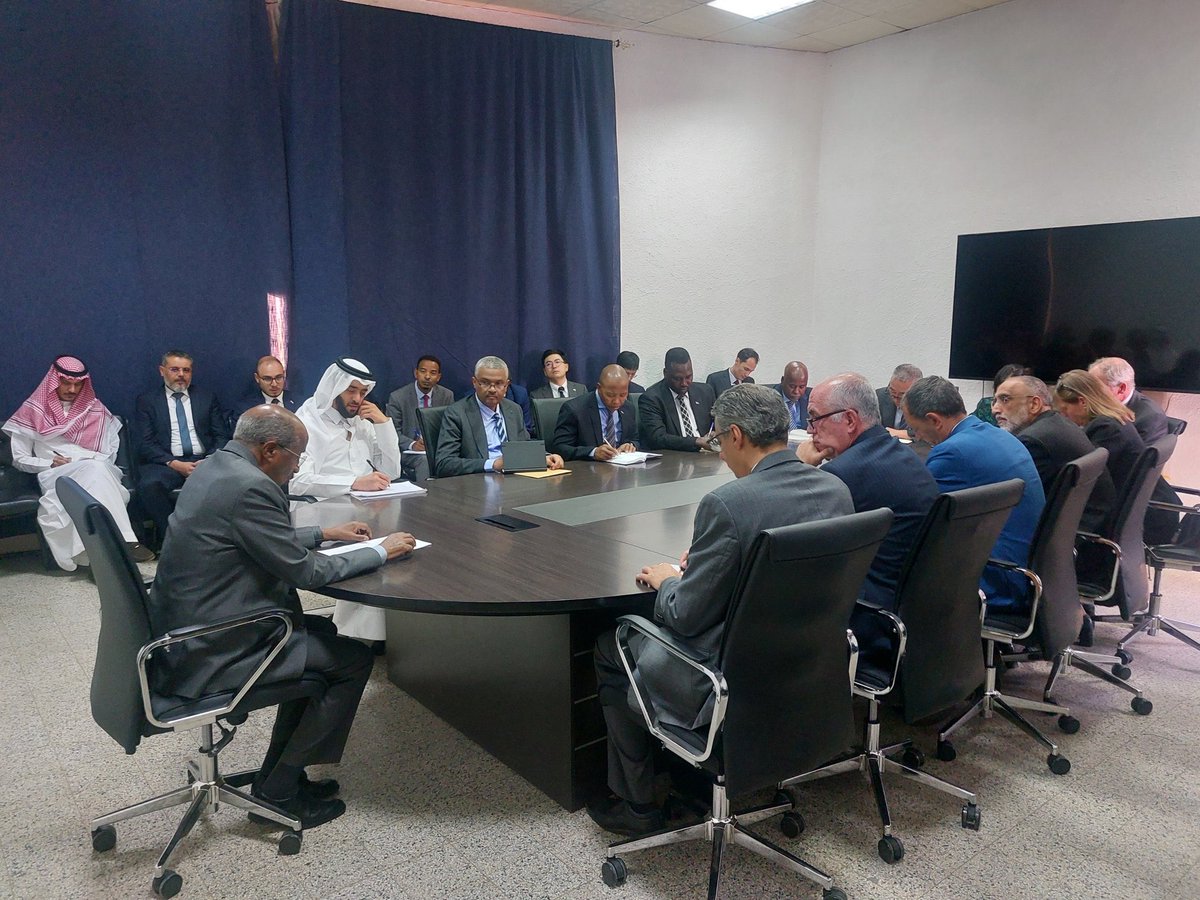
Minister Osman Salih addressed the diplomatic corps about z allegations on #Eritrea’s interference in the internal affairs of #Ethiopia, as a baseless accusation. He underlined that Eritrea remains committed to peace & regional security. #Eritrea#Ethiopia#HoA#RegionalSecurity
Credit: Eritrea|’s Minister of Information @hawelti
“Apparently, another heyday for the usual Conflict Enterpreneurs!
Genuine concern to avert any bout of conflict - Intra-State or Inter State - in the Horn of Africa is of course noble and commendable. Silencing the Guns must indeed be the collective commitment of those who care for the well-being of all the peoples in our region.
But the various postulates and "scenario analyses", as well as calls for "external intervention", peddled by most of these Conflict Enterpreneurs lack depth as well as objectivity, and seem mired in unhealthy motives and underlying agendas. And as ever, sullying the image of Eritrea and using it as a convenient political punch-bag seems to be an organic part of these schemes.
In the event, let us reiterate Eritrea's unflinching commitment to peace on the basis of fundamental pillars of international law and the interests of regional stability.
In this respect,
1. The often repeated accusations of "Eritrean troop presence in the #Tigray Region of #Ethiopia" by certain circles is utterly false and floated to create a pretext for stoking conflict. Eritrea's troops were and remain fully deployed within its sovereign territories.
2. As underlined in unequivocal terms on many occasions in the past, Eritrea has no interest whatseover in scuttling the Pretoria Peace Agreement; which is essentially an internal Ethiopian affair,
3. Similarly, Eritrea has no interest to exacerbate internal schisms within the political factions of the #TPLF which it believes can only entail unnecessary and avoidable suffering to the people of Tigray.
4. Along with other toxic agendas, (ethnic and religious polarization etc.), territorial irredentism has remained the principal cause of endemic and cyclical inter-State and Intra-State conflicts in the Horn of #Africa Region. In this context, constant inflammatory statements issued day-in and day-out by various political forces in Ethiopia regarding the #Red #Sea continue to be a recipes for unnecessary tension. This must be condemned in the strongest terms without any equivocation
#Eritreaprevails
#HornOfAfrica
“Urges #Eritrea and #Ethiopia to de-escalate tensions”?! One cannot help but wonder what prompts such a statement. The last time I checked, #Tigray is a region in Ethiopia, and the tension within the #TPLF and with Addis is a purely internal Ethiopian matter. As are the conflicts in #Amhara, #Oromia, and the rising tensions in the #Somali region. Eritrea has no horse in this race.
Meanwhile, these same quarters conveniently turn a blind eye to the real source of regional tension—the reckless rhetoric and actions of the Prime Minister, who openly speaks of redrawing borders to gain so-called “sovereign access to the sea.” I hear no condemnation of this blatant affront to the bedrock principle of international relations—the inviolability of internationally recognized borders—nor any calls for de-escalation in this context.
Why is Addis Ababa’s clear transgression—which is fueling uncertainty and regional tension—so easily brushed aside, while what is fundamentally a domestic Ethiopian issue is framed as a bilateral or regional concern?
This approach does not help address Ethiopia’s internal crisis, as it only provides the Prime Minister with a convenient excuse to evade the difficult decisions needed to tackle the country’s real economic and security problems. At the same time, by ignoring his blatant disregard for international law, they are effectively emboldening him to take even more reckless actions that would push the region further away from peace.
Time and again, western politicians and pundits have shown us their “expressions of concern” are nothing more than expressions of their own wishes. They shed crocodile tears over conflicts while conveniently ignoring their root causes. We saw it when they raised alarms about tensions between Ethiopia and Eritrea while overlooking Ethiopia’s refusal to implement the Algiers Agreement—going so far as to impose sanctions on #Eritrea. We see it now in #Sudan, where they speak of the people’s suffering while remaining silent on the #UAE’s role in fueling the conflict.
Sudan Confronts the UAE at the UN: Al-Harith Idriss Exposes Abu Dhabi’s Role in Fueling War
At today’s United Nations session, Sudan’s Permanent Representative to the UN, Al-Harith Idriss, delivered a forceful response to the UAE’s attempts to manipulate the narrative surrounding the war in Sudan. The session saw repeated exchanges between the two delegations, with Sudan directly accusing the UAE of fueling the war by funding and arming the Rapid Support Militia (Janjaweed), while the UAE scrambled to deflect responsibility.
The UAE’s Opening Statement: A False Show of Neutrality
The UAE representative began by expressing concern over the suffering of the Sudanese people, highlighting the urgent need for humanitarian aid and calling for stronger mechanisms to protect civilians. The speech was carefully crafted to present the UAE as a neutral party, advocating for a ceasefire and negotiations between both sides of the conflict. However, while Abu Dhabi attempted to position itself as a peace broker, the entire world knew that it was a key player in the war, not merely an external observer.
Rather than addressing its well-documented role in fueling the war, the UAE attempted to shift the blame entirely onto "two warring generals." The representative condemned the violence, called for unrestricted humanitarian access, and even suggested adding conflict-related sexual violence as an independent criterion in the UN sanctions system. Yet, the very crimes the UAE claimed to denounce were being committed by the militia it continues to support.
Al-Harith Idriss Responds: Exposing the UAE’s Criminal Role
Al-Harith Idriss, Sudan’s Permanent Representative to the UN, wasted no time in dismantling the UAE’s façade of neutrality. Addressing the council, he delivered an unfiltered truth: the UAE is not a bystander in this war—it is an instigator. He accused Abu Dhabi of igniting and prolonging the war in Sudan, not out of any genuine concern for peace, but to occupy Sudan, seize its resources, and establish control through its proxies.
His response was clear and backed by evidence. Idriss pointed to UN reports, congressional testimonies, and investigative findings that confirm the UAE’s support for the Rapid Support Militia (Janjaweed). He detailed how Emirati drones and weapons have been used in at least 188 bombing raids in Darfur, how UAE aircraft have landed on dirt runways in Nyala to supply arms, and how Abu Dhabi has been using Chad as a staging ground for further attacks. He also exposed the fact that while the UAE claimed to be offering humanitarian assistance, its financial support was in fact being funneled into purchasing weapons for the militia.
Sudan’s representative did not stop there. He called out the UAE for attempting to whitewash its involvement by referring vaguely to "foreign elements" in Sudan, when the only foreign actor arming and funding the militia is the UAE itself. He challenged the UN Security Council to explicitly name the UAE and hold it accountable for the destruction it has caused.
The UAE’s Retaliation: Deflection and Denial
In response, the UAE representative took the floor again, this time resorting to outright dismissal of Sudan’s accusations. The UAE accused Sudan of spreading "misinformation" and of using the UN platform to deflect from its own role in the conflict. With feigned indignation, the UAE insisted it was not involved in the war and was not taking sides, repeating the claim that "lies remain lies, no matter how often they are repeated."
The UAE also sought to put the blame back on Sudan, questioning why the Sudanese Armed Forces had not agreed to a ceasefire and suggesting that the real obstacle to peace was Sudan’s refusal to engage in negotiations. It was a predictable attempt to divert attention from the core issue—Abu Dhabi’s direct role in sustaining the war.
Al-Harith Idriss Strikes Back: The War Will Not End While the UAE Arms the Militia
Unmoved by the UAE’s deflections, Al-Harith Idriss took the floor once again. He reiterated that Sudan was not making baseless allegations but presenting documented evidence that the UAE has fueled the war by equipping and financing the Rapid Support Militia (Janjaweed). He reminded the council that Sudan had submitted a 74-page official complaint detailing the UAE’s role, citing reports from neutral institutions and testimony presented to the U.S. Congress.
Idriss made it clear that the war would not stop while the UAE continued to support the militia. The Sudanese Armed Forces were fighting to reclaim the country from an armed group backed by a foreign power, not engaging in a meaningless internal dispute. He called on the UN to stop pretending this was a conflict between internal factions and recognize it for what it truly is: a foreign-backed attempt to destabilize Sudan and seize control of its resources.
The UAE’s Last Word: A Desperate Attempt to Save Face
Despite the overwhelming evidence against it, the UAE insisted on having the final word. Its representative once again accused Sudan of misrepresenting the situation, claiming that if Sudan’s leadership truly wanted peace, it would agree to a ceasefire and engage in dialogue rather than continuing military operations. The UAE accused Sudan of blocking humanitarian aid and attempting to spread "disinformation" to shift blame.
Sudan’s Stand: No Peace While the UAE Fuels War
The message from Sudan was clear: this war is not about two generals—it is about a nation resisting a foreign-backed occupation. The UAE has spent billions funding and arming a terrorist militia while pretending to call for peace. But Sudan sees through the deception.
Sudan left no room for doubt—the war will only end when the UAE ceases its support for the Rapid Support Militia (Janjaweed). Until then, Sudan will continue to fight, not just for its land, but for its sovereignty, its people, and its future.
#Sudan
#UAEKillsSudanesePeople
The Eritrean American delegation representing the NPDG Texas Chapter had the pleasure and honor of meeting Senator Ted Cruz in person yesterday at Capitol Hill. We extend special thanks to his staff for their hospitality and warmth. As the saying goes, “A journey of a thousand miles begins with a single step.”. 🇪🇷🇪🇷
Foreign Minister Osman Saleh met, today in Riyadh, Saudi Foreign Minister Prince Faisal bin Farhan bin Abdullah and delivered a message from President Isaias Afwerki to Crown Prince and Prime Minister Mohammed bin Salman bin Abdulaziz.
The two Foreign Ministers also discussed bilateral relations and other vital issues of common interest.
The meeting was attended by the Vice Minister of Foreign Affairs, Eng. Waleed Elkereiji and other Saudi officials, as well as, Mrs. Weini Gherezghiher, Charge d'Affairs at the Eritrean Embassy to the KSA.
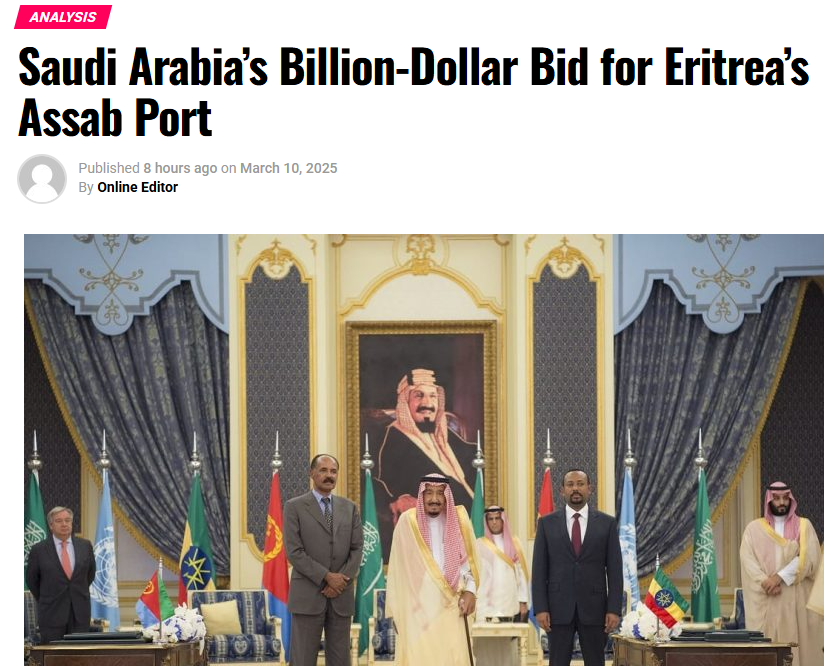
#BREAKING 🚨 ― Saudi Arabia is setting the stage for a profound strategic shift in the Horn of Africa through its planned multi-billion dollar investment in Eritrea's Assab port.
This investment in Assab port could significantly disrupt Ethiopia's maritime ambitions.
Secret report suggest that Ethiopia might even consider military action to secure access through Assab, however, Saudi Arabia's involvement could deter such aspirations by enhancing Eritrea's defensive capabilities and economic stability, making any aggressive move by Ethiopia costly and politically untenable.
Boom! መልካም ንባባ ለ PPዎች ... 😂
https://t.co/A4D8EoY1co
⚡️Power shortages in Asmara are now a thing of the past! Once plagued by a lack of generators and spare parts due to "unilateral" sanctions, our strategic partnership with #China has turned the tide.
Reliable 24/7 electricity is now lighting up homes, businesses, and brighter futures in the capital and its environs. 🇪🇷🫡🇨🇳
Open Network has officially launched, marking a groundbreaking moment for all Pioneers! With external connectivity now enabled, Pioneers can engage in transactions beyond the Pi ecosystem, connect with KYB-verified businesses, and access new integrations like centralized exchanges.
Want to explore all the new possibilities? Go to the Pi mining app home screen to watch a video from Pi Network founder, Chengdiao Fan, and read the official announcement. Discover how Open Network unlocks a new era for Pi and how you can be part of it!
The war-mongering psychosis that has apparently gripped certain political circles/Trolls in Ethiopia these days is astounding indeed. Almost on a daily basis, we see an upsurge of blatant distortion and revisions of ancient, medieval and modern history of the region; brazen rejection of relevant provisions of international law; and irresponsible recycling of inflammatory propaganda. All these to justifty and rationalize what is clearly illegal and that can only destabilize the region. "ጊሔስ ኣብ ክንዲ ትስተር፡ ትግተር" ኢዩ ነገሩ።
https://t.co/ZAge3utKD3
**Congratulations to Chinese Pioneers Purchasing Cars via Full Pi Payments at GCV**
BYD Auto Service Co., Ltd., located in the Yuhua District of Changsha City, Hunan Province, is supporting Pi payments at a GCV rate of $314159 for the exchange of hundreds of cars. Each car was traded for 0.2 Pi, allowing around 40 Chinese Pioneers to drive home today. Congratulations to them! 💪💪💪✌️✌️✌️
Yong Chuang Capital has invested 40 million RMB in these hundreds of cars.
The financial backing comes from Gaoling Group, Sequoia Capital, Hongyuan Construction, Poly Group, and Hunan Pi Chain Co., Ltd. I have verified this information with Mr. Li Shao from the Hunan Pi Network Merchants Association.
The price of 0.2 Pi covers all related fees. While this amount is slightly above the fair market value (FMV), it is justified because the Pioneers did not need to pay Pi upfront; they simply signed contracts committing to pay after Pi migrated. The capital's willingness to accept full Pi payments at this time, before the official mainnet launch (OM), is driven by the potential for significant profits. The belief that the value of Pi is fixed at $314,159, as noted in the GitHub code, contributes to this perception of minimal risk. This can be called the time value. As long as pioneers have been notified this extra charge, it is a Fair barter for both sides.
Although the price is higher than FMV, it addresses the immediate high demand for cars among Pioneers. Time is a critical factor, and Pioneers are willing to pay a premium to acquire their cars as soon as possible.
A special thanks to BYD Auto Service Co., Ltd. for their prompt support of the GCV Ecosystem.
We also appreciate the backing from the financial supporters of the Pi Network at the GCV rate of $314,159!
With just one day remaining until the mainnet launch (OM), I anticipate that more significant commodity merchants will join the Pi Network soon.
The Know Your Business (KYB) process for merchants has opened today, which will help address the challenge of merchants not having wallets to receive Pi. This is a priority channel for merchants to complete their KYB and obtain a wallet to connect to the Pi Network Blockchain.
Doris Yin 🪷🪷🪷