2025 A year of doubt, growth, and finally finding my place in @Aptos and @nova_move
Honestly, there was a point this year where I almost gave up on crypto.
Saturdays are for market milestones
And this one is no different
Tokenized RWAs made a major push this week
• +$34B market value
• +800K asset holders
• +$305B stablecoin value
RWAs refuse to stop accelerating
What are watching closely over the next 6 months?
"We're building the product for the users, and we're listening to them.”
@borntobry on why building close to the community is what keeps Decibel sticky 👇
On most chains, your transaction sits exposed in the mempool before execution giving MEV bots time to frontrun, sandwich, and extract value from your trade.
With the encrypted mempool on @Aptos, transaction details stay hidden until the last possible moment, ⬇️⬇️
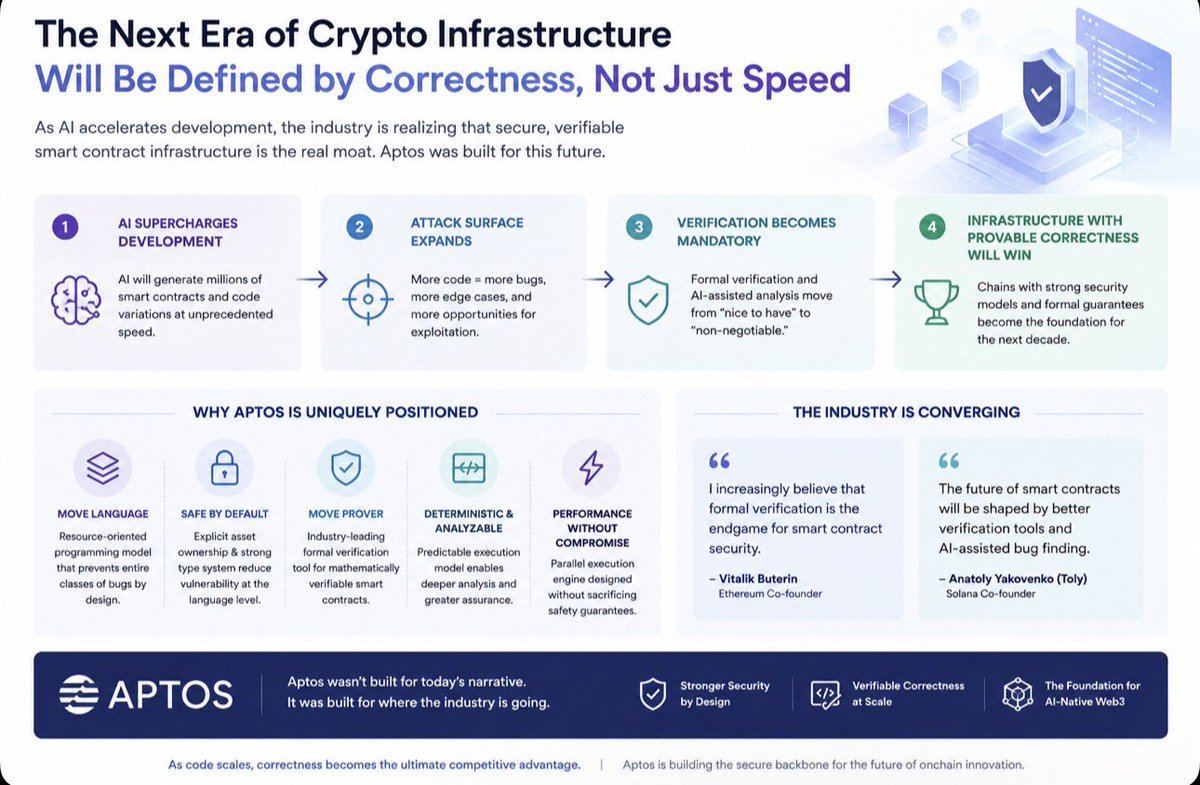
One of the most important shifts happening in crypto right now is the growing realization that scalability alone is not enough.
As AI dramatically accelerates software development, we are entering a world where smart contracts will be generated, modified, and deployed at a pace the industry has never experienced before.
That changes everything.
The bottleneck is no longer “who can write code.”
The bottleneck becomes:
Who can guarantee correctness?
Who can minimize exploit surfaces?
Who can formally verify behavior before billions in value interact with that code?
This is why the recent discussions around formal verification, AI-assisted bug detection, and secure infrastructure from people like @VitalikButerin are so important.
The industry is beginning to converge toward a reality Aptos was architected for from day one.
What makes Aptos interesting is not just throughput or parallel execution.
It’s that the entire stack was designed with stronger safety guarantees in mind:
🔹Move’s resource-oriented programming model
🔹explicit asset ownership semantics
🔹prevention of entire exploit classes by design
🔹formal verification through Move Prover
🔹deterministic and analyzable smart contract behavior
Most ecosystems treated security as something layered on afterward through audits and tooling.
Move approached it differently:
Reduce the possibility space for catastrophic failure at the language level itself.
That distinction matters much more in an AI-native future.
Because AI-generated code will massively increase the amount of deployed onchain logic, but it will also increase the volume of subtle vulnerabilities, edge-case exploits, and unaudited deployments entering the market.
In that environment, chains optimized purely for speed without emphasizing provable correctness may eventually face structural trust problems.
The next evolution of crypto infrastructure will likely favor systems that combine:
high performance,
formal guarantees,
safe composability,
and machine-verifiable correctness.
And honestly, this is one of the strongest long-term narratives for Aptos right now.
The market is finally moving toward conversations Aptos has been preparing for years.
A lot of people still see Aptos as just another general-purpose L1, but the vision is becoming much more focused.
Aptos is now leaning heavily into:
• Trading infrastructure
• Stablecoin payments
• AI agent economies
• Decentralized compute networks
after multiple crypto cycles, one thing has become clear:
Blockchains are extremely good at markets and coordination. That’s where real product-market fit is happening today.
Instead of trying to support every narrative at once gaming, media, NFTs, social Aptos is doubling down on areas with real demand and long-term scale.
Their edge comes from the architecture itself.
Built from the former Meta/Diem research team, Aptos was designed for:
• Web2-level scalability
• High throughput
• Low latency
• Flexible execution environments
And with Aptos Move, they believe they can optimize the chain itself for advanced trading use cases like:
• Better transaction ordering
• Faster execution
• More efficient decentralized exchanges
The AI thesis is also interesting.
Aptos believes AI agents will eventually need:
• Open payment rails
• Autonomous transactions
• Global coordination systems
And blockchains may become the infrastructure layer that allows AI agents to transact with each other at internet scale.
The crypto market is moving away from “generic fast chains.”
The next phase is specialization.
And Aptos wants to become the infrastructure layer for:
→ Global trading
→ Internet-native finance
→ AI-powered economies
GM to the builders, creators, and curious minds shaping the next era of AI + Web3.
The future won’t be built by spectators.
It will be built by those who show up early, contribute meaningfully, and position themselves where innovation is happening in real time.
At Twin3, we’re building systems around digital identity, personal AI, and a contribution-driven economy.
If you want to be where these conversations are turning into real ecosystems, this is where you should be.
Join our Discord and step into the room where ideas become infrastructure:
https://t.co/Ikio7K8zpk
Don’t just watch the future unfold—enter it.
Mainstream pressure. Fractured flows.
BTC ETFs: -$137.77M. ETH ETFs: -$87.73M. Both on a 3-day losing streak.
Against that backdrop, XRP ETFs quietly pulled in $3.59M — standing out as the only major crypto ETF in the green. SOL sits in a different kind of limbo: zero inflows for three straight days. Not leaving, not arriving. Just still.
capital is clearly turning more cautious. As majors face pressure, XRP is still attracting selective inflows, while SOL has moved into clear wait-and-see mode.
Drop your take 👇
#BTC #ETH #XRP #SOL #ETF #SoSoValue
ʏᴏᴜ ᴅᴏɴ'ᴛ ᴏᴡɴ ʏᴏᴜʀ ᴅɪɢɪᴛᴀʟ ɪᴅᴇɴᴛɪᴛʏ. ᴘʟᴀᴛꜰᴏʀᴍꜱ ᴅᴏ
ᴛʜᴀᴛ'ꜱ ᴀʙᴏᴜᴛ ᴛᴏ ᴄʜᴀɴɢᴇ
Here's what @twin3_ai is building and why it matters more than anything else in Web3 right now. 🧵👇