New paper out in Nature Computational Science
neuroGravity is a physics-informed deep learning model that reconstructs mobility networks from what's almost always available
https://t.co/ybFzLpeHuP
https://t.co/IyBHGC97o6
Best Commentary: https://t.co/j6hpxz0jLt by Ryan Qi Wang
Anunciamos que Marta C. González (@martikagv), da UC Berkeley, será palestrante principal do LANET 2027! Porto Alegre, Brasil, de 26 a 30 de julho de 2027. Participe: https://t.co/6r2R5Glet6 #NetworkScience
I kept wondering why smart people write things nobody understands.
Then a Harvard professor gave it a name that stopped me cold: the moment you understand something deeply, you lose the ability to remember not knowing it.
I watched his writing talk at 1am and ended up rewinding the same ten minutes three times.
The professor name is Steven Pinker.
He's spent 40 years studying how language works inside the human brain, and he opened with a question I'd never had the guts to ask out loud. Why is so much writing terrible? Not just school writing. Work emails. Government forms. Half the stuff experts put online.
His answer had nothing to do with effort. Or intelligence. Or how much someone knows.
He called it the Curse of Knowledge.
Here's what it means:
The second you truly understand something, you forget what it felt like to not understand it. The gaps in a beginner's head become invisible to you, because in your head those gaps got filled years ago. You're standing on ground you can't even see anymore, and you assume everyone else is standing there too.
He gave one example I can't shake. A brilliant scientist got on stage at a big event in front of 400 people and lost the entire room in under a minute. He dove straight into words only his lab used. Never said what problem he was solving. Never said why anyone should care. And the worst part? He had no clue it was happening. He thought he was being clear.
That's the curse. You can't feel it from the inside.
Then Pinker said the line that rearranged how I think about writing.
Bad writing isn't a character flaw. It's a failure of imagination. You cannot get inside your reader's head by trying harder or caring more. Trying harder just makes you explain it more confidently in the same language they already don't understand.
So how do you actually fix it?
You find one real person. Not a crowd. One human being who is smart but lives outside your little world. You hand them your writing and you watch their face while they read it. Not the page. Their face. The exact second their eyes go flat and confused is the exact spot your writing broke.
Pinker did this with his own mother. Not because she wasn't sharp. She was. But she wasn't a language scientist, so the moment he drifted into his private vocabulary, she'd get lost, and he'd know instantly.
I sat with that for a while, because I've been doing the opposite my whole life. When someone didn't get what I wrote, I assumed they weren't paying attention. Turns out I was the one who couldn't see the hole. I'd filled it so long ago I forgot it was ever there.
That's the trap. The better you know your subject, the worse you get at teaching it, and you can't feel yourself getting worse. It feels like clarity the entire time you're losing people.
Which means the smartest person in the room is often the hardest one to learn from. Not because they're hiding anything. Because they genuinely can't remember what it's like to not already know.
The cure isn't a bigger brain. It's borrowing someone else's for one uncomfortable minute.
Find one person outside your world. Show them what you wrote. Watch their face, not the page. Everything they don't understand is the part you were too close to see.
Things are heating up on Terry Tao’s blog. In “If Math Is More Than Proof, We Need to Better Celebrate the Rest of It,” Grant Sanderson of @3blue1brown proposes “open exposition problems” -- rewarding the work of making math genuinely understandable.
https://t.co/zBOhhDNuNU
Mapping America's electric infrastructure - transmission lines and substations.
Starts with an archived HIFLD base; updated with OpenStreetMap when possible.
Visualized with high-performance vector tiles.
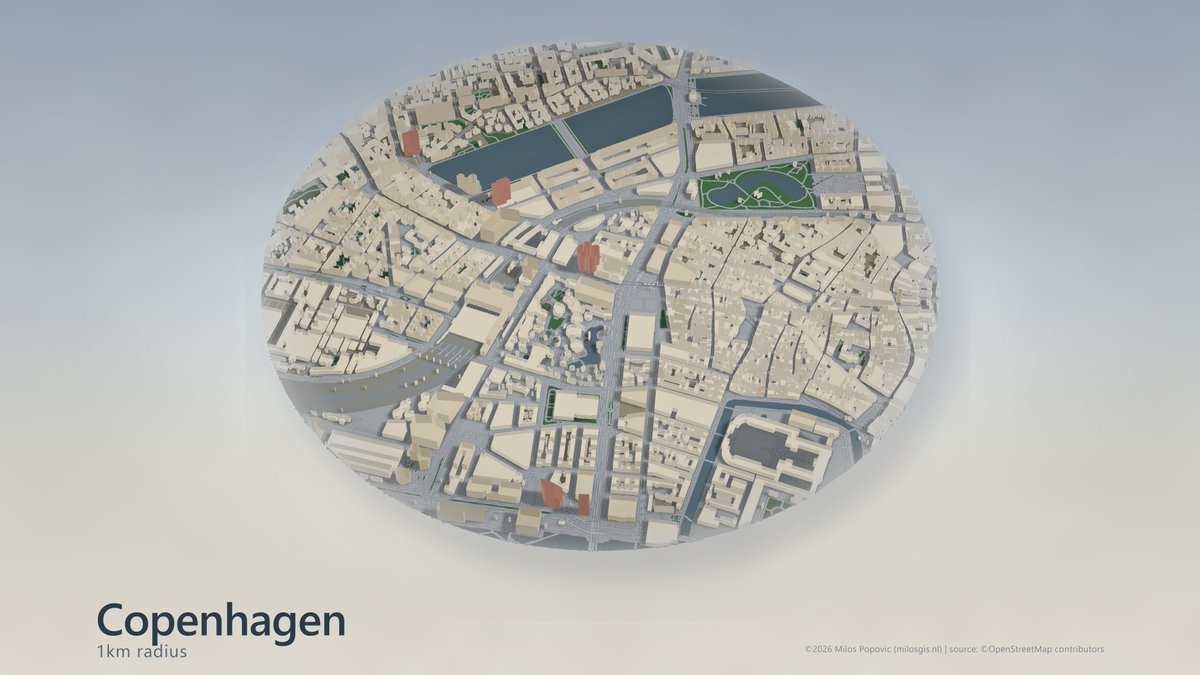
forge3d leverages 3 methods to render beautiful maps from OpenStreetMap data
1️⃣ CPU software raster (oblique). Limestone height tiers, golden-hour warm/cool grade, per-building tone variation, hand-built soft shadows + contact AO. Total control, fully deterministic. ~4 min for an 8K plate.
2️⃣ GPU viewer (oblique). Real-time rasterizer: PCSS 4096 soft shadows, MSAA 8, image-based lighting, tilt-shift DoF. Same scene, ~1–2 min. The fast path — and the one you can fly a camera through.
3️⃣ Path traced (nadir relief). Here the footprints become an extruded heightfield and a path tracer computes real global illumination — soft, sky-lit street shadows no hillshade can fake. Slowest to render, but the light is physically true.
Which look wins for you?
La copa del mundo acaba de quedar marcada para siempre por una intromisión política en una decisión tomada en la cancha.
Múltiple reportes de prensa confirman lo que aquí el presidente de Estados Unidos revela: fue presión directa sobre la Fifa la que consiguió cancelar la suspensión por tarjeta roja del delantero Estrella del equipo estadounidense.
Una vergüenza histórica.
🇻🇪 ¿Cuántos edificios han colapsado en Venezuela?
Los satélites ya han identificado 434 bloques DESTRUIDOS (según @CopernicusEMS). Los dañados serán muchos más: la agencia @UNOCHA contabiliza 9.868 de momento.
Los mostramos uno a uno sobre mapas 👇
🇻🇪 Venezuela Earthquakes Leaves Over 1,430 Dead and 68,900 Reported Missing
The casualty count is rising after two earthquakes, magnitudes struck Venezuela on June 24, devastating La Guaira and Caracas.
Hundreds of people are sleeping on the streets.
Praying for Venezuela
New Class alert from TechTransfer: Geospatial Data Science and Simulation for Transportation
Are you ready to level up your transportation decision-making without needing to learn how to code?
Learn more and registration:
https://t.co/PMBjvYwLhe
My school CSE @UNSW is hiring for a total of 12 faculty positions, including 6 Lecturers/Senior Lecturers (Assistant Professors), and 6 Associate Professors in specific areas such as in ML and NLP, neurosymbolic AI, systems (for AI), cybersecurity, software engineering, cryptography. Check out UNSW Careers website.
#facultyjobs #academicjobs
🚨 Public Good Alert 🚨
Two years of development. Zero funding. 𝟲,𝟲𝟵𝟯 𝗼𝗳𝗳𝗶𝗰𝗶𝗮𝗹 𝘀𝘁𝗮𝘁𝗲𝗺𝗲𝗻𝘁𝘀 𝗳𝗿𝗼𝗺 𝟱𝟭 𝗰𝗲𝗻𝘁𝗿𝗮𝗹 𝗯𝗮𝗻𝗸𝘀. #TextData
Today, we are opening the doors to it all for free 🚀
Visit our website: https://t.co/ToBke8Dxww
🧵1/12 #NLP
📢If you use #geobr to access spatial data of Brazil in #rstats, we'll be upgrading to v2.0.0 in a few weeks
This version includes:
- a few breaking changes💔
- several data fixes + updates🔨
- new data sets!💕
- integration with gearrow⏩
Please test the dev version, see below👇
👉438 docentes e investigadores se fueron de Exactas desde que comenzó el gobierno de Javier Milei.
Renuncian a razón de 1 cada dos días.
Sostener la calidad de la enseñanza y la investigación en este contexto es cada vez más difícil.
En este video, el decano y la vicedecana te cuentan cuál es la situación.
Exigimos al gobierno la aplicación urgente de la #LeyDeFinanciamientoUniversitario