@JoseDuarteUCM@LatinXChem Los materiales pueden soportar 4 ciclos de reuso manteniendo un porcentaje de remoción del 85% para azul de metileno a una concentración de 30 mg/L. Por el momento no se han realizado las respectivas pruebas para el naranja de metilo.
Greeting @LatinXChem,
Presenting my work "Removal of dyes in aqueous solutions using metal-organic frameworks derived from imidazole (Co-Cl and Co-Br)" at #LatinXChem24#LatinXChemEnv#Env084
It is a pleasure for me to respond to questions about the project.
@JoseDuarteUCM@LatinXChem ¡Hola, muchas gracias! La principal diferencia es debido al tamaño molecular entre los 2 colorantes. El azul de metileno es más pequeño en comparación al naranja de metilo, por lo tanto, hay una mayor facilidad de difundirse dentro de los poros de los MOF.
@WaldmanLab@LatinXChem 2) The synthesis of two novel metal-organic frameworks. Co-Br and Co-Cl are isoestructural frameworks derived from the reported ZIF-71 and ZIF-71(ClBr) with the modification of the metal center atom.
@WaldmanLab@LatinXChem 1) Methylene blue is derived from phenothiazine, meaning it has a central three-ring structure with sulfur and nitrogen atoms. The main mechanism for adsorption is due to the pi-pi stacking between the dye's aromatic rings and the MOFs' imidazolate rings.
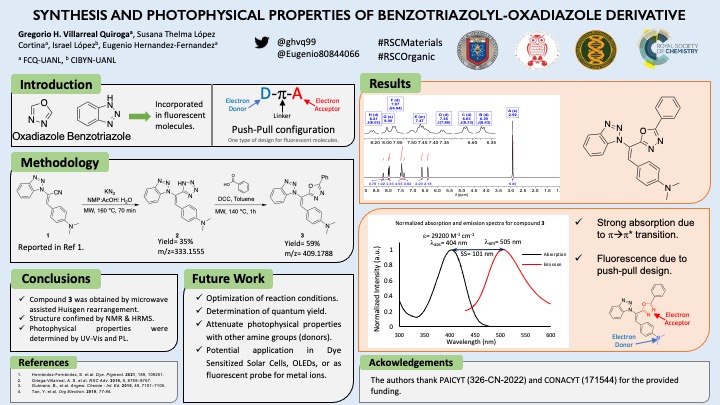
Hi everyone, I'm happy to share my first #RSCPoster#RSCOrg
The main focus of my research is the synthesis of two benzotriazolyl-acrylic acid derivatives and evaluation of their photophysical properties.
@Eugenio80844066
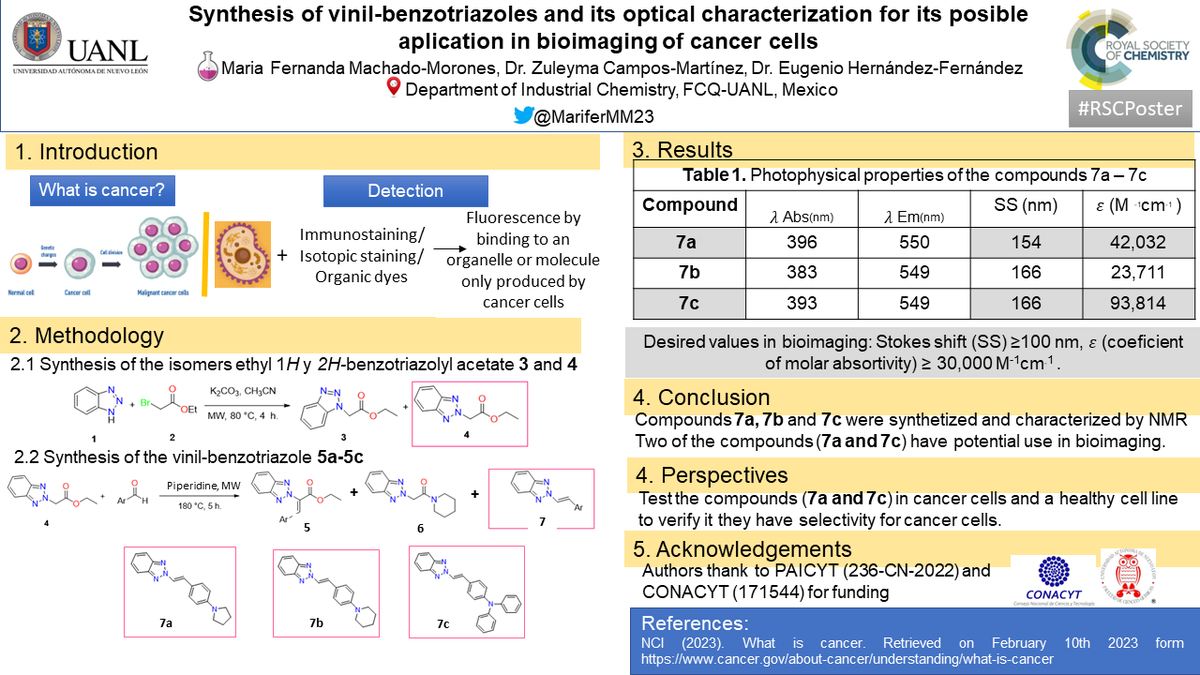
I'm happy to share my #RSCPoster edition 2023 on the topic of fluorescent compounds for the field of bioimaging 😊
@RoySocChem#RSCMat
See the PDF version: https://t.co/EwwPZksFaO