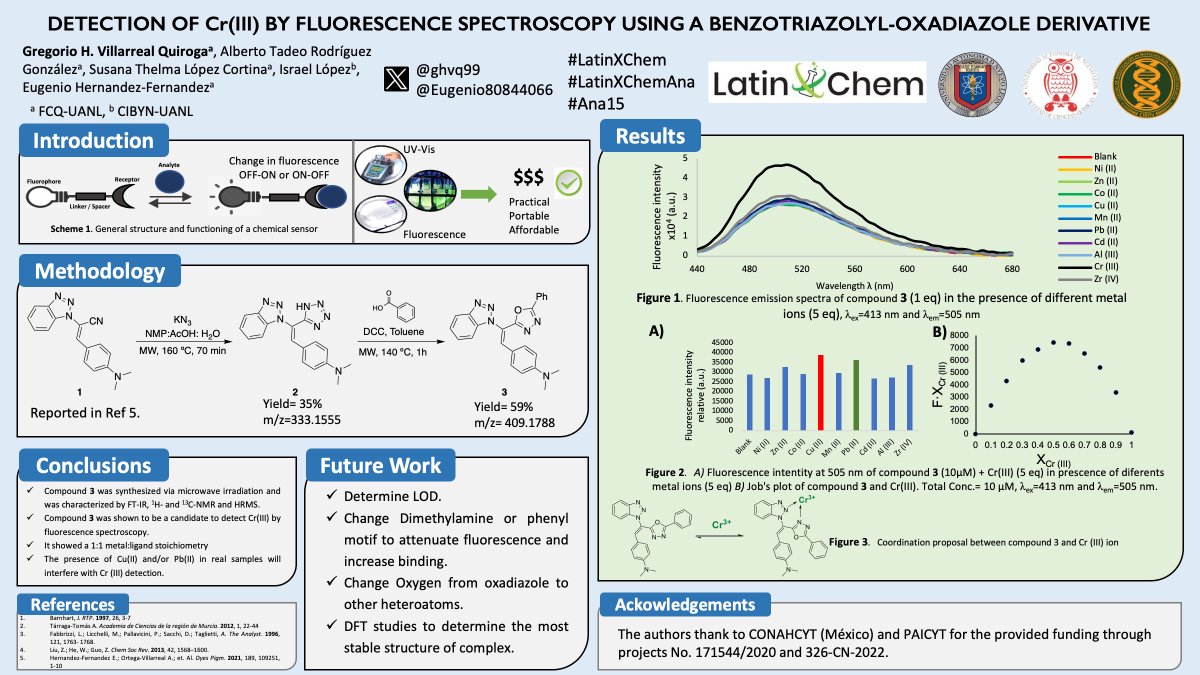
@agbrolo@LatinXChem@MethodsRSC@AnalysisSensing@beyondbenign@green_rsc@RSC_Sus This binding could produce a bimetallic complex, but further studies are definitely needed. Cr will have a larger binding constant than other metals. Cu/Pb will have a smaller constant than Cr, but large enough to allow these to bind to the complex without affecting Cr binding.
@agbrolo@LatinXChem@MethodsRSC@AnalysisSensing@beyondbenign@green_rsc@RSC_Sus Thanks! The LOD has not been determined yet, but we are working on it. Only Cr(III) enhanced the fluorescence intensity, but in presence of Cu or Pb the intensity increased. I think Cu/Pb could be binding with the Cr-sensor, due to the many free pairs of electrons present.
Hi everyone, I'm happy to share my first #RSCPoster#RSCOrg
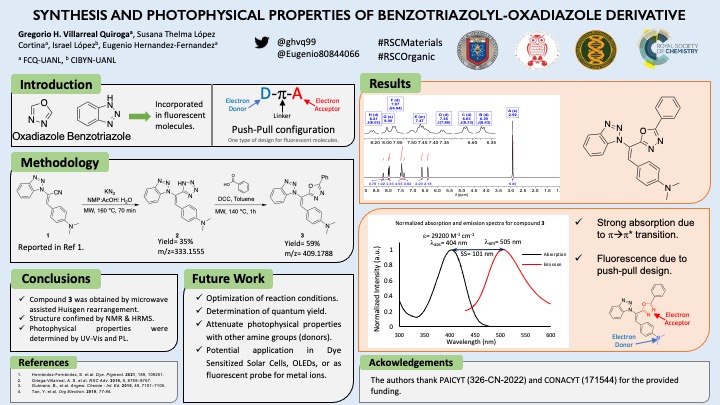
The main focus of my research is the synthesis of two benzotriazolyl-acrylic acid derivatives and evaluation of their photophysical properties.
@Eugenio80844066
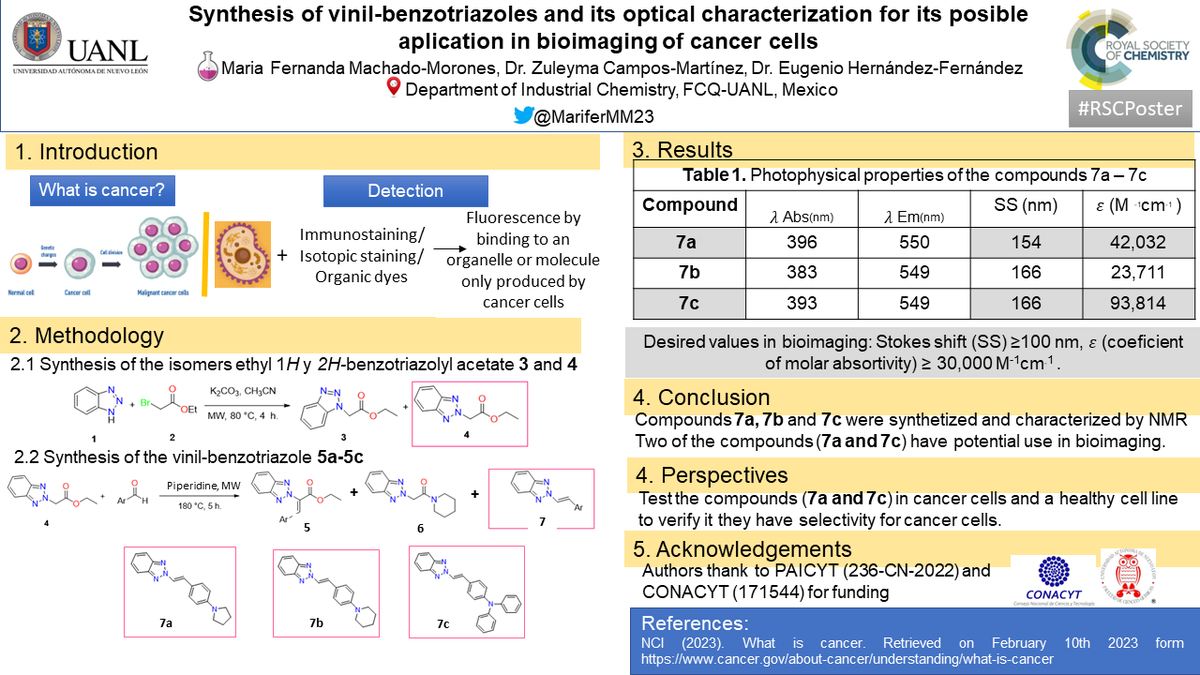
I'm happy to share my #RSCPoster edition 2023 on the topic of fluorescent compounds for the field of bioimaging 😊
@RoySocChem#RSCMat
See the PDF version: https://t.co/EwwPZksFaO
@JoannaOrtyl@JoannaOrtyl We have not tried as of yet to synthesize a water-soluble derivative for that application. However the compound shown will be tested as a fluorescent metal ion sensor using a mixture of acetonitrile and water.