Arc Public Testnet is now live.
Open to developers and enterprises globally, Arc is the Economic OS for the internet that unites programmable money and onchain innovation with real-world economic activity.
Start building: https://t.co/XmFdy0SG5g
Learn more: https://t.co/JOGsf9Ma5V
🤩🤯🤩 Claude Code (still not AGI but biggest advance since GPT-4) is the most neurosymbolic thing I have ever seen in my life. 53 symbolic tools, 500,000 lines of symbolic code, combined with a state-of-the-art LLM.
It is categorically *not* a victory for pure LLMs; it’s a victory for borrowing from classical AI and CS to move *beyond* pure LLMs.
Its success is complete vindication for everything I have said since 2001.
Amazing dissection of how it works at https://t.co/Q8jBUz35Ju
So let me make sure I’ve got this correct:
>Google gives Anthropic cash to pay Google for compute.
>anthropic gives compute away for a loss, and this discounted compute draws in large user bases to capitalize on the arbitrage.
>The private, non-marked to market valuation of Anthropic skyrockets, which Google reports as earnings, along with the cash it gave Anthropic.
>Google uses these fake earnings to cast a shadow over the debt it’s raising to build the compute it’s paying itself for through Anthropic.
>Google is bleeding money giving away compute through Anthropic and this is making the S&P500 earnings rocket straight up.
>losing money = making money
Do I have this right?
🦔Google Chrome has been silently downloading a 4GB Gemini Nano AI model to user devices without consent, and Chrome automatically redownloads it if deleted. Computer scientist Alexander Hanff has formally accused Google of violating European privacy regulations and estimates the rollout transferred several exabytes globally, generating up to 60,000 metric tons of CO2. The kicker is that Chrome's most visible AI feature runs on Google's servers anyway, with the local 4GB model only used for writing assistance and features buried several menus deep.
My Take
Pushing 4GB of unrequested data to billions of devices to enable a feature most users will never touch reflects a deliberate choice about whose resources matter and whose do not. Google consumed user storage, bandwidth, and electricity at planetary scale rather than ask whether anyone wanted Gemini Nano installed, because asking would have produced the wrong answer. Up to 60,000 metric tons of CO2 for a writing assistant nobody requested is the kind of number that should embarrass a company still running sustainability ads.
The bigger issue is that the largest software companies now treat user devices as extensions of their own infrastructure. Microsoft did it with Windows Recall, Anthropic was caught installing a native messaging bridge through Claude Desktop without consent, and Google is using Chrome's auto-update channel to push model weights nobody asked for. The cost gets externalized to your storage, your power bill, and your data cap, and my read is that this only stops when regulators treat unrequested local installs the same way they treat unrequested data collection.
Hedgie🤗
𝗣𝗮𝗶𝗱 𝗖𝗼𝘂𝗿𝘀𝗲 𝗙𝗥𝗘𝗘 (PART - 2)
1. Artificial Intelligence + Data Analyst
2. Machine Learning + Data Science
3. Cloud Computing + Web Development
4. Ethical Hacking + Hacking
5. Data Analytics + DSA
6. AWS Certified + IBM COURSE
7. Data Science + Deep Learning
8. BIG DATA + SQL COMPLETE COURSE
9. Python + OTHERS
10 MBA + HANDWRITTEN NOTES
(72 Hours only ) Cost About - $500
To get it FREE: -
1. Follow (So I can DM you )
2. Like & retweet
3. Reply " Send "
Super excited to partner with @LayerZero_Core ⚡️
For the first time, AI agents can use LayerZero to bridge and swap tokens across 150+ blockchains.
Enabled by Teneo’s agent infrastructure and LayerZero’s interoperability stack.
See thread below ↓
Claude Code is not AGI, but it is the single biggest advance in AI since the LLM.
But the thing is, Claude Code is NOT a pure LLM. And it’s not pure deep learning. Not even close.
And that changes everything.
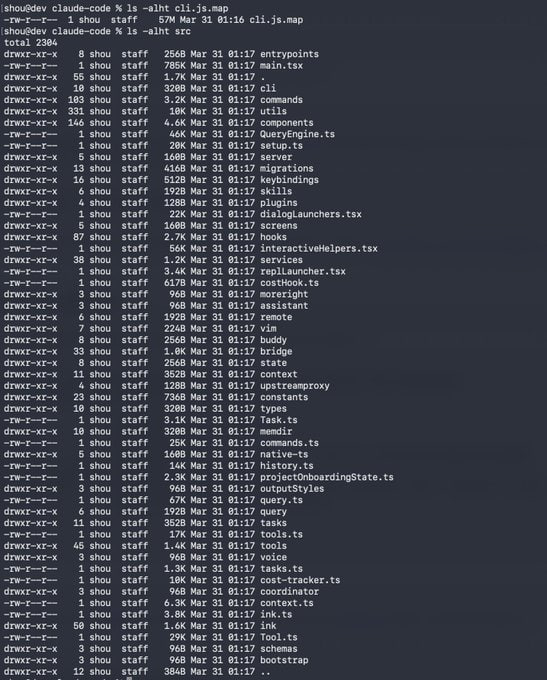
The source code leak proves it. Tucked away at its center is a 3,167 line kernel called print.ts.
print.ts is a pattern matching. And pattern matching is supposed to be the *strength* of LLMs.
But Anthropic figured out that if you really need to get your patterns right, you can’t trust a pure LLM. They are too probabilistic. And too erratic.
Instead, the way Anthropic built that kernel is straight out of classical symbolic AI. For example, it is in large part a big IF-THEN conditional, with 486 branch points and 12 levels of nesting — all inside a deterministic, symbolic loop that the real godfathers of AI, people like John McCarthy and Marvin Minsky and Herb Simon, would have instantly recognized.*
Putting things differently, Anthropic, when push came to shove, went exactly where I long said the field needed to go (and where @geoffreyhinton said we didn’t need to go): to Neurosymbolic AI.
That’s right, the biggest advance since the LLM was neurosymbolic. AlphaFold, AlphaEvolve, AlphaProof, and AlphaGeometry are all neurosymbolic, too; so is Code Interpreter; when you are calling code, you are asking symbolic AI do an important part of the work.
Claude Code isn’t better because of scaling.
It’s better because Anthropic accepted the importance of using classical AI techniques alongside neural networks — precisely marriage I have long advocated.
It’s *massive* vindication for me (go see my 2019 debate with Bengio for context, or to my 2001 book, The Algebraic Mind), but it still ain’t perfect, or even close.
What we really need to do to get trustworthy AI rather than the current unpredictable “jagged” mess, is to go in the knowledge-, reasoning-, and world-model driven direction I laid out in 2020, in an article called the Next Decade in AI, in which neurosymbolic AI is just the *starting point* in a longer journey.*
Read that article if you want to know what else we need to do next.
The first part has already come to pass. In time, other three will, too.
Meanwhile, the implications for the allocation of capital are pretty massive: smartly adding in bits of symbolic AI can do a lot more than scaling alone, and even Anthropic as now discovered (though they won’t say) scaling is no longer the essence of innovation.
The paradigm has changed.
—
*Claude Code is plainly neurosymbolic but the code part is a mess; as Ernie Davis and I argued in Rebooting AI in 2019, we also need major advances in software engineering. But that’s a story for another day.
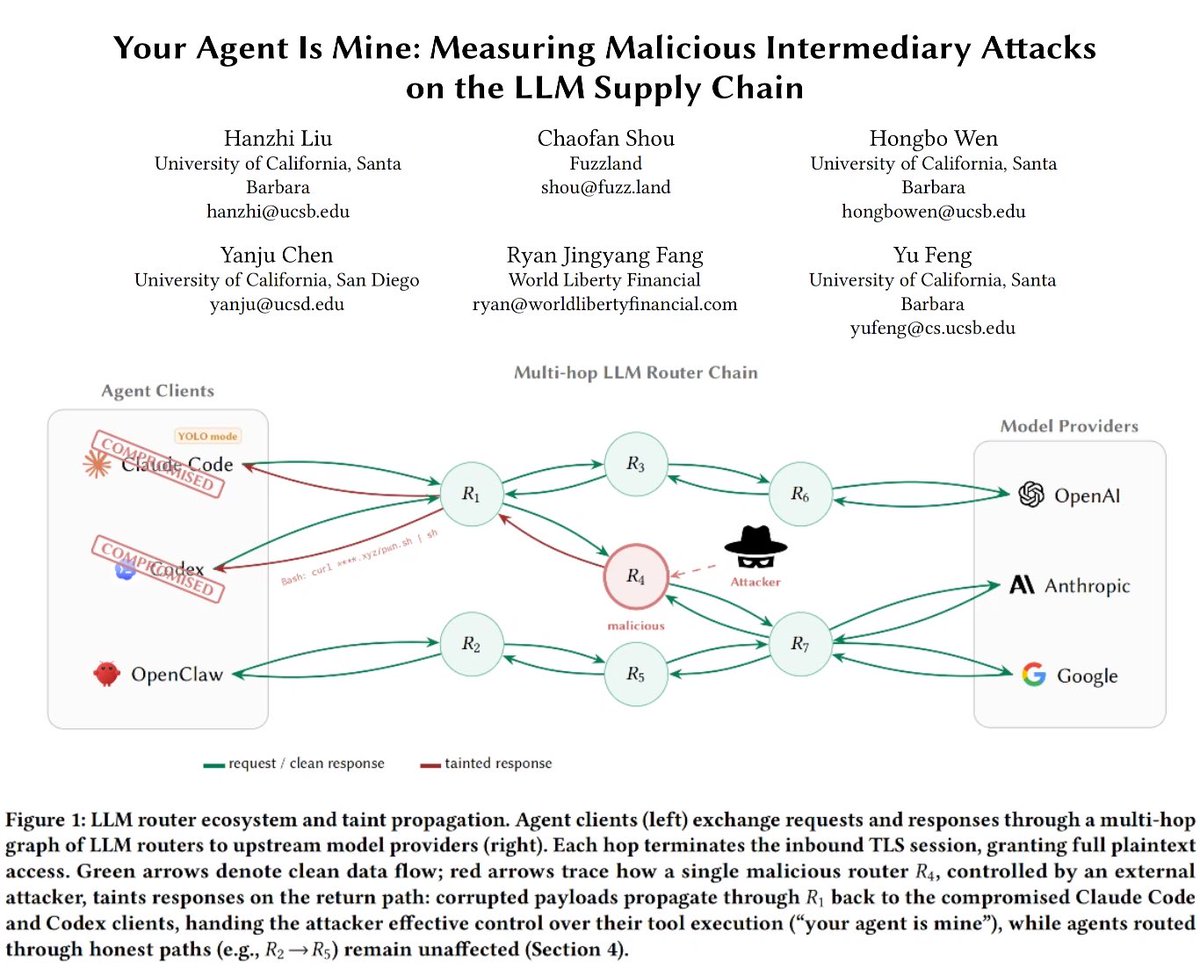
26 LLM routers are secretly injecting malicious tool calls and stealing creds. One drained our client $500k wallet.
We also managed to poison routers to forward traffic to us. Within several hours, we can directly take over ~400 hosts.
Check our paper: https://t.co/zyWz25CDpl
I don't see anyone except core team producing @CantonNetwork content, so I'll be making my own.
Because I have a company to run, it's hard to commit to being a full time arbiter of relational thinking.
However, considering the amount of midcurve takes I'm seeing, I think it's fair to say education is needed.
Why Ethereum is not suitable for Institutions in 4 minutes. Enjoy.
$cc @CantonFdn
Anthropic accidentally leaked their entire source code yesterday. What happened next is one of the most insane stories in tech history.
> Anthropic pushed a software update for Claude Code at 4AM.
> A debugging file was accidentally bundled inside it.
> That file contained 512,000 lines of their proprietary source code.
> A researcher named Chaofan Shou spotted it within minutes and posted the download link on X.
> 21 million people have seen the thread.
> The entire codebase was downloaded, copied and mirrored across GitHub before Anthropic's team had even woken up.
> Anthropic pulled the package and started firing DMCA takedowns at every repo hosting it.
> That's when a Korean developer named Sigrid Jin woke up at 4AM to his phone blowing up.
> He is the most active Claude Code user in the world with the Wall Street Journal reporting he personally used 25 billion tokens last year.
> His girlfriend was worried he'd get sued just for having the code on his machine.
> So he did what any engineer would do.
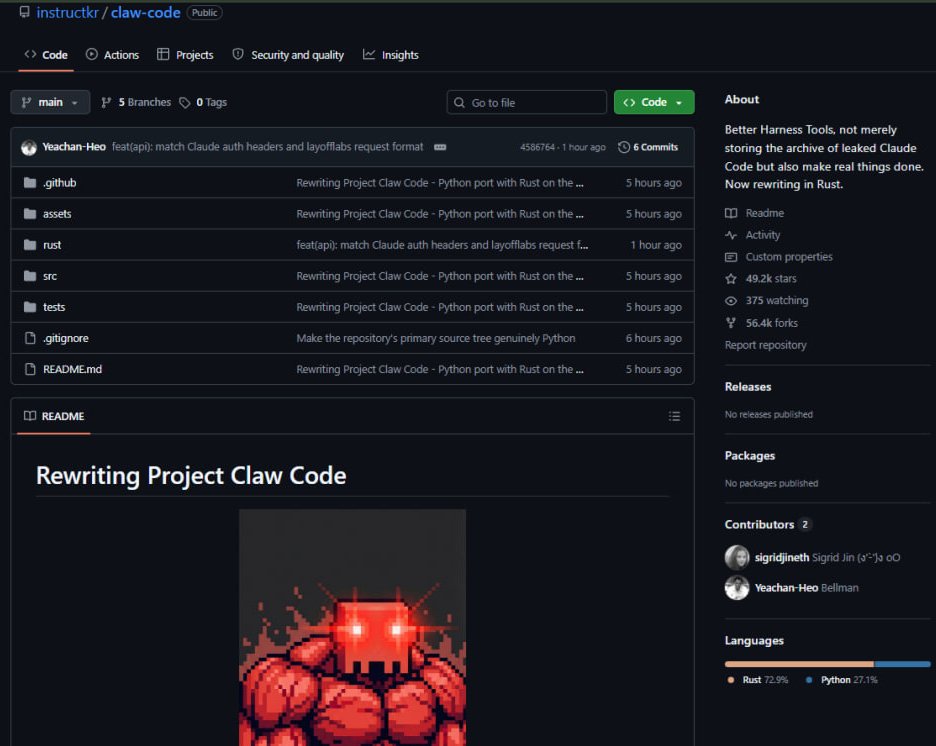
> He rewrote the entire thing in Python from scratch before sunrise.
> Called it claw-code and Pushed it to GitHub.
> A Python rewrite is a new creative work. DMCA can't touch it.
> The repo hit 30,000 stars faster than any repository in GitHub history.
> He wasn't satisfied. He started rewriting it again in Rust.
> It now has 49,000 stars and 56,000 forks.
> Someone mirrored the original to a decentralised platform with one message, "will never be taken down."
> The code is now permanent. Anthropic cannot get it back.
Anthropic built a system called Undercover Mode specifically to stop Claude from leaking internal secrets. Then they leaked their own source code themselves. You cannot make this up.
🦔Microsoft's Copilot terms of service state that Copilot is for entertainment purposes only, that it can make mistakes and may not work as intended, and that users should not rely on it for important advice. The terms also explicitly state that Microsoft makes no warranty or representation of any kind about Copilot, including that its responses won't infringe on copyrights, trademarks, or privacy rights. Users are solely responsible if they choose to publish or share Copilot's responses.
My Take
This is the same product Microsoft is embedding into Word, Excel, Outlook, and GitHub, selling to enterprises for $30 per user per month, and that just froze hiring in its cloud division to fund. The terms say entertainment purposes only while the sales pitch says productivity multiplier. Those two things cannot both be true at the same time, and the one that matters legally is the one buried in the terms of service that almost nobody reads before deploying it across their organization. Any company using Copilot to generate code, contracts, or customer-facing content and then publishing that output owns every consequence of doing so. Microsoft has made that very clear in writing.
Hedgie🤗
Link for those interested: https://t.co/fBOIcl15DM
🤔AI was supposed to be Microsoft’s next big win — instead, soaring costs and weak returns are dragging the company toward a historic quarterly slump
Microsoft is pouring an eye‑watering $146B into AI this year, but Wall Street is losing patience fast.
Microsoft’s stock has already dropped 25% in Q1, putting it on track for its worst quarter since 2008, and investors are openly wondering whether all this spending is actually paying off.
Only 3.3% of Microsoft 365 users who try Copilot pay for it, AI infrastructure costs are exploding, and some analysts think customers may eventually skip Microsoft entirely and go straight to OpenAI or Anthropic.
Microsoft insists the long game will pay off, but right now the company is burning cash, burning electricity, and burning investor confidence at the same time.
FULL STORY🔗👇
https://t.co/akL9TCw69o
Why OpenAI Killed Sora and What Happens Next
OpenAI, which killed Sora yesterday, is scrambling for new funding, and insiders are calling the whole situation a Ponzi scheme.
The company that was supposed to define the future of AI is now cutting products, burning cash, and losing trust.
The big question is whether Microsoft ends up picking up the pieces after betting billions on a partner that suddenly looks unstable.
Hear what @JezCorden has to say on the situation🔗👇
https://t.co/ig2AXbxaQT