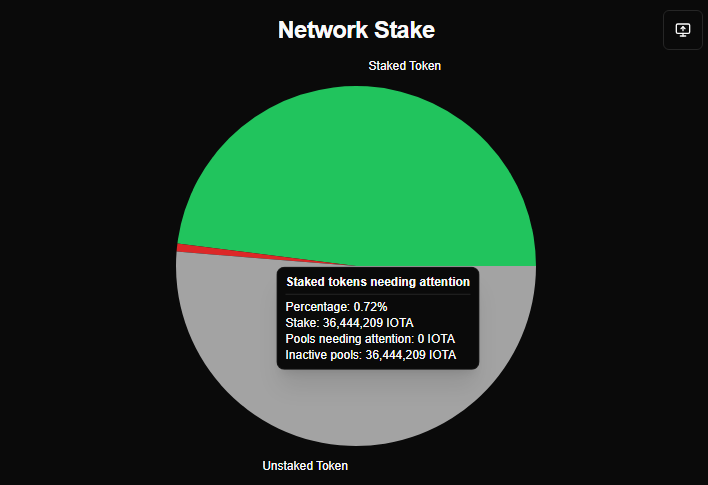
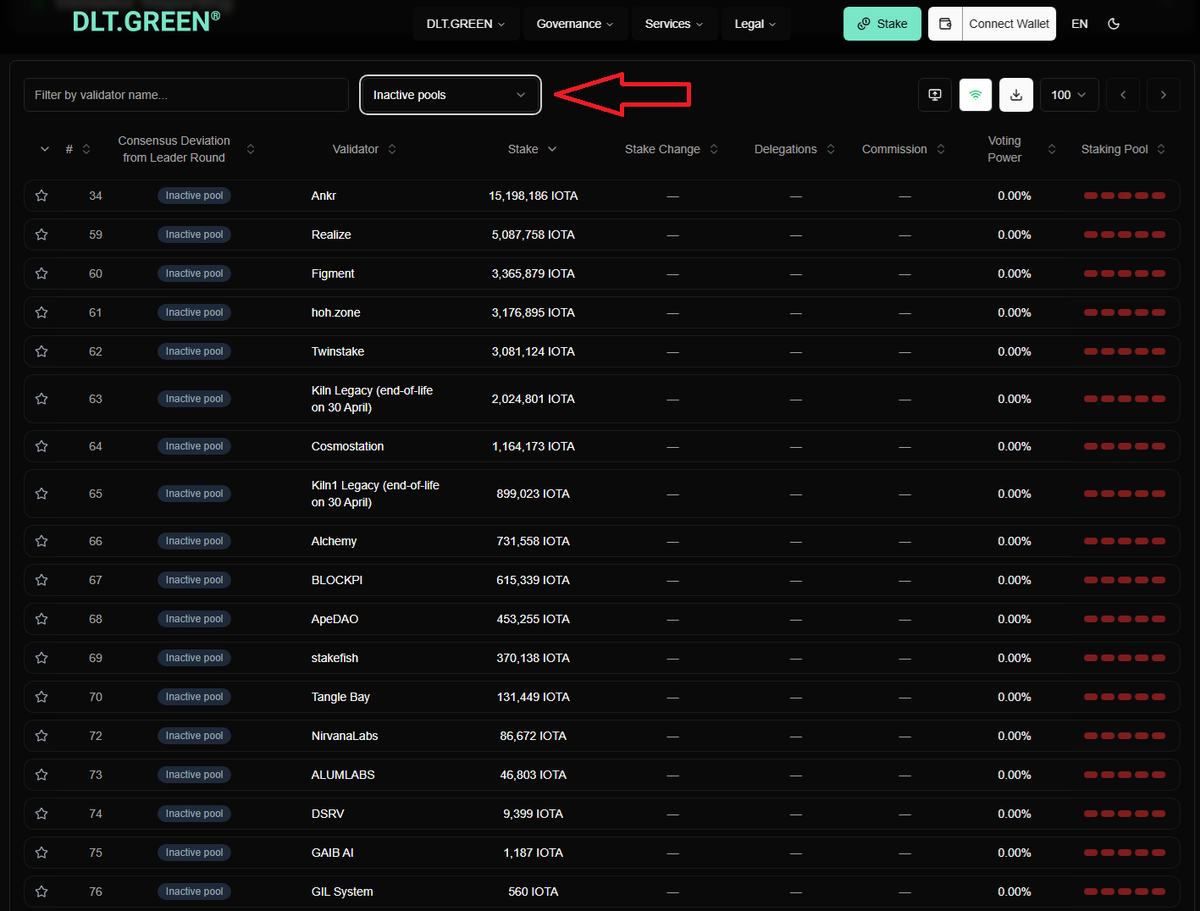
Inactive staking pools from former validators, or from validators who have changed their identity while retaining the same name.
If you don’t re-delegate, you won’t receive any rewards—in some cases, this has been the situation for months already.
▶️ https://t.co/jEGeQDOlyt
Staking Report 2.3-rc.1 — Release Announcement
Changes from dev to main: 1,049 files, +215,384 / −12,370 lines (net +203,014), including simulator changes.
Report version: 2.3-beta → 2.3-rc.1
✨ Features and Safeguards
🔐 Security
- Each report operation requires a fresh wallet signature over a message containing the origin, network, action, job ID, nonce, and issue and expiry times.
- Challenges are single-use, with database-level atomic consumption to prevent concurrent reuse. Sessions are bound to the action, job, network, wallet hash, and origin; non-status sessions are consumed atomically on use.
- Random access tokens are stored as SHA-256 digests with a version prefix. Status sessions use a secure, HTTP-only, strict same-site cookie and a separate CSRF token. Origin checks protect requests from cross-origin use.
- Report services validate a request-local capability for the exact operation, rather than reusing a general-purpose grant.
- Wallet addresses are stored as HMAC-SHA-256 keyed hashes. The hashing and encryption keys are derived separately from the staking report encryption key.
- An unfinished job’s address is retained only as AES-256-GCM ciphertext, authenticated against its address hash. The ciphertext is removed when the job closes.
- Legacy unkeyed address hashes are re-keyed. Addresses are sent in a request header rather than a URL.
- Wallet addresses, ownership proofs, and signed messages are not logged. Voucher codes are treated as bearer secrets: they are not published on-chain, logged, or placed in URLs.
- Report-data ingestion requires server bearer authentication. Report generation is serialized through a database claim gate; worker leases are renewable and default to 120 seconds.
- Report endpoints have per-IP rate limiting and a bounded in-memory limiter to prevent memory exhaustion under high request volume.
🛡️ Privacy by Design
- No user accounts are introduced; wallet identity is stored as a keyed hash, and the worker uses the encrypted address only to fetch staking data and produce the report.
- Wallet challenges expire after 5 minutes and can be used once; action sessions expire after 15 minutes and are consumed on use.
- Status sessions extend with activity, up to a 60-minute maximum from signing; after that, the wallet must sign again.
- Expired challenges and sessions are purged every minute.
- PDFs and CSVs are deleted 15 minutes after generation; cleanup runs every minute, including recovery of temporary artifacts left by interrupted workers.
- Held, undelivered jobs expire after 30 days and release their vouchers. Closed report cases are erased after 30 days.
- Users can delete a report through a signed action or revoke the status session by closing the dialog.
- The updated privacy policy (v1.4) explains in plain language what wallet and report data is processed, how it is protected and retained, and how users can delete their reports.
🚨 Error Handling and Recovery
- Errors are classified as temporary or permanent by examining their full chain of underlying causes, including network, database, HTTP, and JSON-RPC failures.
- Permanent errors count toward the generation failure limit: three attempts, plus up to two operator recovery retries. Reclaiming work after a crash or deployment does not count as a failure.
- Retries use exponential backoff from 1 second up to 30 seconds.
- On-chain transaction outcomes are checked before retrying uncertain operations; unresolved outcomes hold the job for reconciliation rather than risking duplicate execution.
- Failures record their phase and step and surface actionable diagnostics and stable failure codes, with German and English messages.
- Recovered jobs no longer show an obsolete failure after successful completion. Stalled or exhausted recovery reaches a defined hold, cancellation, or replacement state.
- Durable checkpoints preserve in-progress jobs across restarts and deployments. Safe cancellation, retry, and replacement flows cover interrupted and stalled jobs.
- Reports load full history regardless of Explorer filters and recover pruned transactions from archives. Missing validator-rate evidence or unresolved validators block generation rather than silently dropping affected data.
- Required prices are checked for carried opening balances and positions still held at the cutoff.
✅ Report Experience and Verification
- ObjectID records are verified before report download; delivered PDFs can be QR-verified without another approval.
- The report dialog shows processing steps and sub-step history, receipts, and clearer progress and wallet-signature notices.
- A report is considered delivered on its first PDF or CSV download. Vouchers are redeemed on delivery and released when an undelivered job is cancelled or expires.
- Legacy report filenames and voucher reservations are ported to the current job model.
🧩 New Edge-Case Coverage
- Wrapped withdrawals are matched to the correct stake using principal, staking pool, and activation epoch, with ambiguous or incomplete matches rejected.
- Split, unlock, and withdrawal chains preserve the original stake ancestry and reward basis of withdrawn child positions, as well as the principal and lifecycle of the remaining position.
- Historical reports preserve positions as they existed at the selected cutoff, even when later transactions withdraw, merge, or compound them.
- Rewards earned during epoch 0 are included for stakes active from genesis, using the correct closing-rate basis.
- Transferred positions carry earned-but-unclaimed rewards and their original epoch attribution, avoiding lost or duplicated rewards.
- The calculation supports Protocol 40’s safe-mode activation behavior while retaining Protocol 39 behavior, with Testnet activation expected at the end of epoch 724 after reaching 93.39% voting-weight support against an 83.33% threshold, and Mainnet activation planned for November 18, 2026.
- Explicit zeros in either part of an exchange-rate pair are handled according to native conversion behavior rather than mistaken for missing data or used as invalid divisors.
- Timezone handling supports skipped or repeated midnight, rejects nonexistent calendar days, and keeps date boundaries and month partitions consistent across host timezones.
📊 Liquid-Staking Scope
- Recognized liquid-staking activity is excluded before snapshots, custody resolution, reward calculation, and report totals. Independent native staking activity in mixed transactions is retained, and exclusions are recorded as diagnostics.
- Liquid-staking financials are built but excluded by policy; this release does not include them in report output.
🧪 Simulator and Documentation
- Simulator work expands native lifecycle evidence, audit-evidence persistence, diagnostics preflight, and liquid-staking exclusion evidence.
- Simulator documentation describes its acceptance scope and verification process. Generated artifacts include JSON and Markdown reports, a PDF report, and a presentation.
- A previous simulator PASS does not replace a fresh replay or prove complete native acceptance; current verification flags, required case and parent checks, and remaining evidence gaps determine the result.
- The Staking Report manual, runbook, voucher documentation, and timezone guidance are updated.
⏭️ Upcoming Work — Toward the v2.3 Final Release
- Compare deployed IOTA packages with official source and verify how reward-pool limits affect open positions.
- Detect results capped by the indexer’s limit of 1,000 stake objects per wallet and clearly report incomplete data rather than treating it as complete history.
- Distinguish liquid rewards from principal that remains locked after timelocked withdrawals, including the lock’s expiry and label.
- Indicate when a validator pool stops earning so users can distinguish inactive stake from an indexing gap.
- Enable ObjectID anchoring on IOTA Mainnet.
- Remove the “DRAFT” marking from generated reports.
🛠️ Fixes — Generated Report Output
- Withdrawals use their actual transaction timestamp. A position withdrawn before the cutoff is closed even when its epoch ends later, preventing withdrawn principal from appearing as active.
- Detailed claimed rewards are reconciled against on-chain withdrawal payouts. Proven reward-pool limits are accounted for; unexplained differences stop report generation instead of producing inconsistent totals.
- Outgoing principal is taken from the actual exit movement, valued and grouped in the transaction’s month—not the original deposit month. Repeated movements are deduplicated; rewards remain attributed to their earning epochs.
- Withdrawals, transfers, and split/merge movements use canonical transaction times and are sorted by the displayed timestamp in PDF and CSV details.
- CSV principal and reward columns preserve up to nine decimal places from raw amounts, avoiding floating-point precision loss.
- Report ranges, Explorer filters, previous-month cutoffs, completed months, month keys, saved picker dates, and PDF calendar labels follow the selected timezone. Price-day mapping is host-independent; closing-price checks use UTC guards, idempotent storage, and re-verification of recent prices. Timezone and date-range tests verify gap-free yearly coverage, including DST days, with boundary transactions assigned to exactly one month.
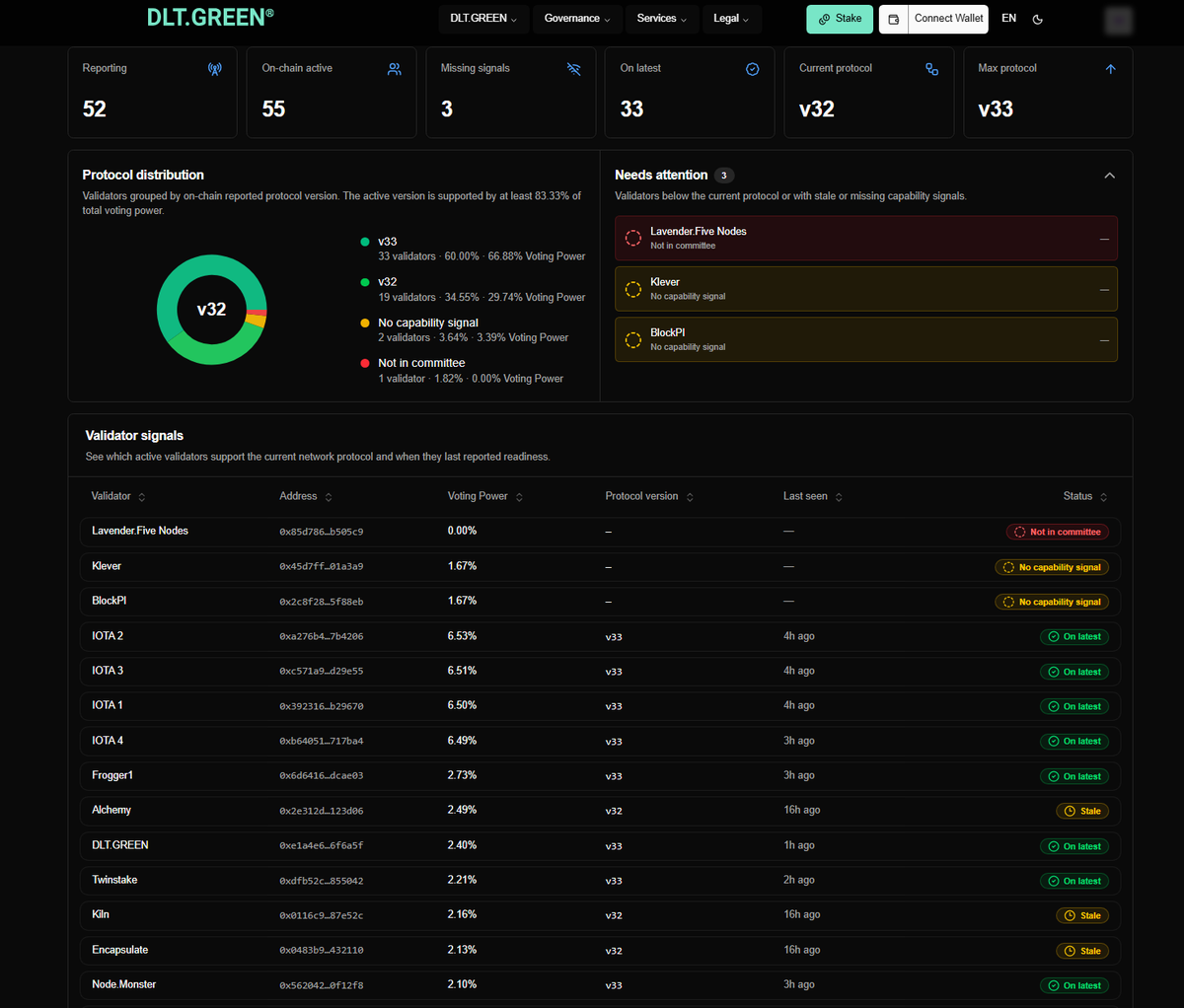
Protocol Readiness is now live on our IOTA Staking Analytics.
For Stakers and Validators💚
Track the current distribution and upgrade progress in real time!
see here now the running TESTNET upgrade:
▶️ https://t.co/rwQIIB7vDq
Summary of the actual IIP-Discussion State:
ℹ️ IIP-29 Gains Strong Momentum!
The community-driven IIP-29 proposes a dynamic minimum validator commission = validator's voting power % (VP%) per epoch.
Goal: Prevent stake concentration, stop unsustainable 0% fee-dumping by large validators, and boost real decentralization + long-term validator sustainability.
✅ Massive validator support (~45% VP of validators are responding (without evaluating IF-related validators), including TokenLabs, Nansen, Kiln, Stakin, Alchemy, BLOCKPI, Lavender.Five, and many more)
✅ IOTA Foundation Research officially supports proceeding with this IIP to observe its positive impact on network health.
This lightweight change ties responsibility (VP) to economic commitment — simple, fair, and effective.
Discussion: https://t.co/s1lTOSj9v1
Thank you to everyone contributing! 💚
Buckle up for what's next.
To celebrate the New Year, we're kicking off a community giveaway and want to hear what 𝘺𝘰𝘶 think is coming next for Plume in 2026 🤔
Your ideas. Your predictions. Your shot to win a brand new @BYDCompany Seal.
New Alliance Loaded. 🟪🟦
Supercharge your trading experience, @HoldstationW x @EdgenTech
Seamless trading infrastructure amplified by next-gen market intelligence
Trades are getting sharper than ever - and what comes next will level it up again 👀
Smarter decisions & Trade with an edge
I'm really loving some of the creations people have made in Dream Protocol.
It’s just as exciting for me to see what you create as it is for the collector who mints it.
That’s the magic of AI Garden: nothing exists here until you make it. 🌱✨
$SUPRA 🌿💚
Have you tested our staking export with daily rewards yet? Next sneak peek with ...
▶️ added time frame selection
▶️ tests are in the final stages
▶️ small improvements still need to be implemented
💚 we are already very close to a release of the additional staking report for our stakers (with partners), are you ready to test?
Your Stake (on https://t.co/s8B0MX6vmA) - Our Mission 💚
𝐒𝐮𝐩𝐫𝐚𝐥𝐞𝐧𝐝 𝐓𝐞𝐬𝐭𝐧𝐞𝐭 𝐢𝐬 𝐋𝐈𝐕𝐄! 🚨
The first money market on @SUPRA_Labs
is now open for testing. This is where real DeFi on Supra begins.
𝙏𝙧𝙮 𝙞𝙩 𝙣𝙤𝙬
👉 https://t.co/BMnlyj4ksC
#GAM3Awards 2025 🏆
It’s that time of year again to vote for your favourite games & creators in web3!
If you’ve had fun in the Anomaly ecosystem, be sure to help us out with a vote for your favourite game! 👾⬇️
Add your custom nominations here: https://t.co/9hqVT3O24k
As announced in our last video, we're excited to share a preview of some key development milestones we've reached. As you know, we steer clear of hype and focus on real progress — over the past few months, alongside other initiatives, we've been hard at work on documenting daily staking rewards.
✍️ We're not weighing in on whether these documented daily rewards matter for your taxes (and remember, we offer no financial or tax advice). This came up from the community, and we wanted to resolve it for ourselves as well. After all, a solid documentation is everything!
🙇♂️ We're thrilled to announce that implementation of this upgrade is live on our website and we launch the public test phase now. (To participate, stake on https://t.co/s8B0MX6vmA, login with your wallet and join our Discord for feedback — we'd love your input!)
This means that we will now be able to provide extendend staking information for you easily and automatically via our homepage using our staking explorer: https://t.co/3NtMwszZot
🔥 Especially:
- Evaluation of daily staking rewards after wallet-login
- Extended Evaluation for our stakers on https://t.co/s8B0MX6vmA
- Export to Excel
- Staking-Report as PDF (next)
- verified through DID and @ObjectID_io (later)
- Support for other validators (later)
- Support for other stakers (later)
We‘ll keep you informed 💚
$PLUME is now live on Binance Pay, powered by @binance
You can now send $PLUME payments to more than 45M users with instant, gas-free transfers.
To celebrate, we’re giving away up to 3,000 $PLUME to first-time Binance Pay users ⤵️
We’re excited to expand our partnership with @plumenetwork 🤝
Plume is the #1 RWA chain, capturing 50%+ of the investor market (200K+ users) in just two months!
Together, we’re delivering trustless, verified intelligence for everyone.