The Amazing Spider-Man is about to become the first Marvel series to reach 1000 issues, and Marvel is teasing this massive book with a gorgeous lineup of artwork. https://t.co/kPumaaMYzK
I love that Michael documented moments throughout his career that capture his unprecedented success because he knew that if he didn’t have the evidence for it, people today would rewrite history & deny a Black man ever reached those heights.
Batman Beyond's spin-off movie is now widely called the darkest Batman story ever animated. Its creator never wanted to make any of it. In 1998, Warner Bros. ordered him to put Bruce Wayne in high school to sell action figures to teenagers. He thought he was dreaming.
Bruce Timm had spent seven years running Batman: The Animated Series and its sequels, still considered the gold standard. The order from Warner Bros. would erase all of that. The new show was supposed to slot in next to teen-drama hits like Buffy the Vampire Slayer and Dawson's Creek, with a high-school-aged Bruce Wayne going to class and fighting crime.
Timm called it "surreal, disappointing, shocking, dream-like." He found a way to give the network its teen Batman without burning seven years of work. His pitch: jump 40 years into the future. Bruce Wayne is now old and retired. A new kid named Terry McGinnis stumbles on the Batcave, takes the suit, and becomes Batman. Old Bruce mentors him over a radio earpiece.
The team had only months to build the world from scratch, and they studied Blade Runner for the look of the future city. The street gangs came straight out of the Japanese animated film Akira. Terry's life was modeled on Spider-Man, where the hero juggles school, a girlfriend, and crime-fighting all at once. The pilot aired on January 10, 1999.
Hasbro, the toy company that pushed for this show, missed the point. The figures they shipped were goofy variants like a Batman on a skateboard and one in neon camouflage. The actual villains and supporting cast, like the Joker and the elderly Bruce Wayne, almost never got made.
Then came the movie. Batman Beyond: Return of the Joker came out in 2000. Warner Bros. ordered huge chunks cut after the Columbine school shooting the year before. In the original ending, the Joker brainwashes young Robin into a mini-Joker and orders him to kill Batman. Robin turns the gun on the Joker instead. He pulls the trigger. A little flag pops out reading "BANG" and stabs the Joker through the chest. The Joker dies on screen. The censored version replaced it with the Joker getting shoved into electrical wires. The full uncut version came out on DVD in 2002 and holds a 100 percent score on Rotten Tomatoes.
The show won two Daytime Emmys, two Annie Awards (the Oscars of animation), ran for 52 episodes, and set up Justice League and Justice League Unlimited, the cartoons that defined DC animation for the next five years. What started as an order to sell action figures turned into one of the most respected superhero stories ever put on screen.
Yes. He’s the most famous entertainer in history.
All of the entertainers you mentioned can sit courtside at a NBA game. Michael Jackson could not. @MagicJohnson told the story of how he invited MJ to a Lakers game and it created so much chaos, they had to stop the game. MJ had to leave because fans were leaving their seats to try to get to him.
None of the people you mentioned have that level of fame where they can’t attend public events.
Just so you know, all of these scenes were from Spectrum Animation.
A studio that literally drove itself to bankruptcy because of how much they valued quality over everything else.
Their episodes of 'Batman: The Animated Series' are a pure joy for the eye.
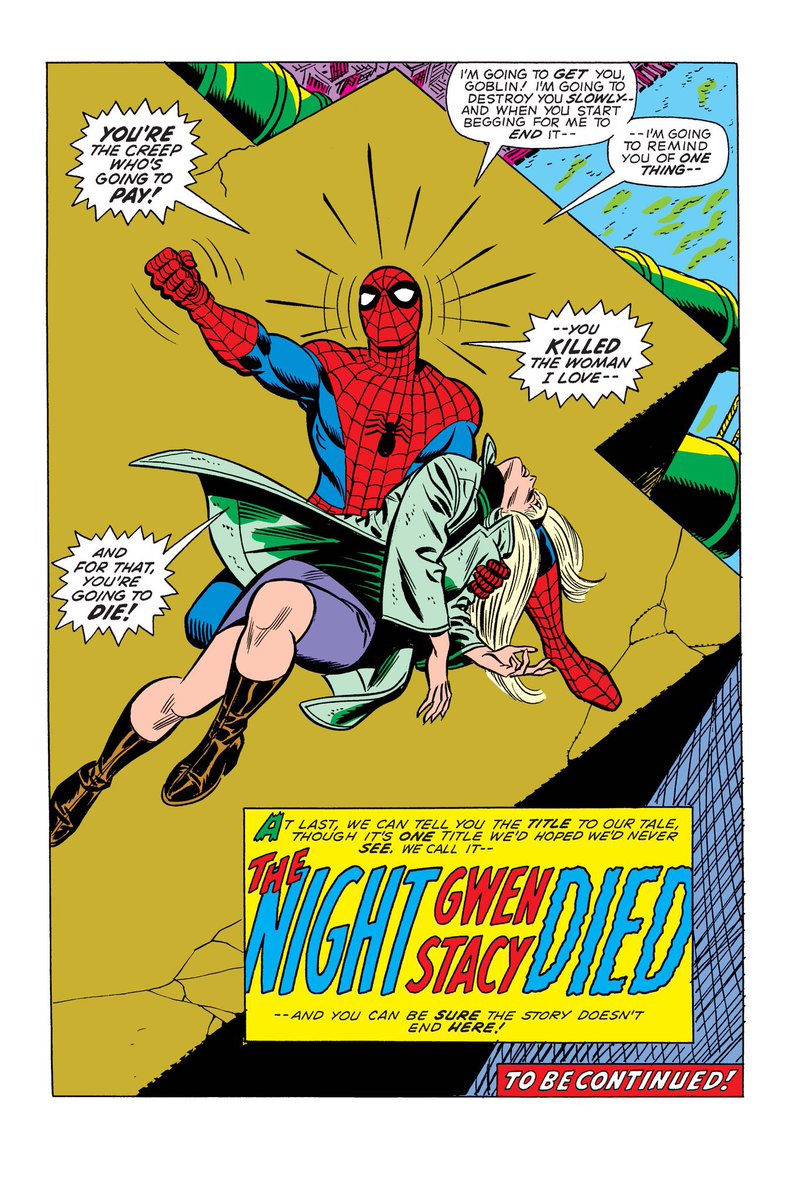
Gerry Conway has sadly passed away at the age of 73.
He is known for co-creating The Punisher, Ben Reilly, Firestorm, Jason Todd & more iconic characters.
He also wrote one of the most iconic comic stories in history — "The Night Gwen Stacy Died"
This episode of Batman: The Animated Series (1992–1995) was animated by Tokyo Movie Shinsha, the studio behind Akira.
No wonder this scene feels so close to Tetsuo’s transformation.
GM killed the Camaro in 2003. Sales had been falling since 1995, bottoming out at just 41,776 units sold in its final year. They shut down production entirely.
Then Michael Bay walked through GM's design studio in 2005, saw an unreleased fifth-gen Camaro concept that wasn't going to hit dealerships for years, and cast it as Bumblebee. The car in the movie wasn't even a real Camaro. GM's team dropped Camaro body panels from the concept car's molds onto a Pontiac GTO chassis. Audiences fell in love with a car they couldn't buy yet.
The first Transformers made $710 million worldwide on a $150 million budget. And it wasn't just product placement. GM got the lead role. Bumblebee had the second-most screen time after Optimus Prime. Every hero vehicle was a GM product: Camaro, Pontiac Solstice, GMC TopKick, Hummer H2. The main villain, Barricade? A Saleen S281, which is a tuned Ford Mustang, dressed up as a police car with "To Punish and Enslave" on the side. GM literally made Ford the bad guy.
When the Camaro finally went on sale in 2009, GM had 14,000 pre-orders before a single car rolled off the line. They sold 60,000 that year. By 2010, they moved over 80,000. In 2011, they hit 88,000+, outselling the Ford Mustang for the second straight year. The Mustang had dominated that rivalry for over two decades. Yellow Camaros saw a 10% sales bump despite yellow normally making up less than 5% of any car model's sales. You could measure the Bumblebee effect by paint color alone.
And each sequel was basically a new Camaro ad with a $200 million production budget someone else paid for. The franchise has grossed $5.4 billion across eight films. Hasbro turned the car into over 150 different toys. Chevy's global CMO said it out loud to Variety: "These movies have helped us get our vehicles in front of a younger audience around the world." The 12-year-olds buying Bumblebee toys in 2007 were the 20-somethings walking into Chevy dealerships by 2015.
I think this might be the single greatest product placement deal in movie history. GM took a dead car, made it the hero of a billion-dollar franchise, made their biggest competitor the villain, and got audiences to pay $12 to sit through what was effectively a two-hour Camaro commercial. All while GM itself was going through bankruptcy in 2009, the Oshawa plant building Camaros was running at full capacity.
You cannot aggressively demand "princess treatment" and a traditional provider man while simultaneously having the mouth, attitude, and combativeness of a fiercely independent street-fighter. Traditional men want peace and cooperation. You cannot ask a man to pay 100% of the bills and lead the household, and then constantly argue with him and challenge his decisions like you are roommates splitting the rent. You have to pick a dynamic.
Directors have been encoding breakups in geometry for almost a century, and most audiences read it perfectly without knowing why.
The technique is called "bisecting the frame." Place a vertical object between two characters and the audience's brain processes them as occupying separate compositions. One shot, two worlds. The pole here does what dialogue would take ten minutes to establish.
Your visual cortex groups objects by proximity. It's called the Gestalt principle of common region. When two people share unbroken space, your brain reads them as a unit. The moment a vertical line cuts the frame, you process two separate fields. You feel the distance before you understand it.
Sofia Coppola built an entire film on this. Lost in Translation frames Bill Murray and Scarlett Johansson through windows, doorways, and hotel glass for two hours. They're always close but compositionally severed. When they finally share unbroken frame space in the last scene, the audience exhales. The barrier dropped and you felt it in your chest without a single line of exposition.
Hitchcock figured this out in the 1950s. Kubrick used symmetrical framing to make characters feel trapped inside the architecture itself. Spielberg splits characters with props when he wants the audience to sense a power imbalance before the scene reveals one.
The wild part: it works even when you know the trick. Your visual system is pattern-matching faster than your conscious mind. A vertical bar between two faces triggers separation processing in under 200 milliseconds. The director already told you the ending. You just haven't caught up yet.
Billionaires don’t have bank accounts like you and me. They have art collections,Yachts,Mansions,Stocks. None of it gets taxed until they sell it. So they just never sell it. They borrow against it instead. Live off the loans. Pay almost nothing. Then when they die, their kids inherit it all tax-free. The wealth never gets taxed, It just gets passed down.
And we wonder why the gap keeps getting wider.
"Princess treatment" was historically the reward for a woman who brought immense peace, loyalty, and cooperative value to a man's life. It was never meant to be the baseline expectation for a woman who brings absolutely nothing to the table except a bad attitude and a list of financial demands.