Your name walks into rooms you will never stand in.
It arrives before your CV. It lingers long after you leave.
You build it in small, boring moments nobody applauds.
Keeping a tiny promise. Telling the truth when a lie was easier and safer. Doing the work when no one was checking.
For years it seems to earn you nothing.
Then one day a door opens that you never even knocked on, because someone vouched for a name you quietly kept clean.
Reputation is the slowest and highest paying investment you will ever make.
Sleep is the most disrespected productivity tool on earth.
A RAND Corporation study put numbers on what most people ignore. The United States alone loses up to $411 billion every year because workers do not sleep enough. That is 2.28 percent of the entire GDP, gone. Not from a recession. Not from a policy failure. From tired people making bad decisions, calling in sick, and dying earlier than they should.
Japan loses $138 billion. Germany, $60 billion. The UK, $50 billion.
About 1.2 million working days vanish in America each year because someone could not keep their eyes open. And the mortality risk climbs 13 percent when you consistently sleep less than six hours.
Here is the part nobody wants to hear: the person bragging about sleeping four hours is not outworking you. They are shortening their runway and dragging their numbers down with them.
Sleep is not laziness. It is compounding in reverse. Every hour you steal from it, you pay back with interest. Slower thinking, weaker immunity, worse judgment.
The fix is boring. Dark room. No screen an hour before bed. Consistent wake time. Seven to eight hours.
Nobody will clap for you.
But ten years from now, when your body still works and your mind still fires, you will know the math was worth it.
A third of all heart-related deaths may trace back to what is sitting in your kitchen cupboard.
Not cigarettes. Not alcohol. Ultra-processed food.
A 2026 study presented at the International Congress on Obesity found that 23 to 38 percent of all cardiovascular deaths are attributable to ultra-processed food consumption. Separate research from the American College of Cardiology linked ultra-processed diets to a 47 to 67 percent higher risk of heart attack and stroke.
Most people do not realize how much of it they eat. In America, 57 percent of all calories consumed by adults come from ultra-processed food. For children and teenagers, 67 percent.
Ultra-processed does not mean cooked. It means engineered. Foods designed in labs to hit your reward system like a drug. Packaged snacks, instant noodles, breakfast cereals, sodas, frozen meals, flavored yogurt, most fast food.
Your great-grandmother would not recognize half of what is in the average shopping cart today.
A Harvard study tracking 200,000 people confirmed the pattern: the more ultra-processed food in your diet, the higher your risk of dying from heart disease.
The food industry spent decades making these products cheap, convenient, and addictive.
The result is a health crisis hiding in plain sight, and most of us are funding it three meals a day.
Read the ingredients list. If it reads like a chemistry exam, your body probably agrees.
@jay4surveys Personal hygiene is one of the simplest and most effective ways to protect your health, show consideration for others, and feel more comfortable and confident.
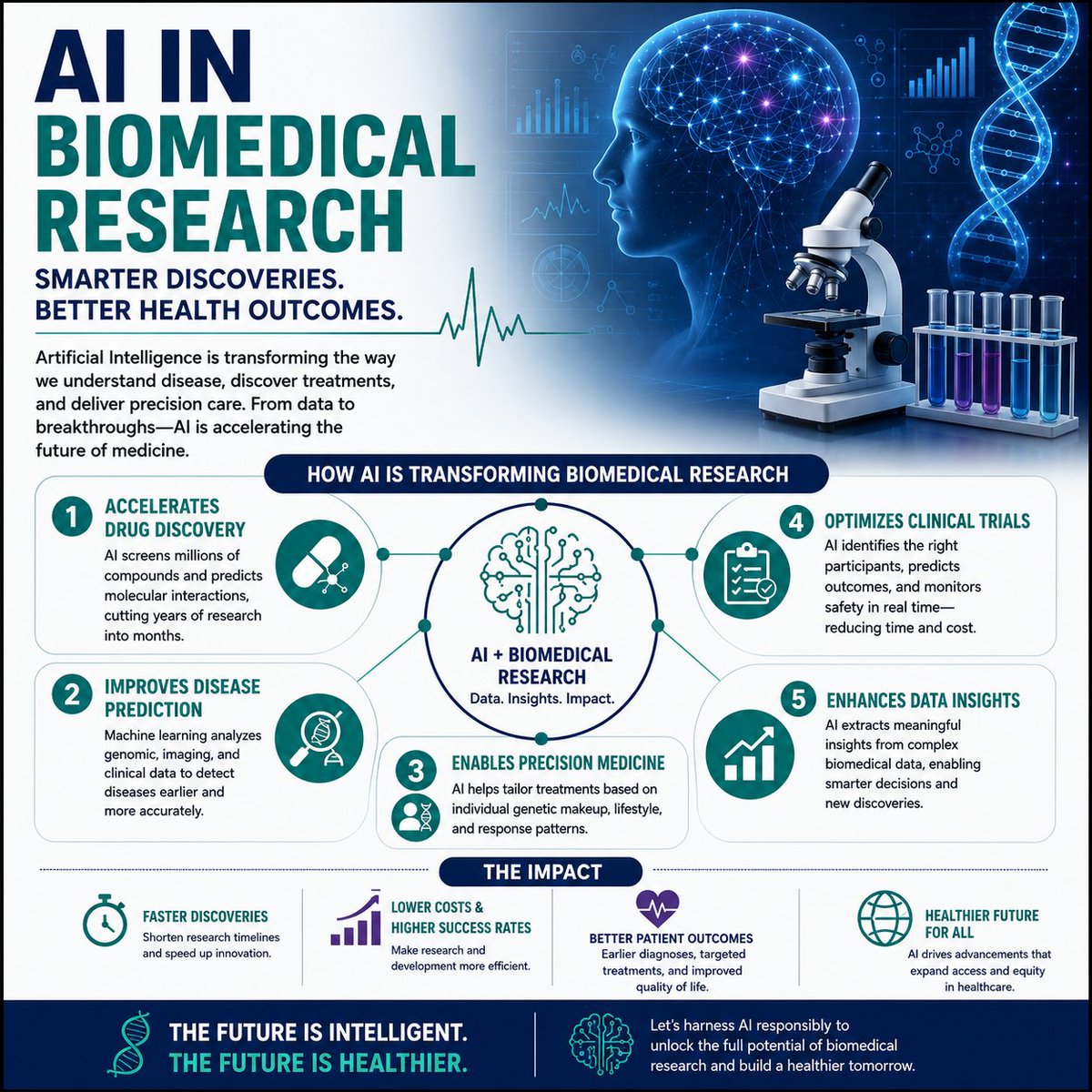
🧬 Transforming Medicine: How AI is Revolutionizing Drug Discovery
A thread
🔹 The Tech:
AI (Machine Learning) in Biomedical Research & Biotechnology
🔹 The Impact:
The traditional process of discovering life-saving drugs is often slow, expensive, and time-intensive;
reducing research costs, shortening development timelines, and improving the efficiency of biomedical discoveries.
Beyond speed, AI is helping shape the future of precision medicine, ensuring that innovative treatments reach patients faster and more effectively.