A Free Press reporter asks New Yorkers if socialism is good for America.
They all say yes.
Then she brings out Daniel Di Martino, who fled Venezuela, and they get a firsthand horror story they weren’t ready for.
NEW YORKER: “I think socialism is actually really good for society.”
DI MARTINO: “Are you familiar with how socialism worked out in other countries historically?”
NEW YORKER: “Just because it didn’t work out so well in other parts of the world doesn’t mean it won’t work out well for New York.”
Di Martino’s family lived through the promises these voters are buying.
DI MARTINO: “My family went from making $2,000 a month 20 years ago to $100 a month in 2016. That was because the government gave everything you can imagine for free.”
“We went from being a normal middle-class family with a car and then no electricity, no water.”
Asked if they support “government grocery stores,” the answer is just as confident.
NEW YORKER: “Of course I do.”
So Di Martino explains what grocery shopping looked like under socialism.
DI MARTINO: “There was very little supply of chicken, toilet paper. It was a line for blocks and blocks for a grocery store.”
NEW YORKER: “What happened in Venezuela isn’t going to happen here. The policy is more focused on helping people out.”
A man describes lines stretching for blocks just to buy chicken and toilet paper, and a Mamdani voter waves it away. Because THIS time, they’re sure it will work.
REPORTER: “You know, they have tried that in the Soviet Union from where my parents and my grandparents are from. All they remember of grocery stores is empty shelves.”
DI MARTINO: “The DSA went to Venezuela just last year to support the dictator and say that he won the election that he didn’t.”
NEW YORKER: “I had no idea. I did not know.”
DI MARTINO: “Government rent control. It’s going to stop people from renting apartments because they’re not going to be able to profit. There are going to be fewer apartments for rent.”
NEW YORKER: “That’s a good point. I agree with that. Okay. I understand more about socialism now for sure.”
Socialism always sounds good to people who’ve never had to live under it.
Those who have never want to live under it again.
We’ve gotten things completely backward.
People who contribute nothing to society but feel entitled to the fruits of others’ labor are somehow seen as “victims” deserving of special treatment.
Meanwhile, those who work, produce, and create wealth are vilified and penalized.
On my way to the office this morning, I passed a group of young people protesting, a Palestinian flag draped over their shoulders.
And I asked myself a question I can't shake: why does this generation always fall into the same trap? No matter the history. No matter the context. Even the ones from wealthy families, who went to the best schools, who were dealt every good card. Always the same trap.
I don't think it's stupidity. I think it's a mechanism. And a mechanism can be taken apart, piece by piece.
A. The observation: everything the state touches becomes unaffordable.
Look at economist Mark Perry's famous chart, the one people call "the chart of the century." It tracks US prices since 2000.
At the top, what explodes: hospital services, college tuition, textbooks, childcare, housing. Increases of +100%, +150%, up to +250%, far above general inflation.
At the bottom, what collapses: TVs, software, phones, toys, clothing. A TV today costs a fraction of what it did in 2000, for an infinitely better product.
Look at what separates the two groups. It isn't technology. It isn't complexity. It's one variable: how much the state is involved.
At the top, sectors that are subsidized, regulated, shielded from competition, where the state funds demand and blocks supply. At the bottom, sectors where companies fight every single morning to serve you better and cheaper.
B. The mechanism: why it's systematic.
When the state subsidizes demand without freeing supply, prices rise. Every time. Guaranteed student loans, and universities raise tuition. Housing aid plus blocked building permits, and rents skyrocket. Administered healthcare, and bureaucracy eats the budget before it ever reaches the patient.
In France it's even more vicious, because the price doesn't disappear: it hides. You never see the hospital bill, you pay it through payroll contributions. You never see the cost of school, you pay it through taxes. Public spending at 57% of GDP, one of the heaviest tax burdens in the world, more than €3.4 trillion in debt. And the result? Overflowing ERs, falling PISA scores, young people who can't afford to live in the city where they work.
The market didn't fail in these sectors. It was never allowed in.
C. Suffering demands a culprit.
A 22-year-old lives all of this in their bones. They can't find a place to live. Their degree either buries them in debt or opens no doors. The future feels blocked. That suffering is real, and I don't deny it for a second.
But human beings can't stand suffering without a culprit. They need a face. A scapegoat.
And this is where everything is decided: who taught them how to read the world?
D. Whoever tells the story picks the villain.
Schools are public. Universities are public. Culture runs on grants. Film goes through funding committees. Public broadcasting shapes the narratives. The people handing down the interpretive framework are, overwhelmingly, paid by the very system that creates the problem.
Do you really think that system is going to name itself as the culprit?
No. It names the capitalist. The boss. The landlord. "The rich." The multinational. The commercial West. Same role, same casting, every time.
E. One lens, a thousand causes.
And this brings me back to that flag. A generation taught to read every situation through a single lens, oppressor on one side, rich, Western, capitalist, oppressed on the other, will apply that lens everywhere. To housing. To climate. To conflicts on the other side of the world. The cause changes, the lens stays. That's why the trap is always the same: it's not the cause that draws them in, it's the way of thinking that was installed in them.
F. The perfect inversion.
Here's the irony. Capitalism is the force that drove down the price of almost everything it touched. The state is the force that blew up the price of almost everything it captured. And young people blame the first for the crimes of the second.
It's like blaming the firefighter for the fire because you saw him at the scene.
G. The ballot box confirms it.
In the US, a few weeks out from the midterms, a large share of urban young voters is getting ready to vote Democrat for more state, more spending, more regulation. New York elected a self-described socialist mayor, carried by young voters, on promises of rent freezes and city-run grocery stores. Rent freezes, the policy that has made housing scarcer everywhere it's been tried. The cure that worsens the disease.
In France, it's the same play in two acts. Part of the youth votes for the radical left, which promises more state. Another part votes for the center, which promises to "manage" the state well, and has dug the debt deeper than ever. Two different ballots, one shared assumption: the problem is the market, the solution is the state.
H. The way out.
These young people aren't stupid. They're right to be angry. They're just aiming at the wrong target.
The day they understand that their rent, their tuition and their hospital are expensive precisely because the state runs them, their anger will change direction. They'll stop protesting against those who create. They'll start protesting against those who capture.
That day, the greatest intellectual scam of our time will be over.
My post about France went viral. Thousands of likes. Many Americans told me: "Democrats aren't socialists. America will never be France." I want to answer that seriously, step by step.
Start with a simple observation. Look at what has gotten cheaper in America over the last 25 years: TVs, phones, software, clothes, toys. Now look at what has exploded: college tuition, healthcare, childcare, housing.
What separates the two lists? The first lives in competitive markets. The second is exactly where government is most involved: subsidies, mandates, licensing, zoning, regulation.
College. Washington lends students almost unlimited money. Universities know the money will always come, so they raise tuition and hire more administrators. The student pays the bill for twenty years. More government money, higher prices.
Housing. Why can't a nurse buy a home in the city where she works? Not because of capitalism. Because of zoning laws, permits, environmental reviews, years of procedure to build a single building. The most expensive places to live in America are the places where it's hardest to build. When building is nearly illegal, prices explode.
Healthcare. The patient almost never sees the price. A third party pays, regulations limit who can compete, and costs climb year after year with no one able to say no.
So here is the trap. The problems you suffer from are not the failure of free markets. They are the places where the market has already been replaced by the state. And the solution you're being offered is more of the same.
That's the Trojan horse. It always works the same way. A real problem. A generous-sounding promise. A program that makes things worse. Then the failure of that program becomes the argument for the next one. People who lived under communism in Poland learned to recognize the lie and the mask the lie wears. The lie never presents itself as a lie. It presents itself as compassion.
In France we are at the end of that road. Debt we can never repay. Young people who can't afford a home. Our best people leaving. And every few years our cities burn. Nobody voted for this. They voted for one more generous promise, fifty years in a row.
If you're a Republican, share this with the Democrat in your life. Not to win an argument. To start a conversation.
If you're a Democrat, I'm not asking you to switch teams. I'm asking you to look at the pattern. Wherever the state took over, life became unaffordable. Don't fix the failures of government with more government.
Stay American. Ask for less state, not more.
A wildlife researcher in the Himalayan foothills watched a snow leopard mother leave behind her cub, its leg caught in a poacher’s snare. What happened over the following months became a story he will never forget.
Every time your phone tells you where you are, it is using a mathematical model of the shape of the Earth.
A Black woman from rural Virginia spent decades building that model by hand, and almost nobody knew her name until she was in her eighties.
Gladys West. She grew up in a sharecropping family in Dinwiddie County and understood early that the alternatives were the tobacco fields or the factory. She finished top of her high school class, which came with a scholarship, and took it.
Her work was satellite geodesy: taking the raw data coming down from orbit and using it to compute, correction by correction, the true irregular shape of the Earth. Not a sphere. Not even a neat ellipsoid. A lumpy thing with gravitational highs and lows.
That model is the foundation the Global Positioning System sits on. You cannot locate a point on a surface until you know precisely what the surface is.
She did this for decades, largely unremarked, and retired in 1998.
She was recognised in 2018, when her sorority mentioned her biography at a function and someone realised what was in it.
The Air Force inducted her into its Space and Missile Pioneers Hall of Fame. She earned a PhD in her seventies.
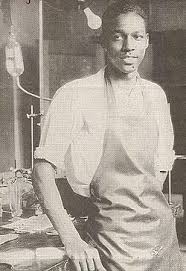
The man who invented the operation that saves babies born with blue-baby syndrome had no medical degree, no college degree, and was listed on the payroll as a JANITOR.
He guided the first operation from a stool behind the surgeon's shoulder, telling him where to cut.
Vivien Thomas. He had been saving to study medicine when the 1929 crash wiped out his savings and the bank holding them.
He took a job as a lab assistant at Vanderbilt for a janitor's wage, because that was the classification available.
Within a couple of years he was running experimental surgery — developing techniques, performing operations on his own, training surgeons.
He moved to Johns Hopkins with Alfred Blalock in 1941, where he was still paid as a janitor and had to enter through a back door.
He was the only Black man in that building not carrying a mop.
He worked out the surgical fix for tetralogy of Fallot — the condition killing infants who turned blue and died — and built the instruments for it.
The first operation on a child was in 1944. Blalock, who had never done the procedure, asked Thomas to stand behind him and talk him through it.
The surgeons on the paper became world famous. Thomas was not credited.
Hopkins hung his portrait in 1971 and gave him an honorary doctorate in 1976. Generations of surgeons he personally trained insisted on it.
He was paid as a cleaner while inventing heart surgery.
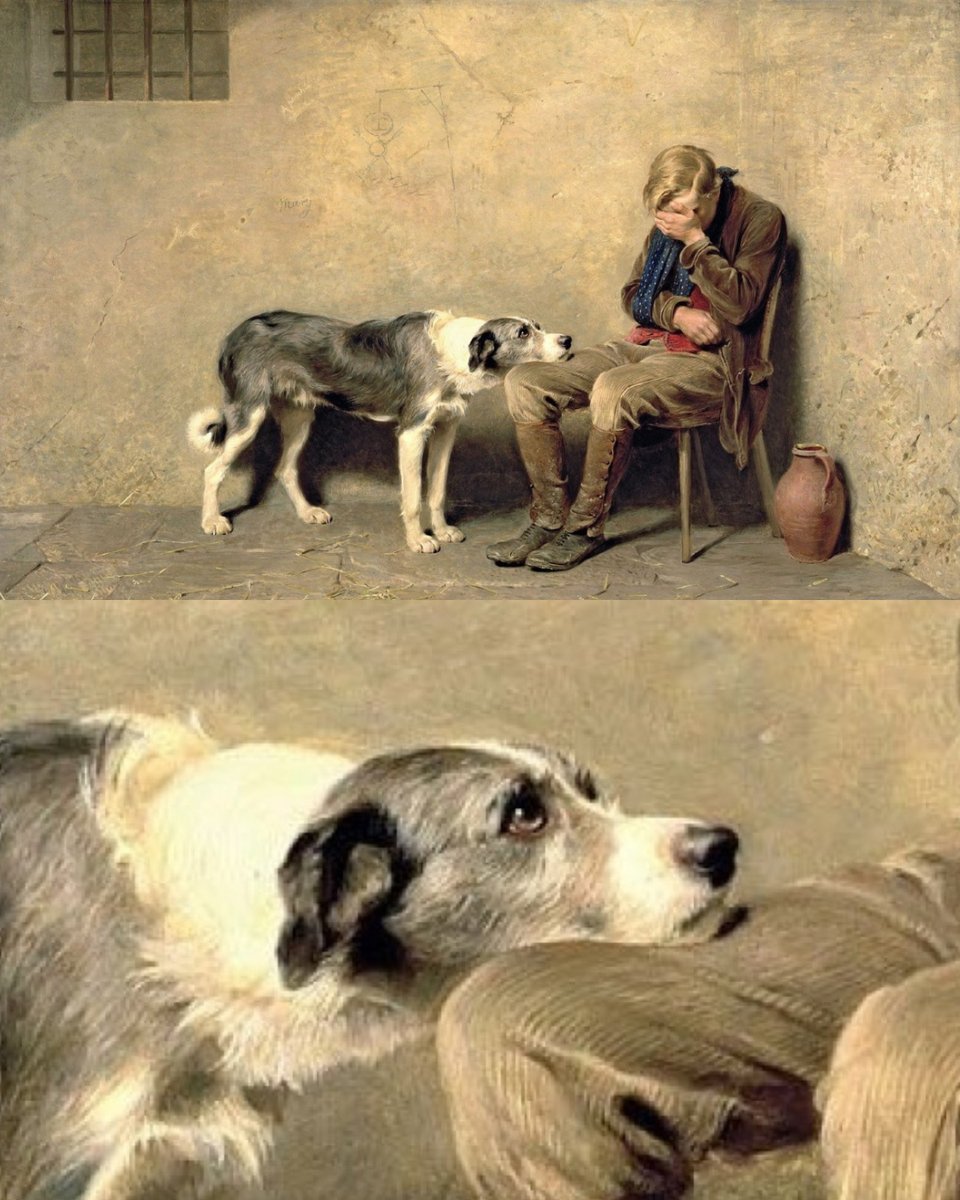
Anyone who has ever had a dog knows this look. It's the one they give you when they can tell something is wrong, and they have decided they are not leaving your side...
This beautiful painting is called Fidelity, and it was made by British artist Briton Rivière in 1869. A young man sits in the corner of a cold prison cell, awaiting trial. He is a poacher, caught taking game in an age when that could ruin a life. And pressed against his knee, gazing up into his face, is his dog, who has followed him even here.
You cannot see the man's face, Rivière hides it so that the entire emotional weight of the painting falls onto the dog. We are left to read the man's sadness in the animal's eyes.
The dog knows nothing of poaching or laws. It only knows that its person is hurting. And anyone who has ever loved a dog knows that look: "I don’t understand what has happened, but I know you are sad, and wherever you go, I will go too." The cold, the fear, the locked cell, none of it matters. Leaving him was never even a choice...
That is the meaning of the title Rivière chose for the painting: Fidelity. Faithfulness that asks for no reason and no reward. As American humorist Josh Billings once said: "A dog is the only thing on earth that loves you more than he loves himself."
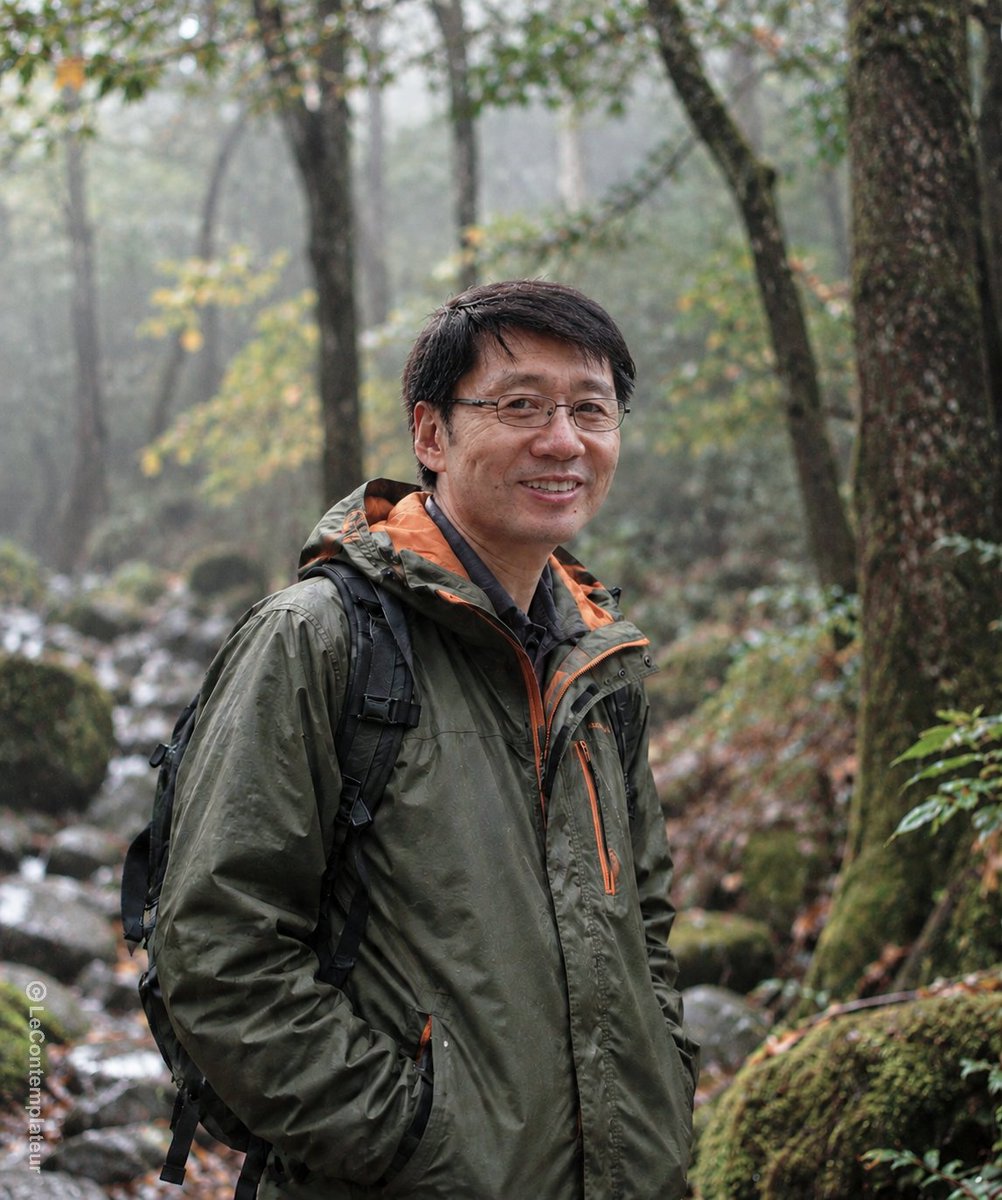
🌳🦠 Un immunologiste a passé plus de 20 ans à étudier ce qui se passe réellement dans notre corps lorsque nous entrons dans une forêt. Et franchement, plus je découvre ses travaux, plus je trouve ça fascinant.
Qing Li n’est pas simplement quelqu’un qui affirme que « la nature fait du bien ». D’origine chinoise et diplômé en médecine en Chine, il s’est installé au Japon à la fin des années 1980 et a consacré l’essentiel de sa carrière scientifique à l’étude des liens entre notre environnement, le stress et le système immunitaire. Il est aujourd’hui professeur clinique à la Nippon Medical School de Tokyo et a également travaillé à Stanford sur les cellules NK.
Au début des années 2000, il s’est intéressé scientifiquement à quelque chose que les Japonais pratiquaient déjà : le shinrin-yoku, littéralement le « bain de forêt ».
Les arbres libèrent naturellement dans l’air des molécules volatiles, notamment des composés appelés phytoncides. Lorsque nous marchons en forêt, nous en respirons certains sans même nous en rendre compte.
Li et son équipe ont alors voulu mesurer ce qui se passait réellement dans notre organisme.
Ils se sont notamment intéressés aux cellules NK (Natural Killer), des cellules de notre système immunitaire capables de reconnaître et de détruire certaines cellules infectées ou anormales.
Dans l’une de leurs expériences, 12 hommes ont passé trois jours et deux nuits en forêt. Après le séjour, 11 sur 12 présentaient une activité NK supérieure à celle mesurée avant leur départ, avec une augmentation moyenne d’environ 50 %.
Mais ce qui m’a le plus surpris, c’est que l’effet ne disparaissait pas forcément une fois rentrés chez eux.
Dans d’autres travaux de Qing Li, cette augmentation de l’activité NK était encore observable plusieurs jours plus tard, et certaines mesures montraient encore un effet environ un mois après le séjour. Une excursion comparable en environnement urbain n’avait pas produit la même augmentation.
Ses équipes ont également observé une diminution de certaines hormones associées au stress, comme l’adrénaline et la noradrénaline.
Et quand on prend un peu de recul, je trouve ça vraiment fou !
On vit aujourd’hui entourés de béton, d’écrans, de notifications, de lumière artificielle et de bruit. Puis on considère la forêt comme un simple décor agréable où aller prendre l’air le dimanche.
Alors que notre organisme semble encore réagir biologiquement à cet environnement.
Évidemment, ça ne veut pas dire qu’une promenade en forêt remplace un médicament ou soigne une maladie. Les premières études de Qing Li portent d’ailleurs sur de petits groupes et doivent être interprétées avec cette limite.
Mais elles nous rappellent quelque chose qu’on semble avoir complètement oublié : pendant l’immense majorité de l’histoire humaine, la nature n’était pas notre destination du week-end.
C’était notre habitat... 💯
🚨 🇮🇶 IRAQ: She was bought and sold seven times in three months. Then, she stood up before the United Nations, forced the world to look her in the eye, and became a Nobel Peace Prize winner.
August 3, 2014. Kocho, Iraq. Nadia Murad was 21 when ISIS surrounded her Yazidi village. What followed was genocide. Men and boys were taken away and executed.
Six of Nadia’s brothers were killed. Her mother was murdered and buried in a mass grave. Nadia was taken. In Mosul, she became property in the eyes of her captors.
Bought. Sold. Traded seven times in ninety days. She was beaten, burned, and repeatedly sexually assaulted.
When Nadia tried to escape, she was caught. The punishment was horrific. Six men gang-raped her until she lost consciousness.
She was beaten until she couldn’t walk. They wanted to destroy her spirit.
They failed. In November 2014, Nadia saw an unlocked door. She ran.
A local Muslim family risked their lives to hide her and help her escape ISIS territory. Eventually, Nadia reached a refugee camp.
Then Germany. She was finally free. She could have disappeared into a quiet life. Instead, she spoke. In December 2015, Nadia stood before the UN Security Council.
She was 22. Her words were fearless. She described girls being sold like cattle. Mothers murdered. A culture being erased. The world listened.
In 2016, the UN recognized the genocide against the Yazidis. But Nadia wasn’t finished. She turned survival into action.
In 2018, she founded Nadia’s Initiative, helping rebuild villages, schools, and clinics while supporting survivors seeking justice.
That same year, at 25, Nadia became the first Iraqi woman to receive the Nobel Peace Prize. The world applauded.
Nadia looked toward those still captive. For her, that was the prize that mattered— their freedom. She continues speaking for the thousands killed and those still missing.
Every telling carries pain. But silence carries a cost too. Nadia transformed suffering into purpose. Trauma into testimony. Survival into a demand for justice.
ISIS tried to reduce her to property. History remembers her by her name. Nadia Murad.
Not because she escaped what happened—but because she survived, stood before the world, and refused to let silence have the final word.
"Eat at a local restaurant tonight. Get the cream sauce. Have a cold pint at 4 o’clock in a mostly empty bar. Go somewhere you’ve never been. Listen to someone you think may have nothing in common with you. Order the steak rare. Eat an oyster. Have a negroni. Have two. Be open to a world where you may not understand or agree with the person next to you, but have a drink with them anyways. Eat slowly. Tip your server. Check in on your friends. Check in on yourself. Enjoy the ride."
-Anthony Bourdain