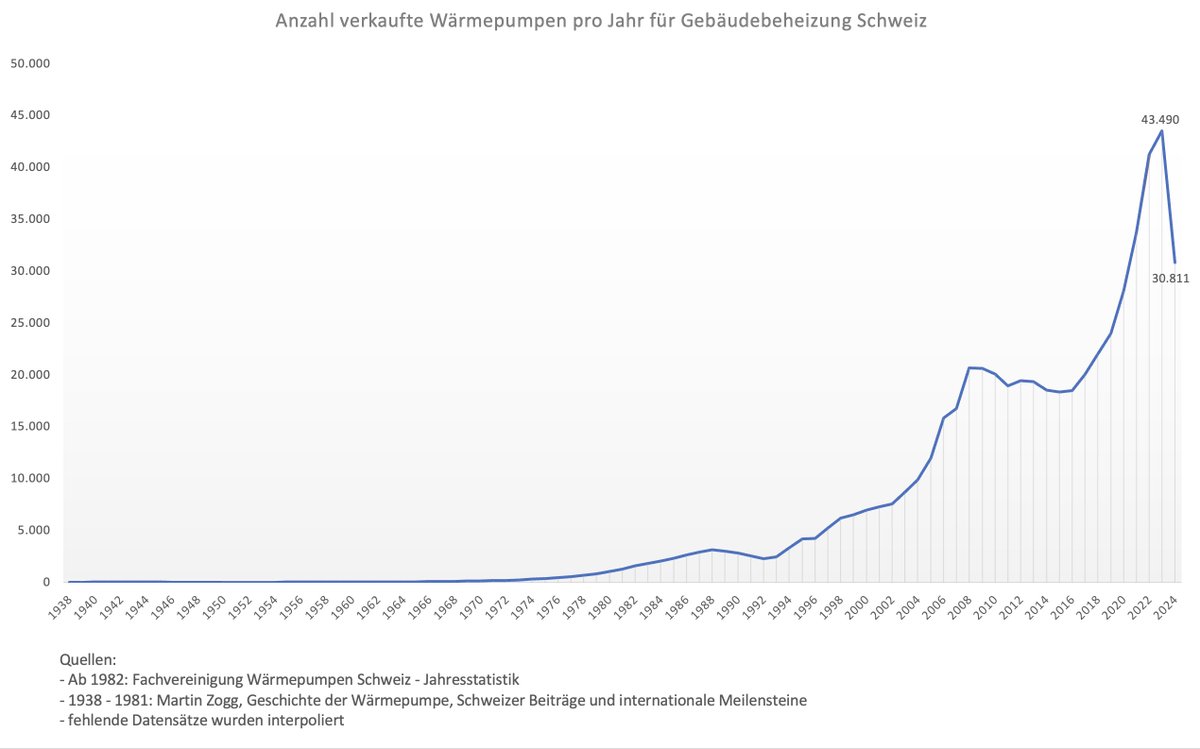
1/ Nach zwei Boomjahren leider 2024 herber Rückschlag bei den Wärmepumpen Installationen in der Schweiz, wie seit Kurzem im FWS Q4-Reporting publiziert und heute in der Sonntagszeitung berichtet. Es wurden 30'811 Wärmepumpen zur Gebäudebeheizung installiert. Das sind 29% weniger als im Vorjahr (43'490).
Wer haette das gedacht! Bulgarien an der Peripherie der EU entwickelt sich zum Batteriechampion. Es hilft seinem Nachbarn Rumaenien waehrend der Krise bzgl AKW (wir erinnern uns, niedriger Wasserstand der Donau) und scheint nun einiges richtig zu machen.
Deutschland sollte mal ueber seinen Tellerrand schauen.
Weiter so Bulgarien!
https://t.co/wD6H8Z6YRI
🇷🇺 Zum dritten Mal seit Juni brennt in Togliatti das Werk Tolyattikauchuk, das rund ein Viertel des russischen Synthesekautschuks liefert, und der Schutz über der Stadt hat damit dreimal versagt.
Anwohner meldeten in der Nacht mehrere Explosionen und Rauchsäulen. Videoaufnahmen zeigen das Feuer auf dem Werksgelände. Stadtchef Ilja Suchich spricht von einem massiven Drohnenangriff und Schäden an „Industrieobjekten“, das Werk nennt er nicht. Tote und Verletzte gibt es nach seinen Angaben und denen von Gouverneur Wjatscheslaw Fedorischtschew bisher keine. Eine Bestätigung aus der Ukraine steht noch aus.
In der Stadt sollen Strom und Wasser ausgefallen sein, das nahe Wärmekraftwerk könnte getroffen sein. Russische Telegram-Kanäle berichten außerdem von einer Evakuierung beim Autobauer AvtoVAZ. Beides ist unbestätigt. Das Verteidigungsministerium meldet für die Nacht 616 abgeschossene Drohnen. Dem Werk in Togliatti hilft die Zahl wenig.
Der Kautschuk aus Togliatti steckt nach Angaben des ukrainischen Militärs in Festtreibstoff für taktische und ballistische Raketen. Der ukrainische Generalstab hatte Treffer samt Feuer auf dem Gelände am 12. Juni und am 12. September bestätigt.
Wir hatten über Togliatti berichtet, am Samstag, 12. September, damals mit dem Chemiewerk KuibyschewAzot im Fokus.
Der Eigentümer Tatneft hat 2023 das Russlandgeschäft des finnischen Reifenherstellers Nokian übernommen. Das 10. EU-Sanktionspaket sah für russischen Synthesekautschuk ab 1. Juli 2024 ein Einfuhrverbot vor. Die Ukraine hat es beschleunigt.
Quellen: Meduza, Ukrinform, Ukrainska Pravda, The Insider
Wake up.
Every profession deemed white-collar, the middle class dream, is about to be decimated by AI, at a much faster pace than anticipated, with monstrous social consequences.
This is it.
Everyone is excited about AI.
I'm not.
AI is the biggest commoditizer of human capability we have ever built. Doctors earn more than cleaners because expertise takes a decade to acquire and judgment to apply. AI is going to make most of that expertise available to anyone, at marginal cost.
The gap doesn't go to zero. But it shrinks. And the same thing happens in almost every knowledge profession. Programmers. Lawyers. Analysts. Traders. Designers. The taxi driver replaced by a robotaxi is the easy case. The harder ones are people who spent twenty years training to do something a model can now do in a second.
The one corner of human life I don't see this hitting is sport. Nobody pays to watch a robot beat a human. The whole appeal is humans competing against each other. That's why nobody watches Deep Blue play chess anymore.
From an investing perspective, the next decade plays out in three phases.
Phase 1 is the buildout. Hundreds of billions in capex on chips, data centers, and energy. This is what's driving today's market.
Phase 2 is the deployment. Productivity rises sharply, then deflation sets in as the cost of knowledge work collapses. Jobs disappear faster than the economy can replace them.
Phase 3 is the social adjustment. Capital becomes more powerful than labor. The biggest winners are likely to sit where AI cannot reach. Real assets. Energy. Commodities. Precious metals. Scarce land.
And there's something deeper than the economics. The Japanese have a word for it: ikigai. The reason you get up in the morning. Your vocation. Your purpose. The work that makes you feel needed. AI is coming for that too. Nobody has yet figured out what a healthy society does when most of its members no longer feel needed by anything.
I might be wrong. I hope I am.
If I'm not, the world is about to change faster than most people are ready for.
Avoid Berlin like cancer.
Europe’s largest residential landlord Vonovia stands to lose more than €8bn from nationalisation plans in Berlin, as the prospective governing parties of the city discuss the socialisation of 140,000 apartments.
The leftwing Die Linke, winner of the September state election, has agreed to coalition talks with the Social Democrats and the Greens over plans to transfer large apartment portfolios into public ownership in an effort to bring down rents in the capital.
The proposal, which foresees compensation far below market values, could impose losses of more than €11bn on four major property companies relative to the levels at which the properties are held in their books, according to FT calculations.
Es ist rein technisch relativ simpel umsetzbar. In einer Welt mit immer stärkeren Automatisierung/KI werden sich die Einkommen stärker von den Löhnen zum Kapital verschieben. Man wird kaum daran vorbeikommen, auch Kapitaleinkommen stärker zu besteuern. Idealerweise entlastet man dabei aber gleichzeitig die Lohneinkommen.
Man kann den Senioren wirklich keinen Egoismus vorwerfen. Obwohl Ihre Renten sicher sind und sie nicht von einer potentiellen Rentenaltererhöhung betroffen sind, stimmen sie am Stärksten der MWSt Erhöhung zu. Werde auch zustimmen, fände persönlich aber einen anderen Finanzierungsansatz besser. Die Unterscheidung zwischen Lohn- und Kapitaleinkommen sollte aufgehoben werden und auf beides sollten die gleichen prozentualen AHV Beiträge erhoben werden. Vermögende Pensionäre würden dadurch einen stärkeren Finanzierungsbeitrag leisten und man könnte dadurch sogar die Abgabenlast auf den Lohneinkommen reduzieren. Mit der KI Welle und den drohenden Jobverlusten wird eine solche Reform sowieso immer dringender.
https://t.co/NgBggUrz38
Bei einer Rentenaltererhöhung wäre ich persönlich dabei. Ansonsten sehe ich die Einsparmöglichkeiten nicht so. In der Schweiz ist vieles schon ziemlich effizient organisiert. Im Gesundheitswesen könnte man stärker zentralisieren und regionale Spitäler schliessen. Das ist aber politisch auch sehr schwierig.
@sw1ss_pr3d4tor Strukturreformen heisst Rentenalter-Erhöhung. Bin persönlich nicht dagegen, denke aber, dass die Chancen für politische Mehrheiten dafür gering sind. Insbesondere mit der anlaufenden KI-Jobautomatisierungswelle.
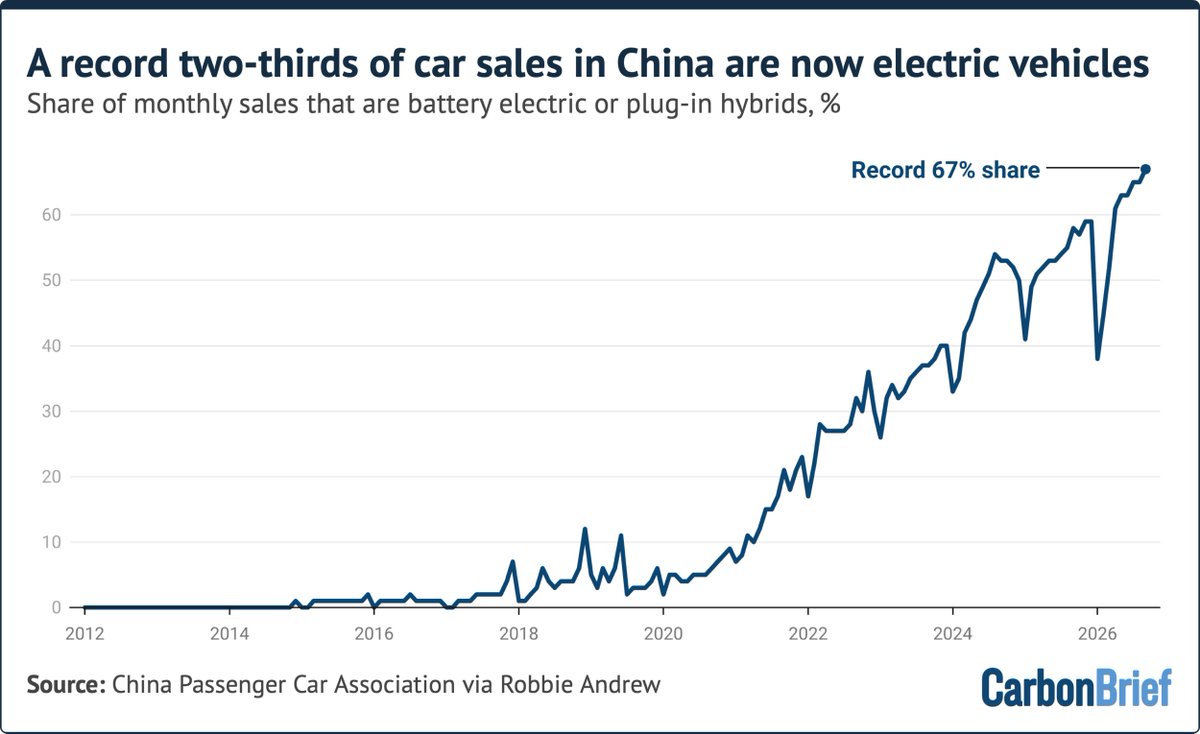
China, der mit Abstand grösste Automarkt der Welt jetzt mit 2/3 (!) Elektro Anteil bei den PKW-Neuzulassungen. Währenddessen ist der Verbrenner Absatz seit seinem Maximum im 2017 um ebenfalls zwei Drittel geschrumpft! Verbrenner PKWs haben keine Zukunft. Wer verzweifelt dafür lobbyiert, wird untergehen.
MIND-BLOWING STATS: A record 2/3 of new cars in China are now electric, while combustion-car sales have fallen by 2/3 since they peaked in 2017
– In 2020, ~95% of sales were combustion-engine cars
– By Sep 2026, they crashed to 33%
– On the flip side, NEVs hit a record 67%
🧵
Iran is losing land trade routes to American pressure, as both Iraq and Pakistan shut key border crossings:
"The Pakistani closures have stranded more than 4,500 metric tons of bottled gas—one of Tehran's last energy exports—on the Iranian side of the border."
It has other borders, but they were already struggling to deal with higher volume: last month there were 17,000 trucks waiting to cross, with delays stretching up to three weeks https://t.co/2THkV3cG9G
$META could finance $220B in CapEx in 2027 without needing to go for external financing (which is 50% more than they will spend this year on CapEx).
$META generated $133B in operating cash flow in the LTM. Next year, with modest revenue growth, they will probably be at the $140B-$150B mark (even with the $10B litigation charge). If they cut their Reality Labs spend, which is still $15-$20B per year, they get could get another $10B, which gets them to $160B. They also have $80B in cash on the balance sheet. Even if they leave $20B of cash and spend $60B in 2027, only $2.75B of debt matures, so their total spend can go up to $220B of CapEx spend.
In April 2026, they also raised $25B in bond issuances. If they did the same in 2027 (which I don't think the market would freak out about), that would get them to $245B in CapEx.
Either way you slice it, if it is $220B or $245B, they would have bought more compute than any frontier lab in 2027, and they would still secure their position in this AI infra race.
Given market conditions, if $META really believes they have to push the pedal this hard on CapEx to be in a strong long-term position, they should first clean house (especially in their RL spend) and look at other options before diluting shareholders at these valuations levels.
Trump floats slapping 200% tariffs on both Russia and Ukraine to force a peace deal, crediting similar threats for ending five other wars. He then admits it probably wouldn't work here since the US doesn't buy enough from either country.
Original iPhone had a dock, SIM ejector, cleaning cloth, charging brick, cable and headphones. Believe it or not, that’s now like $150 of separate purchases.