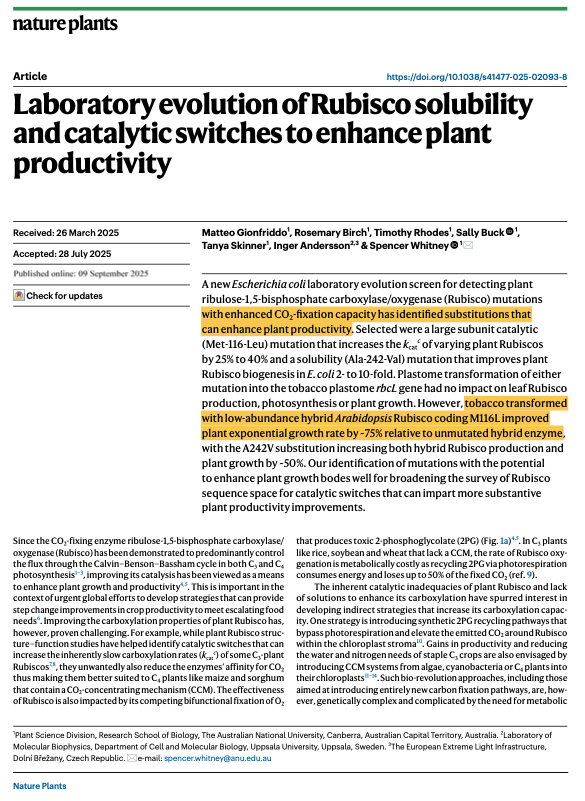
New Article: "Laboratory evolution of Rubisco solubility and catalytic switches to enhance plant productivity" https://t.co/DyhbE7xNXS
E. coli evolution screen to unlock latent functional potential in Rubisco by identifying mutations that enhance CO2 fixation and solubility.
Rubisco is (arguably) the most abundant protein on Earth. (LPP surely comes close, right?) It’s an enzyme that fixes CO₂ into sugars during photosynthesis.
Unfortunately, as most people learn in school, Rubisco is inefficient. Sometimes it confuses O₂ for CO₂ and wastes energy. Plants make up for this in raw concentration; up to half the soluble protein in a leaf is Rubisco.
People have been trying to engineer better Rubiscos for many decades, but it's not easy because the proteins are big, do not fold easily (they need chaperone proteins to help out), are made from 16 subunits in land plants.
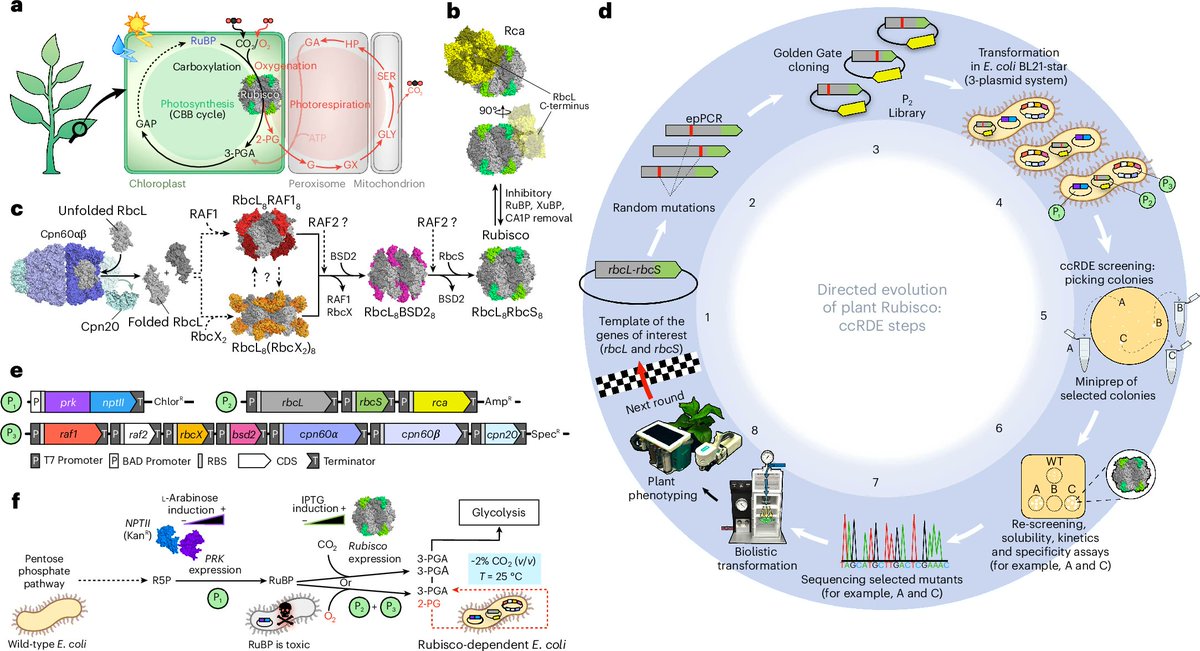
But there's a new paper in Nature Plants that looks really interesting. The TL;DR is that a group in Australia figured out how to express plant Rubiscos (and all SEVEN of their folding chaperones) using a set of 3 plasmids inside of E. coli cells. This enabled them to do "directed evolution" of Rubisco in bacterial cells, and quickly find Rubisco mutants that have higher enzymatic efficiency or that fold better.
In addition to the 3 plasmids, the researchers also coaxed E. coli to make ribulose-1,5-biphosphate, or RuBP, which is the 5-carbon sugar that Rubisco smashes into carbon dioxide to make molecules of 3-PGA for central metabolism.
Now, the clever bit is that you RANDOMLY MUTATE the three plasmids encoding the Rubisco to make millions of variants. Then, you transform those mutated plasmids into E. coli. If the E. coli do NOT make a functional Rubisco, RuBP levels build up and kill the cell; the molecule becomes toxic. But if the E. coli DO make a functional Rubisco, then they keep the RuBP levels in check and live just fine.
Using this "screening assay," the researchers found 46 fast-growing colonies of E. coli. Two of those colonies encoded really useful mutations. One mutation (M116L) makes Rubisco about 25–40% faster. The other (A242V) makes it fold and assemble much more efficiently.
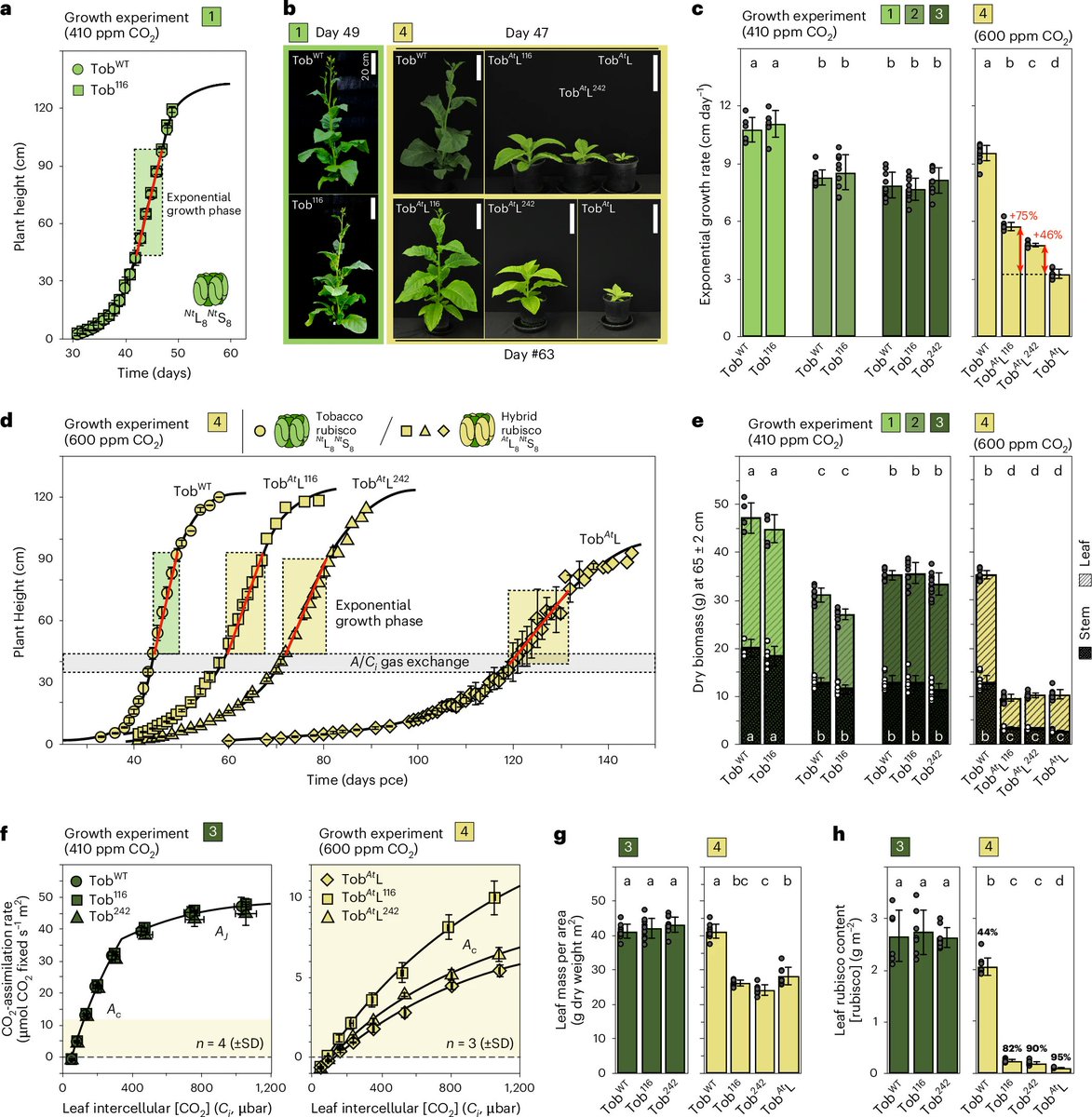
They put this mutation into a "hybrid Arabidopsis–tobacco Rubisco," put that into tobacco plants, and measured growth. The plants with M116L grew 75% faster than wildtype.
No guarantees this will scale to more useful crops, like wheat and corn and soybeans etc. But it seems like a nice in vitro assay for faster prototyping!
New Article: "Grafting Rhodobacter sphaeroides with red algae Rubisco to accelerate catalysis and plant growth" https://t.co/EvCSFqw4tF
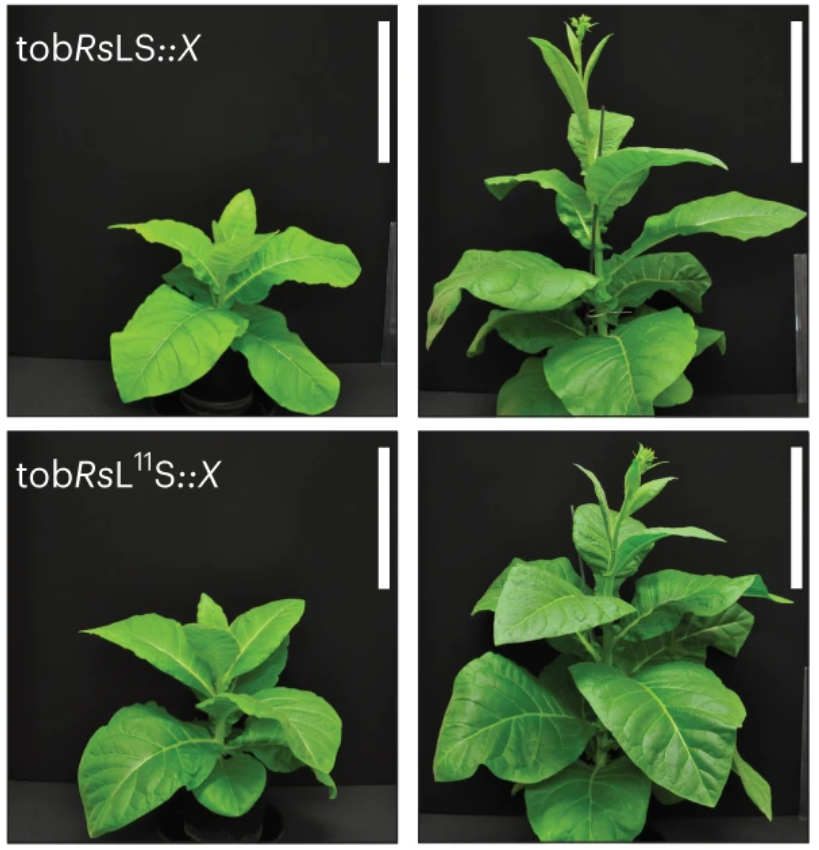
Structure-guided changes from a very effective red algae Rubisco into a bacterial enzyme improves its CO2-fixing traits and growth in tobacco.
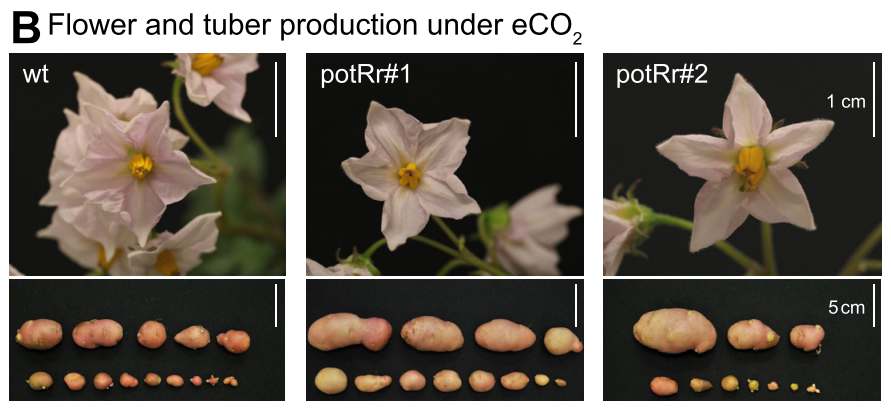
Researchers working on the potato have swapped out an enzyme at the heart of photosynthesis, Rubisco, for a faster version but only in high CO2 environments. The authors say a 30% increase in spud yield may eventually be possible. In PNAS Nexus: https://t.co/CO9l8gZCBY
Here's @sal_buck discussing her recent JXB paper which used an E. coli based expression system as a proxy to test heterologous Rubisco production in plants
Read the full paper here: https://t.co/3KvfOhExBJ
I am excited to share a new paper.
It demonstrates machine learning can predict kinetics of numerous plant Rubiscos. This will ease bioengineering efforts and may allow species-specific parameterization of global photosynthesis models. 1/5
@JXBot
https://t.co/brkDoSsfOc
Nice overview of directed evolution research underway in plants. DE means we don't need to always know what AAs to change, but we do need to understand mechanisms of what is to design clever selection screens for what could be. Enzyme biochemistry in plants needed more than ever!
Neat ‘DE-GE’ acronym (#DirectedEvolution-#GenomeEditing) captures how classical & continuous versions of directed evolution will interface w/ crop improvement, i.e. Take gene out of crop -> Evolve fast in a microbial platform -> Put modified gene back in crop by genome editing.
“It’s clear that for the future generation, we have to act now in a very fast way.”
- 2021 physics laureate Giorgio Parisi speaks about the current climate situation at this morning's #NobelPrize press conference.
Watch how @leaf2field scientists are tackling one of the biggest challenges of this century: increasing crop production by improving photosynthesis. Research funding needs to continue so we can apply these exciting discoveries into crop varieties More: https://t.co/AvD88WA7WG