

Top Tweets for #DirectedEvolution

De Novo Design, Directed Evolution and Computational Study of Heme-Binding Helical Bundle Protein Catalysts for Biocatalytic Enantioselective Ge–H Insertion
1. Researchers have achieved the first example of biocatalytic C–Ge bond formation through enantioselective Ge–H insertion using de novo designed protein catalysts. This represents a significant advancement in the field of biocatalysis, as it enables the synthesis of chiral organogermanium compounds, which have broad applications in materials science, synthetic chemistry, and medicine.
2. The study combines de novo protein design and directed evolution to create a helical bundle protein catalyst that can catalyze Ge–H insertion with high efficiency and enantioselectivity. The final evolved variant, FeHP-1Ge*, demonstrated excellent catalytic activity, achieving up to 8000 total turnover numbers (TTN) and 99:1 enantiomeric ratio (e.r.).
3. The researchers used density functional theory (DFT) calculations to investigate the mechanism of the Ge–H insertion reaction. They found that the Ge–H insertion proceeds through an earlier and more flexible transition state compared to Si–H insertion, which posed challenges for stereocontrol. However, the directed evolution process successfully addressed these challenges by enhancing active-site preorganization and modulating local backbone flexibility.
4. The de novo designed protein scaffold was initially optimized for Si–H insertion, and through directed evolution, it was repurposed for Ge–H insertion. This demonstrates the adaptability of de novo proteins and the power of directed evolution in fine-tuning enzyme active sites for new-to-nature reactions.
5. The evolved protein catalyst FeHP-1Ge* exhibited remarkable stability in the presence of organic solvents, such as ethanol, allowing the biocatalytic reactions to occur with substantially increased substrate concentrations. This highlights the robustness of de novo designed protein catalysts and their potential for large-scale applications.
6. The substrate scope of the Ge–H insertion reaction catalyzed by FeHP-1Ge* was broad, including aryl-substituted germane derivatives with various functional groups and steric properties. This underscores the versatility of the de novo protein catalyst and its potential for synthesizing a wide range of chiral organogermanium compounds.
📜Paper: arxiv.org/abs/2509.24779
#DeNovoDesign #DirectedEvolution #Biocatalysis #EnantioselectiveCatalysis #ProteinEngineering #OrganogermaniumCompounds

Directed Evolution of Proteins via Bayesian Optimization in Embedding Space
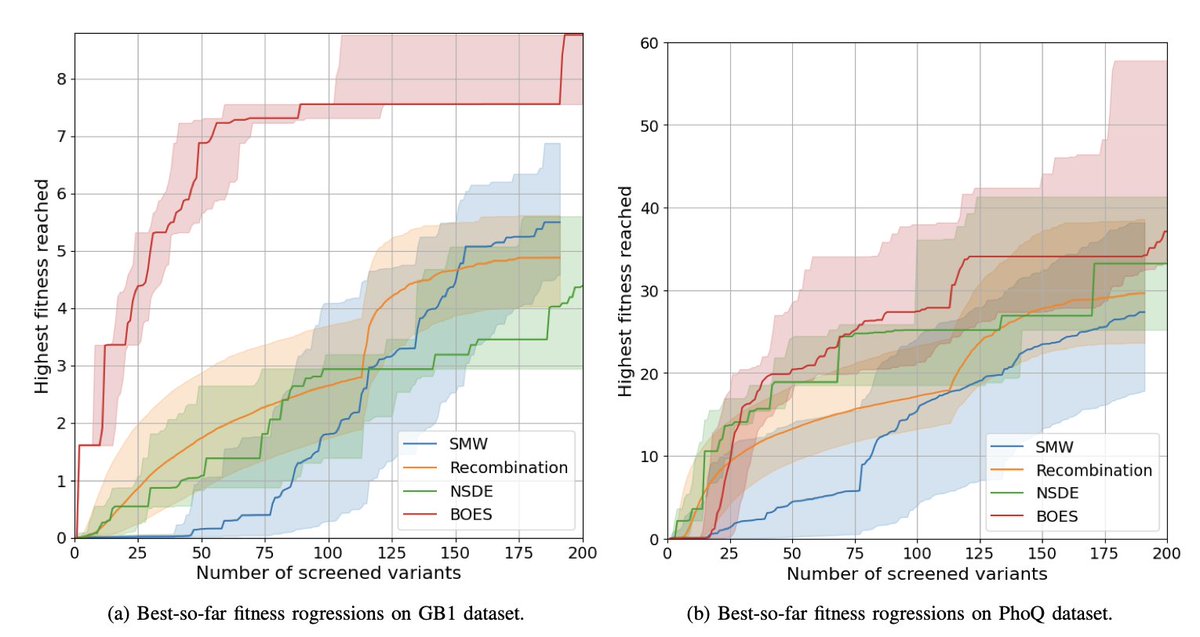
1. This paper introduces a novel method for machine-learning-assisted directed evolution of proteins, termed BOES, which combines Bayesian optimization (BO) with embeddings from a pre-trained protein language model (PPLM). This innovative approach significantly enhances the efficiency of protein engineering by optimizing the selection of protein variants for screening.
2. The core innovation lies in using a PPLM to extract informative embeddings of protein sequences. BO is then conducted in this embedding space, rather than the original sequence space. This method outperforms state-of-the-art machine-learning-assisted directed evolution methods, demonstrating superior performance with the same number of screening experiments.
3. BOES employs a Gaussian process model with a custom Matérn 3/2 kernel to handle the high-dimensional nature of PPLM embeddings. This allows the model to fit a single length scale hyperparameter, making BO feasible in the embedding space. The expected improvement (EI) acquisition function is used to guide the selection of new variants for screening.
4. Experiments were conducted on two datasets (GB1 and PhoQ) with nearly all possible variants of wild-type proteins mutated at four positions. BOES achieved higher maximum fitness compared to other methods, including regression-based MLDE methods and optimization methods like neighborhood search. This highlights its robustness and efficiency in navigating complex fitness landscapes.
5. The method also includes an ablation study to evaluate the impact of using the embedding space versus the original sequence space. Results show that BOES, using the embedding space, outperforms a method using one-hot encoding in the original sequence space, confirming the advantage of the proposed representation.
6. Visualization of the embedding space using PCA and t-SNE revealed that the embedding space captures meaningful similarities between variants and local clusters of high-fitness variants. This validates that the embedding space is suitable for BO and effectively models the fitness landscape.
7. The authors suggest future improvements by combining BOES with additional enhancements such as prescreening outlier detection and robust BO procedures. This could further optimize the method and reduce screening costs while maintaining or improving performance.
📜Paper: arxiv.org/abs/2509.04998v1
#ProteinEngineering #BayesianOptimization #MachineLearning #DirectedEvolution #ProteinLanguageModel #Bioinformatics
Deep Evolutionary Fitness Inference for Variant Nomination from Directed Evolution
1. This study introduces EVFI and DeepEVFI, two novel machine learning methods designed to infer fitness from time-series sequencing data in directed evolution experiments. These tools are particularly innovative for their ability to handle complex, partially unknown mutation mechanisms and diverse starting populations, making them highly relevant for drug discovery.
2. The core innovation of EVFI and DeepEVFI lies in their flexibility. Unlike traditional methods that rely on frequency-based approaches, these methods model the temporal dynamics of variant enrichment, allowing for the identification of "rising stars"—variants with high fitness but low frequency that are often overlooked by conventional methods.
3. The study demonstrates the effectiveness of EVFI and DeepEVFI through both public datasets and experimental campaigns. In one experiment, EVFI identified antibody variants with significantly improved binding affinities using fewer selection rounds than traditional methods, showcasing its potential to accelerate drug development timelines.
4. DeepEVFI further enhances performance by incorporating deep learning to predict fitness based on sequence information. In a macrocycle peptide campaign targeting the YAP domain of TEAD2, DeepEVFI identified binders with up to 7.6× improved affinity compared to human-selected variants, highlighting its superior ability to nominate high-affinity binders from complex datasets.
5. The study also highlights the importance of diversity in variant nomination. EVFI and DeepEVFI can nominate diverse variant sets with high fitness, capturing the broad sequence diversity present in evolved populations. This capability is crucial for lead discovery, where multiple objectives and property constraints need to be optimized.
6. The authors provide a rigorous statistical framework to evaluate the trustworthiness of inferred fitness values, including a method to detect violations of model assumptions. This ensures that the fitness inference results are reliable and can be confidently used for decision-making in directed evolution campaigns.
📜Paper: biorxiv.org/content/10.1101/…
#MachineLearning #DirectedEvolution #FitnessInference #DrugDiscovery #ProteinEngineering

Steering Generative Models with Experimental Data for Protein Fitness Optimization
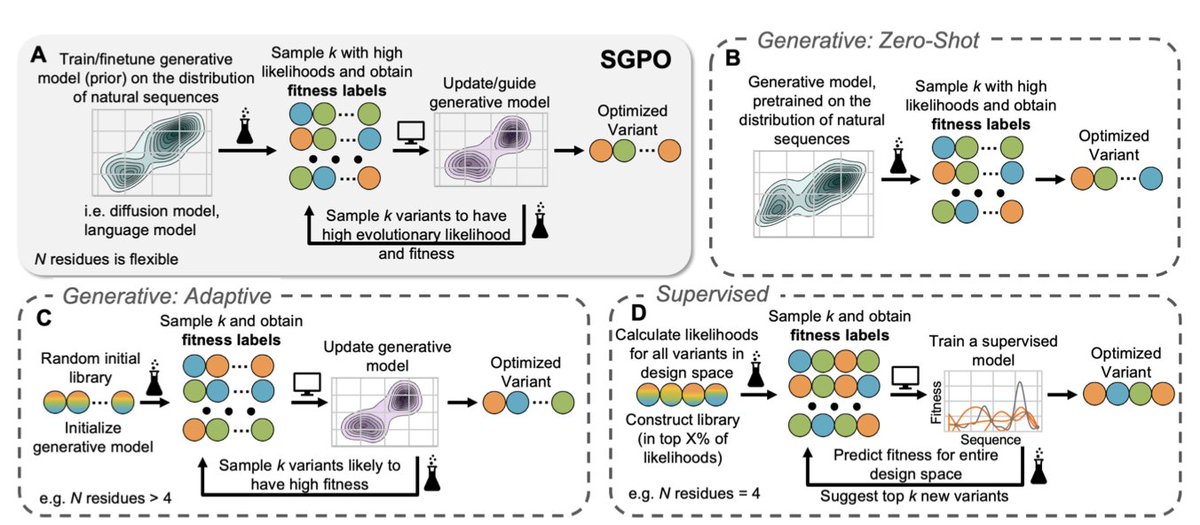
1.This paper introduces SGPO (Steered Generation for Protein Optimization), a principled and scalable framework that guides generative models of protein sequences using small amounts of real fitness data. SGPO enables more efficient exploration and optimization than traditional finetuning or zero-shot generation.
2.SGPO combines generative priors trained on natural sequences (e.g. discrete diffusion models or autoregressive language models) with plug-and-play fitness guidance derived from labeled wet-lab assay data—typically just hundreds of sequences—making it suitable for low-throughput experimental settings.
3.The authors comprehensively evaluate multiple generative models (continuous diffusion, discrete diffusion with uniform or absorbing noise, autoregressive PLMs) and multiple guidance strategies including classifier guidance (CG), DAPS, and NOS, across two benchmark proteins: TrpB and CreiLOV.
4.SGPO achieves strong optimization performance even with just 200 labeled sequences, significantly outperforming supervised finetuning methods like DPO on autoregressive PLMs, especially in low-data regimes.
5.Discrete diffusion models with uniform noise (D3PM) guided by DAPS or CG consistently generate high-fitness, diverse protein sequences. In contrast, language model finetuning via DPO underperforms and is sensitive to hyperparameters.
6.SGPO also supports adaptive optimization workflows akin to Bayesian optimization. The authors use a form of Thompson sampling by guiding generation with an ensemble of fitness predictors, which improves maximum fitness in iterative campaigns.
7.Plug-and-play guidance in SGPO requires minimal computational resources—pretraining is fast and steering can be done in minutes—unlike RL-based or fully finetuned approaches that need longer training and tuning cycles.
8.The framework’s key advantage is its flexibility: generative priors can be pretrained once and reused across campaigns, while guidance strategies like DAPS or CG can be layered on without updating the model weights.
9.SGPO avoids the limitations of other methods: it scales to larger sequence spaces (N > 9), leverages both evolutionary priors and assay-based data, and avoids the inefficiencies of local search in traditional directed evolution.
10.By systematically analyzing steering strategies and model architectures, this work provides best practices and a powerful open-source tool for real-world protein engineering, setting a new standard for ML-assisted protein design.
💻Code: github.com/jsunn-y/SGPO
📜Paper: arxiv.org/abs/2505.15093
#ProteinDesign #GenerativeModels #DiffusionModels #ProteinEngineering #BayesianOptimization #SGPO #ComputationalBiology #DirectedEvolution
SYNEVO: Towards Synthetic Evolution of Biomolecules via Aligning Protein Language Models to Biological Hardware
1.SYNEVO is a closed-loop AI-driven framework that combines protein language models (pLMs), high-throughput experimental feedback, and reinforcement learning (RL) to enable synthetic evolution of biomolecules beyond the limitations of template-based methods.
2.The system directly synthesizes diverse protein sequences—without relying on parent-child mutation chains—and optimizes them via iterative experimental testing and RL fine-tuning, bridging generative AI and wet-lab automation.
3.As a proof of concept, SYNEVO was applied to Zinc Finger (ZnF) DNA-binding proteins. Using pLMs like ESM-IF, ESM3, Progen2, and ZymCTRL, two sequence libraries were generated and tested using CIS display in a cell-free setup.
4.ProtRL, an RL-based method using Direct Preference Optimization (DPO), refined the generative models using enrichment scores obtained via next-gen sequencing after rounds of target binding selection.
5.The second library, generated with ProtRL, achieved a 15-fold improvement in producing positively enriched ZnF variants compared to the first library, with some variants surpassing wild-type (WT) binding performance.
6.In silico validation was conducted using AlphaFold3 to simulate co-folding of ZnF proteins with DNA targets. ProtRL optimization increased contact probabilities with target DNA while maintaining structural and electrostatic features.
7.A head-to-head simulation of SYNEVO versus Directed Evolution (DE) over 10 iterations showed that SYNEVO explored broader sequence space, generated more diverse high-fitness proteins, and did so more efficiently.
8.Unlike DE, which is limited by template-based mutation steps, SYNEVO samples freely across the genotype space and adapts based on experimental rewards, creating a "super-Darwinian" optimization loop.
9.Multi-objective reward functions—including TM-score similarity, electrostatic charge, and AF3 contact probabilities—enabled the model to evolve ZnF variants with improved structural and functional features.
10.SYNEVO integrates experimental phenotype feedback at every generation step, effectively aligning pLM sampling with protein engineering goals without manual filtering or structure-based constraints.
11.The approach promises high scalability, automation, and generalizability, making it suitable for a wide range of protein engineering tasks including therapeutic design, synthetic biology, and enzyme engineering.
12.Published at the GEM Workshop at ICLR 2025, SYNEVO marks a shift toward autonomous biomolecular design systems that unify machine learning and biology for iterative, feedback-driven optimization.
📜Paper: openreview.net/forum?id=mNEL…
#ProteinEngineering #SyntheticBiology #ProteinLanguageModels #ReinforcementLearning #Biodesign #AI4Bio #ICLR2025 #ZincFinger #DirectedEvolution #GenerativeBiology #SYNEVO

Cell-Free Protein Synthesis as a Method to Rapidly Screen Machine Learning-Generated Protease Variants @ACSSynBio
1. This study presents a fast and accessible workflow that combines cell-free protein synthesis (CFPS) with machine learning to improve protease activity through rapid variant screening, achieving up to 4-fold improvements in catalytic rates.
2. The approach uses CFPS to bypass slow and resource-intensive in vivo protein production, enabling screening of 48 random variants within just 6 hours—providing activity data that guides an ML model for subsequent optimization.
3. Starting from a rationally designed protease (Con1), the team used AlphaFold3 and Robetta alanine scanning to identify six candidate residues, split into two regions, for simultaneous mutagenesis.
4. Initial CFPS screens revealed region-specific mutational tolerance: region A was largely intolerant to changes, while region B yielded multiple variants with improved activity, providing asymmetric data for ML training.
5. An ensemble deep learning model using Active Learning-assisted Directed Evolution (ALDE) was trained on this sequence–activity data and proposed 32 new variants—several of which surpassed the activity of the original Con1 protease.
6. The best variant from region B (TB27) displayed 4x greater activity than the wild-type Con1, demonstrating the effectiveness of combining sparse mutational sampling with ML-guided exploration.
7. FRET-based activity assays showed that CFPS screening faithfully reflected protease functionality, correlating well with activity measured from purified proteins—validating CFPS as a reliable high-throughput screening method.
8. The open nature of CFPS allows the use of non-natural substrates or toxic conditions incompatible with living cells, offering flexibility for broader protein engineering applications.
9. The workflow is both low-cost and scalable: it requires no specialized automation and can be implemented in microplate format, making it ideal for academic labs aiming to accelerate enzyme optimization.
10. This work illustrates that accessible CFPS + ML pipelines can serve as powerful platforms for navigating protein fitness landscapes, enabling rapid prototyping of enzymes beyond what traditional directed evolution allows.
💻Code: github.com/deltadedirac/ther…
📜Paper: pubs.acs.org/doi/10.1021/acs…
#ProteinEngineering #MachineLearning #CellFreeBiology #DirectedEvolution #EnzymeDesign #SyntheticBiology #ProteaseEngineering #AlphaFold #CFPS #AI4Science

Capturing Natural Evolution in Function-guided RNA Design via Genomic Foundation Models
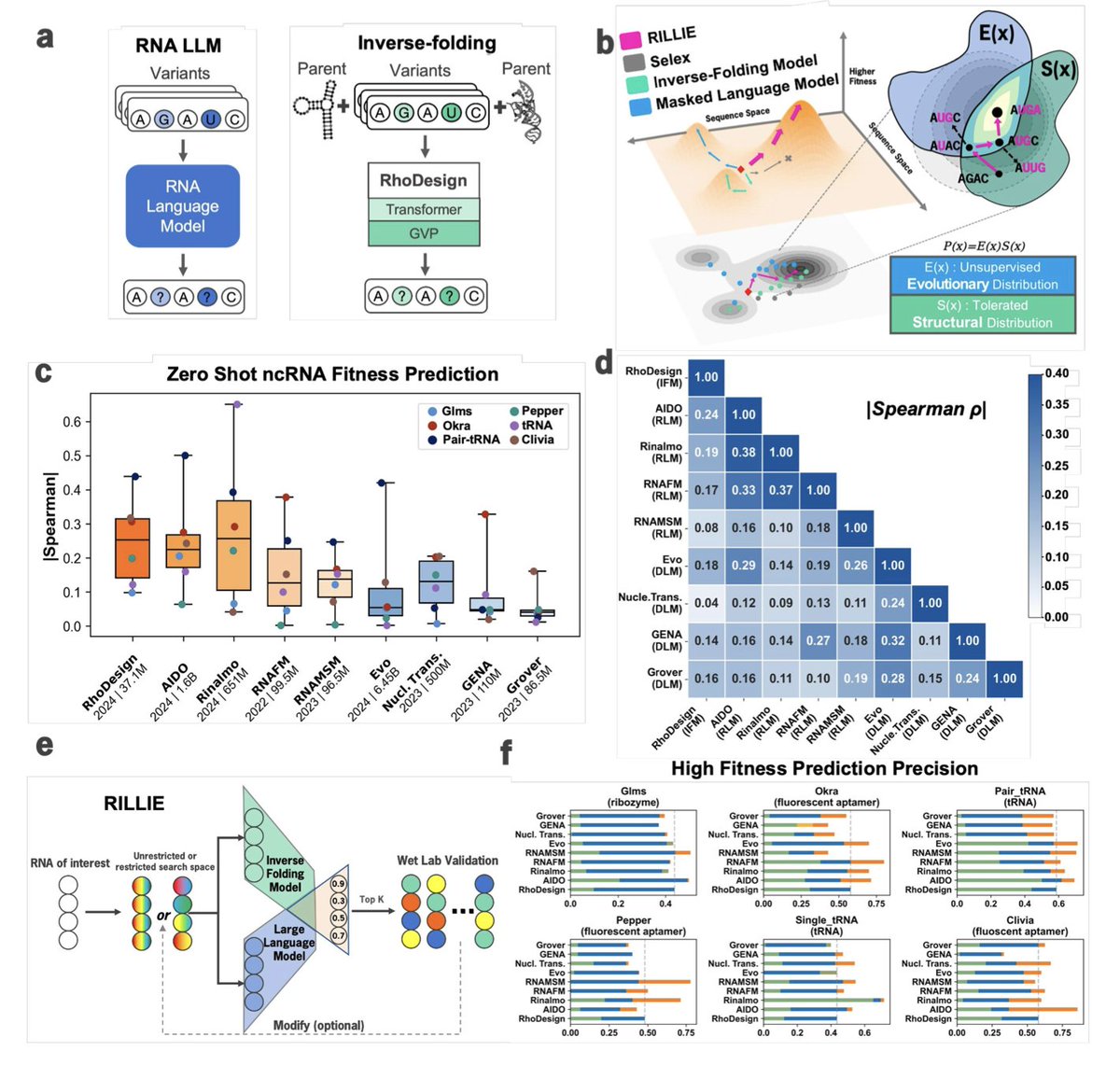
1. This study introduces RILLIE, a zero-shot RNA design framework that combines large language models (LLMs) and inverse folding models (IFMs) to simulate natural evolution and optimize RNA sequences for in vivo function—without any task-specific training.
2. RILLIE integrates AIDO.RNA, a 1.6B-parameter RNA LLM capturing evolutionary plausibility, with RhoDesign, an inverse folding model capturing structural compatibility, forming a “product of experts” model that jointly optimizes for sequence and structure fitness.
3. Unlike traditional SELEX or task-specific ML pipelines, RILLIE operates in a zero-shot setting, rapidly generating RNA variants that maintain natural sequence grammar and structural integrity while enhancing experimental performance.
4. Benchmarking across six diverse DMS datasets (aptamers, tRNAs, ribozymes), RILLIE demonstrates high correlation between model scores and experimental RNA fitness, significantly outperforming both RNA and DNA LLMs alone.
5. Applied to the Broccoli aptamer, RILLIE generated 20 variants in a single round—over half showed increased fluorescence, with B2 achieving a 55% boost in intensity and a 2x improvement in binding affinity, verified via FACS in living HEK cells.
6. For the Pepper aptamer, a two-round directed evolution strategy yielded 40 novel variants, with fluorescence boosts up to 2.6-fold and 3x binding affinity improvement. Over 40% of sequences outperformed wild type, including high-mutation variants with up to 75% sequence divergence.
7. Mutation preference analysis revealed that RILLIE avoids deleterious substitutions (e.g., C5G, U19A) and favors beneficial mutations in variable regions, showing strong alignment with natural selection patterns and high-fitness precision.
8. Importantly, sequences designed with RILLIE retained performance in vivo, demonstrating improved folding and function in HEK cells—a major challenge for aptamers designed solely via in vitro methods like SELEX.
9. RILLIE’s framework can generalize to other RNA classes beyond aptamers. The model was shown to perform well in predicting mutational effects across ribozymes and tRNAs, opening pathways for universal RNA engineering.
10. This work provides the first large-scale evidence that integrating structural and sequence models allows for scalable, evolution-guided, task-agnostic RNA design—enabling a paradigm shift in synthetic biology and RNA therapeutics.
💻Code: github.com/GENTEL-lab/RILLIE
📜Paper: biorxiv.org/content/10.1101/…
#RNAEngineering #SyntheticBiology #RNAaptamers #ZeroShotLearning #LanguageModels #InverseFolding #Bioinformatics #AptamerDesign #RNAtherapeutics #LLM #RILLIE #DirectedEvolution
Machine learning-assisted enzyme engineering through ultra-high throughput sorting and large-scale sequence-function data generation
1. PUSDA is a new framework that integrates ultra-high throughput sorting (ultra-HTS), next-generation sequencing (NGS), and machine learning (ML) to engineer enzymes at an unprecedented scale and accuracy.
2. Using a biosensor-enabled droplet sorting system, PUSDA sorted over 1 million enzyme mutants per hour with 95% accuracy and collected over 5 million sequence-function datapoints from a single experiment.
3. The system was applied to an understudied enzyme, flavone synthase I (FNS I), important for apigenin production. PUSDA generated and analyzed over 1.3 million unique FNS I mutants in a day.
4. ML models trained on the PUSDA dataset classified high, medium, and low-performance variants with up to 93.52% accuracy. Random Forest using DNA input consistently outperformed other models and input types.
5. PUSDA goes beyond single-point mutation analysis: it applies a ratio-based feature selection strategy to capture higher-dimensional mutation patterns, enabling design of combinatorial mutants not seen in training data.
6. Nine novel enzyme variants were designed using this approach, and validation experiments confirmed high accuracy: the top-performing mutant increased apigenin productivity by 8.23-fold compared to wild type.
7. PUSDA improved the efficiency of identifying high-performance enzymes by 16.67-fold compared to ultra-HTS alone, significantly reducing the need for random screening or reliance on prior structural knowledge.
8. Unlike previous efforts that focused on active sites, PUSDA expands the mutational search space to broader regions, uncovering impactful mutations in structural, regulatory, and binding regions.
9. The apigenin biosensor used in this system directly detects the target metabolite with high specificity and linearity, enabling reliable high-throughput screening in both droplet and bulk formats.
10. PUSDA's scalability was confirmed through validation in both microplates and 5 mL culture tubes, showing that the mutant performance in droplets translated to larger experimental setups.
11. This is the first study to combine ultra-HTS, NGS, and ML to generate large-scale, high-quality sequence-function data for enzyme engineering, laying the groundwork for similar approaches across protein families.
12. With its data generation capability and model-guided design, PUSDA complements existing ML tools like AlphaFold or large protein language models, accelerating discovery in biomanufacturing and synthetic biology.
📜Paper: biorxiv.org/content/10.1101/…
#EnzymeEngineering #SyntheticBiology #MachineLearning #ProteinDesign #HighThroughput #Bioinformatics #NGS #DirectedEvolution #MetabolicEngineering #ComputationalBiology #Biomanufacturing

Cell-free protein synthesis as a method to rapidly screen machine learning-directed protease variants
1. This study presents a novel workflow that combines cell-free protein synthesis (CFPS) with machine learning (ML) to rapidly screen and optimize protease variants, reducing the time and resources required for traditional protein engineering.
2. CFPS enables high-throughput functional screening of enzyme variants without requiring in vivo expression and purification, significantly accelerating data generation for ML-directed protein design.
3. The workflow follows a create-test-learn cycle: initial random protease variants are synthesized via CFPS, activity is measured via fluorescence-based assays, and ML models suggest optimized variants for the next round.
4. Using this approach, the authors screened 48 random variants in the first round and 32 ML-directed variants in the second, successfully identifying a protease variant with a fourfold improvement in catalytic efficiency.
5. The study uses AlphaFold3 modeling and computational alanine scanning to identify key substrate-binding residues, guiding rational mutagenesis and improving ML predictions.
6. The CFPS-based screening method provides results in just 6 hours, compared to traditional E. coli expression and purification workflows that require a full week, making it a practical alternative for rapid enzyme engineering.
7. CFPS activity measurements correlate well with purified protein assays, confirming the reliability of CFPS as a screening tool without the need for costly purification steps.
8. The ML-guided approach, powered by the Active Learning-Assisted Directed Evolution (ALDE) framework, balances exploitation and exploration in the fitness landscape, efficiently identifying high-performance variants.
9. The study highlights CFPS as an accessible and scalable tool for protein engineering, demonstrating its potential to be integrated with automated pipelines and robotic screening platforms.
10. By combining CFPS with ML, the authors outline a generalizable and cost-effective workflow for enzyme optimization, paving the way for broader applications in protein engineering and synthetic biology.
📜Paper: biorxiv.org/content/10.1101/…
#ProteinEngineering #MachineLearning #CellFreeBiology #SyntheticBiology #DirectedEvolution

Active Learning-Assisted Directed Evolution @NatureComms
1/ This study presents ALDE, a new approach to protein engineering that combines active learning with directed evolution (DE) to overcome challenges like epistasis. The method significantly improves protein optimization by exploring protein sequence space more efficiently than traditional DE.
2/ ALDE integrates machine learning to iteratively guide experiments, using uncertainty quantification to prioritize which variants to test in each cycle. This enables more precise protein optimization, especially in complex landscapes where mutations interact in non-additive ways.
3/ In a case study, ALDE was used to optimize five residues in a biocatalyst's active site, improving the yield of a cyclopropanation reaction from 12% to 93%. The method demonstrated its ability to identify beneficial combinations of mutations that standard DE methods couldn't.
4/ Through computational simulations on protein fitness landscapes, ALDE outperforms traditional DE methods, offering a practical tool for more efficient protein engineering. This could revolutionize the development of proteins for applications in therapeutics, bioremediation, and more.
5/ The study also highlights that ALDE’s ability to explore large design spaces while maintaining a balance between exploration and exploitation is key to its success. This strategy is applicable to a wide range of protein engineering problems, beyond the specific system studied here.
💻Code: github.com/jsunn-y/ALDE
📜Paper: nature.com/articles/s41467-0…
#ProteinEngineering #ActiveLearning #DirectedEvolution #MachineLearning #Biotechnology #EnzymeOptimization #SyntheticBiology

Large Language Model is Secretly a Protein Sequence Optimizer
1/ This paper demonstrates that large language models (LLMs), originally trained on massive text datasets, can be effectively used as protein sequence optimizers. By integrating them into a directed evolutionary framework, LLMs optimize protein fitness without further fine-tuning, outperforming traditional random mutation methods.
2/ The authors propose an evolutionary method where LLMs generate new protein sequence candidates by performing mutations or crossovers on parent sequences, optimizing for high fitness while keeping edits minimal, even with constrained budgets.
3/ The study tests the LLM-based method across multiple optimization tasks, including single-objective, constrained, and multi-objective optimization, using both synthetic and experimental fitness landscapes. Results show that LLMs outperform traditional evolutionary algorithms (EA) on several benchmarks, especially in non-linear fitness landscapes.
4/ A significant innovation of this work is using LLMs directly to propose sequences for evolutionary processes, making the optimization of protein sequences faster and more efficient, especially when budget constraints or fitness landscapes are complex.
5/ The method is applied to several datasets, including Green Fluorescent Protein (GFP) and Adeno-Associated Virus (AAV) sequences, where the LLM-guided approach consistently yields higher fitness scores than baseline evolutionary algorithms.
6/ The researchers highlight the flexibility of LLMs in optimizing protein sequences, not only for single-objective tasks but also for more complex, multi-objective optimization, demonstrating their potential for high-throughput experiments and real-world applications in protein engineering.
7/ The work offers a promising alternative to conventional directed evolution, which often faces challenges such as slow progress and suboptimal convergence, by harnessing the power of LLMs to efficiently explore vast sequence spaces and identify high-performance variants.
📜Paper: arxiv.org/abs/2501.09274
#ProteinEngineering #DirectedEvolution #MachineLearning #LLM #Bioinformatics #SyntheticBiology #ProteinOptimization

Rapid in silico directed evolution by a protein language model with EVOLVEpro @ScienceMagazine
• A breakthrough in protein engineering, EVOLVEpro combines protein language models (PLMs) with active learning to deliver up to 100-fold improvements in protein properties with minimal experimental data.
• EVOLVEpro surpasses conventional methods by using a few-shot learning framework, requiring only small mutant libraries to optimize diverse proteins, including CRISPR nucleases, antibodies, and RNA polymerases.
• The model efficiently navigates rugged fitness landscapes, avoiding local optima that plague traditional directed evolution approaches. It achieves this by integrating a PLM with a regression layer that learns protein activity landscapes.
• In antibody engineering, EVOLVEpro demonstrated multi-objective optimization, enhancing binding affinity and expression levels simultaneously—showcasing its potential in therapeutic antibody design.
• A highlight is the evolution of PsaCas12f, a compact CRISPR nuclease, achieving 50% editing efficiency at mammalian genomic loci, outperforming state-of-the-art miniature nucleases.
• EVOLVEpro-enabled engineering of T7 RNA polymerase (RNAP) yielded mutants that increased RNA production fidelity and reduced immunogenic byproducts, advancing RNA therapeutic applications.
• Structural analysis of mutations proposed by EVOLVEpro reveals novel insights, guiding future protein engineering strategies and demonstrating the power of combining computational predictions with experimental validation.
• The study benchmarks EVOLVEpro across 12 datasets, validating its broad applicability and modular design, ready to integrate next-gen PLMs for even better performance.
@idmjky @mat10_d @ssgriz @hnisimasu @lukas_villiger @alisankayabolen @omarabudayyeh @jgooten @MITdeptofBE
💻Code: github.com/mat10d/EvolvePro
📜Paper: science.org/doi/10.1126/scie…
#AI #ProteinEngineering #Bioinformatics #EVOLVEpro #DirectedEvolution #Therapeutics #CRISPR #RNA

LatentDE: Latent-based Directed Evolution accelerated by Gradient Ascent for Protein Sequence Design
1. The “LatentDE” model introduces an innovative approach that leverages a latent-based directed evolution (LDE) framework for protein sequence design, combining gradient ascent and a variational autoencoder (VAE). By operating in a latent space rather than the traditional sequence space, LatentDE optimizes protein functionality more efficiently.
2. LatentDE utilizes a pretrained ESM-2 model and a VAE to encode protein sequences into a latent space. This latent space is then navigated through gradient ascent to locate high-fitness areas, followed by directed evolution to explore promising regions further.
3. One of the key breakthroughs of LatentDE is its ability to integrate gradient ascent with directed evolution, effectively overcoming the limitations of traditional directed evolution by reducing the risk of local optima and improving optimization efficiency.
4. Experiments on eight protein design tasks demonstrate LatentDE’s superior performance, showing higher maximum fitness scores and enhanced sampling efficiency compared to baseline models like DyNA PPO, CbAS, and CMA-ES.
5. LatentDE’s results highlight that latent space representation enables more effective exploration of complex protein landscapes, achieving high fitness while balancing diversity and novelty. Notably, LDE excels in longer protein sequences, showcasing robustness in high-dimensional spaces.
6. Future directions for LatentDE include addressing model stability by employing ensembles of surrogate models and enhancing real-world applicability through multi-objective optimization and integration with structural information.
💻Code: github.com/HySonLab/LatentDE
📜Paper: openreview.net/pdf?id=4YkbQG…
#LatentDE #ProteinDesign #DirectedEvolution #MachineLearning #Bioinformatics

Last Seen Hashtags on Sotwe
ai hijab
Seen from Turkey
bop
Seen from France
anxiouspandaa(())******
Seen from France
snapchat
Seen from United States
candid
Seen from Denmark
sex hidden camera
Seen from Pakistan
cuck
Seen from Sweden
rapekink
Seen from United Kingdom
goonette
Seen from United States
huskerdust
Seen from Argentina
Most Popular Users

Elon Musk 
@elonmusk
240.3M followers

Barack Obama
@barackobama
118.6M followers

Cristiano Ronaldo
@cristiano
114.4M followers

Donald J. Trump
@realdonaldtrump
111.8M followers

Narendra Modi
@narendramodi
106.9M followers

Rihanna
@rihanna
98.7M followers

NASA
@nasa
92.2M followers

Justin Bieber
@justinbieber
91.7M followers

KATY PERRY
@katyperry
89.9M followers

Taylor Swift
@taylorswift13
83.9M followers

Lady Gaga
@ladygaga
75.4M followers

Virat Kohli
@imvkohli
73.3M followers

Kim Kardashian
@kimkardashian
70.8M followers

YouTube
@youtube
68.6M followers

Neymar Jr
@neymarjr
66.3M followers

Bill Gates
@billgates
65.2M followers

Selena Gomez
@selenagomez
63M followers

The Ellen Show
@theellenshow
62.1M followers

CNN
@cnn
61.7M followers

X
@x
60.6M followers