

Top Tweets for #AI4Bio

BMFM-RNA: An Open Framework for Building and Evaluating Transcriptomic Foundation Models
1.BMFM-RNA is a new open-source framework for training and benchmarking transcriptomic foundation models (TFMs), with a particular focus on flexibility, modularity, and reproducibility in single-cell RNA-seq analysis.
2.The core innovation is a novel training objective called the Whole Cell Expression Decoder (WCED), which uses a CLS-token-based autoencoder to predict the entire gene expression profile of a cell. This encourages the model to learn compact and generalizable cell representations.
3.WCED-trained models outperform or match the current state-of-the-art (e.g., scGPT) in zero-shot cell type clustering across 12 benchmark datasets, even when trained on just 1% or 10% of CELLxGENE.
4.BMFM-RNA is designed to make TFM development systematic and transparent. It supports plug-and-play pretraining tasks like masked gene prediction, masked expression prediction, and multitask classification objectives.
5.The framework supports a rich set of input transformations, gene ordering strategies, and expression encoding modes (token-based or continuous), including advanced features like read-depth-aware downsampling and dropout simulation.
6.BMFM-RNA enables multitask learning with support for categorical and continuous prediction tasks (e.g., cell type, tissue, donor ID), including adversarial training with gradient reversal to handle batch effects.
7.Expression values can be encoded via tokenization, multi-layer perceptrons (MLPs), or periodic activation functions. A special mechanism is used to handle zero expression values robustly.
8.Gene embeddings can incorporate external biological knowledge such as gene2vec (co-expression), ESM2 (protein), or DNA-based representations, with partial coverage support for unannotated genes.
9.Benchmarking shows WCED models generalize well: for example, on the challenging MS dataset (out-of-distribution), WCED achieved higher accuracy and F1 score than scGPT.
10.The modular architecture is implemented with Hugging Face Transformers and PyTorch Lightning. Training is configured via Hydra, tracked with ClearML, and explained using Captum for interpretability.
11.BMFM-RNA allows researchers to test different pretraining strategies on equal terms, closing a major gap in the field where disparate implementations previously made comparisons difficult.
12.The authors make a strong case that small, strategically sampled datasets can rival massive datasets if trained with the right objectives—an important insight for resource-efficient model development.
13.Future work includes extending BMFM-RNA to support multiomics integration and deeper interpretability tools to better understand how models learn biologically meaningful patterns.
💻Code: github.com/BiomedSciAI/biome…
📜Paper: arxiv.org/abs/2506.14861v1
#SingleCell #Transcriptomics #FoundationModels #AI4Bio #scRNAseq #MachineLearning #OpenScience

A large-scale foundation model for bulk transcriptomes
1.BulkFormer is the first large-scale foundation model designed specifically for bulk RNA-seq data, filling a critical gap left by models trained solely on sparse single-cell data.
2.It is pretrained on over 520,000 human bulk transcriptomes, modeling approximately 20,000 protein-coding genes using a hybrid encoder that integrates both graph neural networks and performer-based self-attention.
3.Despite using significantly fewer computational resources than single-cell models, BulkFormer achieves superior performance in six key tasks: transcriptome imputation, disease annotation, prognosis modeling, drug response prediction, compound perturbation simulation, and gene essentiality prediction.
4.In imputation tasks, BulkFormer reaches a Pearson correlation of 0.954 on masked gene expression recovery, outperforming variational autoencoders and single-cell foundation models, which suffer from modality mismatch.
5.Applied to pancreatic cancer data, BulkFormer recovers missing values that lead to the identification of 408 new DEGs, enriching pathways like oxidative phosphorylation—highlighting its power in uncovering latent biology.
6.The model facilitates the discovery of novel prognostic biomarkers across eight cancer types. For example, H4C1 is identified as a risk gene in kidney cancer (5.2x higher mortality), and PDE6H as protective in pancreatic cancer (HR = 0.26).
7.For disease classification, BulkFormer achieves a weighted F1 score of 0.939 across 23 diseases—substantially outperforming single-cell pretrained models like scGPT and Geneformer.
8.In cancer subtype classification across 33 cancer types, it again leads with a weighted F1 of 0.833 and yields high-quality, disease-separated UMAP projections, indicating strong representational power.
9.By generating context-aware embeddings, BulkFormer improves prognosis modeling, rescuing weak prognostic signals. For example, RPS27 becomes a strong risk gene in lower-grade glioma after embedding (HR = 4.77).
10.It also enables fine-grained prediction of transcriptomic changes upon drug treatment. In compound perturbation tasks, it outperforms PRnet and scLLMs, achieving PCC = 0.493 on unseen drugs like Dovitinib.
11.For drug response prediction (IC50) across 255 compounds and 700 cell lines, BulkFormer attains top-tier performance (PCC = 0.910), showing promise for precision oncology and drug screening.
12.Finally, BulkFormer predicts gene essentiality scores with high accuracy (PCC = 0.931) from expression alone, highlighting cancer-specific vulnerabilities and informing therapeutic strategies.
13.Its rotary expression embedding method captures expression magnitude and continuity more effectively than traditional rank-based methods, improving stability and interpretability.
14.BulkFormer offers fast training—requiring just 1–10% of the GPU time compared to scLLMs—making it both cost-effective and scalable for large-scale biomedical applications.
15.Limitations include reduced applicability to single-cell tasks and lack of modeling for non-coding RNAs, but its focus on bulk-level data makes it ideal for clinical and tissue-scale analyses.
16.Future directions include multimodal foundation models for joint bulk and single-cell data, and integration of patient metadata (age, sex, tissue type) to enhance context-awareness.
💻Code: github.com/KangBoming/BulkFo… 📜Paper: biorxiv.org/content/10.1101/…
#BulkRNAseq #FoundationModel #Transcriptomics #Bioinformatics #CancerBiomarkers #AI4Biomedicine

A generalized and efficient approach for complete mRNA design improves translation, stability and specificity
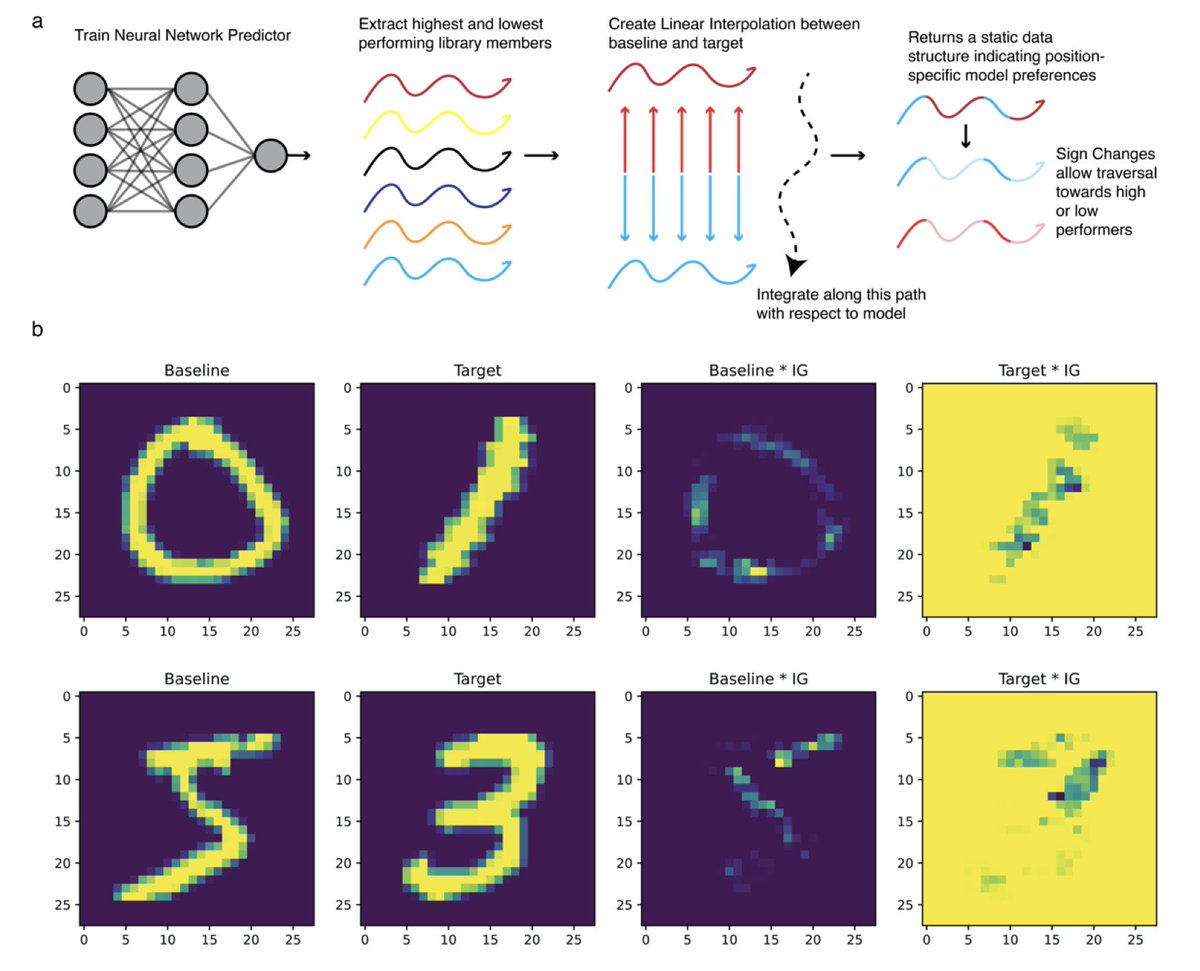
1.The paper introduces DIGs (Design by Integrated Gradients), a simple yet versatile algorithm for mRNA design. It enables precise, end-to-end optimization of mRNA elements—5' UTR, coding sequence, and 3' UTR—based on predictive models without requiring differentiable inputs.
2.DIGs leverages integrated gradients, originally a model interpretation tool, to extract nucleotide preferences between high- and low-performing sequences. This creates a traversable array used to design novel sequences that retain or amplify desirable features.
3.Using DIGs, the authors engineered mRNA UTRs to maximize ribosome load or stability. When tested experimentally, DIGs-optimized UTRs significantly enhanced protein expression—up to 4.6x over non-optimized constructs.
4.The study reveals that coherent selection of mRNA components (e.g., both 5' and 3' UTRs optimized for the same attribute like stability or translation) leads to higher expression. Incoherent combinations—mixing optimizations for conflicting attributes—often yield suboptimal results.
5.The approach is highly generalizable. DIGs successfully redesigned viral UTRs to preserve miRNA binding while improving translation or stability, enabling cell-type-specific expression in both immune and non-immune cells.
6.DIGs also integrates transcriptomic and CLIP-seq data to design UTRs with regulatory motifs (e.g., CIRBP or miRNA-122 binding sites), achieving improved expression and functional selectivity in different cell types.
7.For coding sequences, DIGs designs synonymous variants by optimizing both mRNA secondary structure and context-specific codon usage. It generates extremely unstructured, high-expression CDS designs not accessible via other tools.
8.Experimental tests show that DIGs-designed CDSs using liver-specific codons outperform highly structured designs from tools like LinearDesign, suggesting that context-aware codon usage may supersede folding energy in determining expression.
9.Transcriptomic analyses challenge traditional design dogma. Upregulated genes in immune settings tend to have lower secondary structure, while tissue-specific preferences (e.g., liver vs spleen) imply a need for contextual design strategies.
10.DIGs stands out by combining model-driven design with experimental and omics data. It avoids the limitations of generative methods that require differentiable pipelines or massive training datasets, making it both scalable and versatile.
📜Paper: biorxiv.org/content/10.1101/…
#RNA #SyntheticBiology #mRNA #ComputationalBiology #MachineLearning #Bioinformatics #GeneTherapy #AI4Bio
AMPGen: an evolutionary information-reserved and diffusion-driven generative model for de novo design of antimicrobial peptides @NatureComms
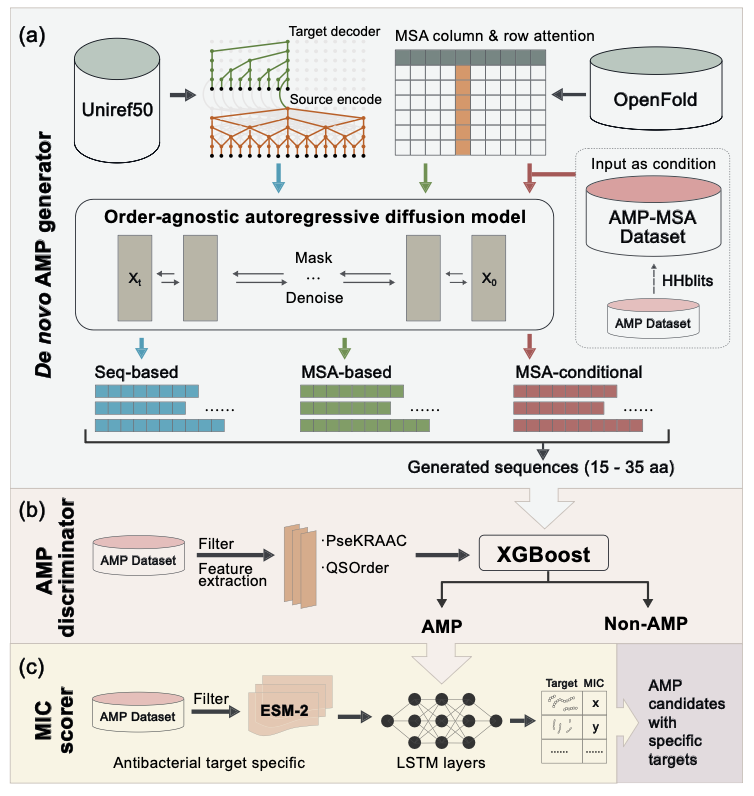
1.AMPGen is a generative AI model specifically built to design antimicrobial peptides (AMPs), a class of short, flexible, and structureless proteins that conventional protein design models struggle to handle effectively.
2.Unlike existing models, AMPGen integrates protein evolutionary information using multiple sequence alignments (MSAs) as conditional input to guide generation. This evolutionary signal significantly improves the design of functionally active AMPs.
3.The model employs a diffusion-based generator trained on the OpenFold MSA dataset, which is order-agnostic and autoregressive, enabling the generation of diverse and biologically plausible short peptide sequences.
4.AMPGen uses a cascade architecture consisting of a generator, a binary XGBoost-based discriminator for AMP classification, and a long short-term memory (LSTM) network for predicting target-specific antibacterial potency (MIC values).
5.By incorporating evolutionary priors into the latent space, AMPGen outperforms baseline models in generating functionally promising AMP sequences. It achieved a 47.4% AMP candidate rate from clean sequences, compared to 16.0% and 6.8% from the MSA-based and sequence-based baselines, respectively.
6.Among the sequences designed using AMPGen, 38 candidates were synthesized and experimentally tested. 81.6% exhibited antibacterial activity, with many showing broad-spectrum effects against both Gram-positive and Gram-negative bacteria.
7.Experimental validation revealed that 9 candidates had strong activity (MIC < 5 μM) across four bacterial species: E. coli, S. aureus, P. aeruginosa, and E. faecalis, demonstrating the model's potential for designing broad-spectrum antibiotics.
8.AMPGen’s generator effectively assimilates biochemical constraints and evolutionary diversity, as evidenced by the high sequence novelty. None of the validated peptides matched entries in current AMP databases.
9.Structurally, the generated peptides showed a mix of α-helices, β-sheets, and linear motifs. Conformational diversity was confirmed via AlphaFold and PepFold4 predictions, reflecting the model’s learned flexibility.
10.AMPGen-generated sequences also showed low hemolytic and cytotoxicity profiles, supporting their potential as antibiotic candidates with good selectivity toward bacterial membranes.
11.Compared to previous AMP generative models like PepGAN or VAE-based systems, AMPGen demonstrated higher experimental success rates and sequence diversity, driven by its MSA-conditioned diffusion process.
12.While powerful, AMPGen still faces challenges in precisely designing target-specific peptides due to limitations in training data granularity and biological variability across bacterial strains.
13.The model architecture—particularly its modular, interpretable cascade—may generalize to other peptide families beyond AMPs, offering a promising framework for therapeutic peptide discovery.
📜Paper: nature.com/articles/s42003-0…
#ProteinDesign #AntimicrobialPeptides #AI4Bio #DiffusionModels #GenerativeBiology #Bioinformatics
SenolyticSynergy: An Attention-Based Network for Discovering Novel Senolytic Combinations via Human Aging Genomics
1.This study presents SenolyticSynergy, a novel deep learning framework using a multimodal attention mechanism to predict synergistic combinations of senolytic drugs targeting aging-related genes.
2.The model highlights a top-ranked drug pair, Temsirolimus + Nitazoxanide, with a predicted synergy score of 13.28. Molecular docking showed both drugs bind to overlapping mTOR regions, suggesting potent combined efficacy.
3.Unlike conventional senolytic discovery, this work uses aging-relevant gene expression datasets (GSE72815, GSE141595) to derive a focused set of 1,624 aging-related genes for model training.
4.SenolyticSynergy leverages large-scale DrugComb synergy data (330k+ pairs) and fine-tuned attention networks to specialize synergy prediction in aging contexts. Only combinations where both drugs appeared in the training set were considered high-confidence.
5.From 1,953 possible senolytic drug pairs derived from 63 known compounds, 190 combinations were retained after rigorous filtering. Ten combinations scored above 8, indicating high predicted synergy.
6.The study explores how synergy can arise from targeting the same (e.g., PI3K-Akt-mTOR by Temsirolimus and Nitazoxanide) or different pathways (e.g., MAPK and NF-κB by Fisetin and Azithromycin).
7.Enrichment analysis of the 1,624 core genes points to calcium signaling, MAPK, PI3K-Akt, and NF-κB pathways as central to aging and senescence regulation—providing a mechanistic backbone for drug synergy.
8.Experimental literature supports several predictions: Cantharidin + ABT-737 and Fisetin + Azithromycin have been shown to work synergistically in cell models, validating the approach.
9.Molecular docking simulations confirm overlapping and complementary binding patterns for high-scoring combinations, enhancing interpretability and biological plausibility of the model's outputs.
10.This work proposes a scalable and interpretable framework for senolytic discovery that bridges human aging genomics and computational synergy modeling, offering a new tool for personalized anti-aging therapy design.
📜Paper: biorxiv.org/content/10.1101/…
#Aging #Senolytics #DrugDiscovery #DeepLearning #Bioinformatics #AI4Bio #AntiAging #SystemsBiology #AttentionMechanism

BIOREASON: Incentivizing Multimodal Biological Reasoning within a DNA-LLM Model
1.BIOREASON integrates a DNA foundation model directly into a large language model (LLM), enabling the LLM to reason over genomic sequences as first-class inputs—a previously unsolved challenge in AI for biology.
2.The architecture supports interpretable, multi-step reasoning from DNA variants to disease phenotypes, combining DNA embeddings with natural language queries to produce transparent, stepwise predictions.
3.BIOREASON achieves 97.2% accuracy on KEGG-based disease pathway prediction—up from 88% for DNA-only baselines—while also articulating the reasoning process behind predictions.
4.Unlike DNA foundation models that operate as black boxes, BIOREASON generates explanatory biological traces using tags, revealing molecular mechanisms and gene interactions involved in disease.
5.A core innovation is its multimodal input strategy: contextualized DNA embeddings are prepended to user queries and processed by the LLM with unified attention, preserving positional relationships and semantic structure.
6.The system is trained using a hybrid approach—supervised fine-tuning followed by Group Relative Policy Optimization (GRPO)—to reward logical coherence and stepwise deduction in its outputs.
7.Three curated datasets underpin BIOREASON’s development, including a new KEGG-derived reasoning benchmark with 1,449 examples linking genetic variants to 37 diseases via structured molecular pathways.
8.On variant effect prediction tasks (VEP), BIOREASON outperforms standalone DNA and LLM models by 10–30% in accuracy and F1-score, demonstrating strong generalizability to both SNVs and non-SNVs.
9.The model not only identifies whether a variant is pathogenic but explains why—for instance, tracing a C>G mutation in PFN1 through disrupted cytoskeletal dynamics to ALS.
10.Compared to prior genomics-focused LLMs like GeneGPT or TxGemma, BIOREASON uniquely processes raw DNA and text in tandem, offering deeper mechanistic insight rather than surface-level database lookups.
11.Its outputs are structured as question-answer pairs with detailed mechanistic traces, facilitating expert validation and hypothesis generation—especially valuable in clinical and research contexts.
12.Limitations include scalability concerns for long sequences and the need for better uncertainty quantification, but future work will address transcriptomic and proteomic extensions.
13.BIOREASON sets a new bar for interpretable, multimodal AI in biology, bridging the gap between high-dimensional genomic encoders and language-based scientific reasoning.
💻Code: github.com/bowang-lab/BioRea… 📜Paper: arxiv.org/abs/2505.23579v1
#Genomics #AI4Bio #LLM #DNA #MultimodalAI #Bioinformatics #VariantInterpretation

VENUSX: Unlocking Fine-Grained Functional Understanding of Proteins
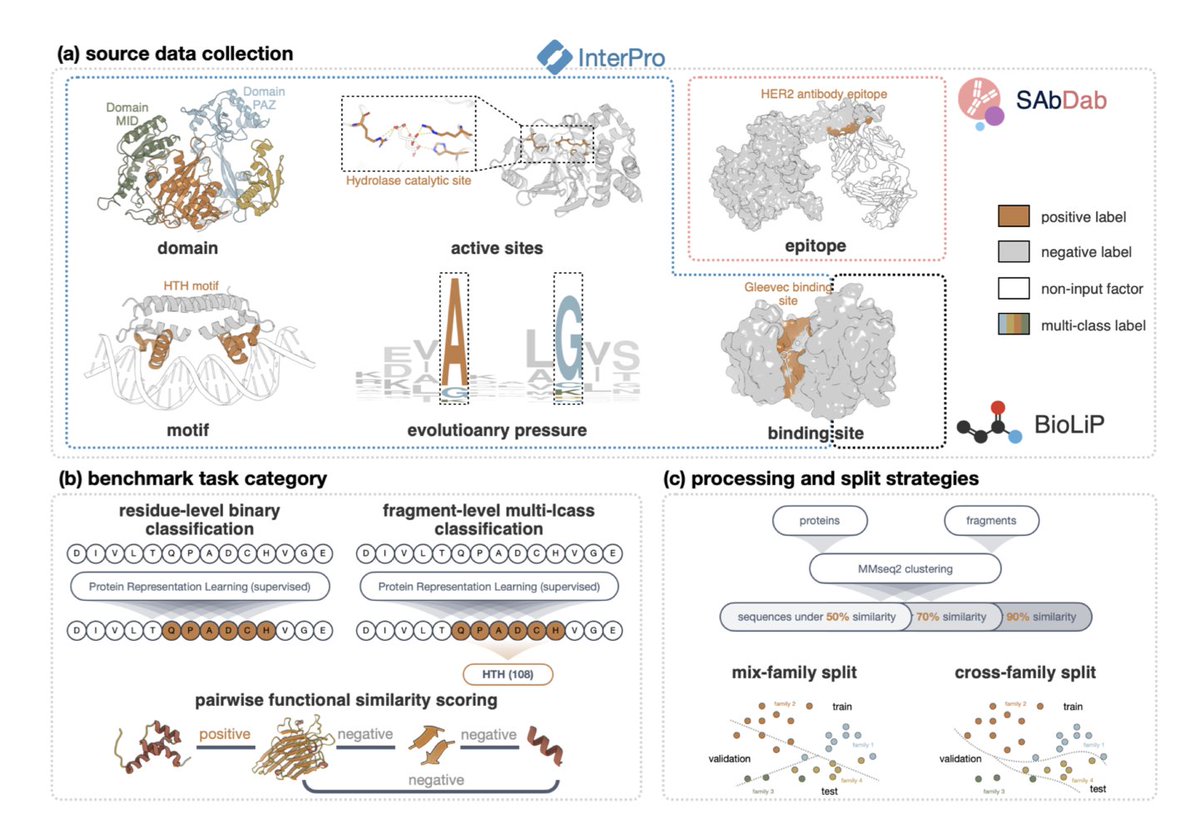
1.VENUSX is the first large-scale benchmark specifically designed to evaluate protein models at fine-grained functional levels—residue, fragment, and domain—addressing the critical gap left by coarse protein-level annotations in existing benchmarks.
2.It introduces three comprehensive task categories: residue-level binary classification, fragment-level multi-class classification, and pairwise functional similarity scoring, spanning over 878,000 curated examples and 56 datasets.
3.Residue-level tasks target the identification of functionally important residues, such as catalytic, binding, and epitope sites, enabling evaluation of models on fine-resolution interpretability and mechanistic understanding.
4.Fragment-level classification maps functional subregions to their InterPro family types (e.g., domains, motifs), supporting applications like domain annotation, multi-function prediction, and structural proteomics.
5.The pairwise similarity task assesses how well models capture functional relationships between proteins or fragments without supervision—crucial for enzyme discovery and remote homolog detection.
6.VENUSX is built from three high-quality sources: InterPro for functional domains and motifs, BioLiP for ligand binding sites, and SAbDab for antibody–antigen epitopes. Each entry is rigorously filtered and aligned with AlphaFold structures.
7.Both in-distribution (mix-family) and out-of-distribution (cross-family) splits are included, across identity thresholds of 50%, 70%, and 90%, enabling fair and challenging generalization tests.
8.Baseline evaluation covers diverse models: protein LMs (e.g., ESM2, PROTBERT), sequence–structure hybrids (e.g., SAPROT, PROTSSN), structure-only networks (e.g., GVP-GNN), and alignment tools (e.g., BLAST, TM-ALIGN, FOLDSEEK).
9.In residue-level tasks, sequence–structure models like SAPROT-650M outperform LMs by large margins on cross-family splits, especially for harder targets like catalytic and binding sites.
10.Fragment-level results show similar trends, with hybrid models achieving higher accuracy and macro-F1 scores—particularly in label-imbalanced settings where structure helps mitigate data skew.
11.In similarity scoring, structure-based methods like FOLDSEEK and TM-VEC dominate, but large sequence–structure models (e.g., PROTT5, SAPROT) are highly competitive and computationally more efficient.
12.Results highlight that many popular protein models generalize poorly to fine-grained tasks, often relying on global distributional cues rather than true functional signals—VENUSX exposes these limitations systematically.
13.The benchmark includes standardized naming conventions, balanced class splits, and interpretable evaluation metrics (AUPR, macro-F1, ROC-AUC), fostering reproducibility and benchmarking best practices.
14.VENUSX provides a critical resource to guide the development of next-generation protein models that are biologically interpretable, generalizable across protein families, and capable of learning fine-resolution function.
💻Code: github.com/ai4protein/VenusX
📜Paper: arxiv.org/abs/2505.11812
#ProteinFunction #Benchmarking #ResidueLevelAnnotation #ProteinLanguageModels #StructuralBiology #FunctionalPrediction #AI4Biology #ComputationalBiology
Multiobjective learning and design of bacteriophage specificity
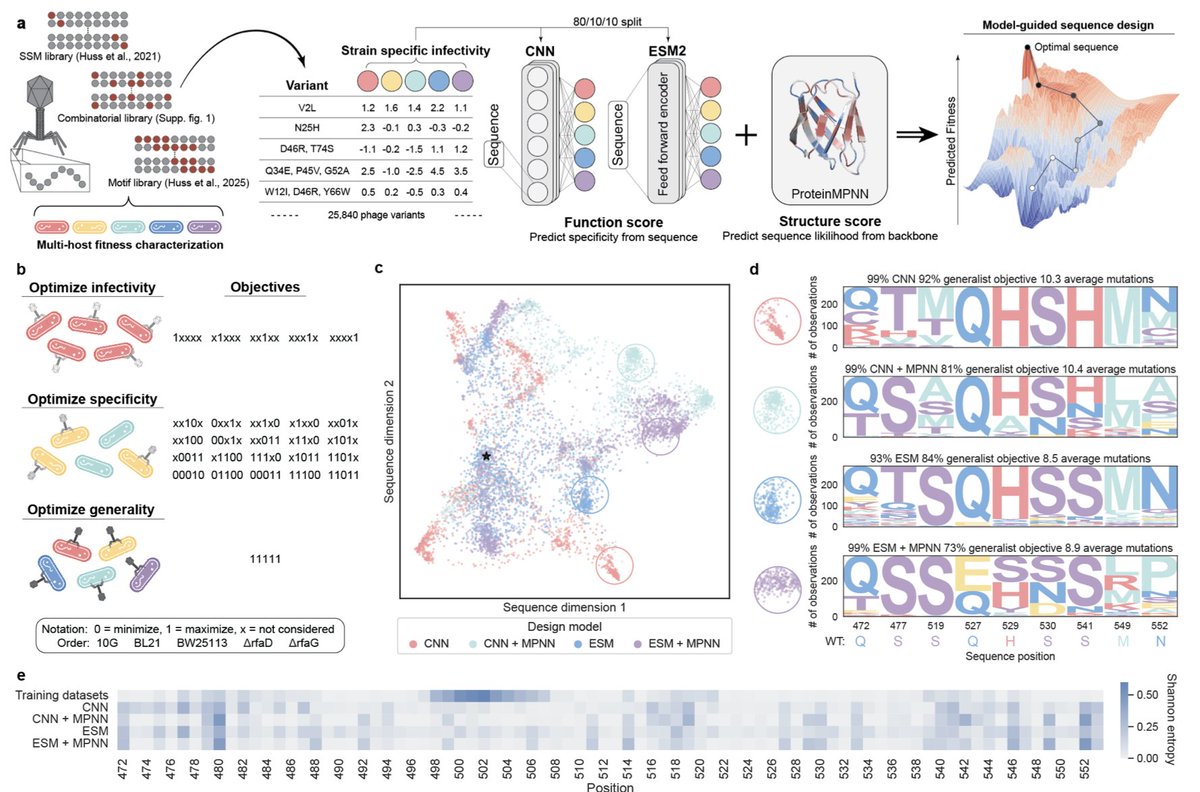
1.This study presents a landmark demonstration of multiobjective machine learning to design bacteriophages with tunable infectivity, precise host specificity, and broad generality, optimizing over 26 complex tasks across five E. coli strains.
2.Using deep mutational scanning data for 26,838 T7 RBP variants, the authors trained sequence-function models (CNN and fine-tuned ESM2) to predict strain-specific virulence, achieving high predictive accuracy (weighted Spearman ~0.8) even on held-out multi-mutant data.
3.Four design strategies were implemented—CNN, CNN+MPNN, ESM2, and ESM2+MPNN—guiding simulated annealing to generate 7,845 synthetic phage variants, each optimized for infectivity, multi-strain specificity, or generalist virulence.
4.Strikingly, only a few mutations were often sufficient to invert or reprogram phage specificity. In several cases, phages with just 3 substitutions achieved completely opposite host preferences to wild-type T7, underscoring the evolutionary plasticity of RBP.
5.The authors validated designs using pooled sequencing-based selection and plaque assays, with some engineered variants showing >10,000-fold increases in specificity or infectivity over wild-type.
6.ESM2+MPNN was the best-performing model for high-complexity tasks, such as simultaneously minimizing virulence on resistant hosts while maximizing it on susceptible ones—demonstrating the value of structure-aware constraints for multiobjective tradeoff resolution.
7.For generalist design, 9-mutant phages generated by CNN or ESM2+MPNN infected all five training strains with >50% success, and ~35% of these also generalized to infect eight unseen receptor-deletion strains, including ClearColi and ΔtonA/B.
8.Despite training only on five strains, generalist-optimized variants exhibited strong cross-host promiscuity, outperforming both infectivity- and specificity-focused phages in broad targeting—highlighting a scalable strategy for rapid phage discovery.
9.Mutation analysis revealed diverse functional optima for similar design goals: even among objectives sharing key host preferences, different sequence clusters and substitution patterns emerged—showcasing the model's ability to navigate a rugged fitness landscape.
10.ProteinMPNN inclusion biased the models toward more conservative mutations, reducing background noise and increasing specificity success in high-order objectives, though it had little effect on single-task infectivity.
11.Importantly, the authors show that models trained on high-throughput fitness data alone—without structure or evolutionary priors—are sufficient for successful single-objective design, but added constraints are beneficial for complex, multi-strain engineering.
12.This work establishes a powerful template for rational phage engineering, enabling low-throughput experimental validation and offering a scalable alternative to slow directed evolution methods that lack negative selection.
13.The framework has broad applicability to other mutable biological systems like enzymes, transporters, and receptors—where conflicting functional requirements must be balanced across large sequence spaces.
📜Paper: biorxiv.org/content/10.1101/…
#BacteriophageDesign #MachineLearning #SyntheticBiology #HostSpecificity #ProteinEngineering #PhageTherapy #AI4Biology #ComputationalBiology
DS-ProGen: A Dual-Structure Deep Language Model for Functional Protein Design
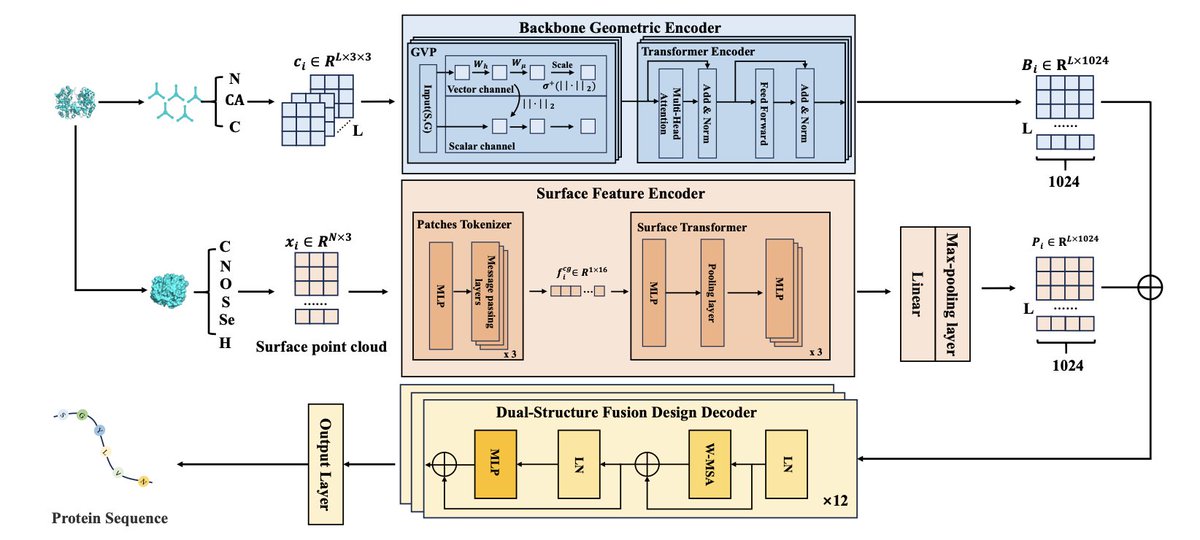
1.This paper presents DS-ProGen, the first inverse folding model to integrate both backbone geometry and molecular surface features for functional protein design, achieving state-of-the-art recovery accuracy on challenging benchmarks.
2.DS-ProGen uses a dual-encoder framework: a geometric encoder for backbone atoms (N, C, Cα) and a surface encoder that processes atomic types, curvature, and chemical environments via a Transformer-based patch encoder.
3.These multimodal features are fused in a Transformer decoder based on the ProGen2 architecture, enabling autoregressive amino acid sequence generation that respects both global topology and surface chemical specificity.
4.On the PRIDE benchmark, DS-ProGen reaches a 61.47% recovery rate, significantly outperforming strong baselines like ProteinMPNN (48.44%), PiFold (51.74%), and ESM-IF (51.85%), especially on short (<100 aa) sequences.
5.Ablation studies confirm that both structural encoders contribute meaningfully: removing the surface encoder drops performance to 50.71%, and removing the backbone encoder plummets recovery to 31.06%.
6.Pretraining on 4M+ structure-sequence pairs offers a 19% gain over training from scratch, underlining the importance of large-scale structural priors in boosting generalization and convergence.
7.Beyond sequence recovery, DS-ProGen achieves the lowest RMSD (1.40 Å) among all tested models when evaluated via AlphaFold3, confirming that designed sequences reliably refold into accurate 3D structures.
8.DS-ProGen also excels in downstream design tasks involving ligand and ion binding: predicted sequences yield binding pockets that preserve native residue placement and geometry in ATP-, GTP-, and Cu2+-binding proteins.
9.Sequence diversity remains high: despite strong structural alignment, designed sequences share only 61.9% identity with native sequences, indicating DS-ProGen does not merely memorize input but captures functional constraints.
10.Compared to unimodal inverse folding models (e.g., ESM-IF, SurfPro), DS-ProGen’s integration of chemical surface information enables better binding site modeling and more accurate design near functionally critical interfaces.
11.Its modular architecture and surface-aware encoding make DS-ProGen well-suited for future extensions into RNA folding, protein–ligand interface engineering, and multi-objective biodesign pipelines.
12.Limitations include reliance on AlphaFold-predicted structures, use of fixed-size surface patches that may omit irregular features, and constraints due to pretraining on precomputed datasets.
💻Code: github.com/chq1155/PRIDE_Ben…
📜Paper: arxiv.org/abs/2505.12511
#ProteinDesign #InverseFolding #SurfaceEncoding #AlphaFold #LanguageModels #AI4Biology #ComputationalBiology #DrugDiscovery
AI assisted design of ligands for Lipocalin-2
1.This study presents a fully automated, AI-guided pipeline that designs de novo miniproteins targeting Lipocalin-2 (LCN2), a neuroinflammatory marker implicated in blood-brain barrier disruption and CNS diseases like Alzheimer’s and Parkinson’s.
2.Starting from 10,000 RFdiffusion-generated scaffolds, the team used ProteinMPNN for sequence design and AlphaFold2 for structural triage. 1,184 binders were selected with interface pAE < 10, and the top 5 (by PRODIGY-predicted ΔG) were expressed and purified.
3.Of the five candidates, MinP-2 emerged as a nanomolar binder with dissociation constant Kd = 0.7 nM, nearly matching antibody affinities while maintaining a much smaller 12-kDa size—key for potential blood-brain barrier penetration.
4.Biophysical validation showed MinP-2 is monomeric, soluble, and thermally stable, with DLS and nanoDSF confirming favorable biophysical profiles compared to similar AI-designed scaffolds.
5.BioLayer Interferometry confirmed strong binding for MinP-2, while the other four miniproteins showed minimal to moderate interaction—demonstrating the pipeline’s ability to enrich for true positives through consensus scoring.
6.AlphaFold2 structural modeling revealed that MinP-2 binds via a short antiparallel β-augmentation interface, dominated by backbone hydrogen bonds—suggesting a modular binding motif that could be grafted onto other scaffolds.
7.Docking simulations using AlphaFold3 suggest that MinP-2 sterically interferes with both NGALR and MMP-9 binding interfaces on LCN2, positioning it as a promising antagonist of neuroinflammatory signaling.
8.This work addresses the critical therapeutic gap in targeting LCN2: no current small molecules or antibodies cross the blood-brain barrier efficiently to block LCN2-mediated interactions—MinP-2 offers a potential breakthrough.
9.The design–build–test cycle was completed in a single pass using only computational and E. coli-based systems, validating the practicality and scalability of AI-driven miniprotein engineering.
10.The authors propose MinP-2 as a lead candidate for affinity maturation, structural elucidation, and in vivo evaluation—paving the way for LCN2-targeted diagnostics or therapies in neurodegenerative and inflammatory diseases.
📜Paper: biorxiv.org/content/10.1101/…
#MiniproteinDesign #AlphaFold #Neuroinflammation #AI4Biology #LCN2 #ProteinEngineering #DrugDiscovery #ComputationalBiology

Foundation Models for AI-Enabled Biological Design
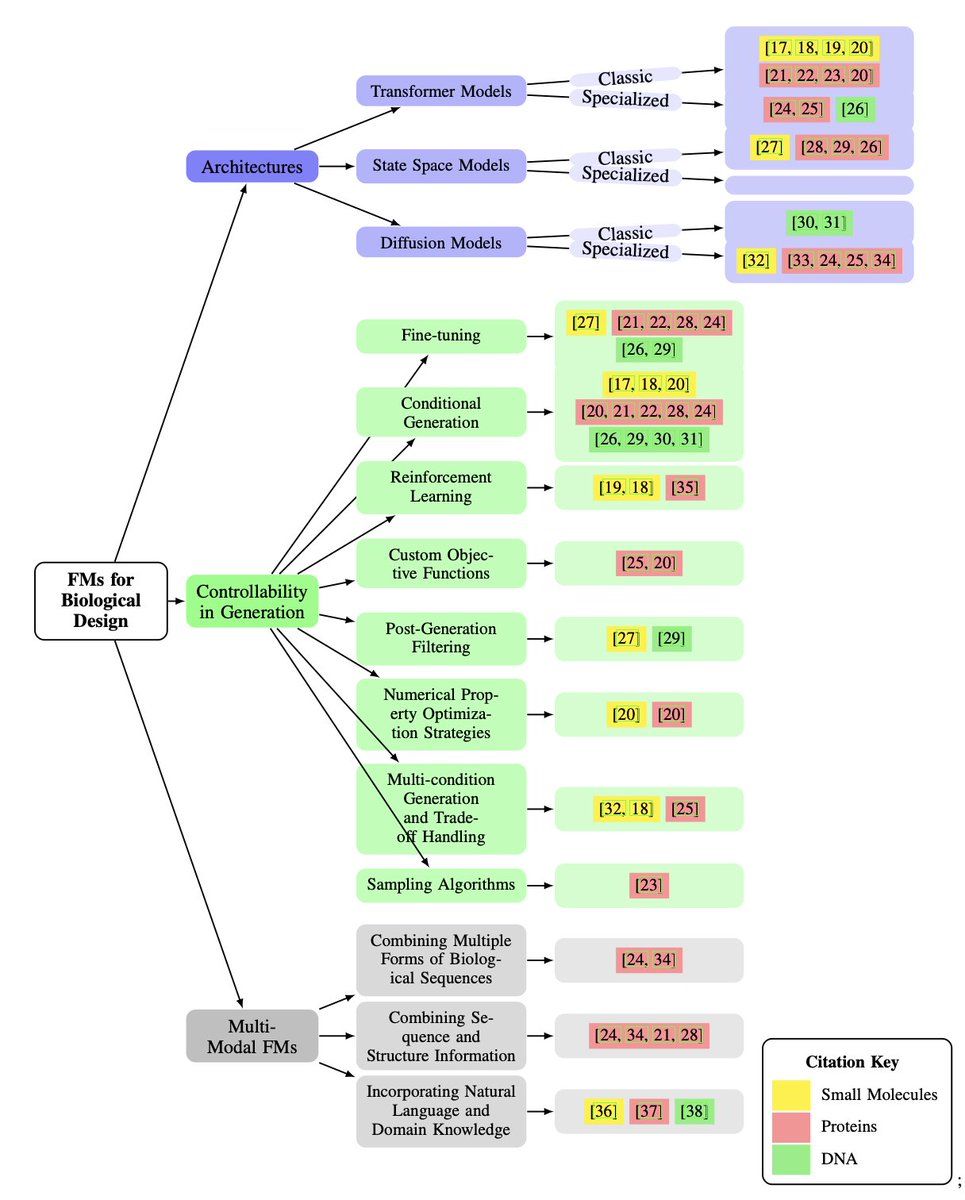
1.This survey provides the most comprehensive taxonomy to date of foundation models (FMs) in biological design, classifying dozens of recent models by domain, architecture, and generation method—across proteins, DNA, and small molecules.
2.The paper identifies three dominant FM architectures—Transformers, State Space Models (SSMs), and Diffusion models—and explores their adaptations for sequence-based biological generation tasks such as protein engineering, regulatory DNA design, and de novo molecule synthesis.
3.It highlights how biological FMs differ from their NLP counterparts: biological data often involves long-range dependencies, multi-modal information (sequence + structure), and requires fine-grained controllability for practical lab synthesis.
4.Transformer-based models dominate protein and small molecule design, with tools like ProGen2 and MolGPT showing strong performance. However, for ultra-long genomic sequences, SSMs like HyenaDNA and Evo offer better scalability and memory efficiency.
5.Diffusion models are emerging as a promising paradigm for biology, enabling structure-aware and controllable generation. Examples include DNA-Diffusion, DiscDiff, and EvoDiff, which model regulatory sequences and protein families with evolutionary noise.
6.The authors emphasize controllability as a key FM challenge—covering strategies like conditional generation, fine-tuning, reinforcement learning, and custom loss functions. Models like Regression Transformer and NOS exemplify successful multi-objective optimization.
7.The survey calls attention to tradeoffs in sequence generation—validity vs. novelty, or multi-property balance—and how models like MCMG and DiffuMol attempt to manage them using RL or stepwise diffusion control.
8.Multi-modal integration is a rising frontier. Models like MMDIFF and RFDiffusionAA combine sequence and structural information to co-generate functional macromolecular complexes, while tools like ChatNT and Nach0 bridge biological data and natural language.
9.The authors highlight open problems: unclear architectural best practices across tasks, weak performance in low-data regimes, lack of benchmarking standards, and limited capability in generating rare or novel function/property combinations.
10.They argue that domain-specific self-supervised objectives, better pretraining strategies, and improved biological modality integration (e.g., Gene Ontology graphs, chemical graphs) will be critical to unlock the full potential of FMs in biology.
11.The paper concludes with a call for interdisciplinary efforts to standardize evaluation, promote generalization, and prioritize practical design capabilities—especially given the growing societal and scientific investment in FM-driven discovery.
📜Paper: arxiv.org/abs/2505.11610
#FoundationModels #ProteinDesign #DNASequenceGeneration #SyntheticBiology #MolecularDesign #AI4Biology #ComputationalBiology #MultiModalAI
Artificial Intelligence And First Principle Methods In Protein Redesign: A Marriage Of Convenience?
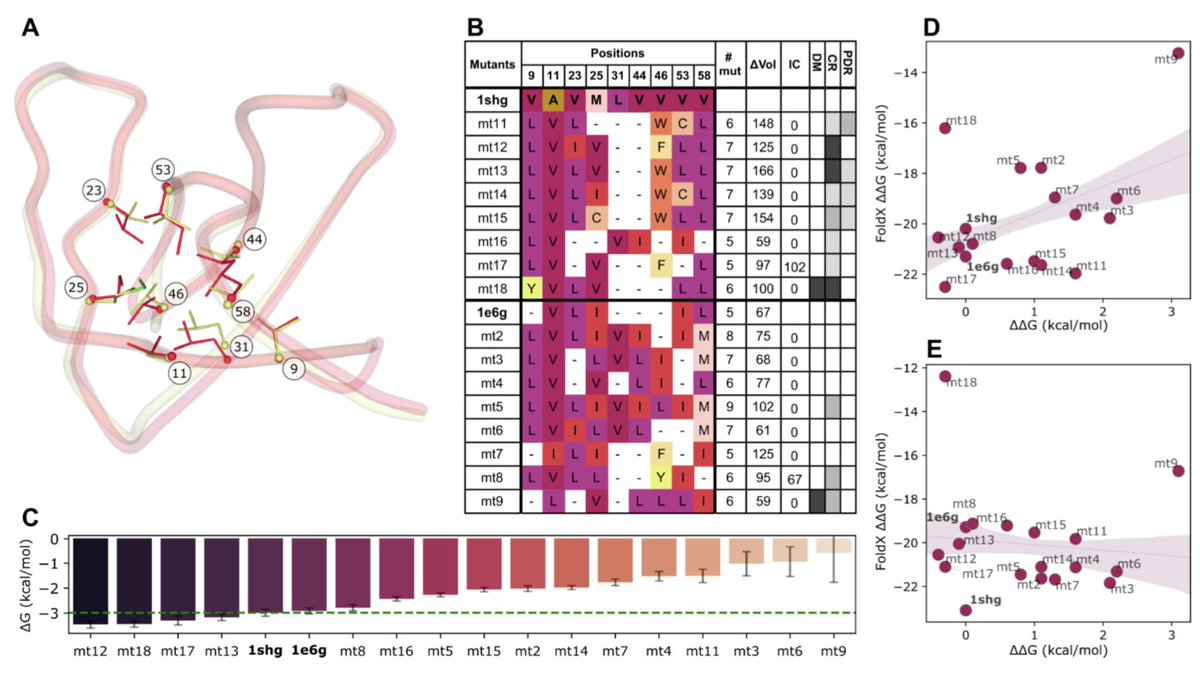
1.This study systematically compares modern AI-based tools and first-principle force field methods for multi-site protein redesign, focusing on structure, stability, and practical predictive value.
2.The authors introduce TriCombine, a new structure-guided inverse folding tool based on residue triangles (TriXs), which selects mutations using a geometry-based database and scores them for compatibility, independent of prior domain knowledge.
3.They redesigned the hydrophobic core of the SH3 domain, generating 16 multi-mutation variants with up to 9 substitutions. These were evaluated experimentally via folding stability and X-ray crystallography.
4.EsmFold, AlphaFold2, and RoseTTAFold were benchmarked alongside force fields (FoldX, Rosetta) and inverse folding models (ProteinMPNN, Esm_inverse) for their ability to predict the stability of designed variants.
5.For complex mutants, combining EsmFold models with FoldX scoring (EsmFold_F) and AlphaFold2 with Rosetta scoring (AlphaFold2_R) yielded the best balance of precision and correlation with experimental ΔΔG values.
6.EsmFold outperformed others in reproducing native-like 3D structures and side chain orientations, especially when used without relaxation. Refinement sometimes degraded side chain accuracy in residues where Cα was misplaced.
7.Force fields (FoldX, Rosetta) remained best for predicting point mutations and independent substitutions, especially on natural proteins with crystallographic structures, as seen across the GB1 and Mega-scale datasets.
8.In large-scale benchmarks (e.g. 160,000 GB1 mutants), Esm_inverse surpassed FoldX for predicting stable designs involving 3–4 mutations, while FoldX had better precision for point mutations.
9.TriCombine, while less accurate on single mutations, performed best for multi-residue mutations in artificial domains—its design accommodates small backbone rearrangements and geometric variability.
10.The Mega-scale benchmark showed that all models struggled on de novo proteins without known structures, underlining the limitations of structure-based tools when AlphaFold models lack crystallographic support.
11.TriCombine’s use of TriX geometrical patterns and substitution frequencies offers an interpretable and efficient approach to design proteins with multiple concurrent mutations, especially in hydrophobic cores.
12.The work emphasizes that hybrid strategies combining AI modeling (EsmFold/AlphaFold2) and physical scoring (FoldX/Rosetta) are essential for accurate multi-mutation redesign in therapeutic protein engineering.
📜Paper: biorxiv.org/content/10.1101/…
#ProteinDesign #AI4Biology #FoldX #AlphaFold2 #EsmFold #InverseFolding #TriCombine #SH3 #StabilityPrediction #SyntheticBiology #Rosetta #DeNovoDesign #ComputationalBiology
A unified multimodal model for generalizable zero-shot and supervised protein function prediction
1.This study introduces FunBind, a multimodal foundational model that predicts protein function by integrating five heterogeneous modalities: sequence, structure, InterPro domain annotations, textual descriptions, and GO terms—enabling both supervised and zero-shot predictions.
2.FunBind uses contrastive learning to align all modalities into a shared embedding space, using sequence as the central anchor—allowing it to operate even when some data modalities are missing, a major advance over existing models.
3.The model excels at zero-shot function prediction, assigning GO terms never seen during training to proteins based solely on modality similarity. Its performance surpasses prior zero-shot methods, achieving high Recall@5 across CC (91.3%), MF (90.5%), and BP (78.4%).
4.Text modality turned out to be especially informative—outperforming sequence across all metrics—and its emergent alignment with GO terms via the sequence backbone reveals strong latent cross-modality connections.
5.FunBind achieves the best performance when combining modalities: a weighted consensus approach using sequence, structure, InterPro, and text leads to Recall@5 up to 93% and Mean Reciprocal Rank of 0.90 in CC.
6.The model architecture includes frozen encoders (ESM2-t48 for sequence, ProtST for structure, LLaMA2 for text and GO terms) and a Mixture of Experts gating module that produces diverse, modality-specific embeddings.
7.For supervised classification, FunBind is fine-tuned to predict pre-selected GO terms using available modalities. On a large test set, it outperforms current SOTA models (DeepGO-SE, TransFew, SPROF-GO) across all metrics in all GO categories.
8.In terms of AUPR for Biological Process (BP), FunBind reaches 0.429, over 10 percentage points higher than the best SOTA baseline, indicating substantial improvement in annotating complex biological functions.
9.FunBind also generalizes well to novel proteins with less than 30% sequence identity to training data. On this “Test Novel” set, it continues to outperform all existing methods, confirming strong robustness and transferability.
10.Textual annotations drive especially strong gains in BP and MF predictions, while InterPro and sequence offer complementary stability. Structural features (from FoldSeek’s 3Di) contribute modestly, suggesting room for richer representations.
11.The authors propose extending FunBind to incorporate protein–protein interaction networks and to fine-tune the backbone encoders for further gains, especially in settings where structure or domain data is sparse.
12.Overall, FunBind establishes a new standard for zero-shot and supervised protein function prediction, offering a flexible and interpretable model that supports robust function inference—even for novel proteins or rare annotations.
💻Code: github.com/jianlin-cheng/Fun…
📜Paper: biorxiv.org/content/10.1101/…
#ProteinFunction #ZeroShotLearning #MultimodalAI #Bioinformatics #DeepLearning #ContrastiveLearning #GOterms #GeneOntology #ProteinAnnotation #FunBind #GNN #ProteinEmbedding #AI4Bio

Experimental Evaluation of AI-Driven Protein Design Risks Using Safe Biological Proxies
1.This study presents the first large-scale, experimental evaluation of AI-driven protein design (AIPD) risks by generating and testing synthetic homologs of safe proxy proteins—offering a model for understanding the dual-use potential of AIPD technologies.
2.Using three protein targets of increasing complexity—PDZ3 (binding domain), URA3 (enzyme), and T7 RNA polymerase (transcription factor)—the authors benchmarked 300 synthetic homologs generated with open-source models like ProteinMPNN and EvoDiff.
3.Despite high predicted structure similarity to wildtype, most AI-generated sequences failed to retain measurable activity, especially for complex proteins—highlighting the limitations of current AIPD systems in reliably redesigning functional proteins.
4.The team developed a replicable Testing, Evaluation, Validation, and Verification (TEVV) framework, enabling systematic empirical assessment of AIPD model predictions using bacterial, yeast, and cell-free expression assays.
5.29% of PDZ3 synthetic homologs retained binding activity, but most URA3 and all T7 RNAP homologs were inactive—suggesting that protein function is significantly harder to preserve than structure during sequence rewriting.
6.Surprisingly, some PDZ3 homologs showed low sequence identity and predicted structure similarity yet exhibited activity, pointing to nonspecific binding and emphasizing the importance of orthogonal validation.
7.Even at low sequence identity, most active homologs were still detectable by simple BLAST searches, suggesting that biosecurity screening systems based on sequence similarity remain robust under current AIPD capabilities.
8.However, a few highly obfuscated yet weakly active sequences (e.g., Homolog 70) show the potential for sequence-structure decoupling, indicating long-term risk as models improve and generate novel folds.
9.The study demonstrates that reliable evasion of biosecurity screening while preserving function is not currently feasible using open-source AIPD tools and highlights the significant expertise and time needed for wet-lab TEVV.
10.This work offers a realistic benchmark for assessing the capabilities and limits of AIPD in both research and biosecurity contexts, providing a practical path for labs to validate generative model outputs safely and effectively.
11.The authors call for better integration of experimental data in AIPD model development, more rigorous validation of sequence-function relationships, and standardized TEVV protocols using benign proxy proteins.
💻Code: github.com/usnistgov/AIPD_TE…
📜Paper: biorxiv.org/content/10.1101/…
#AI4Biosecurity #ProteinDesign #AIPD #Bioengineering #DualUse #SyntheticBiology #ProteinFunction #OpenScience #AlphaFold #ProteinMPNN #Biosecurity #RiskAssessment

SYNEVO: Towards Synthetic Evolution of Biomolecules via Aligning Protein Language Models to Biological Hardware
1.SYNEVO is a closed-loop AI-driven framework that combines protein language models (pLMs), high-throughput experimental feedback, and reinforcement learning (RL) to enable synthetic evolution of biomolecules beyond the limitations of template-based methods.
2.The system directly synthesizes diverse protein sequences—without relying on parent-child mutation chains—and optimizes them via iterative experimental testing and RL fine-tuning, bridging generative AI and wet-lab automation.
3.As a proof of concept, SYNEVO was applied to Zinc Finger (ZnF) DNA-binding proteins. Using pLMs like ESM-IF, ESM3, Progen2, and ZymCTRL, two sequence libraries were generated and tested using CIS display in a cell-free setup.
4.ProtRL, an RL-based method using Direct Preference Optimization (DPO), refined the generative models using enrichment scores obtained via next-gen sequencing after rounds of target binding selection.
5.The second library, generated with ProtRL, achieved a 15-fold improvement in producing positively enriched ZnF variants compared to the first library, with some variants surpassing wild-type (WT) binding performance.
6.In silico validation was conducted using AlphaFold3 to simulate co-folding of ZnF proteins with DNA targets. ProtRL optimization increased contact probabilities with target DNA while maintaining structural and electrostatic features.
7.A head-to-head simulation of SYNEVO versus Directed Evolution (DE) over 10 iterations showed that SYNEVO explored broader sequence space, generated more diverse high-fitness proteins, and did so more efficiently.
8.Unlike DE, which is limited by template-based mutation steps, SYNEVO samples freely across the genotype space and adapts based on experimental rewards, creating a "super-Darwinian" optimization loop.
9.Multi-objective reward functions—including TM-score similarity, electrostatic charge, and AF3 contact probabilities—enabled the model to evolve ZnF variants with improved structural and functional features.
10.SYNEVO integrates experimental phenotype feedback at every generation step, effectively aligning pLM sampling with protein engineering goals without manual filtering or structure-based constraints.
11.The approach promises high scalability, automation, and generalizability, making it suitable for a wide range of protein engineering tasks including therapeutic design, synthetic biology, and enzyme engineering.
12.Published at the GEM Workshop at ICLR 2025, SYNEVO marks a shift toward autonomous biomolecular design systems that unify machine learning and biology for iterative, feedback-driven optimization.
📜Paper: openreview.net/forum?id=mNEL…
#ProteinEngineering #SyntheticBiology #ProteinLanguageModels #ReinforcementLearning #Biodesign #AI4Bio #ICLR2025 #ZincFinger #DirectedEvolution #GenerativeBiology #SYNEVO

Most Popular Users

Elon Musk 
@elonmusk
240.3M followers

Barack Obama
@barackobama
118.6M followers

Cristiano Ronaldo
@cristiano
114.4M followers

Donald J. Trump
@realdonaldtrump
111.8M followers

Narendra Modi
@narendramodi
106.9M followers

Rihanna
@rihanna
98.7M followers

NASA
@nasa
92.2M followers

Justin Bieber
@justinbieber
91.7M followers

KATY PERRY
@katyperry
89.9M followers

Taylor Swift
@taylorswift13
83.9M followers

Lady Gaga
@ladygaga
75.4M followers

Virat Kohli
@imvkohli
73.3M followers

Kim Kardashian
@kimkardashian
70.8M followers

YouTube
@youtube
68.6M followers

Neymar Jr
@neymarjr
66.3M followers

Bill Gates
@billgates
65.2M followers

Selena Gomez
@selenagomez
63M followers

The Ellen Show
@theellenshow
62.1M followers

CNN
@cnn
61.7M followers

X
@x
60.6M followers