

Top Tweets for #RNAEngineering

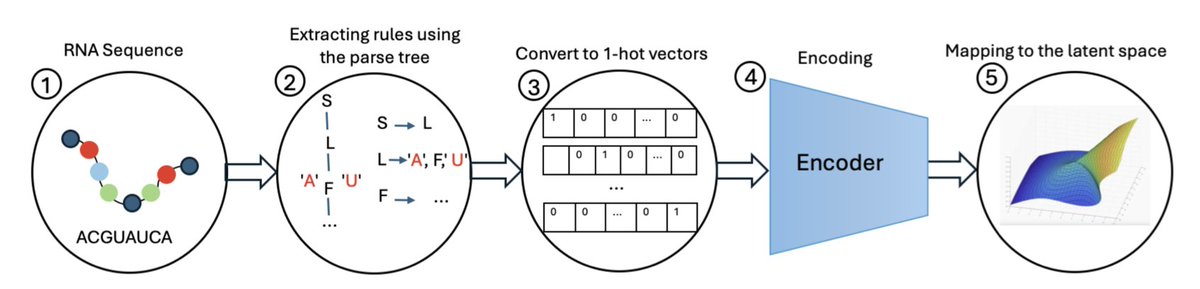
Efficient Design of RNA Sequences with Desired Properties, Structure, and Motifs Using a Grammar Variational Autoencoder
1. This paper introduces the RNA Grammar Variational Autoencoder (RGVAE), a novel deep learning approach for designing RNA sequences with specific target properties, including structural stability, desired motifs, and other constraints. The RGVAE leverages stochastic context-free grammars (SCFGs) to ensure that generated RNA sequences form thermodynamically stable secondary structures.
2. The RGVAE builds on the grammar variational autoencoder (GVAE) framework, incorporating SCFGs to parse RNA sequences into production rules. These rules are then encoded into a continuous latent space, where optimization can be performed efficiently. The optimized latent representations can be decoded back into RNA sequences with desired characteristics.
3. The authors demonstrate that the RGVAE significantly outperforms traditional methods such as randomized design and regular VAEs that do not utilize SCFGs. The model is tested on various practical use cases, including minimizing minimum free energy (MFE), maintaining specific GC content, and incorporating mandatory or forbidden motifs.
4. One of the key innovations of the RGVAE is its ability to optimize RNA sequences in the latent space using Bayesian optimization. This approach allows for efficient exploration of the design space, even for complex constraints involving multiple properties and structural requirements.
5. The study shows that the RGVAE can generate RNA sequences with lower MFE compared to training data and other models, while also satisfying additional constraints such as GC content and specific secondary structures. The flexibility of the model allows it to be applied to a wide range of RNA design scenarios.
6. The authors provide the source code and data used in the study, making it accessible for further research and development in RNA design. The RGVAE represents a significant advancement in the field of bioinformatics, offering a powerful tool for the design of functional RNA molecules with specific properties.
💻Code: github.com/nzarnaghinaghsh/R…
📜Paper: arxiv.org/abs/2507.15912
#RNAEngineering #DeepLearning #Bioinformatics #RNASequences #GrammarVAE
Capturing Natural Evolution in Function-guided RNA Design via Genomic Foundation Models
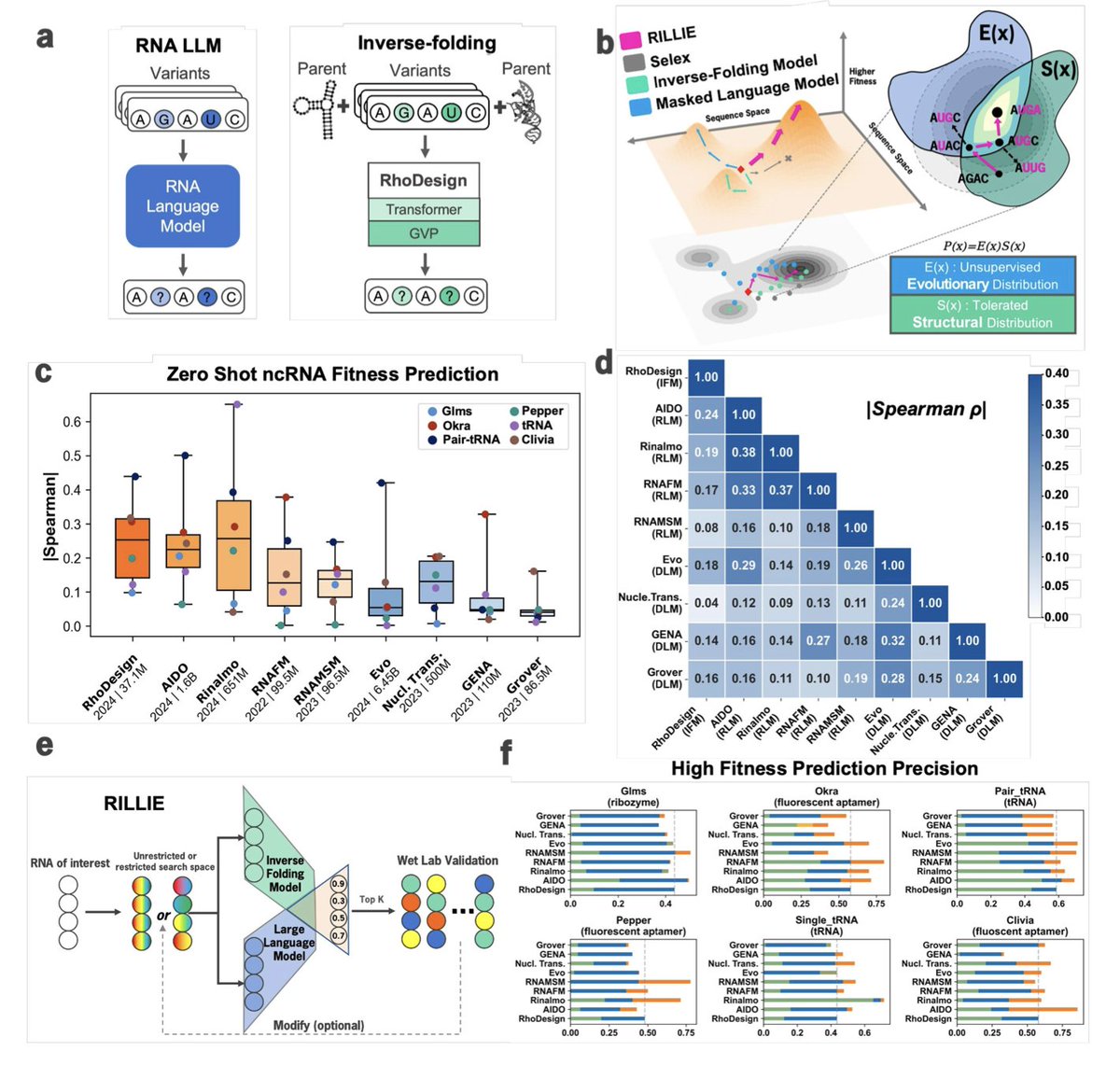
1. This study introduces RILLIE, a zero-shot RNA design framework that combines large language models (LLMs) and inverse folding models (IFMs) to simulate natural evolution and optimize RNA sequences for in vivo function—without any task-specific training.
2. RILLIE integrates AIDO.RNA, a 1.6B-parameter RNA LLM capturing evolutionary plausibility, with RhoDesign, an inverse folding model capturing structural compatibility, forming a “product of experts” model that jointly optimizes for sequence and structure fitness.
3. Unlike traditional SELEX or task-specific ML pipelines, RILLIE operates in a zero-shot setting, rapidly generating RNA variants that maintain natural sequence grammar and structural integrity while enhancing experimental performance.
4. Benchmarking across six diverse DMS datasets (aptamers, tRNAs, ribozymes), RILLIE demonstrates high correlation between model scores and experimental RNA fitness, significantly outperforming both RNA and DNA LLMs alone.
5. Applied to the Broccoli aptamer, RILLIE generated 20 variants in a single round—over half showed increased fluorescence, with B2 achieving a 55% boost in intensity and a 2x improvement in binding affinity, verified via FACS in living HEK cells.
6. For the Pepper aptamer, a two-round directed evolution strategy yielded 40 novel variants, with fluorescence boosts up to 2.6-fold and 3x binding affinity improvement. Over 40% of sequences outperformed wild type, including high-mutation variants with up to 75% sequence divergence.
7. Mutation preference analysis revealed that RILLIE avoids deleterious substitutions (e.g., C5G, U19A) and favors beneficial mutations in variable regions, showing strong alignment with natural selection patterns and high-fitness precision.
8. Importantly, sequences designed with RILLIE retained performance in vivo, demonstrating improved folding and function in HEK cells—a major challenge for aptamers designed solely via in vitro methods like SELEX.
9. RILLIE’s framework can generalize to other RNA classes beyond aptamers. The model was shown to perform well in predicting mutational effects across ribozymes and tRNAs, opening pathways for universal RNA engineering.
10. This work provides the first large-scale evidence that integrating structural and sequence models allows for scalable, evolution-guided, task-agnostic RNA design—enabling a paradigm shift in synthetic biology and RNA therapeutics.
💻Code: github.com/GENTEL-lab/RILLIE
📜Paper: biorxiv.org/content/10.1101/…
#RNAEngineering #SyntheticBiology #RNAaptamers #ZeroShotLearning #LanguageModels #InverseFolding #Bioinformatics #AptamerDesign #RNAtherapeutics #LLM #RILLIE #DirectedEvolution
Integrating experimental feedback improves generative models for biological sequences
1. This work introduces a likelihood-based reintegration method that incorporates experimental feedback into generative models for RNA and protein sequences, drastically reducing false positives without altering model architecture.
2. Applied to DCA models, the reintegration method penalizes non-functional sequences and rewards functional ones using weighted likelihoods, refining the generative boundaries of viable sequence space.
3. Across multiple RNA families from Rfam, reintegration improved the fraction of predicted functional sequences from ~50% to over 99%, as measured by thermodynamic stability using RNAeval folding free energy.
4. In chorismate mutase (CM) protein design, the percentage of predicted functional sequences increased from 39% to 68% after reintegration, with minimal loss in diversity, validating the approach on real protein fitness landscapes.
5. Experimental validation on Group I intron ribozymes confirmed that reintegrated models generate far more active sequences at higher mutation distances—up to 63.7% activity at 45 mutations, compared to 6.7% for the non-reintegrated model.
6. A variant of the reintegration scheme, REINT BS0, grouped sequences by mutation bins and maintained balance across distance levels, successfully mitigating overfitting to wildtype and extending functional generation up to 65 mutations.
7. Reintegration consistently improves the model’s ability to predict actual fitness (proxy or experimental), showing stronger correlation between model energy and experimental activity post-training.
8. The approach is general and compatible with any generative model (e.g. VAEs, RBMs, PLMs), and it only requires adjusting the data likelihood to reflect experimental results—offering broad utility in data-driven biological design.
9. The key insight is that limitations of generative models are often due to underinformative training data, not model expressivity; refining these models with experimental labels substantially enhances their predictive power.
10. This work offers a practical, principled path to more reliable biomolecular design—by closing the loop between generative prediction and experimental feedback, and doing so in a mathematically tractable way.
📜Paper: arxiv.org/abs/2504.01593
#ProteinDesign #RNAEngineering #GenerativeModels #MachineLearning #SyntheticBiology #Bioinformatics #DCA #MolecularDesign #ComputationalBiology #HighThroughput #RNA #ProteinEngineering

RiboFlow: Conditional De Novo RNA Sequence-Structure Co-Design via Synergistic Flow Matching
1. This paper introduces RiboFlow, a novel framework designed for de novo RNA sequence-structure co-design. Unlike previous models, RiboFlow incorporates both RNA backbone frames and torsion angles, effectively capturing the dynamic conformations of RNA while ensuring sequence-structure consistency.
2. The model leverages a synergistic flow matching approach to generate RNA structures and sequences based on target molecules. By conditioning on ligand geometry, RiboFlow models RNA-ligand interactions and optimizes binding affinity, outperforming state-of-the-art RNA design methods.
3. A new benchmark dataset, RiboBind, is presented, which includes 1,591 RNA-ligand complexes and 3,012 RNA-ligand pairs. This dataset offers comprehensive structural diversity, providing a valuable resource for training and evaluating RNA-ligand interaction models.
4. RiboFlow achieves a 2.2-fold improvement in the AF3 binding metric and a 50% increase in validity compared to existing models. Its co-design strategy allows the generation of RNA sequences that are structurally valid and have high binding affinity to specific ligands.
5. The model is also capable of controlling the generation process to produce RNAs with desired properties, making it suitable for applications in RNA-based therapeutics, biosensing, and synthetic biology.
6. RiboFlow’s performance is further enhanced through a co-design pre-training strategy, which improves geometric awareness by distilling structural priors from RNA crystal structures.
7. Experimental results demonstrate that RiboFlow surpasses baseline models in terms of structural validity, diversity, novelty, and binding affinity, offering a promising tool for ligand-conditioned RNA design.
📜Paper: arxiv.org/abs/2503.17007
#RiboFlow #RNA #RNAEngineering #Bioinformatics #GenerativeModels #DeepLearning #RNASequenceDesign #MoleculeDesign #MachineLearning #AI

Last Seen Hashtags on Sotwe
ديوت_بدويٌّْ
Seen from Bahrain
mafercam()
Seen from Greece
incestoconmamá
Seen from Turkey
rapethreats
Seen from Turkey
desislut
Seen from India
sex
Seen from United States
yungho
Seen from United States
buttcrack
Seen from Sweden
pmv #goon
Seen from Spain
snapchattt ()()()()()()*****
Seen from United States
Most Popular Users

Elon Musk 
@elonmusk
240.3M followers

Barack Obama
@barackobama
118.6M followers

Cristiano Ronaldo
@cristiano
114.4M followers

Donald J. Trump
@realdonaldtrump
111.8M followers

Narendra Modi
@narendramodi
106.9M followers

Rihanna
@rihanna
98.7M followers

NASA
@nasa
92.2M followers

Justin Bieber
@justinbieber
91.7M followers

KATY PERRY
@katyperry
89.9M followers

Taylor Swift
@taylorswift13
83.9M followers

Lady Gaga
@ladygaga
75.4M followers

Virat Kohli
@imvkohli
73.3M followers

Kim Kardashian
@kimkardashian
70.8M followers

YouTube
@youtube
68.6M followers

Neymar Jr
@neymarjr
66.3M followers

Bill Gates
@billgates
65.2M followers

Selena Gomez
@selenagomez
63M followers

The Ellen Show
@theellenshow
62.1M followers

CNN
@cnn
61.7M followers

X
@x
60.6M followers