I’ve handed designers working HTML prototypes to “polish,” a word that understates how much of the product they still have to design.
Claude Code and Codex make it easier to demonstrate an idea. Once the interface responds, it becomes easy to assume someone has worked through its behavior. An agent or framework has often supplied answers to questions the team never discussed. Designers have to uncover those assumptions while figuring out how the experience should work beyond the conditions shown in the demo.
That work needs an environment of its own. A designer should be able to explore a workflow with different permissions or missing data, try another approach, and bring a colleague into the same situation for review. Building the setup each time takes time away from making those decisions.
The design system belongs at the center of this environment. Its components carry work the team has already resolved. The system also needs to carry designers’ reasoning about how those components fit together, with a way to examine what happens when an agent applies that guidance.
I would expand the design systems engineer’s role into a Design Platform Engineer, responsible for the infrastructure around this work, including AI skills and connectors. Designers would define the guidance and judge the results. The engineer would build and maintain the system that makes that process practical.
Asking designers to work in code means allocating engineering capacity to the environment they depend on.
Full essay, “Design Has a DevOps Problem”: https://t.co/5jSoQAb1Tf
A weird difference in Canadian and American tech culture is that those in Canadian tech are very resistant to making introductions with low signal. Like they have to be quite comfortable with everything involved to send a ping.
But in American tech it seems like there is much more openness to taking risks in making intros that probably won’t work out but have a high reputational reward if they do.
I’m personally much more comfortable with the American tech attitude on this, and I think it makes for a more vibrant community.
גרוק בוט משוגע!
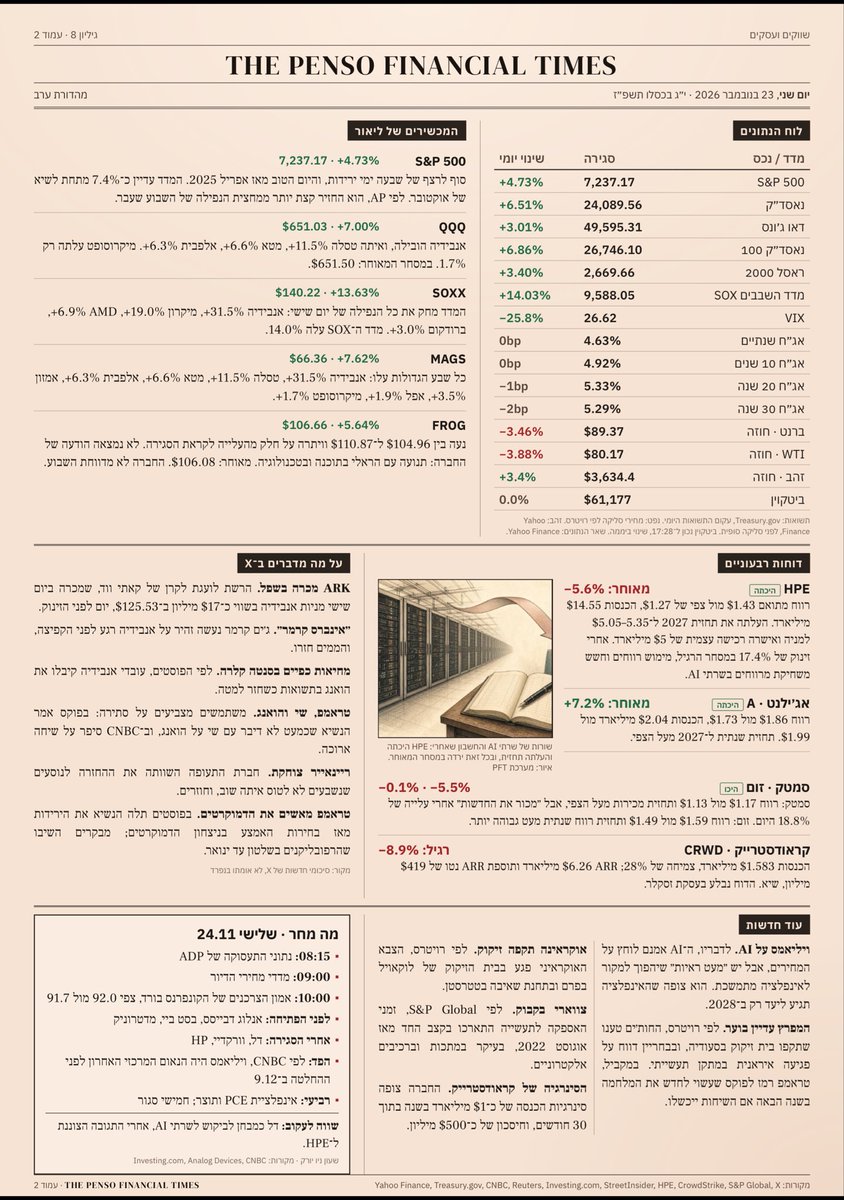
כבר שבוע וקצת, כל ערב אחרי סגירת המסחר, אני מקבל למייל עיתון כלכלי מתומצת ומותאם עבורי.
כל יום בשעה 17:30 שעון ניו יורק, בעולם של היצף מידע יש לי שני עמודי עיתון כמו פעם.
אגב בשישי הוא מוציא מהדורה נרחבת שמכסה גם את ישראל וכתבת מגזין.
@bot
It cost us about $1 to train our company's rulebook into an open model.
One rented GPU at 45 cents an hour, for about 20 minutes.
- 116 rules written down
- About 1,350 clean examples
- Trained without the rulebook
So the model has to actually learn the rules.
Our first try still made things up. Here's what fixed it 👇
AI is making software cheaper to build and skilled work cheaper to reproduce. A task that once cost $1,000 may eventually sell for $10 as competing agents become capable of performing it.
That could unlock enormous demand while making SaaS economics harder.
I wrote about who captures the value.
I finally built the 3D Strava activity visualizer of my dreams. It's called slab.
slab procedurally builds beautiful, artisanally styled (not AI!) terrain "slabs" of your most ambitious activities.
I love running uphill, and in spectacular places, and I'm always disappointed when I load up the flat, standard map and my hard work gets compressed down into a Flatland. slab is the solution!
My goal designing the styles was to make your routes feel "realer than real": to match the way you think of a big effort in your head afterwards, before you make the mistake of looking at the flat satellite map or iPhone-focal-length photo and wonder if maybe it wasn't so amazing after all...
DM me for the testflight if you want app version otherwise link below 😊
Back in January (ages ago) I wrote about how execution got so cheap that the hard part of projects became figuring out which ideas actually deserved the time.
Turns out that's basically my whole job now 🤷♂️
A complex feature takes us ~2-3 days to get to prod at @CopilotKit (shorter for greenfield @0penBot). I can prototype something before lunch. I asked an eng lead if we'd have a really complex new feature by Wednesday and got "whoa whoa whoa, Wednesday?! I can do Thursday or Friday” instead of next month or next quarter. Crazy.
So, much of my day is spent keeping up, scoping and spec'ing high impact work and deciding whether the thing should exist in the first place.
Stakeholder alignment is still stakeholder alignment though. Haven't found an AI accelerant for that one yet.
GPUs are just the first constraint. The harder challenges in enterprise AI are security, trust, and control.
@Get_Writer has shipped 10+ production models and 20+ frontier research papers. Next: secure, American-built, open, domain-specific business models, coming in weeks to months.
Zero data retention. Non-negotiable.
🔗 https://t.co/U2e0j11Vno
Build it with us. Join Writer.
hello Anthropic folks! congratulations! it is time to get to know the San Francisco Opera. let me know, I’m very happy to take you and show you around! retweet to boost!
Signal says it will restrict screenshots by default to stop AI agents from reading private chats on phones but warns its new protections are "incomplete" (@katielpaul / Reuters)
(Visit Techmeme dot com for the link and full context!)
saas runs on software, so everyone is building a software factory
the hardest part of building agents is the context (or knowledge that they have)
if youre building agents, you should be building a knowledge factory
New trailer for Luca Guadagnino's ‘ARTIFICIAL’, starring Andrew Garfield as Sam Altman.
The film follows the story involving OpenAI focused on the firing & rehiring of CEO Sam Altman.
In theaters on January 8.
Frontier AI companies do not expose any of their internal, AI-related data (that could be used for eg training/insights) to any third-party.
At the same time, they are building tools and solutions for companies to expose their data and use cases to *them*.