@JohnEstesMath Nice work! I love the improvements (both in setup and in presentation) you've come up with. Extra columns *before* the pivot columns seems obvious in hindsight. I added it to my PT Gradebook playlist as the first video: https://t.co/HzlKdHAcUF
@DrChadWiley@dccmath@RobertTalbert @joshua_r_eyler @siwelwerd In the same vein, asking teachers if they ever had a student pass (or fail) a class that they didn't think really deserved to. Or did they ever fudge numbers to move a student up to a higher letter grade? If trad grading is "objective", those things shouldn't happen, right?
@sbagley We have weekly 2hr labs for calc2 (I use desmos). In non-lab classes, I start calc2 with integration stuff, but the labs start with taylor polys (only needs derivs; follows nicely from calc1). Ignore conv/div until the non-lab material gets to series. LMK if you want my labs.
@solidangles In calc, I assigned 1-2 (short) hw exercises due each day. Spot-check for completion (no pressure). Students can email a pic before class (no penalty or questions asked if absent). Attendance improved even though this system doesn't "require" attendance.
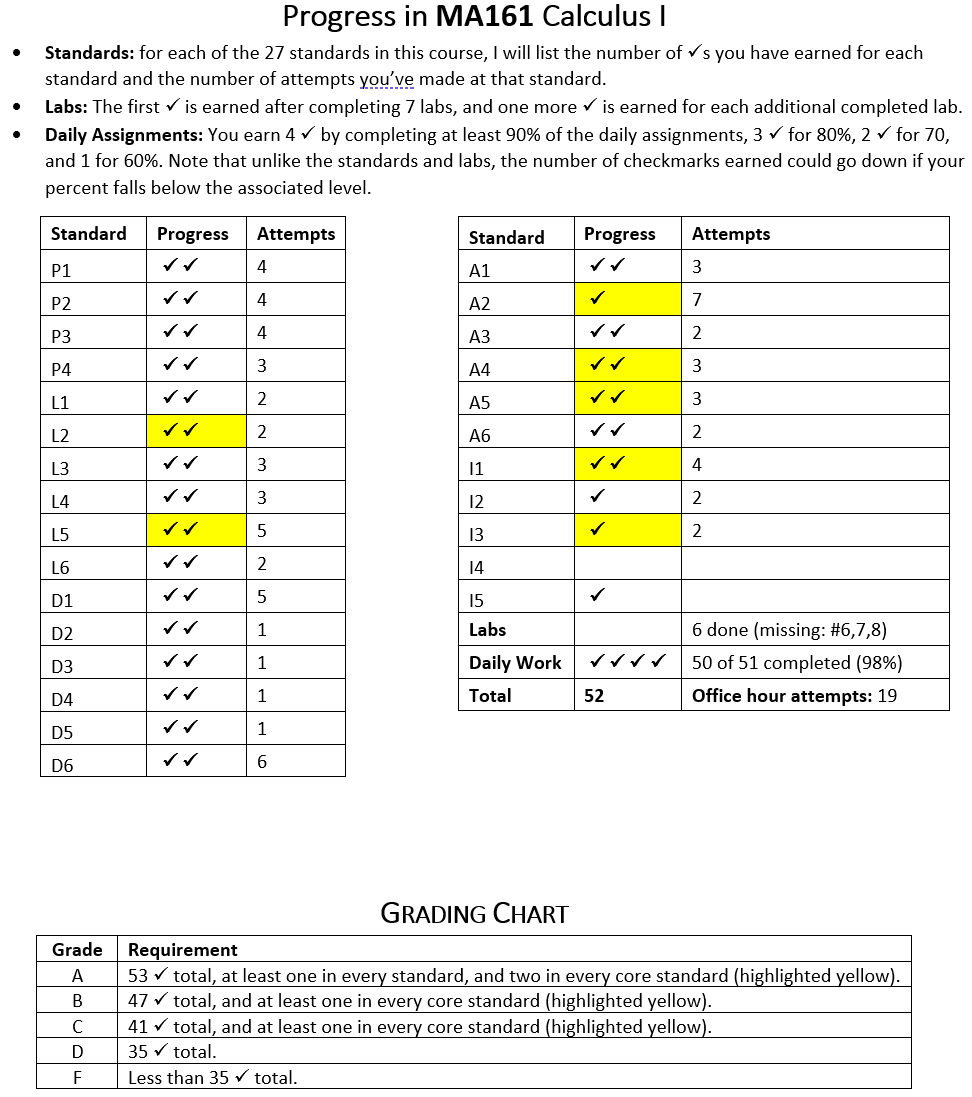
@matthematician @MasteryGrading Example: I have 25 standards, students can pass each twice. Each pass is a "checkmark". Completing at least 90% of daily homework across the whole semester is worth 4 checkmarks that just get thrown into the pool with everything else. They can fill in gaps but aren't required.
@AlexKontorovich I've been using it with great success in grad math courses. Having LaTeX support is great. They're more intrinsically motivated, so I use it more as a carrot than a stick (simplified scoring system; scores visible to students in real-time). Great for finding typos in the text!
@matthematician I use a mixture of fill-in-the-blank and using "☆" as a wildcard to be selected later. So far, I've been happy with the results. (Example video: https://t.co/mgUwFTFcQt)
@solidangles@moodle The next level is saving the comments for each problem in a spreadsheet that you can reuse each year. It gives me an incentive to carefully word feedback to common mistakes knowing that I can reuse it.
@neil_calkin I saw @_qnlw's example below, and it makes a lot of sense. I had considered Σ(-1)^n/ln(n), but not fixing the denominator for a few terms and going -,-,+,-,-,+,...
I was thinking up conjectures for my Adv. Calc class' exam and stumbled upon one that stumped me. Any ideas?
If \sum x_n converges, then there exists some integer m>1 such that \sum (x_n)^m converges.