PREPRINT UPDATE: Revised version now online.
From muscle fibres to muscle gears: How dynamic fascicle orientation and shape change impact skeletal muscle function?
Comments and feedback would be much appreciated. Link below:
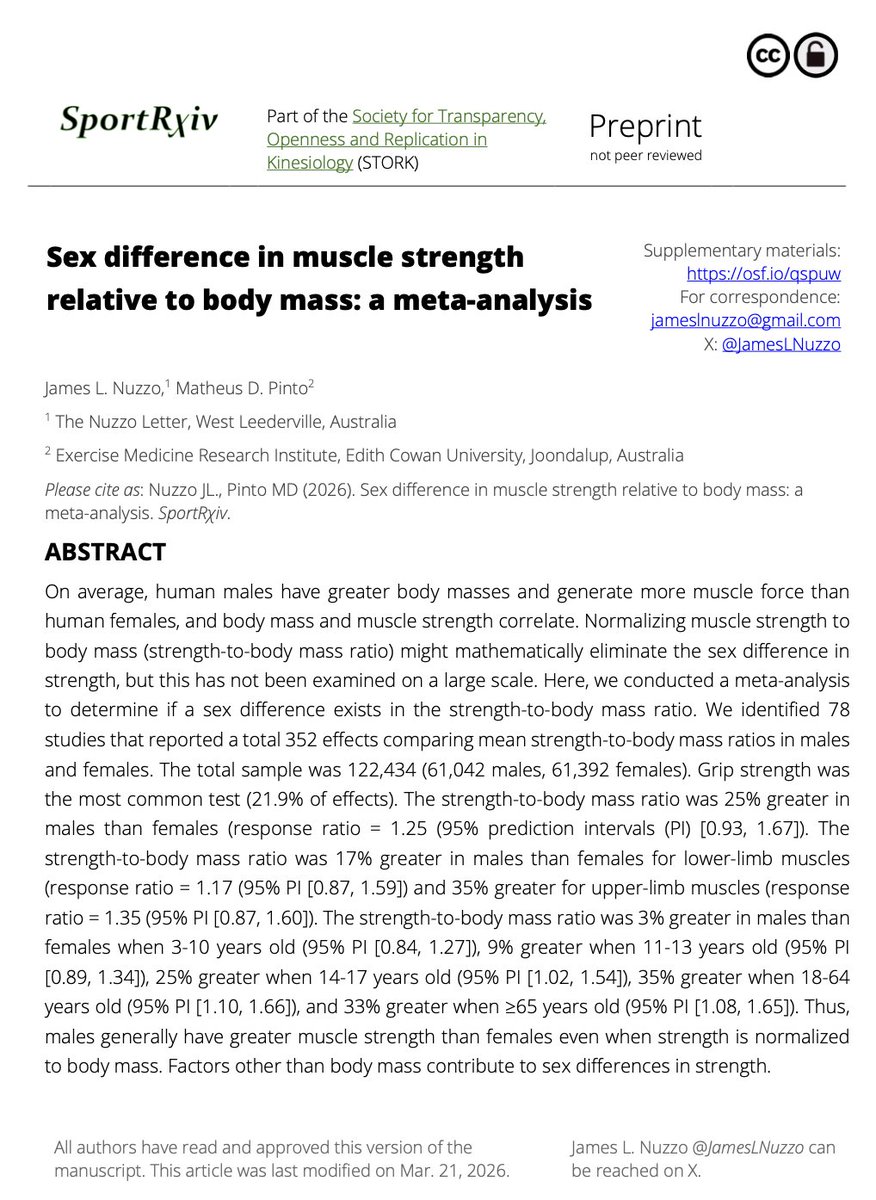
NEW: Pre-print of our new meta-analysis now available. Using data from 78 studies and over 120,000 males and females, we found that the muscle strength-to-body mass ratio is generally greater in males than females. Thus, dividing muscle strength by body mass does not mathematically eliminate the male strength advantage. This is likely because factors other than body mass contribute to the sex difference in muscle strength and because the relationship between muscle strength and body mass is not linear, which is what is assumed when dividing muscle strength by body mass (i.e., ratio scaling). Further, we found that the sex difference in the strength-to-body mass ratio is smallest in children and largest in adults, and it is greater in upper- than lower-limb muscles.
Note: This paper is currently undergoing peer review at a journal. Some contents of the pre-print will change after we receive feedback from reviewers.
How to Support Our Work:
This research was conducted independently, without institutional backing or external funding. If you value this work and would like to support it, please visit the GoFundMe link in the comments or in my pinned tweet. Thank you for your support.
Co-author: @MatheusdPinto
🧵NEW: Our latest paper is a meta-analysis of sex differences in upper- and lower-limb strength in kids aged 5-17 years old (3,497 boys; 3,137 girls).
Before, during, and after puberty, boys are stronger than girls on average. The sex difference in muscle strength is ~10% in 5–10-year-olds and increases to ∼40% in 14–17-year-olds. Throughout development, the sex difference in strength tends to be more pronounced in upper- than lower-limb muscles.
Co-author: @MatheusdPinto
@DustinOranchuk@Retlouping I think that in itself is already hinting they will display different fibre/ fascicle behaviours.. Yep, I think that'll do and maybe we just to remind they're isometric at the joint level - out of curiosity, which muscles/ joints are these commonly performed?
@DustinOranchuk@Retlouping@DustinOranchuk, thanks for clarifying. I'd think this is the first step before suggesting there are two 'forms of isometric muscle actions'
@Retlouping Do you know what the muscles and fascicles are doing during these 'isometric' contractions? Are they moving? Do they move differently? You are calling them "isometric muscle actions", so my interpretation is that the fascicles and the muscle remain at fixed length.
@ricardoNOmesqui@ActivateGlutes@jacksonfyfe@MathewPiasecki Well, yeah, I don't really know but... don't SCI patients face apoptosis of spinal motor neurones? So perhaps in extreme cases of disuse we might lose motor units regardless of age... but in any case, movement (and particularly lifting heavy weights) seems the way to go...
@ricardoNOmesqui@jacksonfyfe@MathewPiasecki Nice paper, I wasn't aware. I agree, but could that be muscle specific (and assocaited to training requirements)? In Figure 1, the Master's athlete has much bigger gastroc and soleus than the young and old representations (and myself haha). Would you expect MU loss on them?
@JamesSteeleII @AJThurston@AllenDowney@jonaslindeloev Would also be keen to see them. Were you teaching R coding or are they stats concepts? Or perhaps a mix of both?
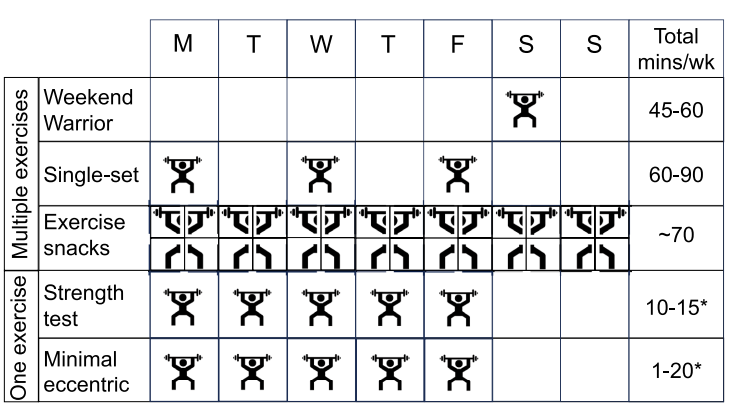
Even small doses of resistance training can have big benefits.
Some updated evidence on minimal dose resistance training approaches, including:
“Weekend warrior”: a single weekly resistance training session
“Single-set resistance training”: one set of multiple exercises, multiple days per week
“Resistance exercise snacking”: brief bouts performed once or multiple times daily
“Practising the test”: one maximal repetition in one or more sets, multiple days per week
“Eccentric minimal dose”: low weekly volumes of submaximal or maximal eccentric-only repetitions
All can improve muscle strength - and at lower doses than current recommended guidelines.
Nice work from @JamesLNuzzo and co.
https://t.co/rGsklJoo78
On this day last year, I was awarded the 1st prize for my presentation at the @AusHumanBiology conference. Almost a year later, the paper is now published open access in the @JBiomech.
Thank you reviewers for valuable feedback.
Link: https://t.co/vpyYwodsD4
@TonyBlazevich
@Mohamed67199696@peteburridge@gstevens21 If you haven't already shared, here is our paper discussing multiple devices for eccentric training.
https://t.co/MNUit2qsnW