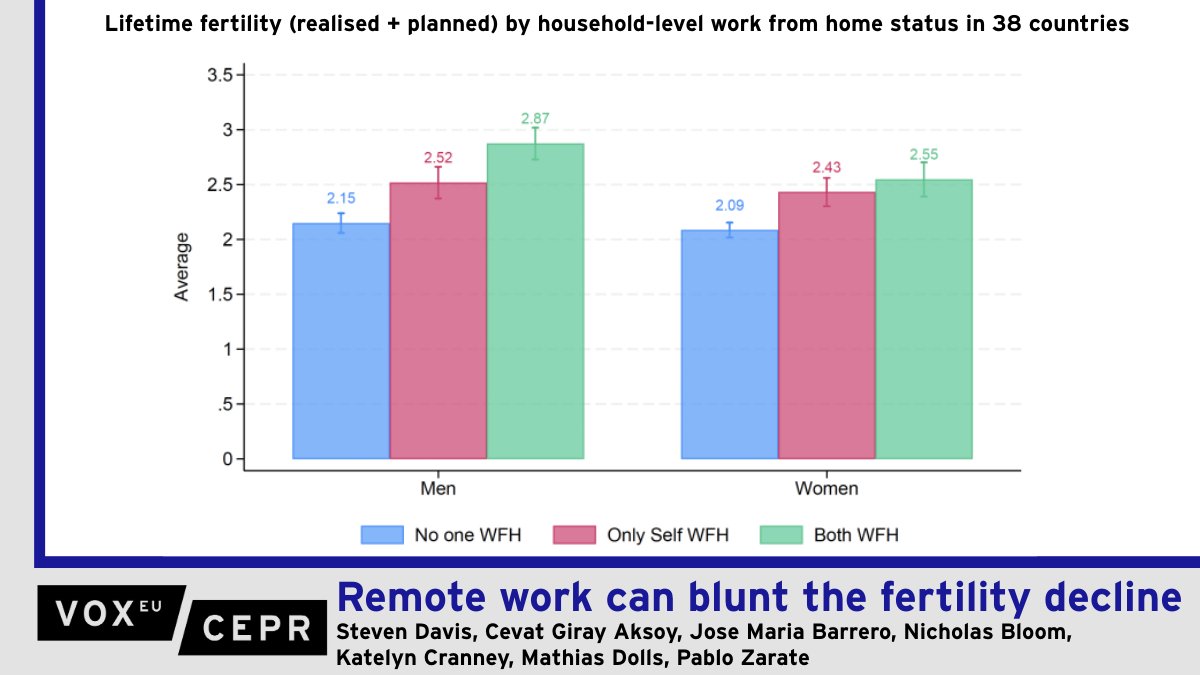
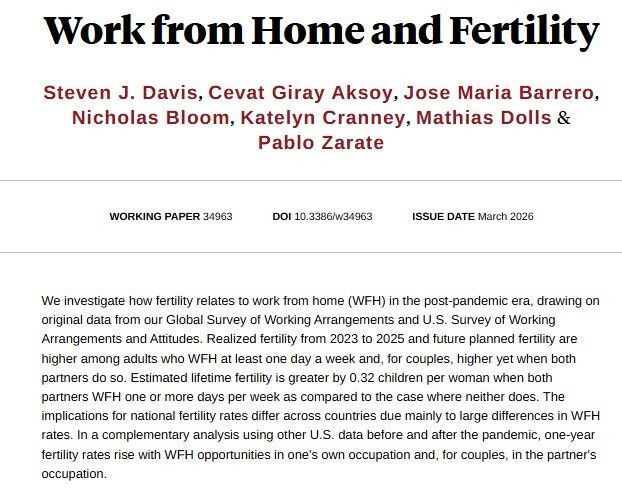
Working from home (WFH) raises fertility rates. Globally 0.3 extra kids per WFH couple, and in the US 0.5 extra kids per WFH couple, from Steven J. Davis, @cevatgirayaksoy, Jose Maria Barrero, @I_Am_NickBloom, Katelyn Cranney, @MathiasDolls, and @PabloZarate98 https://t.co/PwAAtf2OY7
We show how inflation-driven fiscal drag is shaping tax burdens across Europe and discuss what this means for fiscal policy and distribution. It’s been a great collaboration with the ESCB Network on Microsimulation Modelling. (2/2)
Die @BILD und die @nytimes berichten über unsere Forschung zu den Fertilitätseffekten des mobilen Arbeitens. Lesenswerte Artikel mit Tiefgang (1/3):
https://t.co/D9ssznyCJ8
Die @BILD und die @nytimes berichten über unsere Forschung zu den Fertilitätseffekten des mobilen Arbeitens. Lesenswerte Artikel mit Tiefgang (1/3):
https://t.co/D9ssznyCJ8
📊 Die Bevölkerung in 🇩🇪 lehnt Reformen mehrheitlich ab, die die Nachhaltigkeit der gesetzlichen Rentenversicherung stärken würden. Zu diesem Ergebnis kommt eine aktuelle Studie von @julia_baarck, @MathiasDolls und Lisa Windsteiger im #ifoSchnelldienst 📊 https://t.co/N3tX9HmHG7
Über die Ausgestaltung der sozialen Grundsicherung, insbesondere des Bürgergeldes, wird in der Öffentlichkeit immer wieder kontrovers diskutiert. Welche Reformen finden Zustimmung in der Bevölkerung?
—more than any other single factor. Industry mix, population density, and economic development each matter, but less. We close by discussing what this means for the future of work and for labor market policy. Full article: https://t.co/VVy669eOop (2/2)
Our latest research, “Why working from home varies across countries and people”, is out in the Proceedings of the National Academy of Sciences (@PNASNews). Our key finding: cultural individualism alone explains about 29% of the cross‑country variation in WFH rates(1/2)
The paper provides new evidence on the fiscal and distributional implications of fiscal drag in Europe and offers useful data for public-finance analysis.
Many thanks to all contributors! (2/2)
Pleased to share collaborative research with the ESCB Network of Microsimulation Modelling: “Fiscal drag in theory and practice – a European perspective.”
Now available as ECB Working Paper: https://t.co/sq8FCoOkkG (1/2)
Can one word change borrowing decisions? In our new WP "Speaking of Debt: Framing, Guilt, and Economic Choices" (with @cevatgirayaksoy, @MathiasDolls, @APeichl, and Lisa Windsteiger), we show how moral connotations in language shape attitudes & behaviors toward debt. https://t.co/ErlWnwwgOD
A summary thread 🧵1/9
🚨 New research out! 🚨
Words matter! Change the language about debt → change how people think, feel, and choose.
Our new paper featured in @faznet:
https://t.co/Rb0BKY3w4u
Full paper (with @cevatgirayaksoy, J. Klejdysz, @APeichl, L. Windsteiger):
https://t.co/zPPYPnz3Ov