I am looking for Primary School Teachers who have had some success in overcoming their mathematics teaching anxiety to share their experience with me for my PhD research project. If you know anyone who might fit the bill, please pass this on. https://t.co/EaxWgiwRCl
Are you an Australian primary teacher who has had some success dealing with your anxiety around teaching mathematics? If so, you could make a valuable contribution to research. Please click here to express interest in participating: https://t.co/0givdyE4cW See flier for details.
Finally, the paper from Janet Metcalfe's "Learning from errors" project (I was on the advisory board) is out: https://t.co/qZZeDAWSD4. Main finding: teacher time spent on learning from errors produced better progress on the NY Regents' Algebra exam than explicit instruction.
@Lamooshka77@larianstudios They won't be able to patch that. That requires rewriting of the core code to make it more efficient. Mine drops to about 4 fps at points during the action.
I'll be presenting this session on Thursday and Friday at the same time. Hope to see you there if you're interested navigating the tension between explicit and inquiry-based approaches to teaching mathematics.
https://t.co/Qa8rGEsFOg
@BruceMcBruce3@MissSDoherty @brassoteach This is a good demonstration of why the examples we use matter. The example doesn't match what's being explained. The example is of a collection of wrong definitions. It's impossible for the audience (teachers) not to notice, and hence it distracts them from the intended meaning.
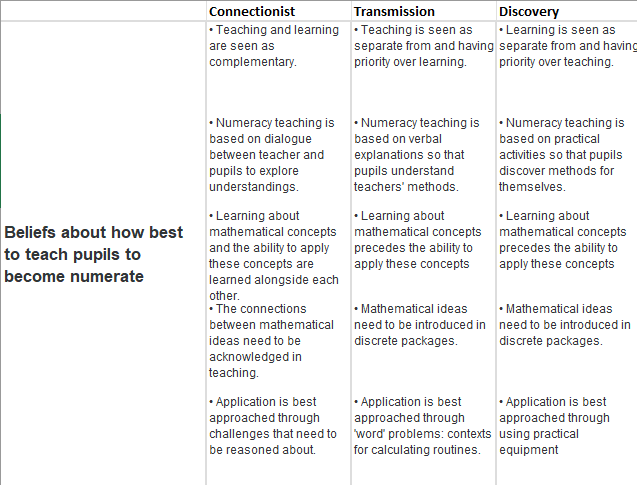
@dylanwiliam "Learning about mathematical concepts precedes the ability to apply these concepts." and "Mathematical ideas need to be introduced in discrete packages." are core ideas in explicit and direct instruction approaches.
@dylanwiliam How do you view the results of the Effective Teachers of Numeracy study these days? Do you see any conflicts between the significance of connectionism (as reported) with the importance of Cognitive Load Theory (and it's implications: e.g Direct Instruction)?
@dylanwiliam Sure. That is the argument of the paper - orientations are a set of beliefs. However... when the orientations are broken down they seemed to clearly align themselves with a pedagogy. " E.g.,
@naomicfisher@_MissingTheMark@JKPBooks Absolutely agree with you. Also acknowledge that many of the most important changes needed, teachers themselves are very restricted in implementing (which can lead to their defensiveness). Teachers are also burnt out by the system and issues of high accountability and reporting.
Very happy to be featured on the latest episode of the national Maths in Schools podcast, discussing how to build a dialogic classroom with @Allan_Dougan https://t.co/VF9bgeOQRw
Can we stop talking about the teaching and learning of mathematics as if it were the same as learning to read? The limited parallels break down too quickly for an argument to stand. #MTBoS
@jamestanton Say 2 x3 is two groups with an amount of 3 in them. 2 x 0 is two groups with an amount of zero in them, therefore, zero. 0 x 0 is NO groups with an amount of zero in them. All fine.
Hey everyone. Over the past two years I’ve created 175 short explicit teaching videos for primary aged children. Please check out my channel, some videos need to be refined but they’ve worked great as a Flipped Classroom model. #iteachmath#mtcoz#mtbos
https://t.co/FQHDCekl8J
@MathsCirclesOz Not full solution but first check for reasonableness is to notice both fractions are less than a half so the solution must be less than one.