I just finished teaching the first lecture of the course “Geoeconomics Uncovered: Theory Meets Evidence” at Oxford, so I decided to post the slide deck:
https://t.co/8lcVCInfi4
This was a 90-minute, big-picture lecture: what is geoeconomics, why does it matter, and what can economists do in this field?
It draws on several plenary talks I have given over the past year, so you may have seen some of these slides before. But I have many new followers, and some are clearer than before.
During the rest of the week, I will post more of these slide decks. The next one will be on the history of the field.
PS: Oxford is such a lovely place. Unfortunately, a country that gave us Newton, Darwin, and Turing cannot keep escalators running at Heathrow.
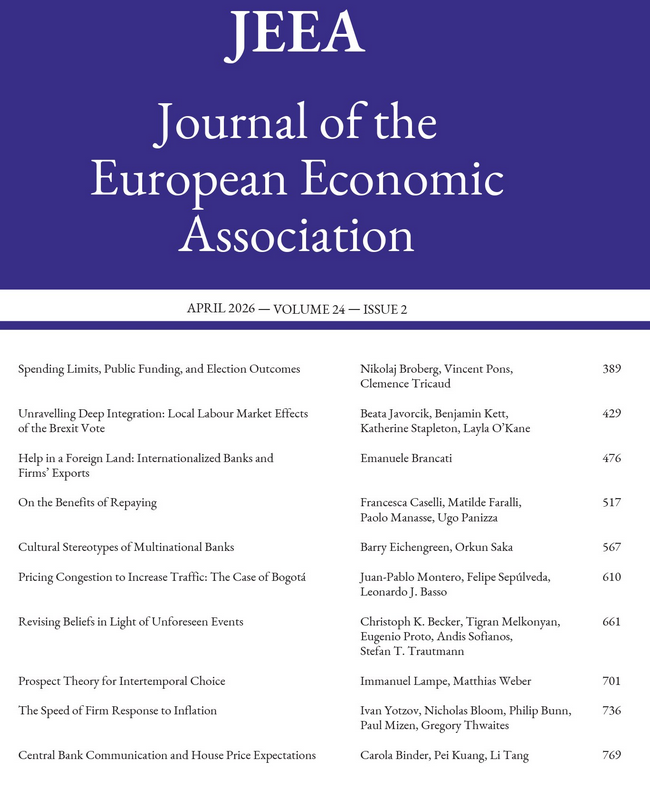
Check out the April 2026 issue (24,2) of @JEEA_News Journal of @EEANews@OUPAcademic
Teaching materials available: https://t.co/tCzfSWh4Lu
https://t.co/ClS8d0lwlx
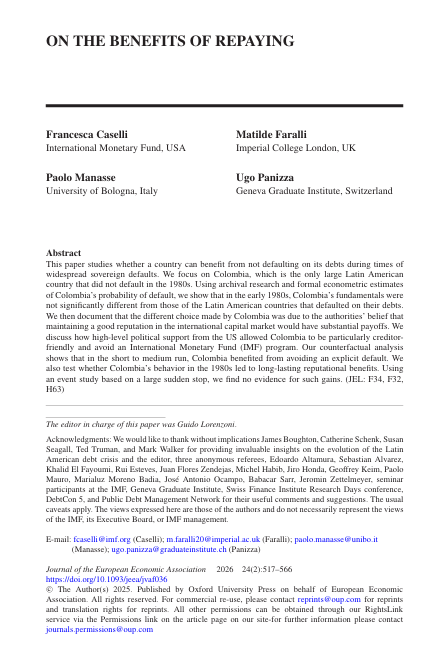
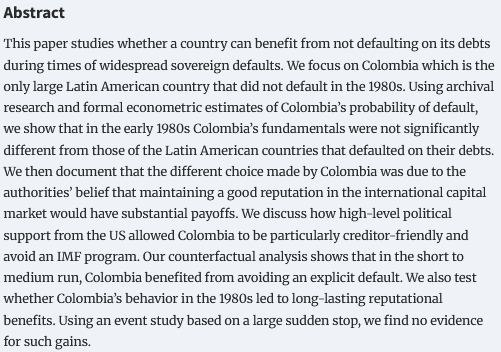
Nice to see this out in @JEEA_News It all started with a conversation with @fgcaselli while she was still a PhD student (so more than 10 years ago), we began serious work with @MatildeFaralli and @pmanasse more than 8 years ago and learned a lot through the journey
I wrote my dissertation on placebo effects. My advisors were Gary Becker and Steve Levitt. This was not a normal thesis topic for a Chicago economist. Here's why I did it — and why it changed how I think about economics.
Results from my Claude Code audit of six Callaway and Sant'Anna packages (two in python, two in R, two in Stata). Same specification, same dataset, same covariates, same estimator, almost never do they agree.
https://t.co/KpRwlAagbr
📢 Funding for Research Projects
EIEF offers funding for research projects in economics and finance to researchers based in Italian institutions.
Submit your Applications by April 10th 2026 👇
https://t.co/hORdPJRDwi
Excited to share that my paper “The Rise of Climate Risks: Evidence from Firms' Expected Default Frequencies” (with Francesco Ruggiero) is now Revise & Resubmit at Energy Economics 🎉 A great way to kick off 2026!
Check it out here: https://t.co/vOG0BwTw0j
My study was mentioned in an online article of https://t.co/iuU7SBuuNO -> Bankitalia, aziende inquinanti a maggior rischio di default - https://t.co/iuU7SBuuNO https://t.co/WjxwWGADMA
If you've been wondering how to explore the informational content of your Parallel Trends assumptions to get the most precise DiD and ES estimator possible, we have some good news for you!!
Our new DiD paper is out: https://t.co/kNYgOdBoqa
😎Get along for a brief overview😎
1/
This (recently updated) free textbook on difference-in-differences looks amazing!
It comes with practitioner checklists and practice data + code.
A teaching/research goldmine!
by @CdeChaisemartin and Xavier D'Haultfoeuille.
I’m sharing my slide deck on the demographic future of humanity,
🔗 Slides: https://t.co/geZQFXwN8h
prepared for the keynote address I will give tomorrow to the 7th EBRD and CEPR Research Symposium on “The Economics of Demographic Change”:
🔗 Symposium: https://t.co/L9Hn1fKA8A
Here are a few key ideas I’ll be discussing tomorrow, some of which even economists tracking population trends may not fully appreciate:
1️⃣ Fertility is falling everywhere: rich and poor countries alike, booming and stagnating economies, secular and religious societies. The decline is happening far faster than anyone anticipated, even me, ten years ago!
2️⃣ For example, Colombia’s fertility rate is 1.06, Iran’s is 1.44, and Turkey’s is 1.48, all of which are below the U.S.
3️⃣ The decline accelerated around 2014, well before the COVID pandemic.
4️⃣ As a result, humanity’s fertility is likely already below the replacement rate.
5️⃣ Many assume the replacement rate is 2.1 children per woman. That’s true for rich, advanced economies. But not for emerging economies, where selective abortion and higher young female mortality push the replacement rate higher. Thus, for humanity, the replacement rate is closer to 2.2.
6️⃣ The 2024 UN World Population Prospects are riddled with data and forecasts that, frankly, make little sense to my coauthor Patrick Norrick (at @AEI) and me.
7️⃣ Most of the differences in economic growth among advanced economies over the past 35 years can be attributed to demographic factors. Once adjusted for this, Japan’s economic performance is roughly on par with the U.S. (See my paper with Gustavo Ventura, @King_ofSweden, and Wen Yao, The Wealth of Working Nations):
🔗https://t.co/lm2iigVk7E
There are many other ideas (I could talk about this for hours!), but here’s the punchline: the world’s fertility crisis is worse than you thought, even after considering you already thought it was bad.