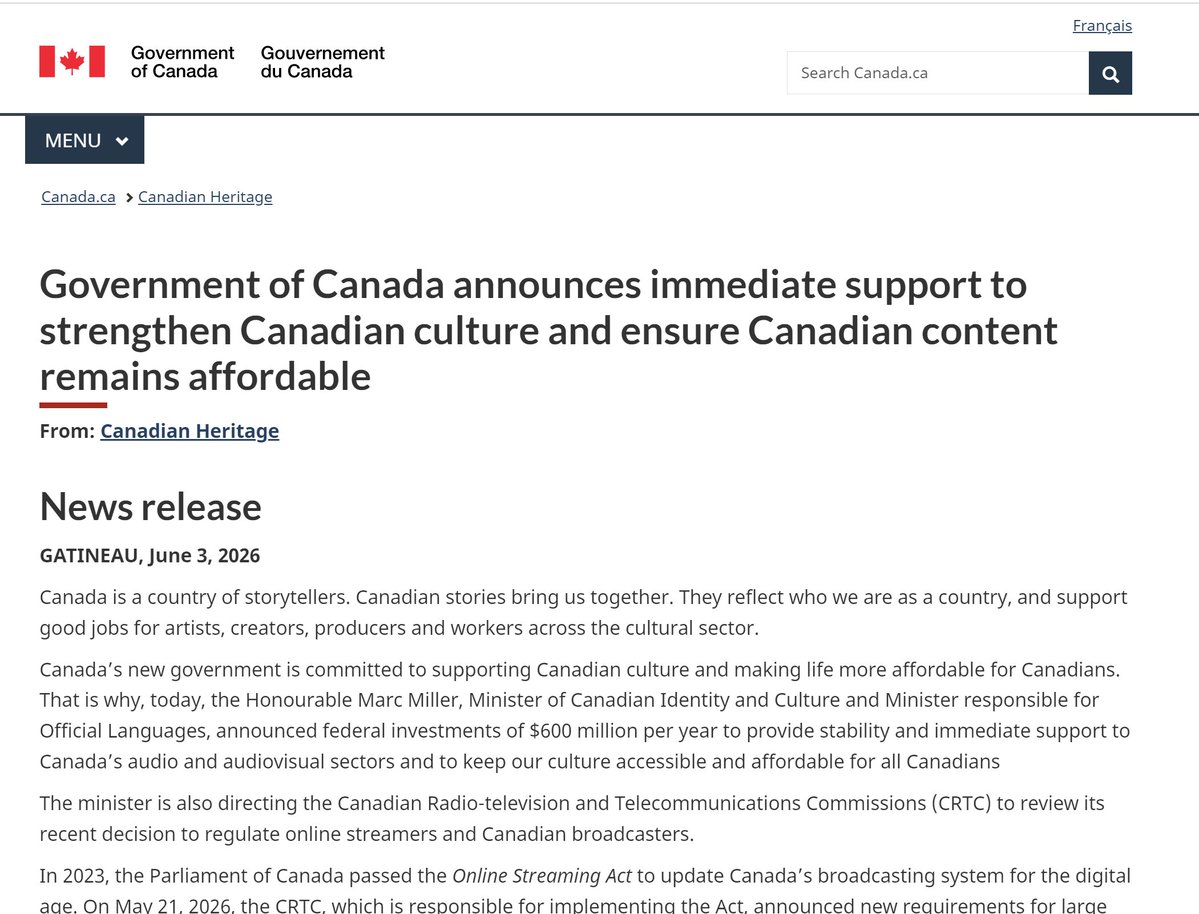
BREAKING: In order to prevent subscription streaming services from raising their prices, and angering Trump
Carney will cover the new CRTC fee of $600 million by billing you on April 30th every year, via the taxbase.
(and its borrowed, so youll pay interest on it too)
In 2018, Australia passed the Telecommunications and Other Legislation Amendment. The bill bears strong similarities to C-22. 🇦🇺
What happened after?
- 22% of firms cut R&D investment
- 36% of firms reported TOLA made their global risk environment worse
- Australian firms lost contracts. Big ones.
The problem is, 🇨🇦 is much more exposed than Australia ever could be.
Housing First had a 20-year run and $4 billion a year. The federal government just killed it.
This will change homelessness in every city in America – including yours.
Housing First activists sued over the last attempt at major reform. But this time, they’ll have an uphill battle.
Here's what you need to know:
Damn I am extremely Claude CoWork pilled
I think I can probably cut 5-6h of my work per week with this
and the @rabois-style calendar audit can now happen automatically
List out my top 3-4 priorities, and Claude can check if my time allocation matches to those
So cool
Officially 1 month since I switched to a flip phone.
- Everyone is more severely addicted to their smartphones than I thought. Once you have a dumbphone, you'll frequently find yourself as the only person in the room not on their phone. It's not just teenagers, it's parents and adults of all ages. It's like everyone is stuck in a trance. 75+ year olds might be the only exception.
- All the objections I previously had for getting a dumbphone have turned out to be overblown and/or solvable. My iPhone addiction had fed my brain excuses to not do this earlier. If you really want to make the switch, you can.
- I've felt embarrassed to pull out my flip phone in public at times, for fear of being different or drawing too much attention to myself. But I have learned to just own up to it. Most people end up saying something like "Oh, I probably should do that too."
- I am using my brain more. Even though my flip phone has Waze, I find myself memorizing maps and roads. I'm more bored and get lost in my thoughts. I'm using paper and pen more. Increased desire for tangible things > digital things.
Overall, it has been a great experience and I plan on never going back.
The Three Humans Left in a VC Firm
Fred Wilson, co-founder, Union Square Ventures, interviewed by Michael Mignano (USV)
[I post one executive summary daily of an interview I enjoyed and learnt from. I loved this interview that @mignano did with @fredwilson, who I've learnt a tremendous amount from on the board of Coinbase. Tons of great nuggets for founders and investors.]
Summary: After 40 years in venture, Wilson has rebuilt USV around a single conviction. Only three things in the firm still need a human: picking the thesis, building relationships with founders working in that thesis, and supporting them after the check. Everything else, including sourcing, diligence, term sheets, and CRM, is being handed to agents. The interview is a working sketch of what a venture firm looks like when the back half of its job becomes software, and a clear read on what stays human-only and why.
1. The Three Humans Left. A year ago Wilson wrote a memo to his partners saying that if he were starting USV from scratch today, only three jobs would stay with humans: high-level thesis development, building relationships with founders inside that thesis, and supporting them after the check. Everything else gets handed to agents. USV is now executing on that memo, not theorizing about it. For founders raising, this is the new operating profile of the firm sitting across the table.
2. Agents Love Data Rooms. "I hate data rooms. Agents love data rooms." USV no longer asks a junior associate to scrub the data room before a term sheet. An agent reads the room and answers questions in conversation: cap table, vesting, founder ownership, anything in the corpus. The effect on partner time is direct, with less work on the parts of the job no one enjoys and more time with founders.
3. Term Sheets Without Lawyers. USV's term sheets are now written by an agent, with no outside counsel stamp at the term-sheet stage. The firm seeded the agent with standard term sheets by sector and by stage, then partners shape each document in conversation with the agent. Wilson does not yet trust an agent to write long-form definitive docs. The implication for founders: term sheets land faster, with less round-trip friction, and the cost structure of the next-generation venture firm starts to drop.
4. The Kill Zone Test. Wilson ran a sample contract through a legal-AI startup and through raw Claude Code, side by side, and Claude's markup was better. "All of legal AI is in the kill zone." The test is portable to almost any AI vendor pitch. If a wrapper company cannot outperform the raw model on the thing it sells, the wrapper is paying for the privilege of being disrupted. Operators should run the same test before signing a multi-year contract.
5. No Wrappers Allowed. To survive the kill zone you cannot wrap a model. You have to rebuild the business model from scratch around the new economics. Cursor is the example Wilson reaches for: it has been hugely successful, but more developers are dropping back to raw Claude Code, and nothing stops Anthropic from shipping an IDE. A defensible AI company redesigns the workflow itself, so the foundation lab would have to abandon its current pricing model to copy.
6. Energy Is the AI Trade. About a third of USV's deployment now goes to energy, because no matter which model wins, the winner needs power. The firm has backed a decentralized model-training network and a company that turns each grid-scale solar and wind plant into a mini data center selling inference tokens. The trade is indexed to AI without forcing USV to pick the model. Builders hunting for a less crowded adjacent market should read the same memo, because the picks and shovels of AI run through electricity.
7. Sellers, Not Coders. The skill USV now overweights in founders is selling: recruiting, fundraising, convincing customers, inspiring teams. Forty years has taught Wilson that the founder who can tell the story and bring it to life wins more often than the founder who can write the code. The corollary is uncomfortable for technical founders. "Actually being able to write code is probably not a big deal anymore," though enough technical vision to see three moves ahead still matters. If you are a CEO who cannot recruit, that is now your constraint.
8. The 80–90% Open Source Window. Open-source models, especially the ones shipping out of Asia, are running at 80 to 90 percent of the quality of the closed frontier models. Right now the closed labs are subsidizing usage, so price does not force the comparison. When the labs have to charge a real margin, open source becomes a serious value alternative and the playing field levels. Wilson is not betting the firm on this outcome, but he is hedging into the quadrant where open source wins.
9. Founders Still Want Humans. Founders do not want to raise money from an agent. They want to know the human they are getting in business with, and that is why Wilson does not see VC automating itself out of a job in the short term. The firm can automate the back half of the workflow. The front half, sitting across from a founder at 11 p.m. when they have had a horrible day, stays human.
10. Don't Pass on Price. The biggest regrets of Wilson's career are deals he passed on because the price was too high. The market-clearing valuation will almost always feel uncomfortable a year later, and the right answer is to find a way in, even if that means buying secondary instead of leading the round. Saying no on price is a defensive move masquerading as discipline. Founders raising can use the line in negotiation, because a firm that walks on price is telling you it has not adjusted to the current market.
11. Offense Over Defense. Wilson lost $25 million in six months in 2001 and learned that getting it wrong is a byproduct of the job, not a verdict on the investor. He spent his first 15 years scared of losing money and only got good at venture once he stopped playing defense. The advice is harder to apply for someone breaking in, because the first checks really do matter, but the directive holds at every level. For operators, the analog is the founder who refuses to ship until the product is perfect, because you cannot win a game you are not playing.
12. The Relationship Is the Moat. After 40 years and an AI rebuild of the firm, Wilson's one-line summary of the venture business is the same as it was on day one. The relationship between the investor and the founder is the secret sauce. Everything else, including the work USV used to staff up to do, gets compressed by technology. Find great founders, build real relationships with them, and help them build great companies. If your venture pitch to LPs does not lead with that, you are pitching the wrong business.
@Shaughnessy119 Good take... in 6 months when the open weight models match Opus 4.7 or GPT5.5 for 1/30th the price, it'll be hard to justify the premium unless it's really a massive step change.
The most basic way AI could blow up imo. I'm not saying it does but this is the most obvious way I can see it happening
- Per seat subscriptions are massively subsidized. The flat fee was priced way below what heavy usage actually costs
- For real business use you have to move to the API anyway. Data protections, work integrations and compliance officer approval
- On the API you pay metered rates, and businesses are burning credits way faster than the per seat pricing ever led them to expect
- This is everywhere right now. Internally for us, Codex users, Uber torching its entire 2026 AI budget in 4 months, the Microsoft comments. Just go try an API
I shared more on this here: https://t.co/iZrqrCAIRW
- And I don't think most businesses have the money to keep paying increasing API rates without a real change to how they operate (caps needed)
- Because they have a cheap alternative. They can reach open source models through any aggregator (OpenRouter, Venice, Baseten, Together) and still get strong privacy. Venice private data centers, or E2EE/TEE serving GLM 5.1.
More on open source inference provider raises here: https://t.co/7kf56P44yQ
- And the discount is enormous. DeepSeek V4 codes within a hair of Opus on SWE bench at roughly 1/30th the price, and the cheapest open models run closer to 1/100th
- Chinese labs open source frontier grade models. The model is the single biggest cost an inference provider has, and they get it for free
- This idea dies if China goes closed source. That is actually bullish web2 AI labs, because if everyone is closed you pay up for the best intelligence. China goes closed source if they are tired of giving away an asset and they want the revenue and data flow to train new models
- Is this showing up in web2 AI lab revenue yet? No. Revenue is off the charts. Anthropic went from 9B to 47B run rate in five months
- So go forward, what happens?
- I think revenue slowly starts leaking to the open source inference providers (see Venice usage, OpenRouter's $113M raise, Baseten is raising at $11B or triple its valuation in three months, on revenue that went from $200M to $600M annualized in a single quarter)
- It doesnt move overnight, but it caps the labs ability to raise prices, and margins are already deeply negative. OpenAI is reportedly running near negative 122%
- With margins that bad there is no cash flow, so the labs are fully dependent on outside capital to buy GPUs, train models, and keep subsidizing usage (I.e. see Google tapping $80b equity sale, granted 30b for employee RSU taxes. Clearly they think Equity is overvalued or you wouldn't sell it)
- The break comes when that capital stops. Pricing is capped so margins cant improve, and the moment investors lose conviction on payback, the whole flow reverses
- Why would they lose conviction on payback? Back to the start - the inability to improve margins or get businesses to pay more
- This is also limiting, if we start making new drugs with AI or create entirely new businesses, you better believe people will pay up to the max for AI usage
In the last 6 months at @Ahrefs, we analyzed over 1 billion data points across 14 studies. Here's what we learned about AI search optimization:
1) "Best X" blog listicles are the single most prominent content format cited by AI chatbots. They make up 43.8% of all page types cited by ChatGPT specifically.
2) 67% of ChatGPT's top 1,000 citations come from sources marketers can't influence: Wikipedia (29.7%), homepages (23.8%), app stores (6.6%). Only 32.3% are influenceable content like educational pages, reviews, news, and blog posts.
3) 28.3% of ChatGPT's most-cited pages have zero Google organic visibility. These pages get cited repeatedly by ChatGPT despite not ranking in Google at all. A completely separate discovery layer.
4) ChatGPT only cites about 50% of the URLs it retrieves. It fetches dozens of pages per query but uses half as background context without attribution. This means that being retrieved and being cited are very different things.
5) Adding schema markup had zero meaningful impact on AI citations. AI Overviews actually dipped −4.6%, while AI Mode (+2.4%) and ChatGPT (+2.2%) showed changes indistinguishable from zero.
6) YouTube mentions have the highest correlation (0.737) with AI brand visibility out of all the factors we studied (including all the conventional SEO metrics like backlinks, page count, DR, etc). This held true for both Google-owned and OpenAI products.
7) AI Overviews reduce clicks to the #1 result by 58%. That’s up from 34.5% just 10 months earlier. The trend is accelerating.
8) 99.9% of AI Overviews appear on informational intent queries. Transactional, navigational, and local searches are almost entirely AIO-free. Shopping triggers AIOs just 3.2% of the time.
9) For a given search query, Google’s AI Mode and AI Overviews reach the same conclusions 86% of the time — but cite almost entirely different sources (only 13.7% citation overlap).
10) AI Overviews change every 2.15 days on average, with 70% of content differing between consecutive observations. But semantic similarity stays at 0.95. The words, sources, and entities constantly shuffle, but the actual meaning barely moves.
@globeandmail Didn't we just open up Canadian citizenship and Old Age Security Benefits to millions of people who never paid taxes here via the C-3 bill?
@Citizen004 A major driver of university equity settlements and hiring quotas stems from federal funding agreements. The federal government and the tri-council funding agencies (like SSHRC) mandate that universities meet specific diversity to continue receiving federal $$$