1/
Are the right AI rules... zero rules? Not for Little Tech.
To ensure AI thrives in the long run—and that startups can compete at the frontier—we need smart regulation. Here’s what we believe at @a16z 🧵
The war in Ukraine was a wake-up call for modern defense production, says @ESPriceWright. If you’re not building things, you’re not building military things.
AI can help the U.S. rebuild the capacity to make things at scale, but policy will determine how quickly that happens.
.@ESPriceWright on data centers: “This is investment going into teaching us how to build mega projects again in the US.”
Erin explains the other side of the data center debate: high-utilization industrial loads can help finance new power generation, modernize our aging electric grid, and lower costs for consumers over time.
What does AI-powered manufacturing mean for jobs? @ESPriceWright explains why the opportunity is not just bringing back the rote factory work of previous generations, but creating demand for more high-skilled industrial jobs in the U.S.
“What things could we not build in the U.S. before that we could build now?”
@ESPriceWright joined me to discuss how AI can unlock building in America.
We cover how AI and robotics are changing the economics of manufacturing, and why AI is a defining factor in U.S. competitiveness in robotics, mining, energy, defense, data centers, and skilled industrial work.
Numerous AI bills propose versions of mandating a “human in the loop.” Ben Supple, head of global public policy @ElevenLabs, talks about their approach: using voice AI to help teams manage high call volumes, resolve common issues, and escalate to people when needed.
Our full conversation is on the a16z AI Policy Brief.
When most people call the government, they usually need help: questions about benefits, a business license, a tax issue, or their child’s school enrollment. But instead of getting answers, they wind up in an antiquated, endless phone tree.
Ben Supple, head of global policy at @ElevenLabs, joins the AI Policy Brief to talk about how the company’s voice AI is helping fix the front door to government. Plus, he discusses what it’s like to build a policy function inside a fast-scaling Little Tech company.
Listen below.
AI liability has a Goldilocks problem.
Too little accountability, and bad actors get a pass while public trust erodes. Too much, and the legal risk crushes startups.
The hard part is getting it just right: a regime that holds bad actors accountable, preserves trust, and keeps the market open to competition.
@JaiRamaswamy and I lay out 10 principles for crafting that regime.
What does life actually look like for a two-person team building a startup at a kitchen table? And why are these founders almost never in the room when policy gets made?
.@AndrewChen joins the AI Policy Brief to talk about the Littlest of Little Tech. Through a16z @speedrun, he backs startups on day one. Through @TechWeek_, he sees what makes startup ecosystems thrive.
A conversation about founder reality, the Little Tech policy gap, and how regulation shapes what gets built.
The state-level patchwork of AI laws is growing, and competition with China is intensifying—putting pressure on Congress to set a federal baseline.
Many stakeholders (including @a16z) have called for a national framework, and public support for AI regulation remains high and bipartisan.
In this piece, @MattPerault and I unpack what actually determines whether a bill moves—committee jurisdiction, floor time, leadership support, bicameral negotiations, and must-pass vehicles—and what that means for AI legislation.
Read more 👇
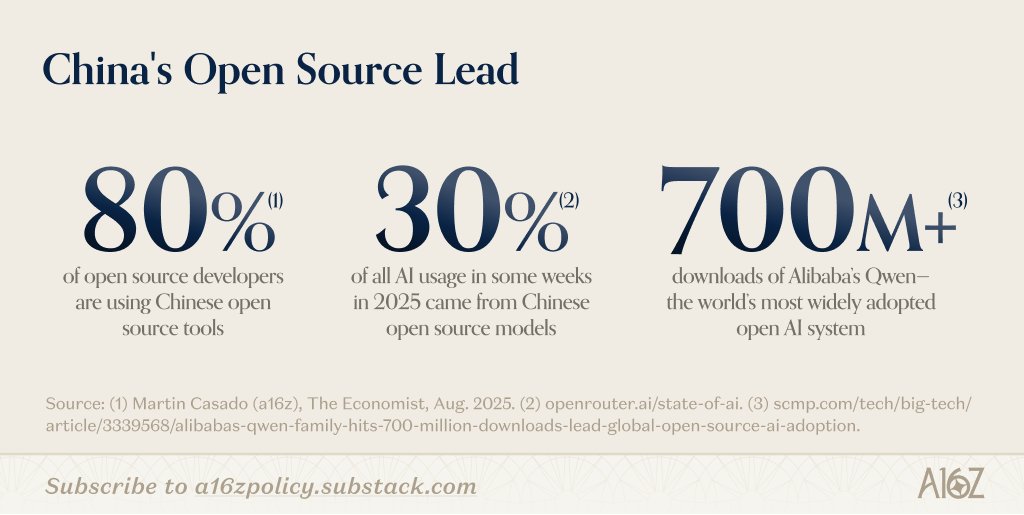
Policymakers are beginning to appreciate the role of open source as the foundation for the global AI ecosystem. But the status quo is troubling. If the U.S. wants to lead in open source AI, policymakers need to 1) promote it and 2) protect it.
New from @Jai_Ramaswamy and me outlining a policy agenda for asserting American leadership in open source AI.