@ScottS_Biochar@NU_ChemE@BrendanWhalen14 @DerkNasty_ @swolerito@MarcZoleta Hi Scott,
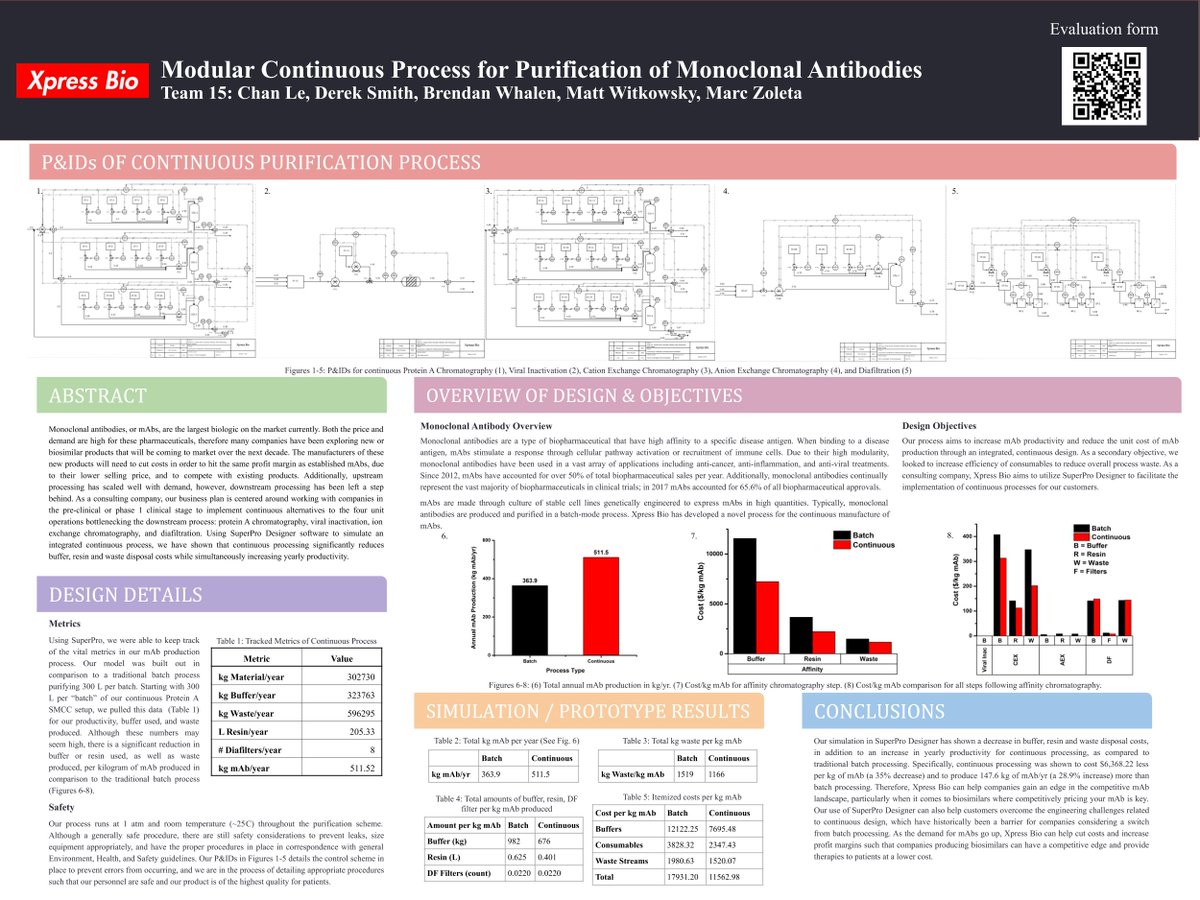
As the protein A chromatography unit accounts for the highest cost of waste in the batch unit, a lot of our work went into reducing the cost there. By reducing column size, and thus resin/buffer requirements, we were able to have the most considerable savings there.
@chris_gagnon88@NU_ChemE@BrendanWhalen14 @DerkNasty_ @swolerito@MarcZoleta Hi Chris,
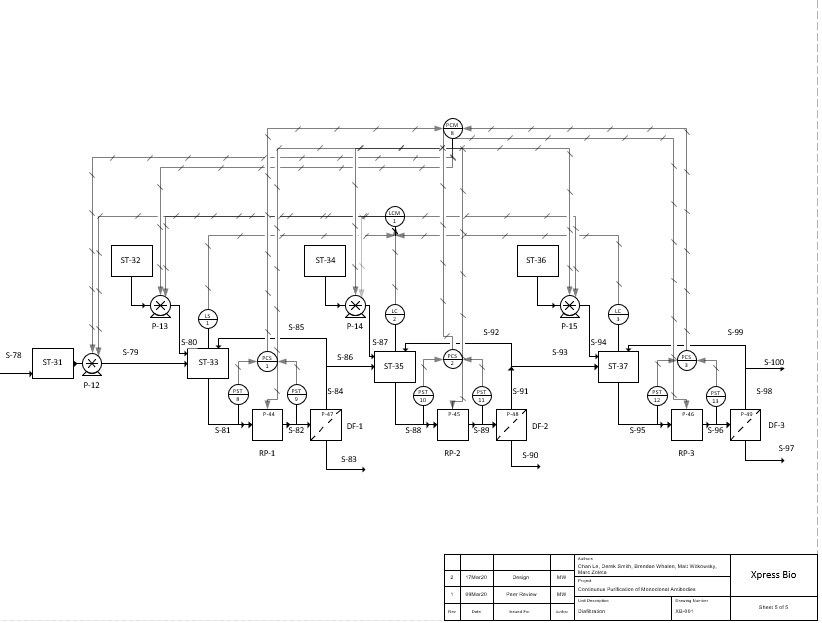
This process could be scaled up for a higher throughput process. Major factors we'd have to account for in scale-up in purification would be understanding column breakthrough at a higher scale and flowrate as well as filter membrane performance in diafiltration.
@renegold8@NU_ChemE@BrendanWhalen14 @DerkNasty_ @swolerito@MarcZoleta A majority of our buffer use, thus comes from these chromatography sections. We understand there's a lot of components added/taken out of the process, so we've defined our metrics in terms of waste per kg mAb to have a hopefully more understandable comparison to the batch case.
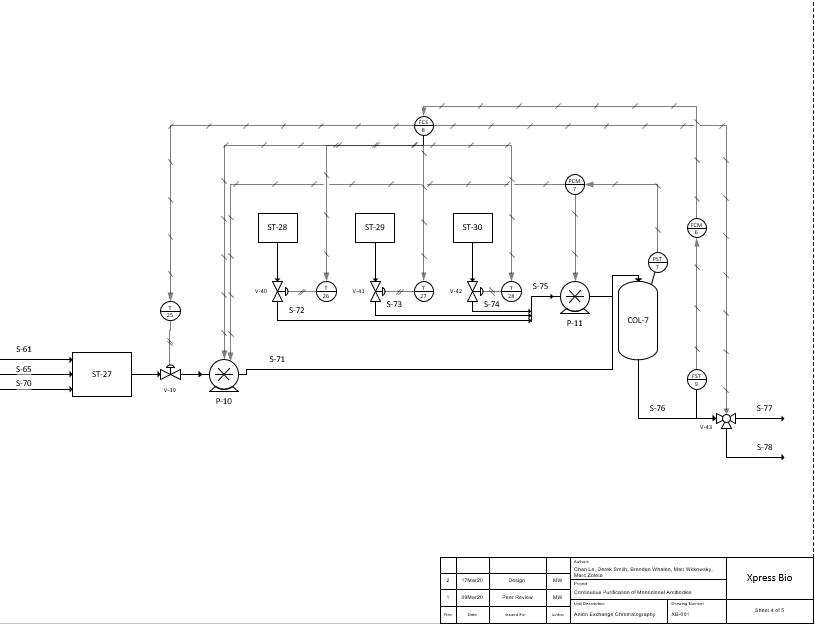
@renegold8@NU_ChemE@BrendanWhalen14 @DerkNasty_ @swolerito@MarcZoleta For all chromatography sections, waste is generated through different buffers used for separate column phases. The process works through switching buffer lines on/off (load, wash, equil, regeneration) dependent on the column phase to purify the product.
@ThomasJWebster1@NU_ChemE@BrendanWhalen14 @DerkNasty_ @swolerito@MarcZoleta Hi Professor,
Our process was modeled based on batch-case parameters and materials for the Humira manufacturing process described in their patent. We've chosen Humira as a case study as it is continually the highest selling mAb with the most available data.