Introducing Language Atlas. Multilingual LLM training breaks when built around English. We've built a linguistic parameter graph to fix it at the source.
Most multilingual failures are decided early: which dialect you hire for, which standard you grade against, which register the model speaks in.
Get them wrong and fine-tuning can’t fully recover. We map each dialect first using Language Atlas, then hire and grade around it.
Your multilingual model speaks dozens of languages. It sounds native in one.
We built Language Atlas to find where English-built AI breaks: 140+ languages and 1,700+ dialects, scored on 11 traits from honorifics to tonality.
This is a big problem for adoption in Enterprise in the Western world. AI will actually accelerate GDP and job growth, but until the public narrative and discussion is improved to emphasize some of the positives it will be tough to get companies and people to adopt it in real scaled deployments...
This seems like a likely parallel over the next few years, the value will eventually accrue to the application layer and assembling models/agents/tools into an enterprise business outcome
I have seen the AI movie before, it is the story line of the Cloud. First you build the infrastructure (where we are today), then you build the applications (which are 3-5x larger). My bets today are on the AI application layer winners in 5-10 years.
See: Cloud
Completely agree with the core themes of this, in the coming years value will accrue to assembling all models/agents/tools into a working AI system, and delivering an outcome – “The next phase will be organized around a different question: who will convert intelligence into useful work, and ultimately control the economics of getting it done? Bet is that power shifts toward the companies deciding which steps need frontier reasoning, which can use smaller models or ordinary software, where the work runs, and which suppliers get paid. Outcome pricing rewards this continuous adjustment.”
A one-day selloff reprices the compute buildout, not the usefulness of AI, and pushes the market toward the layer that was always the real bottleneck -- proven deployment, production infrastructure, ROI per workflow, and post-training work.
The market is repricing the AI compute buildout on political risk to data center permitting, not on model capability or Enterprise deployment potential. If state-level pauses materialize, capex plans face delays...
https://t.co/oHgX6pHhlO
AI investment is pegged at ~3.5% of GDP, bigger than electrification, highways and the internet combined. But Enterprise P&Ls barely see 1-2% productivity gains from it (NBER). The build gets absorbed when Enterprise deployment catches up, model improvement is not the bottleneck.
Thoughts around AI
1) Given AI is the largest technology revolution in history at roughly 3.5% of GPD (larger than electrification, highways & internet combined); there is overinvestment due to the potential rewards for the eventual winners.
2) But much like during the Internet buildout, which had several large drawdowns including in 1997 (Asian currency crisis) and 1998 (Russian bond default), and then ripped higher, the question is whether this is THE TOP.
3) AI had 3 separate investment waves: training, inference and now Agentic
a. Agentic demands 10-100x more tokens than inference and started with OpenClaw in January for the tech savvy followed by Muse in late September for the rest of us.
4) Currently, the market is repricing two things
a. Financing costs are higher in both debt & equity mkts
i. Debt- $CRWV unsecured debt trading at 15%
ii. Equity- expected timing for AI related IPOs like OpenAI, Anthropic delayed earlier this year while filed IPOs of Firmus, AirTrunk, NScale, SB Energy delayed/ pulled
iii. Meta 8K “timing is important to secure capital before competitors saturate various funding options… in an increasingly challenging environment for raising capital.”
b. AI native growth rates slowing
i. Anthropic revs 145% q/q in Q2 to 45% in Q3
ii. Openweight driving ASPs down ~50% since May
5) Datacenter moratoriums seem to be the only thing both parties agree on
a. This could get worse after the mid-terms with a less AI-friendly political climate
In summary, because of the advent of Agentic, I do not believe this is THE TOP. But having higher cash levels and being circumspect as the market reprices has been important. This has been my advice for the past several weeks.
Unfortunately, my belief that it was time to start putting money to work for at least a short-term rally this past week due to oversold conditions in areas like semiconductors has been early so far. The SOX was down 3.2% last week vs the S&P down 0.5% but time will tell.
$MSFT $AMZN $GOOGL earnings this upcoming wk
1) I think much like with $Meta earnings this past week where I previewed concerns, the stock reactions for the above three will have a lot more to do with their comments around future capex investments, expenses, cash flow and financing needs.
2) I worry whether a datacenter moratorium causes an issue with cloud growth guidance for the December quarter despite very strong growth in the September quarter. NextDC in Australia cut their rev guide by 22% for CY27 due to local community pushback and the stock was hit for 39% last week.
Microsoft seems committed to being cash flow positive and I see them being an ultimate winner in enterprise AI. 1. They provide a safe environment to run Co-Pilot AI applications given almost all S&P companies run M365 already. Co-Pilot seats were 30M+ in the June quarter up from 20M+ in March and 15M in December.
2. One potential risk is their high margin PC business being impacted by the large declines being caused by surging memory prices.
3. Azure expectations vs their guidance of 45% y/y for September vs 43% in June have also picked up given the share gains being seen by OpenAI against Anthropic recently in enterprise.
Google should see accelerating cloud growth & be an ultimate winner in consumer AI through their Android distribution on smartphones. My short-term concerns are the following:
1. Cash flow was negative for the first time since being a public company in the June quarter.
2. A slight miss in search revs in the June quarter raise concerns around AI Agents not looking at ads.
3. More aggressive analysts expect GCP growth of ~100% y/y for CQ3 y/y (but this includes TPU sales) up from 82% in CQ2 and 63% in Q1. This is more than double the growth rate expected for AWS and Azure so I worry that these datacenter moratoriums may on the margin impact the revenue growth possible at GCP.
4. Google needs to get out their consumer Agentic AI product. This should be a catalyst for their stock given it should integrate with the 14 Google products that have over 1B users each.
Amazon should benefit from physical AI improving efficiency in their heavy asset e-commerce business.
1. I also think their e-commerce demand is solid as shown by them hiring more seasonal workers (+20% y/y) for the first time since 2023.
2. But as the biggest public cloud vendor and the one with the most capex, could they be too big to escape the data-center moratorium impact on their December quarter? As an example, Amazon last week abandoned its plans for a large 4 building datacenter in Loudoun County Virginia which has been dubbed "Data Center Alley." AWS grew 28% in Q1 an accelerated to 37% in Q2 with no formal guidance but hopes for a slight acceleration in Q3.
3. However, Amazon reports on Thursday so their AWS expectations will be reset by whatever results are from Microsoft Azure and Google GCP on Wednesday.
Best of luck in the week ahead.
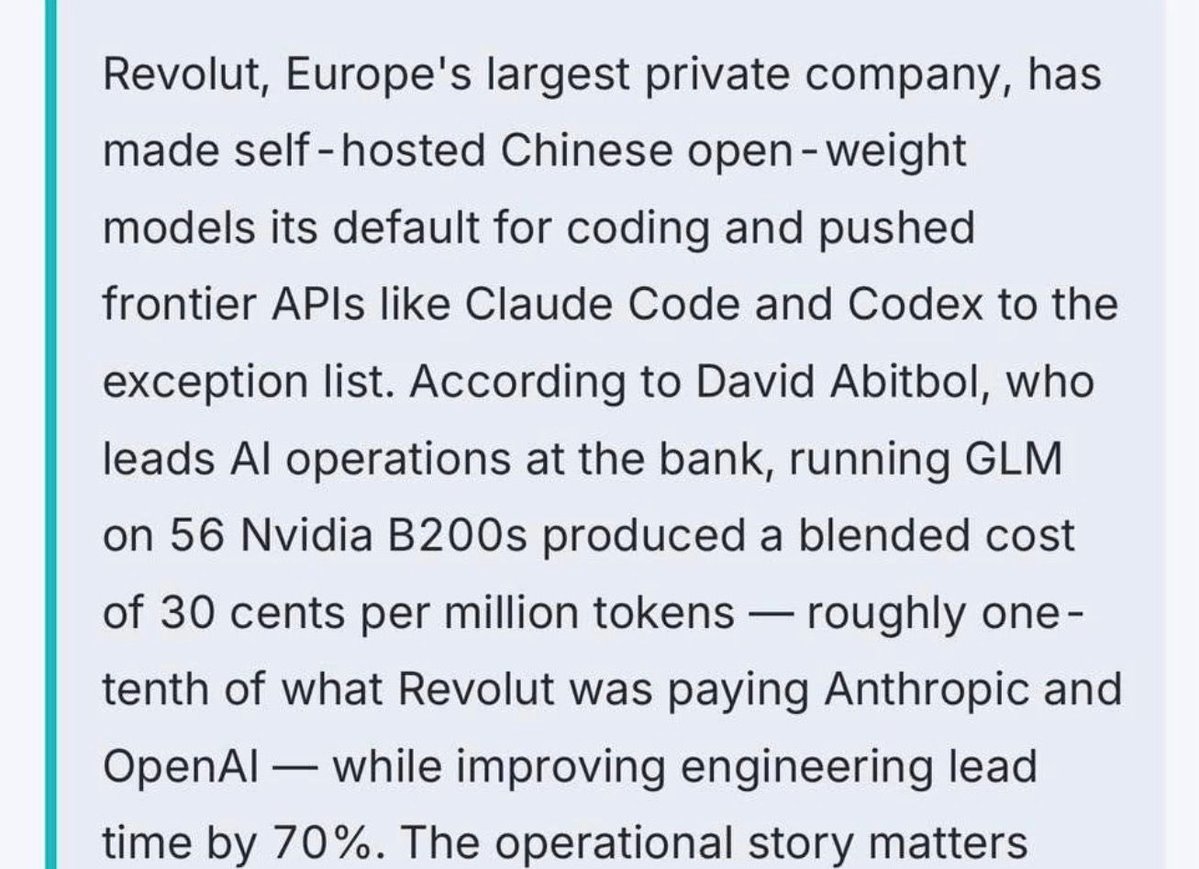
Revolut is post-training on its own data and keeping it private by default. The proprietary data and the environment where it learns in are the asset. The mix of models it uses will change every quarter, which environment trained it matters more. The value is in the last mile of Enterprise context.
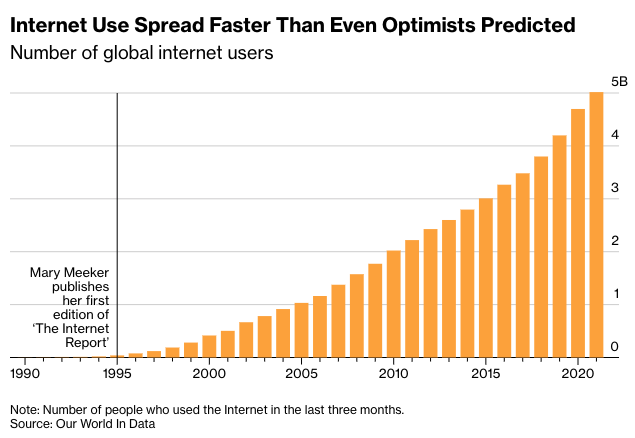
Mary Meeker was called the "Queen of the Net" by Barron’s in the 1990s, for her “optimistic” predictions about the future during the dot-com era. After the crash, PBS described her as emblematic of "the intellectual hollowness of the Internet bubble's headiest days."
Decades later, her predictions look different, and provide an interesting parallel for the evolution of AI, as laid out in this @Bloomberg article. The optimism that comes with any new technology can often create elements of a bubble, but “the days are long and the decades are short”, and 𝐨𝐯𝐞𝐫 𝐭𝐡𝐞 𝐩𝐚𝐬𝐭 𝟑𝟎 𝐲𝐞𝐚𝐫𝐬 𝐞𝐯𝐞𝐧 𝐌𝐞𝐞𝐤𝐞𝐫’𝐬 𝐦𝐨𝐬𝐭 𝐚𝐠𝐠𝐫𝐞𝐬𝐬𝐢𝐯𝐞 𝐚𝐧𝐝 𝐨𝐮𝐭𝐥𝐚𝐧𝐝𝐢𝐬𝐡 𝐩𝐫𝐞𝐝𝐢𝐜𝐭𝐢𝐨𝐧𝐬 𝐟𝐞𝐥𝐥 𝐬𝐡𝐨𝐫𝐭 𝐨𝐟 𝐫𝐞𝐚𝐥𝐢𝐭𝐲:
In 1995, she projected 7% global internet penetration by 2010. The actual figure was 29%
She predicted $36 billion in new internet business revenue by 2000. The actual figure exceeded $171 billion in 1999
She predicted online advertising budgets would increase, but not that 63% of total media spend would eventually be allocated to online
A recent Bloomberg analysis of 86 predictions from Meeker's Internet Trends Reports between 1995 and 1997 found the same pattern. The vast majority proved directionally correct, and often modest in hindsight.
But perhaps even more interesting is where Meeker was wrong: Who she thought would be the winners of the internet era. In 1997, she foresaw the multibillion-dollar online retail market, but predicted firms like Barnes & Noble and CUC would dominate it. She also saw Netscape and Microsoft as the long-term browser winners.
Meeker believed current scaled incumbents would adapt and win as adoption accelerated. But in the end it was digitally-native new entrants that captured most of the growth.
I see the same dynamic playing out with AI today.
Digitally-native companies use AI as an operating system, and they are operating on cleanly architected data and modern infrastructure. They can move, adapt, and build much faster.
Larger existing Enterprises have several decades of tech debt to work through to scale AI to production: 70% of software in the US is over 20 years old, with extremely fragmented data across regions/business lines. 80%+ of Enterprise AI initiatives fail to deliver value, and 60% will be abandoned through 2026 due to data readiness challenges.
But those failures are infrastructure problems, not technology limitations.
The companies investing in data harmonization, workflow redesign, and governance are building the foundation for what comes next. That’s what we’re focused on at Invisible Technologies. The tech works, the adoption is real, and long-term impact will exceed current projections. It will just take time, the same pattern Meeker saw with the internet.
Skeptics will be right about short-term volatility in markets and valuations. They'll be wrong about the direction.
https://t.co/Qd0C7XeMRz
Great blog post from @huggingface on post-training Agents. Hugging Face's free post-training guide covers five stages: SFT, distillation, RL, RL environments, harnesses. For Enterprise agents, the last two do most of the work.
Scaling agents effectively requires harmonized data foundations and well designed Evals/RL environments to ensure reliability
https://t.co/rJXwbnEzUA