Way and colleagues showed in 2003 that most bile duct injuries are not failures of skill. They are failures of perception. The surgeon sees the common duct as the cystic duct and proceeds with full confidence. The error does not feel like an error.
So it is a design constraint, not only a governance one. Untested in the OR, borrowed from human factors work elsewhere, but it is the kind of failure a retrospective benchmark will not reveal, because it occurs in the surgeon's response to the output, not in the output itself.
New in Surgical Endoscopy: LCBDE and IOC use are declining, with resident exposure now under one case per trainee per year. A single-stage option for bile duct stones is fading from training.
https://t.co/XbVBWFanHg
This is a useful review of where laparoscopic video AI stands. The next step is not just better benchmarks, but clearer definitions of what information is actionable inside the operative workflow.
https://t.co/NEjtCNYuPR
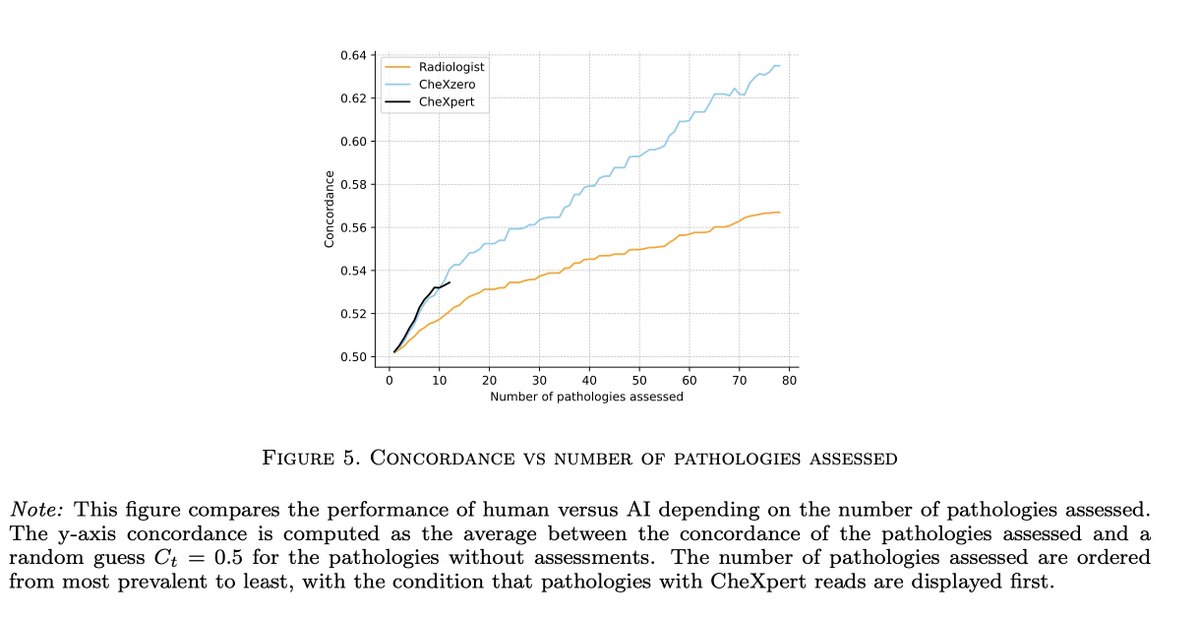
6/ Our results highlight the immense promise of self-supervised learning to improve diagnosis of rare diseases, enabled by algorithms like CheXzero.
At the same time, much work remains to translate these advances into real clinical impact. Excited to share this work!
Major thanks to my amazing co-authors @agarwaln_econ, Ray Huang, @alex_moehring, @TobiasSalz, @feiyangkathyyu. Let us know your thoughts!
Paper here: https://t.co/hKFp4HRrR0
I wish this story had distinguished training & testing. It's not an "open secret" that training data is error-prone, it's well known. Training is tolerant of noisy labels. A smaller test set with correct labels IS needed to assure AI works as intended.
https://t.co/Wj2vyvwCfe
@vineettiruvadi@EricTopol@NatMachIntell@caromitreka@CamImaging@jhfrudd@Cambridge_Uni@EvisSala I disagree. Academic journals have recognized the need for authors to apply proper statistical methods and describe in detail their use. As outlined in this paper, most authors using AI algorithms on their datasets are not properly using data techniques against bias.Suboptimal!
In January, the FDA released their AI/ML Action Plan, which describes their "multi-pronged approach" to advance oversight of ML-enabled devices—with a focus on ensuring patient safety, algorithm transparency and real-world results.
Learn more here: https://t.co/3Oy7IcDBYD