Quandoom is a DOOM port for quantum computers, using 70,000 qubits and 80 million gates. Runs at 10-20 FPS on classical hardware with a lightweight C++ QASM simulator.
👇source code in comments.
Hermes Desktop just removed the biggest barrier to AI agents.
No more terminal.
Here’s what changed everything:
→ You can now run Hermes in a clean Mac app
→ Edit memory + skills without SSH
→ Search every past conversation instantly
→ Run multi-agent workflows visually
→ Assign tasks like a real team board
This turns AI from “tool” → “operator.”
Save this video, you’ll finally understand how agents actually work.
Want the SOP? DM me. 💬
You can text someone hundreds of miles away with no cell service, no wifi, and no servers in between.
All it takes is a cheap radio board and open source software like Meshtastic. Meshtastic turns the board into a node in an encrypted mesh, capable of receiving and relaying information across vast distances.
Your Hermes Agent can now build full videos with the official HyperFrames skill by @HeyGen
HyperFrames videos are HTML-native, so your agent has total control over the final output
Video made entirely by Hermes using the HyperFrames skill
Introducing SubQ - a major breakthrough in LLM intelligence.
It is the first model built on a fully sub-quadratic sparse-attention architecture (SSA),
And the first frontier model with a 12 million token context window which is:
- 52x faster than FlashAttention at 1MM tokens
- Less than 5% the cost of Opus
Transformer-based LLMs waste compute by processing every possible relationship between words (standard attention).
Only a small fraction actually matter.
@subquadratic finds and focuses only on the ones that do.
That's nearly 1,000x less compute and a new way for LLMs to scale.
OpenTUI Keymap is a host agnostic key/cmd engine for DOM like apps.
It allows extreme customisation of a generic core, from key stroke syntax parsing to to command resolution and dispatch behaviour. It composes layers of bindings and commands into a single adaptive dispatch model.
Demo link in the replies.
There are many such systems, most of which stop at the key binding part. Apps often are expected to implement their own command layer on top of these. This disconnects the bindings from the actual command registry.
Looking for a proper solution usable in OpenCode I couldn't find anything that fulfilled the need of being extremely extensible to allow plugins to fully control key mapping and command behaviour. I wanted it to always be able to know exactly which keys and commands are reachable at any point in time, no matter from where and how the mappings are manipulated.
The main driver was enabling a which-key like plugin and vim like bindings in a mostly declarative way. While any other plugin could extend the keymap even further with a custom config syntax for key strokes for example. So addons for it are mostly composable and it comes with a variety of addons providing common behaviour.
It can also power other discovery features directly from live state. Help views, command palettes and graph/debug UIs can all ask the engine what is active, reachable, shadowed, pending, or dispatchable instead of rebuilding that knowledge separately.
The core is intentionally very much generic: hosts adapt focus, hierarchy, input events, and lifecycle, while addons extend parsing, tokens, sequence patterns, command metadata, resolvers, interceptors, and event matching. The result is a keymap that plugins can compose with rather than work around.
This could all be built directly into OpenCode and just be app specific. Working on OpenTUI though I want applications to have an out-of-the-box solution to build keyboard-first apps easily. Well, at least agents can.
It is extremely over-engineered. And I love it.
I hope some of you will too.
nless is a TUI tool that is like Excel for live log data.
It takes in logs, CSV or JSON and transforms them into columns in the terminal. You can then filter, sort, search, stream live data and more.
Matt Pryor (mpryor on GitHub) made nless using @textualizeio and is Terminal Tool of the Week! ⭐️
VLMs too slow for production? Not anymore: 46ms end-to-end inference, 60+ fps on a single H100. Introducing Photon, Moondream's inference engine. Runs on everything from edge to server. https://t.co/UTt6vQOzOY
🚨 BREAKING: Physicists just measured “negative time” in the lab.
Not theory. Not math.
Measured.
What actually happened
Scientists fired photons (particles of light) through a cloud of atoms.
Normally, light should:
• Enter
• Interact
• Exit
Simple.
But instead…
The photons appeared to exit before they entered.
It gets stranger
They didn’t just infer this from timing.
They measured how long the photon “lived” inside the atoms.
Result:
Negative dwell time.
The atoms themselves confirm it.
So is time broken?
No but our intuition is.
This comes from quantum mechanics:
• Photons aren’t single points they’re spread-out waves
• Only certain parts of the wave make it through
• That skews the average timing
But here’s the key:
Two completely different measurements gave the same negative value
That means:
This isn’t a measurement error.
It’s a real, observable quantum effect.
Why this matters
This challenges one of the deepest assumptions:
That time always moves forward in a simple, measurable way.
At the quantum level:
• “Time spent” isn’t always positive
• Interactions don’t behave classically
• Reality is shaped by probability, not sequence
The deeper idea
What we call “time” might not be a flow…
It might be a constraint on interactions.
And under certain conditions?
That constraint bends.
Follow me I break down the moments where physics stops behaving normally.
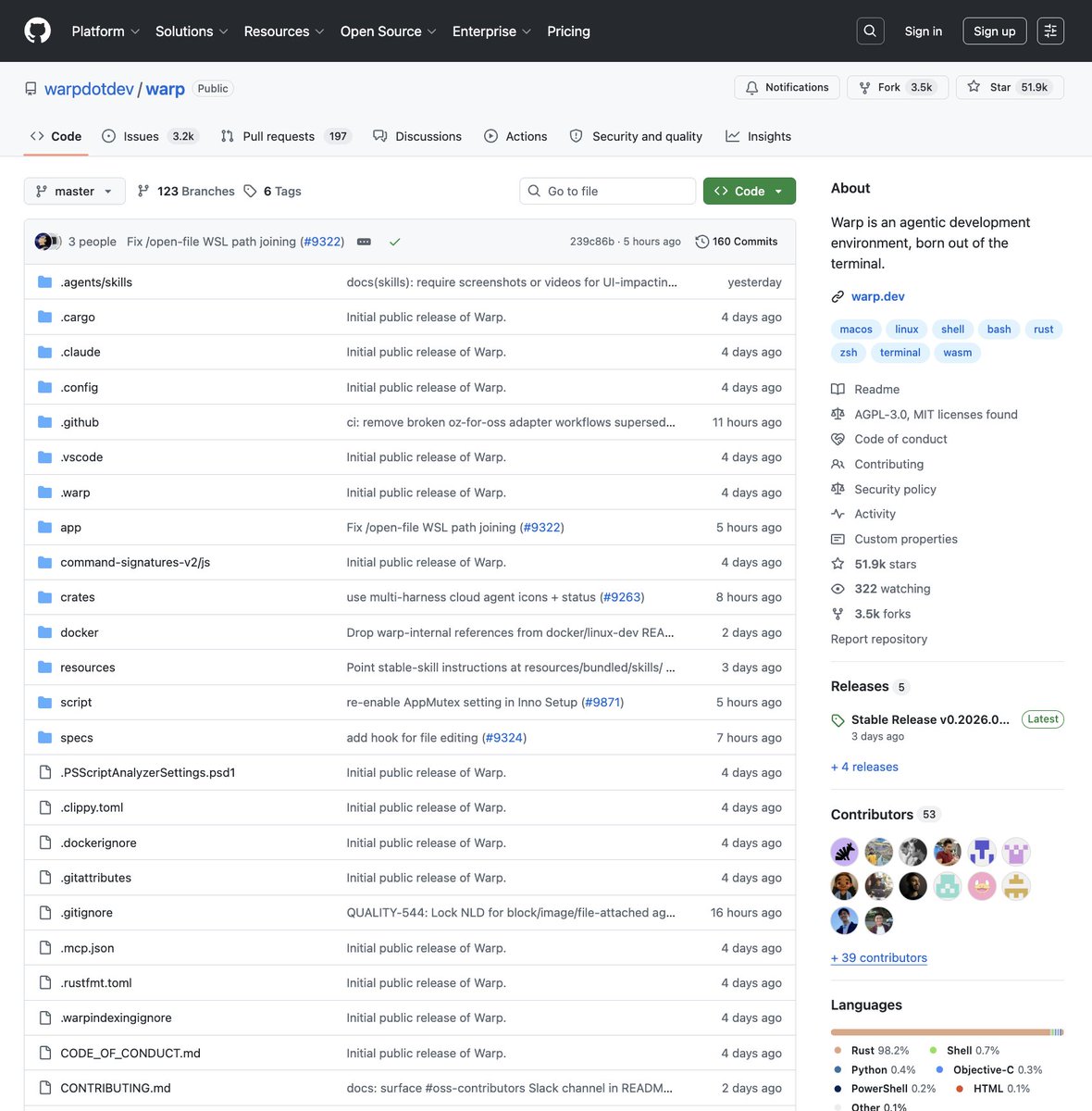
🚨 BREAKING: Warp just dropped its entire source code. 42,000 GitHub stars. Written in Rust. And it just made the traditional terminal obsolete.
This is not a terminal with AI features bolted on.
This is an agentic development environment where coding agents operate with full autonomy. From issue to PR. No babysitting.
Here's how it works:
→ You plug in Claude Code, Codex, or Gemini CLI
→ You give it a GitHub issue
→ The agent reads the codebase, writes the spec, implements the fix
→ It opens a PR with full context
→ You review and merge
That's the entire workflow. No prompting. No copy-pasting. No hand-holding.
Here's how far ahead they are:
At build. warp. dev you can watch thousands of AI agents building Warp's own codebase. Live. Right now. Triaging real issues. Writing real code. Submitting real PRs.
Click into any session. Watch the agent work in a real terminal. In your browser.
They are building the product with the product.
OpenAI is the founding sponsor. GPT powers the agentic management layer. The entire client is Rust-native and GPU-accelerated. Works on macOS, Linux, and Windows.
Your terminal types commands.
Warp ships features.
100% Open Source. AGPL-3.0 + MIT.
(Link in the comments)
We're open-sourcing more of our stack: iron-proxy, a default-deny egress proxy for untrusted workloads.
It's been a bad month for supply chain security. Trivy, KICS, LiteLLM, and Axios all followed the same playbook: compromise a package, harvest env vars, exfiltrate secrets to a C2 server. Your CI runner, your agents, and your sandboxes all have real keys.
iron-proxy sits between your workload and the internet. Workloads get proxy tokens. iron-proxy swaps in real credentials at the network boundary. If a compromised dependency exfiltrates your API key, it gets a token that's worthless outside the proxy. It's how we secure our VMs at iron[.]sh.
The only way out is making sure there are no real secrets to steal.
GitHub: https://t.co/KElrG9hZy6
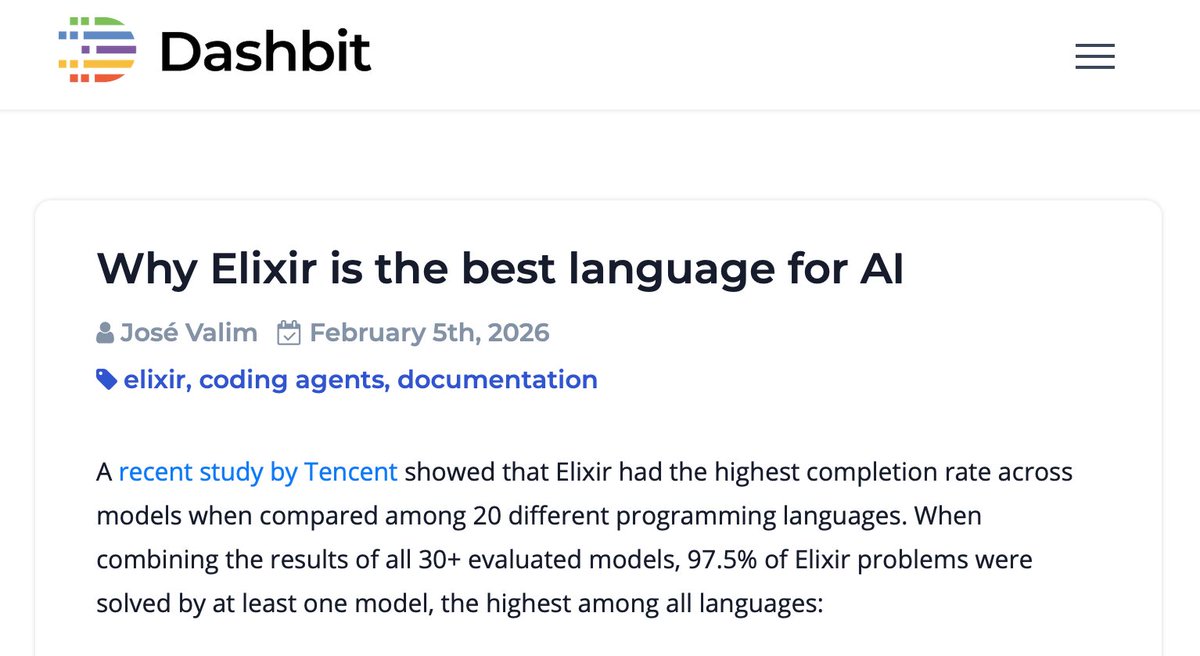
Here is my take on why Elixir is the best language for AI: immutability, documentation, stability, and tooling for coding agents.
It builds on the recent study in which Elixir had the highest completion rate across models among 20 different languages.
Link in the thread below.