My lexical call-to-arms is now out in The Atlantic: Let’s abandon the term “lab” as a term for the AI industry’s most powerful corporations. We should reserve the word for organizations whose primary activity is scientific research. Gift link: https://t.co/1isBwH2my5
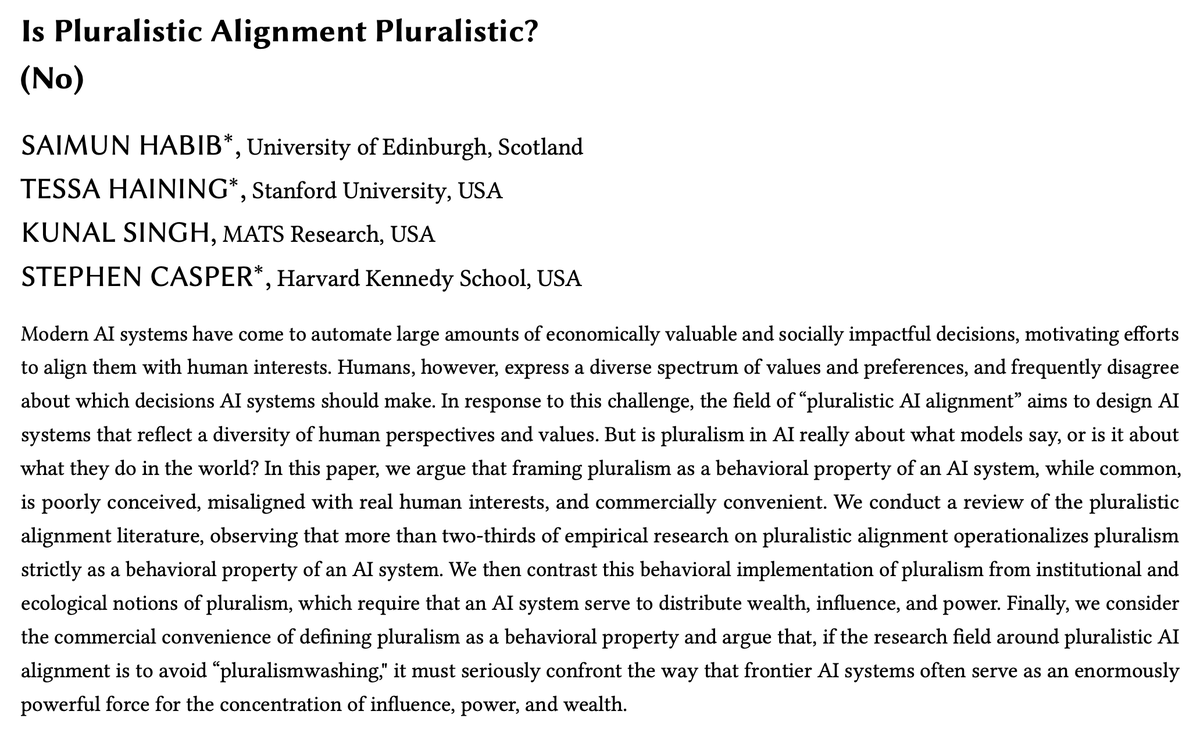
📢 New paper!
We argue that treating pluralism as a technical alignment problem is poorly conceived, misaligned with real human interests, and commercially convenient. The pluralistic alignment field may be doing far more harm than good via "pluralismwashing."
excellent reporting by @jasminewsun in the NYT today about the strange and idiosyncratic myths that the company behind the soon-to-be largest IPO in history believes about itself
fitting that this is also coming out today! how will the world see Anthropic - the way that it sees itself and believes it has earned, or the way that a growing chorus of independent citizens, advocates, and researchers are arguing for?
Ahead of Anthropic’s IPO, a rare coalition across AI safety, open source, e/acc, science, and law has signed the MisAnthropic Statement. Read the statement or sign at: https://t.co/wjlNbSL8EX
Just heard this morning that my essay for @asteriskmgzn was selected as a Notable Essay in Best American Essays 2026.
It's about me half-assing my duties during my military service in South Korea so I could read a bunch of books — give it a read!
https://t.co/RWF23MU1JM
Personal news: I just joined @NYTOpinion! I’m starting a new AI newsletter, writing on tech for the editorial board, and appearing on podcast feeds near you.
I’ve had the best two years of independence & it was not my plan to give that up. But I believe the NYT is the best place to shape the AI conversation as it stretches beyond Silicon Valley and into homes, workplaces, laws, and lives everywhere.
There’s so, so much to write about, and my first story will be out this week.
(As I onboard, doing a bunch of background learning convos from folks around the ecosystem; also always open to tips, feedback, etc - say hi via DM or on Signal at jws.27!)
Yesterday, I had the privilege of testifying to the California Assembly Privacy Committee what AI legislation we need to help incentivize AI safety.
One of my main takeaways was that there is immense enthusiasm in the California legislature around AI legislation.
As one example, the event was organized when the legislature is off-session, but was still attended by 15 assembly members, including many who are not on the Privacy committee. It was also attended by the speaker of the assembly.
In my testimony, I laid out a plan to develop a layered approach to AI safety:
- Clarify and strengthen liability, building on AB 316 (which
- Require AI companies to hold insurance against a threshold of liability
- Require third-party evaluators to audit AI companies' safety practices
- Broaden transparency via incident reporting, safe harbors, and whistleblower protections (at lower thresholds compared to SB 53)
- Provide public support for the adoption of defensive AI, especially in critical infrastructure (starting with the CA govt.)
- Prove public support for AI safety research (e.g., in the form on compute, such as via CalCompute)
- Develop mechanisms for coordination between AI companies and owners of critical infrastructure to share capabilities with defenders much more quickly
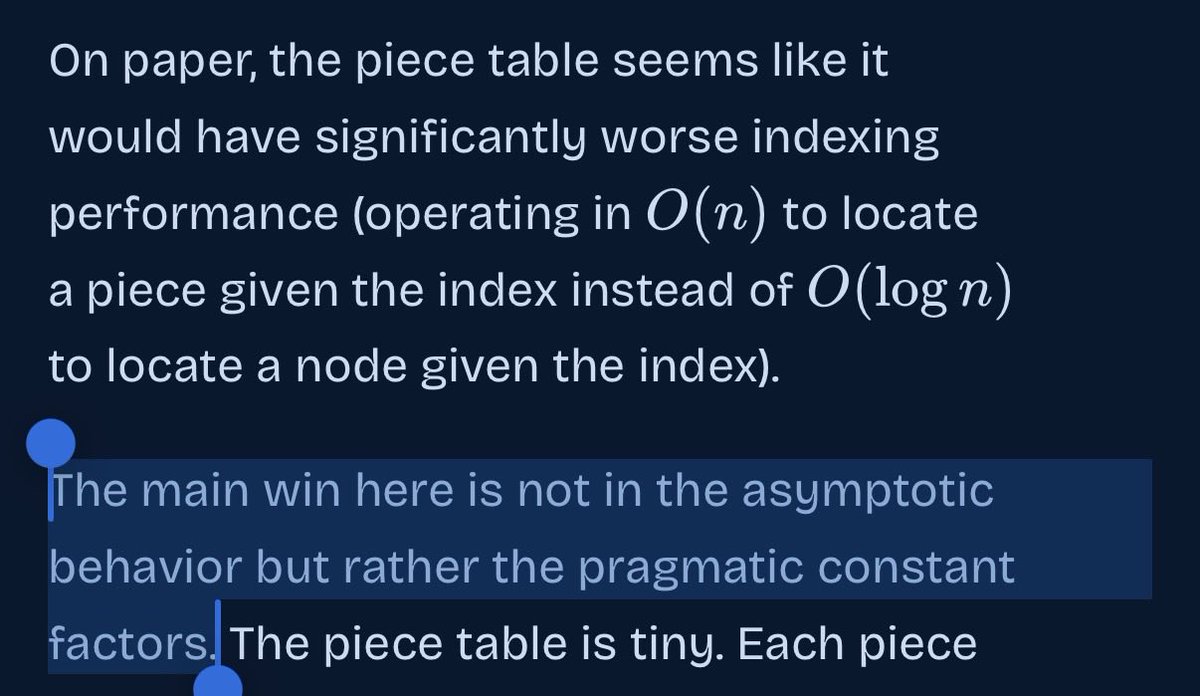
I spent some time off reading some papers and thought that I could improve upon what was previously the world's fastest CRDT
Introducing eg-strider: a set of improvements on top of Eg-walker that result in significantly better performance on every measurable axis
https://t.co/t1W5MULCfq
https://t.co/IpN7O4alKT
(now featuring exclusive twitter language balls benchmark visualizations)
Is it "weird" or does he maybe know what he's talking about? Anyway, for those who are open to the idea that there's a well-thought-out AI-as-normal-technology perspective on AI safety and the recent loss-of-control incidents, see my essay with @sayashk, or my interview with Ezra Klein, or the writing of many others with similar views including @joshua_saxe and @natolambert.
https://t.co/sS8OS9LerG
the interpretability experts can duke it out on the merits of the claims, but as a work of scientific communication, what a beautiful artifact & a testament to changing your mind after years of dedication to a particular area of study
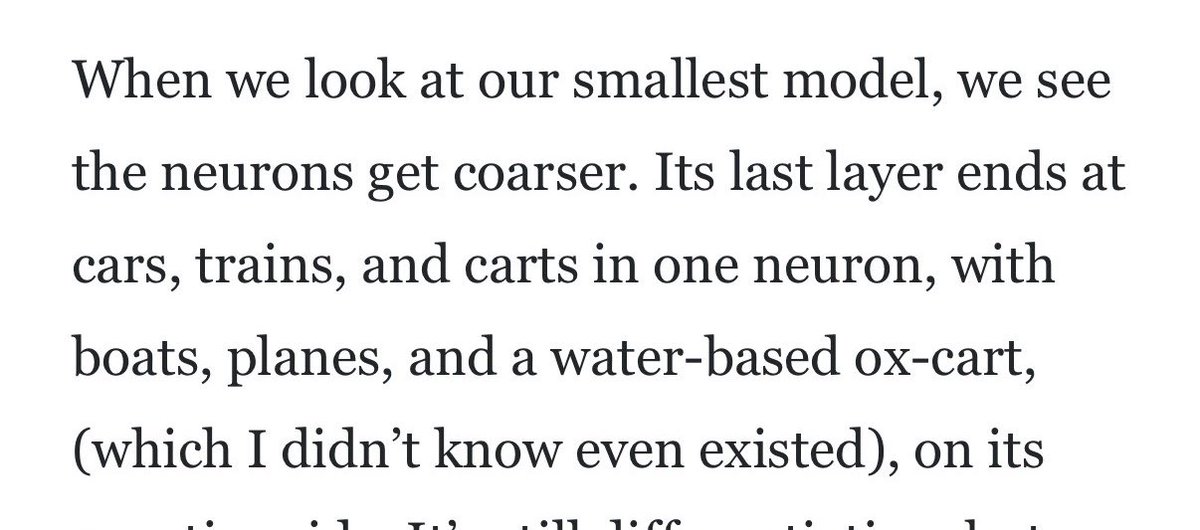
interpretability might be the most important scientific problem in the world right now, as I don't think we can solve alignment if we don't know what we're building. I think I have good news about it. I co-authored early work in mechanistic interpretability at OpenAI and came away pessimistic, because neural networks appeared to fold into arbitrary tangled knots. years later, I started openai's first large-scale automated interpretability project, finding about 2% of neurons legible with the primitive tools we had
with modern agentic tools and a much closer look, the picture looks totally different. the vast majority in models up to trillions of parameters are legible, and their circuits beautiful. many famous examples of tangled neurons turned out to be misunderstood. The roadblocks I expected mostly aren't there. I now think ambitious interpretability will be solved by the time we need it most, and possibly quite soon, as automated scientists keep improving. it may be a bitter lesson for interpretability: the simple thing, at absurd scale, works
https://t.co/zHij5zwKGT