“If you don’t understand why the Palestinians endure, what Hezbollah is fighting for, or the role that self-determination and independence play in Iran’s purposes, then this war is nothing more than a one-dimensional tale composed of false and misshapen tropes and stereotypes. It will also lead you to believe, wrongly, that there is resolution available, i.e. victory, through more airstrikes, a tighter blockade or another village bulldozed. Finally, failing to acknowledge resistance to occupation and foreign domination as the basis for the Palestinian resistance, Hezbollah and Iran’s foreign policy will make you think that it is possible to end the war with anything other than an end to occupation and guarantees of sovereignty.”
Link in first comment.
“If you don’t understand why the Palestinians endure, what Hezbollah is fighting for, or the role that self-determination and independence play in Iran’s purposes, then this war is nothing more than a one-dimensional tale composed of false and misshapen tropes and stereotypes. It will also lead you to believe, wrongly, that there is resolution available, i.e. victory, through more airstrikes, a tighter blockade or another village bulldozed. Finally, failing to acknowledge resistance to occupation and foreign domination as the basis for the Palestinian resistance, Hezbollah and Iran’s foreign policy will make you think that it is possible to end the war with anything other than an end to occupation and guarantees of sovereignty.”
Link in first comment.
"To this day – nearly six months after the events of Jan. 8-9 – the allegation that the Iranian government killed 30,000-40,000 protesters remains wholly unproven or meaningfully corroborated," writes @MsJamshidi, who examines the numbers & the sources:
https://t.co/eMyMc8Ze4L
Must-read piece by @Rory_Johnston on what it will take to reopen the Strait of Hormuz if/when the U.S. and Iran reach a deal (linked below).👇
An immediate stockpile of roughly 160 million barrels will be released to the market as trapped tankers exit, but the real issue is the flow problem: getting the roughly 14 mb/d of shut-in production back online.
From a sheer physical perspective, Kuwait has said that could take 3-4 months for its oilfields to resume prewar production levels, though timelines will vary by country. To enable that, the excess oil in onshore storage will need to be cleared to make way for new production.
But physical constraints aside, the bigger issue is whether and when Persian Gulf countries can be assured that a regular outlet for exporting petroleum exists -- i.e. can they trust that Iran will actually *keep* the Strait of Hormuz open, and will it permit a resumption to prewar levels of traffic?
When cast that way, the reasons for the strong resistance of Persian Gulf governments to "allow" Iran any post-war control over Hormuz becomes obvious: Iran could potentially use its leverage over Hormuz to essentially *decide for them* what their new levels of ongoing oil production will be.
Whether, and under what conditions, Iran would try to impose de facto production limits on Gulf states by squeezing Hormuz is unclear.
But my take is that the issue is best left for regional actors to work out themselves. After all, the U.S. has armed and equipped states like the UAE and Saudi Arabia with U.S. materiel for years. Local actors can retaliate impose costs on Iran, too, should Tehran get cute with the Strait of Hormuz. They have means to deter Iran from interference with the strait.
In the most recent war, Gulf countries stayed largely on the sidelines in hopes of minimizing Iranian retaliation (with the UAE a glaring exception, as it conducted significant airstrikes on Iran).
But if the U.S. were not so deeply enmeshed, trying to micromanage everything in the region, 1.) this war would never have happened and Iran would not have discovered the extent of its geographic leverage over Hormuz, and 2.) regional actors would balance each other and work out their political problems without the U.S. -- perhaps more peacefully. The resulting political arrangements would be more durable in the absence of U.S. meddling because they'd more accurately reflect the regional balance of power.
International relations is all about bargaining in the shadow of relative power. With the U.S. constantly and ham-handedly putting its thumbs on the scale, we interrupt and warp local bargaining processes in ways we barely understand -- and keep us trapped in the region.
Trump never should have launched this disastrous war. But he did, and the Persian Gulf won't ever be the same. An irresponsible U.S. regime change war is what provoked Iran into closing the Strait of Hormuz and taking the global economy hostage.
Simply put, we did this to ourselves. Meddling has consequences. And there's no engineered solution that can be attained through U.S. military force that approaches anything like reasonable cost.
The sane response to failure is to change strategies. Trump should drop his blockade in exchange for Iran reopening the Strait of Hormuz. Other issues can be handled later. The longer Trump waits, the worse his leverage gets, as the delayed costs of the Hormuz closure finally hit this summer.
And then the U.S. needs to reconsider its entire approach to the Middle East.
All those wrecked U.S. military bases? We should NOT rebuild them -- and not just because our air defenses can't adequately protect them from Iranian missiles and drones.
We need to take this opportunity to drastically scale back U.S. commitments to the region -- not just physical U.S. posture and presence, but the *underlying political commitments* to regional actors, whether it's Israel or Saudi Arabia.
Regional actors can balance Iran. They have more skin in the game and a far better understanding of realities on the ground than Washington ever could.
Rarely do historical events so upend political inertia as the Iran War has. Let's hope that the U.S. can take advantage of this opportunity to redefine its role and trim legacy commitments that no longer serve U.S. interests -- if they ever truly did.
This is the most transparent War Department in history. No amount of spin from the Fake News media will change that.
The Pentagon Press Office has been redesignated as a Sensitive Compartmented Information Facility due to speechwriters from the Office of the Secretary of War sharing the facility.
These speechwriters routinely handle classified material and require SIPRNet access. As a result, journalists will no longer be permitted to enter the office space. There’s nothing controversial about that.
Access to the office of the Assistant to the Secretary of War for Public Affairs @SeanParnellASW and to the Press Secretary remains available by appointment only.
@CrowellBrian Unfortunately, I don’t think that mentality applies only to those from the south. I too am worried by the number of officers from all parts of the country who would be more loyal to Trump than to the Constitution.
🚨🇺🇸🇮🇱 The diplomatic alignment between Washington and Israel is unraveling as they pursue competing strategic objectives.
Matthew Hoh believes that the U.S. remains trapped in an unwinnable regional conflict with no clear political space to offer concessions.
He emphasizes that Iran maintains the clear upper hand through its tight control of the Straits of Hormuz, leaving the current framework at a complete impasse.
@MatthewPHoh
🚨🇺🇸🇮🇱 A deeper look into the leaked phone call between Trump and Netanyahu reveals an administration intensely frustrated by its strategic traps.
Matthew Hoh suggested that Israel is trying to use the conflict in Lebanon to goad Iran into a wider retaliation that forces American intervention.
While Tehran has shown patience in the past, they now possess a dangerous level of confidence regarding a potential regional war.
"I don't doubt at all that Trump was angry at Netanyahu.
Trump is trapped in this war."
@MatthewPHoh
🚨🇺🇸🇮🇷 Any lingering hope for a grand diplomatic resolution in the Persian Gulf may have completely collapsed.
Marine Matthew Hoh warns that returning to direct warfare would be catastrophic, as the U.S. risks entirely running out of Patriot missiles.
He suggested the best-case scenario is a series of superficial, chest-beating proxy exchanges while Washington desperately tries to pivot public attention elsewhere.
@MatthewPHoh
Going live with @NoPeasants_ to discuss the 1967 Israeli attack on the USS Liberty with former Marine and USS Liberty survivor Bryce Lockwood:
https://t.co/opDoV0hXRl
🚨 How To Perpetrate And Sell A Top-Notch Genocide! 🚨
One might think that completing and marketing a genocide to the fun-loving folks of America, the UK, etc. is nearly impossible. But in fact, you too can perpetrate your very own genocide without much fuss if you just follow these simple steps.
- Allow / facilitate an initial attack that you can pretend is the beginning of all history. Even the NY Times has reported on the Israeli government’s awareness that the Oct 7, 2023 attack was going to happen (including every last detail) for over a year in advance.
- Murder a bunch of your own people because it will help sell the casus belli. Regular people’s lives don’t matter even if they’re your own citizens.
- Commence your genocide via every means possible — bombing, shooting, starving, disease, whatever ya got. Don’t worry about whether it “looks” too much like a genocide. You can deal with that later.
- Ban all reporters from the area because you don’t want anyone to see what’s actually happening.
- For reporters who refuse to stop reporting, go ahead and murder them.
- When you first murder a journalist, claim it was a tragic accident.
- When you next murder a journalist, claim it was because they were standing next to a terrorist.
- When you next murder a journalist, claim the journalist was also a terrorist.
- When you next murder a journalist, don’t even bother to give a reason. No one cares anymore.
- Turning the horrific and unbearable into the normal and commonplace is the key to completing a great genocide.
- Blow up hospitals and medical facilities in the region because they might help people survive, and we don’t want that.
- When you first bomb a hospital, claim it wasn’t your fault. The bad guys did it to themselves.
[SIDE NOTE: Nearly every sentence in this column has links with sources. To get those (at no cost), simply go to "RealLeeCamp" on subs tack. Subscribe to my work there. Thanks!]
- When you next bomb a hospital, claim it was because the bad guys were underneath the hospital.
- When you next bomb a hospital, claim it was because the bad guys were seen going into the hospital.
- When you next bomb a hospital… ummmm… You know what, after you’ve bombed 5 or 10 hospitals, most of the world will stop asking why you did it because they’ll be bored and instead want to read stories about their favorite actor’s favorite chef’s favorite dish.
- Bomb schools, universities, community centers, places of worship, even cemeteries — anything that allows for community and ties the people to the land. Remember: You’re going to want to ethnically cleanse the survivors after your killing is done, so you don’t want them to have anything left that keeps them there.
- Cut off the food, water, and medicine in the area. Claim you did it because the bad guys were hiding in the food, water, and medicine. Logic doesn’t really matter. Westerners just want something they can repeat around the water cooler at work to explain why genocide is “totally fine.”
- Bomb or attack any aid groups operating in the region. You want to get rid of aid groups because A) they might help some of the population survive, and we can’t have that. And B) they will often report back what they saw in the genocided region, and we can’t have that either.
- When asked why you’re murdering aid workers, just rinse and repeat the same old excuses as with the bombed hospitals.
- At some point international pressure to stop your genocide might get to be too much. If that happens, move on to Phase 2: Pretending It’s A Ceasefire.
- Agree to some bullshit ceasefire plan with the genocided people. It doesn’t really matter what the agreement says because you’re not planning on abiding by any of it anyway.
- If it says you can’t steal anymore land, ignore that.
- If it says you can’t bomb anymore, ignore that.
- If it says you must allow food and medicine in, ignore that.
- If it says you must allow international aid groups in, ignore that.
- If it says you must allow the victims to leave and/or return from the area, ignore that.
- Okay, now that you have your super awesome ceasefire, you can tell the world you’re relieved the “conflict” is over while internally making it clear that nothing is over. (Oh yeah, always call it a “conflict” because people act all weird and touchy when you call it genocide.)
- Slowly steal more and more of the region until the genocide survivors are all condensed onto a completely uninhabitable tiny spit of land without food, water, medicine, or refuge.
- Luckily most of the international news media will have moved on by now as will the people donating money to help the victims. It’s been a couple years and the media rarely cares about anything for more than a few months. The only time they’ll view your genocide as worthy of coverage is when something strange or new happens — but since you’re basically just killing innocent people in the same manner you have been for over two years, there won’t be any good “news hook” there. Booooooring.
- After another year or two, make a very generous offer that the people in the “conflict zone” can “voluntarily” leave if they would like. Most will take you up on your offer because the alternative is to die.
Congratulations! You have yourself a successful genocide!
Of course don’t forget to be proactive on the propaganda front as well. Claim that anyone criticizing your genocide is antisemitic. Pay social media influencers to gush about how awesome and moral you are. Pay PR companies to “reframe” your massacres as really cool and hip. Accuse the people you’re ethnically cleansing of doing all the things you’re actually guilty of. You get the idea.
Follow these simple steps and you too can commit a nice, easy genocide without all the fuss!
[I'm very suppressed here. Follow my work for free at "RealLeeCamp" on subs tack. Thanks! ]
This note from two days ago on the US debt crisis on substack is driving me nuts.
https://t.co/IOXBPGCM1g
In the note he reports that by 2031 every dollar collected in taxes will be exceeded by mandatory spending requirements. All manner of questions are asked about entitlements, pearls are clutched and the comments don’t address reality either.
Hopefully, in a few hours @MatthewPHoh will make some sense of our out of control military and intelligence spending, which combined account for half of all discretionary spending.
So, if we cut the military and intelligence budgets by half we could afford our interest payments and the promises we’ve made to present and future retirees.
Why no one says this aloud is beyond me.
Anyway, I am very eager to hear what @MatthewPHoh has to say, link here: https://t.co/yECSmkC4JH
@iwelsh@KidNate@Known__Unknowns
🔥 “WHERE IS THE ANTI‑WAR MOVEMENT?” — Matt Hoh Exposes The Game
In the latest Daniel Davis Deep Dive, Matt Hoh (@MatthewPHoh) exposes the incredibly cynical reality of why national leadership refuses to stop the Iran war. While leaders may perform opposition, the strategic calculus is rooted in partisan gain rather than peace.
Hoh explains that Democrats view a failing conflict as an electoral asset: "the democrats view this as beneficial politically... they'll oppose it but just like with the Iraq war if they have any ability to end it they won't."
The political incentive structure is clear: if Trump pursues a peace deal, Democrats anticipate that the Israel lobby will punish his candidates, allowing them to "benefit politically by picking up Israeli lobby support."
Whether the war continues or a deal is reached, the political establishment finds a way to win, which is why "there is no anti-war movement... politically at the national level."
The Middle East conflict is being treated as a tool for political discipline rather than a crisis of national security, revealing a disturbing failure in U.S. strategy.
This is the political machinery driving the crisis — and why the stakes are far higher than most Americans realize.
👇 Watch the full clip now for the unvarnished truth on Washington’s cynical political calculus.
https://t.co/yH8CUPJpqI
🏷️ #IranWar #USStrategy #MiddleEastConflict #ForeignPolicy #Geopolitics #DanielDavisDeepDive #NationalSecurity #MilitaryStrategy #AIPAC #WashingtonDC #Diplomacy #Accountability
Have the Iranians said this as directly before?
“And to the esteemed Palestinian people we say: The time has come to reclaim your land. Our fire is at your service. The departure of the settlers from the occupied territories may be a preliminary step for your return to it.”
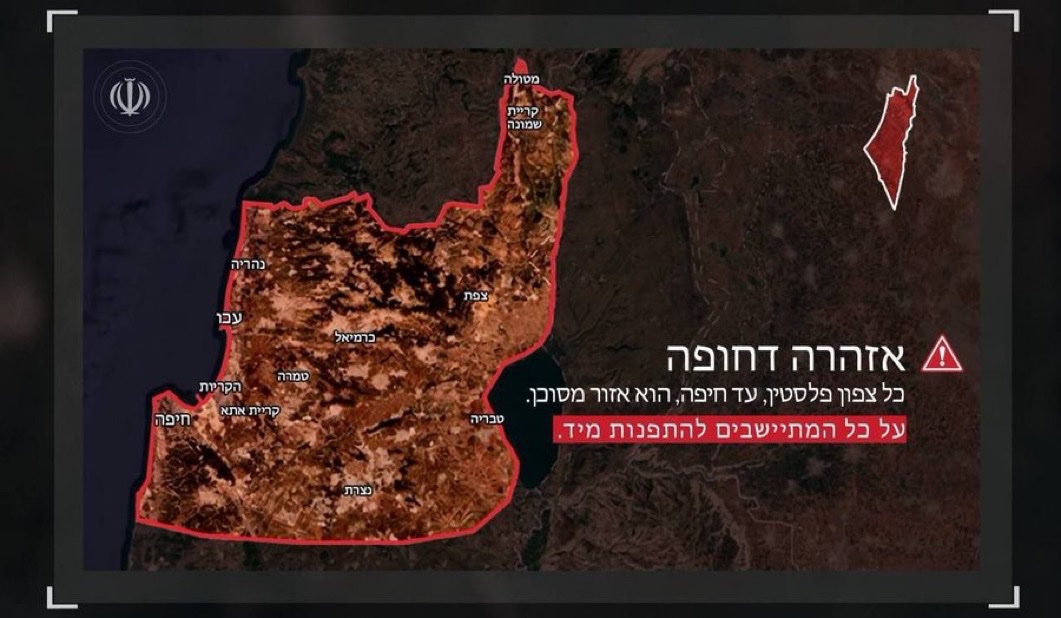
BREAKING: IRGC URGENT WARNING:
“We announce to the settlers in northern occupied Palestine that the area specified in the attached map, which includes the Upper Galilee, the Lower Galilee, the Golan, and Haifa, has become a closed military zone as of this moment. If your criminal leaders target the southern suburb of Beirut or the city of Beirut, this area will be a target for attacks by the Iranian armed forces.
And we say to the honorable Palestinian people: The time has come to reclaim your land. Our fire is at your service. The departure of settlers from the occupied territories may be a prelude to your return to it.
Immediate evacuation order
To the residents of the settlements in northern occupied Palestine, it is announced that the area marked on the attached map, which includes the Upper Galilee, the Lower Galilee, the Golan Heights, and Haifa, is hereby defined as a closed military zone. Should your criminal leaders attack the southern Dahiya of Beirut or the city of Beirut, this area will become a target for the Iranian armed forces.
And to the esteemed Palestinian people we say: The time has come to reclaim your land. Our fire is at your service. The departure of the settlers from the occupied territories may be a preliminary step for your return to it.”





![LeeCamp's tweet photo. 🚨 How To Perpetrate And Sell A Top-Notch Genocide! 🚨
One might think that completing and marketing a genocide to the fun-loving folks of America, the UK, etc. is nearly impossible. But in fact, you too can perpetrate your very own genocide without much fuss if you just follow these simple steps.
- Allow / facilitate an initial attack that you can pretend is the beginning of all history. Even the NY Times has reported on the Israeli government’s awareness that the Oct 7, 2023 attack was going to happen (including every last detail) for over a year in advance.
- Murder a bunch of your own people because it will help sell the casus belli. Regular people’s lives don’t matter even if they’re your own citizens.
- Commence your genocide via every means possible — bombing, shooting, starving, disease, whatever ya got. Don’t worry about whether it “looks” too much like a genocide. You can deal with that later.
- Ban all reporters from the area because you don’t want anyone to see what’s actually happening.
- For reporters who refuse to stop reporting, go ahead and murder them.
- When you first murder a journalist, claim it was a tragic accident.
- When you next murder a journalist, claim it was because they were standing next to a terrorist.
- When you next murder a journalist, claim the journalist was also a terrorist.
- When you next murder a journalist, don’t even bother to give a reason. No one cares anymore.
- Turning the horrific and unbearable into the normal and commonplace is the key to completing a great genocide.
- Blow up hospitals and medical facilities in the region because they might help people survive, and we don’t want that.
- When you first bomb a hospital, claim it wasn’t your fault. The bad guys did it to themselves.
[SIDE NOTE: Nearly every sentence in this column has links with sources. To get those (at no cost), simply go to "RealLeeCamp" on subs tack. Subscribe to my work there. Thanks!]
- When you next bomb a hospital, claim it was because the bad guys were underneath the hospital.
- When you next bomb a hospital, claim it was because the bad guys were seen going into the hospital.
- When you next bomb a hospital… ummmm… You know what, after you’ve bombed 5 or 10 hospitals, most of the world will stop asking why you did it because they’ll be bored and instead want to read stories about their favorite actor’s favorite chef’s favorite dish.
- Bomb schools, universities, community centers, places of worship, even cemeteries — anything that allows for community and ties the people to the land. Remember: You’re going to want to ethnically cleanse the survivors after your killing is done, so you don’t want them to have anything left that keeps them there.
- Cut off the food, water, and medicine in the area. Claim you did it because the bad guys were hiding in the food, water, and medicine. Logic doesn’t really matter. Westerners just want something they can repeat around the water cooler at work to explain why genocide is “totally fine.”
- Bomb or attack any aid groups operating in the region. You want to get rid of aid groups because A) they might help some of the population survive, and we can’t have that. And B) they will often report back what they saw in the genocided region, and we can’t have that either.
- When asked why you’re murdering aid workers, just rinse and repeat the same old excuses as with the bombed hospitals.
- At some point international pressure to stop your genocide might get to be too much. If that happens, move on to Phase 2: Pretending It’s A Ceasefire.
- Agree to some bullshit ceasefire plan with the genocided people. It doesn’t really matter what the agreement says because you’re not planning on abiding by any of it anyway.
- If it says you can’t steal anymore land, ignore that.
- If it says you can’t bomb anymore, ignore that.
- If it says you must allow food and medicine in, ignore that.
- If it says you must allow international aid groups in, ignore that.
- If it says you must allow the victims to leave and/or return from the area, ignore that.
- Okay, now that you have your super awesome ceasefire, you can tell the world you’re relieved the “conflict” is over while internally making it clear that nothing is over. (Oh yeah, always call it a “conflict” because people act all weird and touchy when you call it genocide.)
- Slowly steal more and more of the region until the genocide survivors are all condensed onto a completely uninhabitable tiny spit of land without food, water, medicine, or refuge.
- Luckily most of the international news media will have moved on by now as will the people donating money to help the victims. It’s been a couple years and the media rarely cares about anything for more than a few months. The only time they’ll view your genocide as worthy of coverage is when something strange or new happens — but since you’re basically just killing innocent people in the same manner you have been for over two years, there won’t be any good “news hook” there. Booooooring.
- After another year or two, make a very generous offer that the people in the “conflict zone” can “voluntarily” leave if they would like. Most will take you up on your offer because the alternative is to die.
Congratulations! You have yourself a successful genocide!
Of course don’t forget to be proactive on the propaganda front as well. Claim that anyone criticizing your genocide is antisemitic. Pay social media influencers to gush about how awesome and moral you are. Pay PR companies to “reframe” your massacres as really cool and hip. Accuse the people you’re ethnically cleansing of doing all the things you’re actually guilty of. You get the idea.
Follow these simple steps and you too can commit a nice, easy genocide without all the fuss!
[I'm very suppressed here. Follow my work for free at "RealLeeCamp" on subs tack. Thanks! ]](https://pbs.twimg.com/media/HJ0D_uMWIAARIFs.jpg)