@hammer_mt@danshipper I hadn’t heard that before, but agree with the direction. I often have 10x or more of input from input context and back-and-forth conversations that go into my AI output. Also a skill that makes it sound much more like me
I’ve been using a personal assistant I built over the last few months and it’s incredibly useful. This level of computer use capability will be a huge unlock
Introducing Hark Handoff
It is verifiably the best model ever built for using the internet.
It can order food, book flights, shop, deeply research, you name it - better and more affordably than frontier models.
The cost of generating the proofs for all 10 of these breakthroughs combined was under $2,000 at Sol API prices. We’re excited to see what scientists and researchers are able to create with our upcoming Astra models!
Opus 5 sets a new state-of-the-art on ARC-AGI-3, at 30%.
ARC-AGI-3 measures solving problems with no prior exposure -- the setting where scaling has historically bought the least. Impressive jump!
When people say that those of us on here are in the .001% of AI, this is what they are talking about. So few people realize what AI is actually capable of today, let alone in a year or two
Droids can now take on Missions: goal-oriented work that may take days to fully spec out, build, and test.
Genuinely mind blowing to see what Missions some of the world's largest enterprises have been sending Droids on. My favorite examples have been:
• Modernize a 40-year-old COBOL core module
• Migrate >1k microservices to a new Kubernetes cluster across three regions
• Recalculate 10 years of pricing data after a revenue recognition rule change
• Refactor a monolith that processes 20M daily API calls, with no downtime
Try sending a Droid out on a Mission today and let me know what you think!
It is hard to communicate how much programming has changed due to AI in the last 2 months: not gradually and over time in the "progress as usual" way, but specifically this last December. There are a number of asterisks but imo coding agents basically didn’t work before December and basically work since - the models have significantly higher quality, long-term coherence and tenacity and they can power through large and long tasks, well past enough that it is extremely disruptive to the default programming workflow.
Just to give an example, over the weekend I was building a local video analysis dashboard for the cameras of my home so I wrote: “Here is the local IP and username/password of my DGX Spark. Log in, set up ssh keys, set up vLLM, download and bench Qwen3-VL, set up a server endpoint to inference videos, a basic web ui dashboard, test everything, set it up with systemd, record memory notes for yourself and write up a markdown report for me”. The agent went off for ~30 minutes, ran into multiple issues, researched solutions online, resolved them one by one, wrote the code, tested it, debugged it, set up the services, and came back with the report and it was just done. I didn’t touch anything. All of this could easily have been a weekend project just 3 months ago but today it’s something you kick off and forget about for 30 minutes.
As a result, programming is becoming unrecognizable. You’re not typing computer code into an editor like the way things were since computers were invented, that era is over. You're spinning up AI agents, giving them tasks *in English* and managing and reviewing their work in parallel. The biggest prize is in figuring out how you can keep ascending the layers of abstraction to set up long-running orchestrator Claws with all of the right tools, memory and instructions that productively manage multiple parallel Code instances for you. The leverage achievable via top tier "agentic engineering" feels very high right now.
It’s not perfect, it needs high-level direction, judgement, taste, oversight, iteration and hints and ideas. It works a lot better in some scenarios than others (e.g. especially for tasks that are well-specified and where you can verify/test functionality). The key is to build intuition to decompose the task just right to hand off the parts that work and help out around the edges. But imo, this is nowhere near "business as usual" time in software.
@joon_s_pk@karpathy@percyliang@msbernst Congrats on the launch! Are the similes made up environments? Are do you combine with something like the V-IRL paper to put the agents in real world environments?
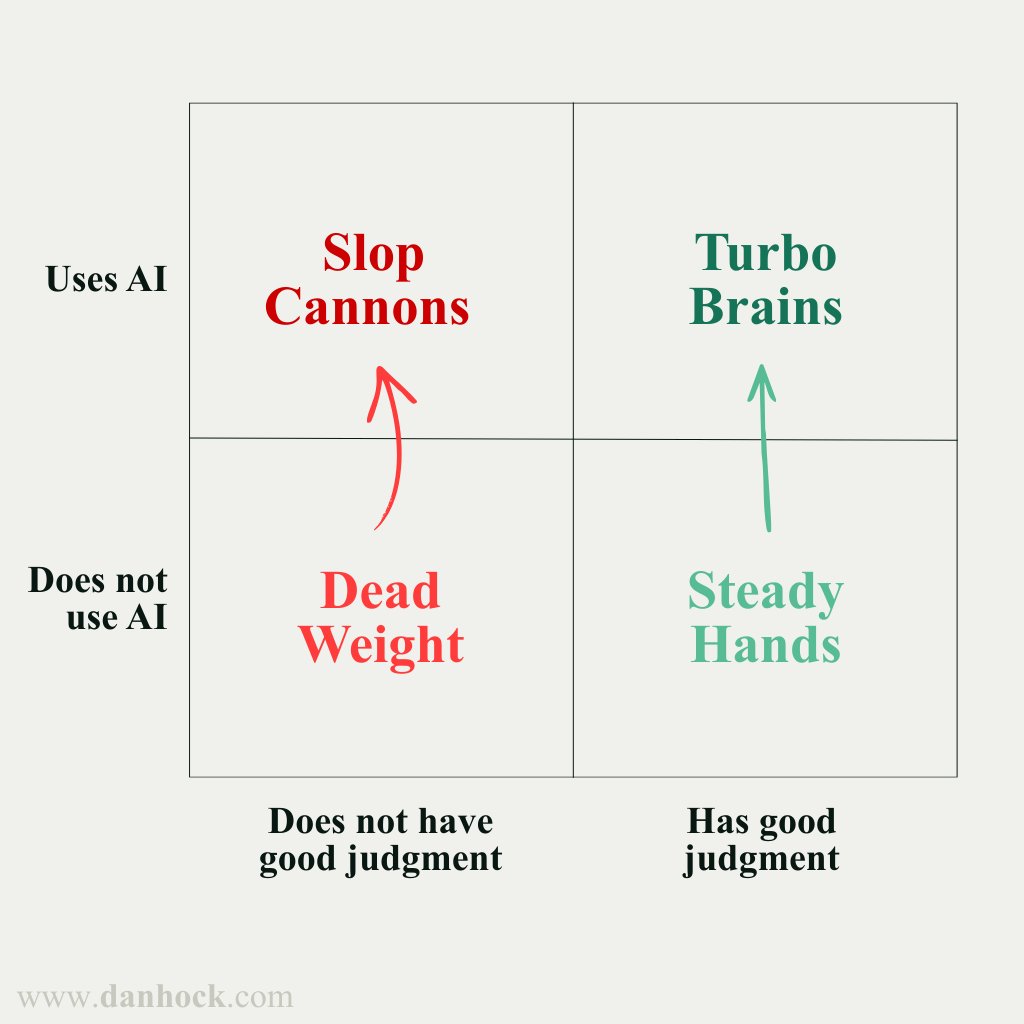
Four types of people at every company now
yes, people get 10x better when the go from bottom right to top right
but also, people get 10x worse when they go from bottom left to top left
Simon really knows what he’s talking about - his posts have so many insights and are really helpful if you are working with the latest tools and models
Really well thought out piece. This resonated with me when he describes how you talk to people outside of tech about the current state of AI: “the honest version sounds like I've lost my mind.”