— UChicago PhD candidate
— Iraq/Syria/Yazidis/Islamic thought
— Former ED Yazda Iraq
— Former editor Syria Comment
— Image: Castañeda, "La Vocacion de Ezequiel"
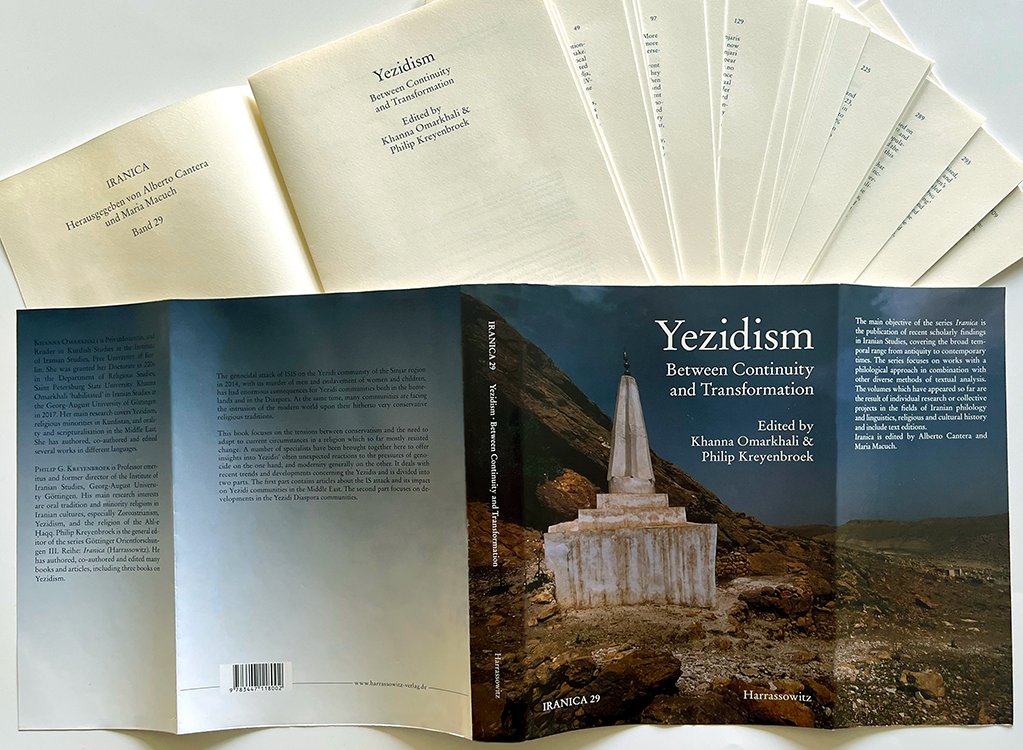
I've just published a detailed political/historical overview of the early phase of the #Yazidi Genocide, in the latest volume of the Iranica series. The volume can be purchased in print or e-book from @harrassowitz_v:
https://t.co/Nh0TF2goLV
#Sinjar
At the Yazidi Truth Commission in Berlin, survivor Samih testified that ISIS was aided by local neighbors in blocking Kocho residents from escaping. He survived a mass killing that claimed 450 lives. https://t.co/jBZYDxpzfY
In her testimony at yesterday's Truth Commission on the Ezidi Genocide, a Yazidi survivor of enslavement claimed that "the man who is the current president of Syria" once visited the home of her captor for a meeting. She denied that al-Julani engaged in any sexual act with her but stated that she was required to serve him tea. Upon questioning by the commissioners, she affirmed that Julani would have been aware that she was an enslaved Yazidi, as the Muslim wives of jihadists were not allowed to serve tea to men or to visibly show their faces in that context.
Jabhat al-Nusra, the terrorist organization that Julani (now Ahmed al-Sharaa) led, once criticized the Islamic State organization's preoccupation with enslavement, implying that it was a distraction to the jihad, but did not condemn the practice. The survivor did not differentiate between IS and Nusra, but referred to Julani as "a member of ISIS." While Nusra was a separate entity from IS, it is plausible that discussions and negotiations between the two groups took place in such meetings.
The testimony was delivered on Monday, Nov. 16, 2026, the first of three days of testimony to be delivered to the Commission.
Website for the Truth Commission: https://t.co/aDzbV54XgB
Full livestream (English): https://t.co/RZ4y3FwKe1
Everyone knows ISIS. Almost no one knows the Ezidi people, their main victims
A Truth Commission is coming in 2026 as part of the GAPS project Survivor-experts at the centre. High-level commissioners including Baroness Helena Kennedy and Judge Navi Pillay
https://t.co/JaXCJoNJSA
@mkhammer I was targeted with similar comments from my academic colleagues while doing humanitarian work with the Yazidis. It made me feel unwelcome in academia.
@HaithamElmasri1 In your final paragraph:
This part—"Israel has committed filthy and savage crimes against Palestinians"—is very true,
while this part—"unlike anything the world has ever witnessed in the entire history of humanity"—is completely and absolutely false.
I'm sad you're so black-pilled on women because of your experience. I've had amazing female friends who have been supportive during tough times, including one who flew across the country to visit me during a time of personal crisis. At my place she decided I needed new linens, kitchenware, cooking stuff, etc., so without telling me she went and bought them all for me. Sometimes the skill is in picking true friends.
The Nine Christian Martyrs Who Lost Their Lives in the Jordan Church Attack
Nine Jordanian Christians were martyred in a deadly terrorist attack on St. George’s Greek Orthodox Church in the village of Hamoud, Karak Governorate, on Friday, October 23, 2026. Three armed men opened fire on mourners who had gathered for a funeral, turning a moment of prayer and farewell into a tragedy. The attack initially claimed the lives of seven martyrs, with two more victims later dying from their injuries, bringing the death toll to nine. Approximately 40 others were injured.
Dr. Fadi Al-Halsa
Dr. Fadi Al-Halsa was a young Jordanian dentist who had recently graduated from Alexandria University in Egypt in 2026. The only son of his parents, he was remembered by his professors and classmates for his kindness, good character, and dedication to his studies. After years of hard work, he had returned to Jordan to begin his dental career and build his future.
Dr. Khaled Al-Halsa
Known as the “Doctor of the Poor,” Dr. Khaled Al-Halsa was a beloved dentist in Karak, Jordan, remembered for his kindness and dedication to helping those in need. He frequently provided free dental treatment to the poor and would even cut his vacations short to return to his hometown and care for his patients. He was martyred during the terrorist attack after being shot in the head.
Mazen Rasmi Al-Qusus
Mazen Rasmi Al-Qusus was a Jordanian lawyer from Karak, remembered by those who knew him for his kindness, good character, and respectful treatment of others. His death brought grief to his family, friends, and the legal community in Jordan. He was among those wounded during the terrorist attack and later died from his injuries.
Dr. Assem Barqan
Dr. Assem Barqan was a father and Jordanian associate professor at Hashemite University who had pursued his studies in Poland. He was deeply devoted to his students and passionate about education. Out of his love for Jordan, he actively spoke in defense of his country and worked to contribute positively to its future. He cared deeply for his hometown of Karak, expressing his hope that it would overcome its hardships and remain strong through the efforts of its people.
Ehab Nayef Al-Halsa
Ehab Nayef Al-Halsa, affectionately known as “Abu William,” was a Jordanian from Karak, remembered by his friends and neighbors for his kindness, compassion, and good character. He was known for caring deeply about others and often spoke about the suffering of people around him. One acquaintance recalled that although he had known Ehab for only nine months, his kindness had left an unforgettable impression.
Maher Al-Zureiqat
Maher Al-Zureiqat was a Jordanian pharmacist who served as the pharmacist in charge at the Italian Hospital in Karak. He was remembered for his kindness, dedication to his profession, and the strong relationships he built with his colleagues and community. Throughout his career, he devoted himself to his work while striving to provide a dignified life for his family.
Dr. Mohammed Al-Qusus
Dr. Mohammed Al-Qusus was a Jordanian Christian dentist and one of the country’s longest-practicing dental professionals. Known for his kindness and generosity, he dedicated much of his life to helping those in need, often providing free dental treatment to patients who could not afford it. He served communities in Zarqa, Karak, and Amman. He was seriously wounded during the terrorist attack and later died from his injuries, becoming the ninth Christian martyr.
Alaa Al-Masarweh
Alaa Khalil Al-Masarweh was a Jordanian from Karak whose life was tragically cut short during the terrorist attack. His death brought deep sorrow to his family, friends, and loved ones, who mourned his loss alongside the wider Jordanian community.
Marwan Al-Khitan
Marwan Al-Khitan was a Jordanian Christian from Karak who was actively involved in politics and the public life of his country.
@maandd@KurdistanWatch They've been needing to return for 10+ years but the KDP implemented a series of blockade policies designed to prevent their return and to prevent the reconstruction of their destroyed homes in Shingal. This has kept them as quasi-prisoners in the camps.
@calleymeans There were never any signs that he was trustworthy to begin with, but people were desperate to believe that his promises might be genuine. His base deceived itself.
Italy for one. Italian lacks a θ phoneme, so when I lived in Italy, most Italians would call me either "Matew" or "Mafew." Kurdish likewise lacks it, and despite the presence of ث in Arabic, many Iraqi Kurds seem to struggle with it and instead call me "Mat-ee-yo" or even "Mat-ee-yos" (not sure why on the latter—maybe having heard the Greek "Matthaios" somewhere?). In sub-Saharan Africa, people would sometimes just modify my name and make up their own version for no apparent reason. A close Rawandan colleague who knew my name very well never seemed able to pronounce it and instead preferred to call me "Matin Barb" (which he would invariably use as if the full form was my given name).
Of course, I have never taken offense in any of these contexts—that would be silly.