kaspa:native doesn’t need hype.
If real adoption comes + a real bull run starts, Kaspa hitting $1–$3 is not crazy.
What’s crazy is people still acting like every serious L1 has already had its Solana moment.
Kaspa Activates Toccata Hard Fork...
@Kaspaunchained officially launches the Toccata Hard Fork release, with mainnet activation scheduled for June 30, 2026, at DAA score 474,165,565.
This consensus-changing upgrade introduces native L1 covenant support and transaction introspection, allowing for expressive stateful contracts on $KAS.
The update also features the OpZkPrecompile for trustless L1 ZK proof verification and partitioned sequencing commitments to scale-based ZK applications.
🚨#Cardano is going through a difficult period, but I wouldn't call it dead. The team is still building, and ADA could do well in the future.
But if there's one project that truly stands out to me, it's #Kaspa.
While most blockchains are still talking about scalability, Kaspa is already delivering. Fast, decentralized, secure, and built on Proof of Work.
And the biggest catalyst is still ahead.
The Toccata upgrade isn't just another network update. It pushes Kaspa closer to a level of performance that could challenge many assumptions about what a blockchain can do. If successful, it could change how the industry thinks about speed, scalability, and decentralization.
Cardano may recover.
Kaspa may redefine the game.
$KAS The Toccata pre-release has officially been published.
This release is not the update that enables Toccata on June 30.
Instead, it serves as a compatibility and stability step, making sure the current Kaspa network can transition smoothly to the upcoming hard fork.
A final release is still expected before June 30, and that update will be the one that officially activates Toccata across the network.
🔥 Un chiffre qui change tout.
Pour **1 million de transactions** :
- Kaspa : ~10 $
- Ethereum : ~259 500 $
- Bitcoin : ~348 100 $
Quand les frais tombent à ce niveau, on ne parle plus seulement de « paiements moins chers ». On change de paradigme.
Ce que ça rend possible dans les années qui viennent :
🔹 L’économie des agents IA
Des millions d’agents autonomes qui vont effectuer des micropaiements en continu (pay-per-API, pay-per-inférence, pay-per-donnée). Aujourd’hui, ce modèle est encore limité par les frais. Demain, il devient rentable à très grande échelle.
🔹 Machine-to-machine à grande échelle
Des drones qui paient pour des données météo en temps réel, des capteurs IoT qui règlent automatiquement leur bande passante, des robots qui louent du compute ou de l’énergie entre eux… sans intervention humaine.
🔹 Micropaiements de contenu et de services
Payer 0,0001 $ pour lire un article, écouter 10 secondes de musique, ou accéder à une donnée précise. Des modèles économiques qui étaient impossibles deviennent viables.
🔹 Stratégies financières haute fréquence on-chain
Rebalancement permanent, yield compounding par seconde, stratégies complexes qui étaient trop chères à exécuter deviennent accessibles.
Kaspa n’est pas seulement plus rapide et moins cher.
C’est une infrastructure qui rend économiquement viable des usages qui n’existent pas encore à grande échelle.
Toccata (fin juin) va encore amplifier ça en ajoutant la programmabilité native.
Ce genre de comparaison vous parle, ou vous pensez que le marché mettra encore du temps à réaliser l’impact réel ?
#Kaspa #Toccata
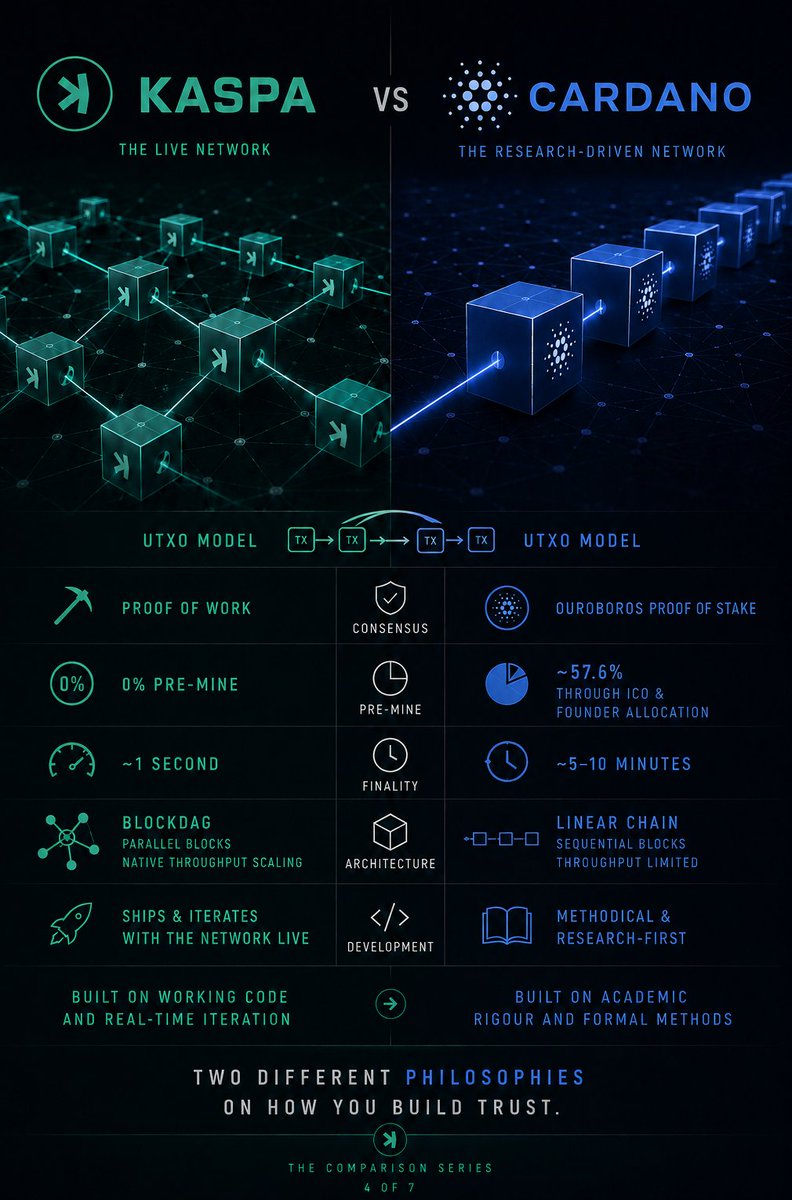
Kaspa vs Cardano. Architecture only. No tribalism.
Cardano is the most peer-reviewed blockchain in existence. Rigorous academic foundation. A serious team building with genuine care for correctness.
Here's where the architecture differs:
Consensus: ADA uses Ouroboros PoS. Kaspa uses Proof of Work.
Pre-mine: ADA distributed 57.6% through ICO and founder allocation. Kaspa: 0%.
Finality: ADA 5-10 minutes. Kaspa Sub 1 second.
Architecture: Both use UTXO model. ADA runs linear. Kaspa runs BlockDAG - parallel blocks, native throughput scaling.
Development: Cardano is methodical and research-first. Kaspa ships and iterates with the network live.
Two different philosophies on how you build trust. One through academic rigour. One through working code.
The Comparison Series. 4 of 7
$KAS
why I’m personally excited about Kaspa’s upcoming Toccata covenants
- for the first time, I can build creative, complex apps directly over infrastructure I helped design and build
- we designed under architectural constraints, but the result came out surprisingly expressive and powerful
- Silverscript is cool as hell
- I can literally open a *.sil file and write a complex contract that will be fully verified on Kaspa L1
- (nottoself: create a 10-minute video showing the building of such an app e2e)
- I can design my own vaults and safeguards, and manage funds securely without risking a heart attack each time I touch a wallet
- covenant ids, contract templates, and inter-covenant communication (ICC) feel like a new set of axioms, or a new algebra to work with and discover
- sig verify from stack / sighash anyone-can-pay + covenant ids can allow interesting shared-state covenants (requires a non-consensus miner policy; kudos to @maxibitcat for pushing this line of thinking)
- complex contract systems can be deployed in one spk hash. no storage rent, no deployment tax; users pay only the transient mass for tx data as they use it
- as I’ve mentioned in the past, this becomes especially interesting for AI/agentic environments, where bots could cheaply create one-time agreements between themselves
- I didn’t even mention based apps yet. That’s a whole vertical that isn’t ready for exploration yet, but will be very soon
A new era for Neoxa starts now.
The latest Neoxa website is live at 📷https://t.co/KRD5vNcsaS.
And yes, the Neoxa SDKs for games and AI agents are now live too.
Explore the developer docs:
https://t.co/6brbIZH0MW