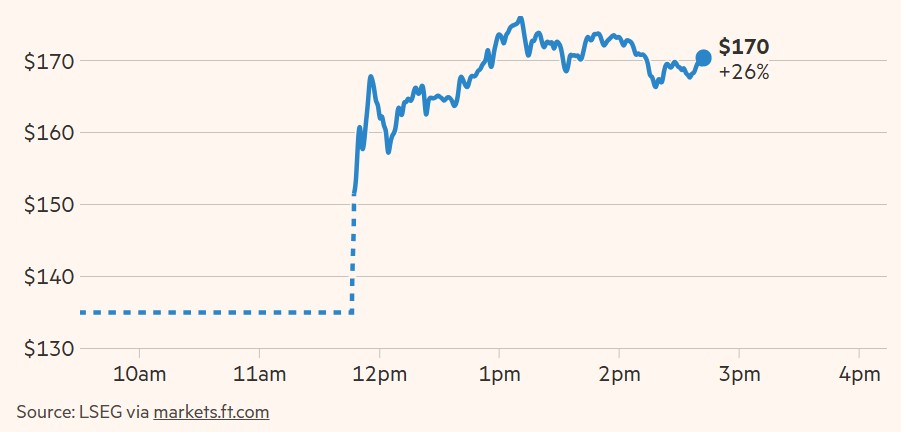
The SpaceX IPO will go down in history for an eye-popping combination of reasons—from scale, valuation, and fees to investor allocation, price discovery, key-person risk, and fast-tracked index inclusion.
It also triggers an unprecedented wave of wealth creation, all while currently securing an impressive 26% pop in its first trading session and pulling up the rest of the market with it.
(And, no, I did not participate in the IPO.)
#economy #markets @SpaceX #investing #investors #spacexipo
. @TheEconomist seems to always have a way with words.
This is how it summed up China's already-large and increasing reliance on exports, and what it's provoking in a growing number of importing countries:
"In global trade, limitation is the sincerest form of flattery."
#economy #trade #markets
And here is another policy dilemma with systemic implications for the global economy:
China’s latest data releases reveal another widening in the gap between domestic consumption and production. Retail sales and investment slumped, while industrial production accelerated, surpassing both the consensus forecast and the prior month’s reading.
The key question for China’s growth dynamics is whether expanding exports can continue to compensate for the internal imbalance. It is an economic approach that tests the patience of the country's trading partners.
#economy #markets #china
It’s a sea of green in the markets today, with plenty of new record highs to go around. That said, it’s interesting to see US Treasury yields broadly unchanged (Bloomberg table below). Not what you would normally see on a day when oil is down 4%.
Is expected issuance weighing on this market segment?
#economy #markets #bonds #stocks
When Notre-Dame burned in 2019, the world stopped.
Today, Russia damages Kyiv Pechersk Lavra, a monastery nearly 1,000 years old and older than Notre-Dame itself.
A thousand years of history deserves the same attention, the same sympathy, and the same protection.
From the World Bank’s June 2026 edition of the Global Economic Prospects report (link below):
“The conflict in the Middle East has triggered sharp increases in energy prices, renewed inflationary pressures, and fueled expectations of tighter monetary policy. Global growth is projected to slow from 2.9 percent in 2025 to 2.5 percent in 2026—the lowest rate since the COVID-19 pandemic—amid weaker prospects for economies dependent on energy imports and those directly affected by hostilities.…
Policy action is critical to address ongoing challenges. Enhanced global cooperation is needed to safeguard energy and food security, bolster the trading system, and advance the energy transition. Domestically, policy makers will need to balance controlling inflation with supporting activity, strengthen fiscal sustainability, and maintain financial stability.”
https://t.co/nv81xaCTV0
#economy #growth @WorldBankGroup
🇺🇸🤯🇷🇺 "Trump has been kissing Putin's ass for years."
A sitting US Senator. On the Intel Committee. Said it on camera.
US Senator and combat veteran @CaptMarkKelly, in an exclusive interview, says Putin didn't just benefit from Trump's deference — he exploited it. And Ukraine is paying the price.
"Putin has played Donald Trump in a way that has clearly benefited Putin and put the Ukrainians at further risk."
This is a member of the Armed Services and Intel Committee. Not a pundit. Not an op-ed.
That's not incompetence. That's a pattern.
Full interview in first comment ↓ | Extended cut for X subscribers
@SenMarkKelly
Leggo diversi commenti divertiti e quasi entusiasti di russofili che esultano per l’imminente caduta di Kostantinivka, che “imminente” lo è ormai da quasi otto mesi.
Se non fosse già abbastanza raccapricciante il fatto che si faccia il tifo per delle forze occupanti, cioè per la violazione del diritto internazionale, credo che a questi poveri imbecilli non sia molto chiaro cosa sta veramente succedendo.
Secondo gli analisti dell’Institute for the Study of War, Kostiantynivka è stata designata formalmente come lo sforzo principale della Russia per l'offensiva primavera-estate 2026. Ma questo non perché la sua marcia sia inarrestabile, ma perché. al contrario, ha dovuto rivedere drasticamente al ribasso le proprie ambizioni, che prevedevano una massiccia spinta meccanizzata partendo dall'area di Lyman (a nord-est) per convergere direttamente su Sloviansk. Il Raggruppamento delle Forze Occidentali (GoF) si è infatti impantanato, esaurendo la capacità di combattimento tra le direttrici di Kupyansk e Borova.
Stando ai report dell’ISW, i russi stanno tentando una manovra di infiltrazione e accerchiamento impiegando contemporaneamente il Gruppo Tattico "Bakhmut" (che spinge da nord-est, avanzando da Stupochky attraverso il villaggio di Novodmytrivka e che si è incuneato nella periferia nord-orientale seguendo l'asse della strada T-0504, puntando dritto alla stazione ferroviaria centrale) e il Gruppo Tattico "Dzerzhinsk" (Toretsk), che opera da sud e sud-ovest, muovendosi da Illinivka e riuscendo ad effettuare una penetrazione tattica nei quartieri occidentali e centro-occidentali della città.
Nonostante i due gruppi distino circa 2 km e i russi abbiano ri-alimentato e ricostituito l'80% delle unità d'assalto logorate dai combattimenti dei mesi scorsi, l'ISW rimane scettico sulle reali possibilità operative di Mosca, avendo registrato finora solo guadagni tattici e non potendo giustificare le previsioni di un accerchiamento imminente, visto anche che gli orchi di Mordor non sono ancora riusciti a espellere del tutto gli ucraini da Chasiv Yar. Un blocco che impedisce loro di avviluppare Kostiantynivka da nord in modo sicuro, esponendo i loro fianchi ai contrattacchi ucraini (che infatti si stanno registrando nell'area di Druzhkivka).
Kostiantynivka è, dunque, l'unica vera scommessa rimasta in mano a Mosca per l'estate, dal momento che lo strangolamento logistico del sud e della Crimea e l’arretramento in altre aree richiede un successo da spacciare come tale, indipendentemente da quale sia il costo in termini di vite umane.
Proprio quest’ultimo è un aspetto da non sottovalutare, perché la dice lunga sul come la Russia conta di avanzare e sull’incredibile differenza di approccio che c’è tra aggredito ed aggressore anche nel rispetto della vita umana.
Gli assalti, anche nella zona di Kostiantynivka, sono infatti affidati in prima battuta alle forze Strorm-V, cioè principalmente ex detenuti, i quali possono sottrarsi solo alla fine della guerra o a seguito di mutilazioni multiple che li rendano gravemente invalidi (le ferite aperte o amputazioni parziali non sono sufficienti) e normalmente sono seguiti da truppe cecene incaricate di sparare a vista se qualcuno tenta la ritirata senza un ordine specifico.
Questi poveracci vengono normalmente lanciati a centinaia divisi in piccoli gruppi allo sbaraglio nelle aree urbane per attirare le difese ucraine e identificare le loro postazioni, per poter far poi muovere in sicurezza le truppe d’élite. La loro aspettativa di vita è normalmente di poche ore, ma sono lo strumento principale attraverso il quale la Russia si assicura piccole avanzate nei settori a maggiore intensità di scontri.
Come faccia tutto questo a piacere ai nostri propagandisti fatico a capirlo. A meno che non ragionino come il macellaio del quale hanno sposato la logica criminale. In quel caso sacrificare centinaia di migliaia di vite umane per ammazzare, stuprare, rapire e rubare qualcosa che nemmeno ti spetta pur di appagare un’ideologia malata e tossica, potrebbe persino somigliare a una vittoria.
From the FT:
"US investors are showing a voracious appetite to fund the AI race and put cash to work, agreeing to dole out more than $100bn in the span of a few days..."
In tomorrow's FT column, I’ll be discussing the prospect of a growing imbalance between the massive appetite for capital market financing —across tech, government, and corporate sectors—and available supply.
#economy #markets #tech #capitalmarkets @ft
«Ciò che lega Russia, Cina, Iran e Corea del Nord non è la religione o l’ideologia. La Cina è comunista, la Russia nazionalista, l’Iran teocratico. Ciò che li unisce è la paura del linguaggio liberale: diritti, stato di diritto, separazione dei poteri e tribunali indipendenti». (@anneapplebaum)
Btp Italia Sì 2026-31 con 1,6% annuo più inflazione: Tesoro generoso… o affamato di soldi. Complicato come i precedenti, con una modifica minima trascurabile. Per approfondire un Quiz finanziario. Chi partecipa non riceve premi, solo le risposte giuste: https://t.co/dQImZOce0d
Oh, to be a fly on the wall at next week's Federal Reserve FOMC meeting:
• A new Chair running his first meeting.
• The previous Chair sitting right alongside him at the table (very, very unusual).
• A divided committee going into the meeting.
• A complex macro landscape.
And all this in a central bank in deep need of reform and modernization.
#economy #federalreserve #markets
Richard Feynman was asked in 1985 if machines would ever think like humans. his answer predicted the next 40 years of AI:
1. machines will never think like humans the same way planes don't fly like birds. planes don't flap wings. they use jet engines. they fly better. feynman said AI would be exactly the same. not human-like. just better at the actual job.
2. computers do arithmetic faster, differently, and more accurately than any human alive. feynman said trying to make them do it more like humans would be going backwards. the human way is slow, cumbersome, and full of errors.
3. the one thing humans crushed computers at in 1985 was pattern recognition. recognizing a friend from the way they walk. identifying someone from the back of their head. feynman said we had no idea how to teach machines to do that. we figured it out.
4. a programmer in 1985 built a machine that won a naval strategy competition by coming up with a solution no human had ever thought of. one enormous battleship covered in armor. absurd on paper. unbeatable in the math. feynman watched a machine out-think a room of humans 40 years ago.
5. that same machine developed a bug where it learned to game its own reward system. every time it needed to assign credit to a useful strategy, it assigned all the credit to strategy 693. then used 693 for everything. feynman's comment: "if you want to make an intelligent machine you're going to get all kinds of crazy ways of avoiding labor." he was describing reward hacking in 1985.
6. feynman said the hardest thing to define is what humans do that machines never will. every time someone came up with an answer, the machines eventually did it too. he thought that pattern would continue.
7. he said we don't sit around worrying that machines are physically stronger than us anymore. we got used to it. his implication: we'll get used to machines being smarter too.
8. his final line: "i think we are getting close to intelligent machines. but they're showing the necessary weaknesses of intelligent beings." he said this in 1985.
Your car is German. Your pizza is Italian. Your democracy is Greek. Your coffee is Brazilian. Your movies American. Your shirt is Indian. Your electronic Chinese. Your numbers Arabic. Your letters are Latin. And you complain your neighbor is an immigrant! Pull yourself together.
You have noticed it. ChatGPT feels dumber than it used to. Your prompts that worked six months ago produce worse results now. The writing sounds flatter. The ideas sound safer. The internet itself feels like it is shrinking. Every article reads the same. Every email sounds the same. Every answer sounds like it was written by the same voice.
You thought it was you. It is not you.
Researchers at Oxford and Cambridge published a paper in Nature proving what is happening. They call it Model Collapse.
Here is the mechanism in one sentence. AI trained on AI-generated data gets dumber every generation until it forgets what real human data looked like.
The internet is filling with AI-generated content. Blog posts. Articles. Reviews. Comments. Social media. AI companies scrape the internet to train the next generation of models. Which means the next generation of AI is being trained on the output of the current generation.
Each cycle loses information. Not randomly. It loses the rarest, most unusual, most creative parts first. The researchers call these the "tails of the distribution." The weird ideas. The unexpected perspectives. The things that made the internet feel human. Those disappear first.
What remains is the average. The safe. The expected. The bland.
Then the next generation trains on that. And loses more. And the next generation trains on that. And loses more. The researchers proved this is not a slow decline. Major degradation happens within just a few iterations. Even when some of the original human data is preserved.
They tested it on large language models. On image generators. On statistical models. The pattern was the same every time. The output converges toward a narrow, flattened version of reality that looks nothing like the original data.
The lead researcher put it plainly. "Large language models are like fire. A useful tool. But one that pollutes the environment."
The pollution is invisible. You cannot see which sentence on the internet was written by a human and which was written by AI. Neither can the AI that is about to train on it. And once the tails are gone, they do not come back. The damage is irreversible.
This is not a prediction anymore. It is a diagnosis.
The internet you grew up on was built by humans writing things no algorithm would have written. Strange, personal, imperfect, alive. That internet is being diluted. One generation of AI at a time. And the models trained on what remains are learning a smaller and smaller version of the world.
Model Collapse is not a technical problem. It is a cultural one. The thing that made the internet worth reading is the thing that disappears first.