PhD student @CUBoulder using remote sensing & GIS with statistical learning to better understand the social-ecological landscape of wildfire. opinions = my own
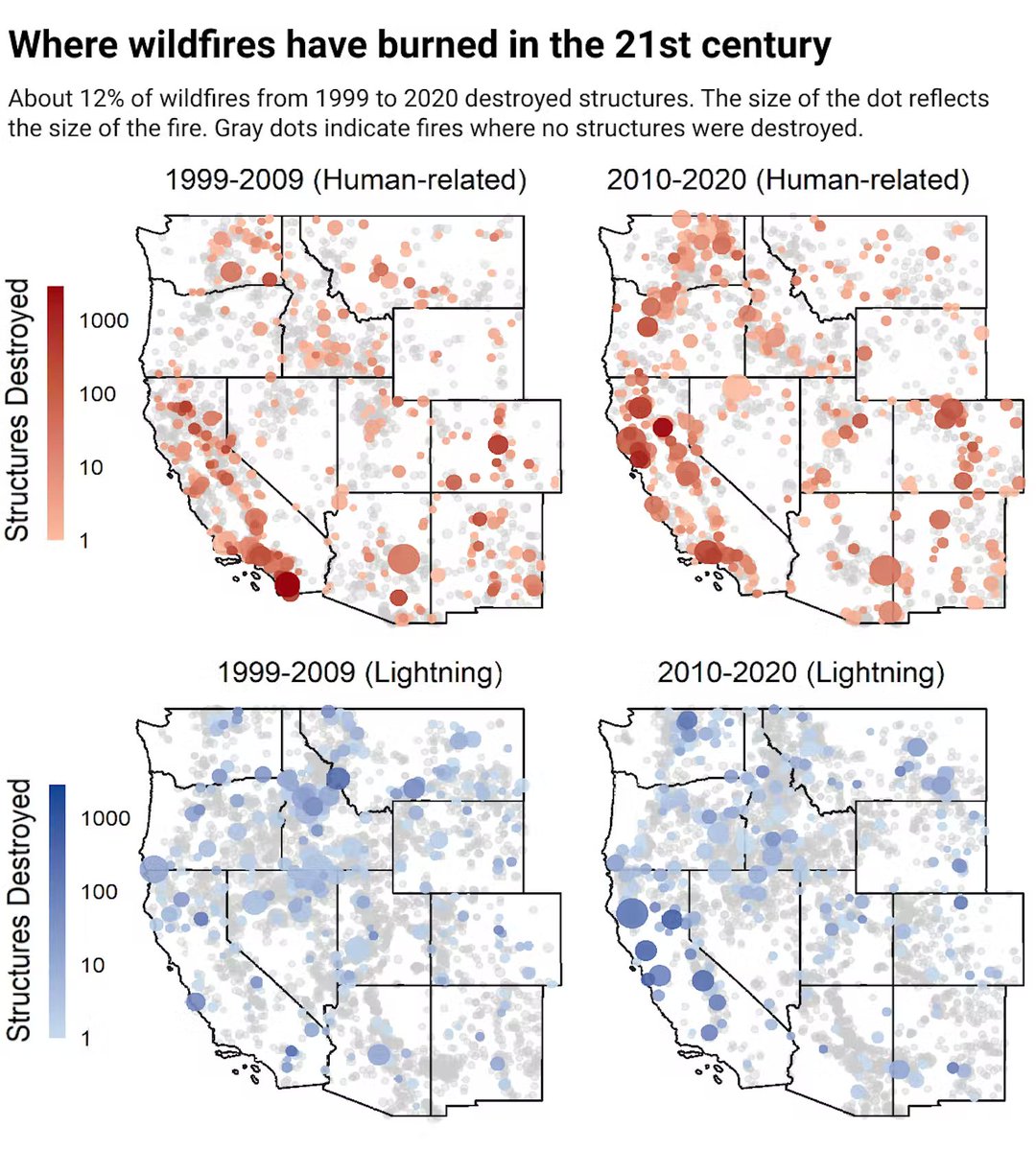
🚨Proud to share this new pub in @PNASNexus, w/ @PhilipHiguera @DrBalch@DrWKID @adm0n @LaSTdenis, out today. We document a 246% increase in west-wide structure loss to #wildfires in the last decade, largely driven by unplanned human ignitions. Link to paper in press release ⬇️
More than 3 times as many houses and other structures burned in Western #wildfires in 2010-2020 than in the previous decade, according to work led by @umontana's @PhilipHiguera, a past CIRES visiting fellow, and co-authored by CIRES/@EarthLabCU scientists
https://t.co/Hvmz8njjMd
I’ll be presenting alongside amazing colleagues both current and former @EarthLabCU@CIRESnews@CU_ESIIL reach out if you’re in Long Beach, CA! This will be an amazing session 🌲 🔥 🛰️
At ESA this week? Interested in wildfire data science? Check out our OOS on Thu: Harnessing the Fire Data Revolution to Understand our Changing Fire Regimes. I’ll be presenting exciting new research, coming out soon 🤫 ! #ESA2024#DataScience#Wildfire
We've received multiple inquiries about smoke from the Boulder area. This smoke is from the Blue Ridge prescribed burn in Grand County. Follow @usfsarp for more information. #COwx
Fire is going to do the work in the landscape that it needs to do in a warming climate, @DrBalch writes in a guest opinion.
“If we do nothing to curb our risk, these fires will do far more than just pollute the air.” https://t.co/WH9OCAzrML
It's Day 1 of our 2023 Innovation Summit! @DrBalch is welcoming our attendees, and inspiring us all to build a diverse, inclusive, and innovative #earthdatascience community
Western wildfires destroyed 246% more homes & structures in the past decade. Earth Lab's @PhilipHiguera, @MaxCCook, @DrBalch, and @DrWKID wrote an article in The Conversation, where they explain what's changing in #wildfires
https://t.co/htRXwJOlYD
From @PhilipHiguera @MaxCCook@DrBalch @adm0n @LaSTdenis & me in @PNASNexus: https://t.co/IuB2pWxW6W
TL;DR: https://t.co/0R2gWp2Gj1
Answer: a growing WUI, century fire supression & #climatechange... also unplanned human ignitions; which means we can do something about it
A 🧵
You can read more in a public-facing piece in @ConversationUS which highlights this work on the changing social-ecological context of #wildfires from the perspective of home/structure loss across the American #West, 1999-2020.
https://t.co/cBntvlOOXl
🚨Proud to share this new pub in @PNASNexus, w/ @PhilipHiguera @DrBalch@DrWKID @adm0n @LaSTdenis, out today. We document a 246% increase in west-wide structure loss to #wildfires in the last decade, largely driven by unplanned human ignitions. Link to paper in press release ⬇️
More than 3 times as many houses and other structures burned in Western #wildfires in 2010-2020 than in the previous decade, according to work led by @umontana's @PhilipHiguera, a past CIRES visiting fellow, and co-authored by CIRES/@EarthLabCU scientists
https://t.co/Hvmz8njjMd
Our @CIRESnews , @EarthLabCU , @FCFCMontana team found that unintentional human-caused #wildfires typically destroy over 10 times more structures for every square mile burned, compared to lighting-caused events across the #West. https://t.co/bnETkyqFL6
Are you thinking about using #drones for ecology research? Is one of your grad students? Maybe you're teaching a course about it?
This paper was written for you!
We provide a mental framework and functional workflow for ecologists new to the #drone world.
1/ With August now over, the ongoing soil-moisture drought in southwestern North America has now, at 23 years old and counting, matched the duration, and probably exceeded the severity, of the “megadrought” that struck the region from 1571–1593.
Fabulous news to share! On August 1st we are launching the Environmental Data Science Innovation & Inclusion Lab @CU_ESIIL! @NSF's newest data synthesis center! Please join a Virtual Toast, 2:30-3 pm MT on 8/1. All welcome! Please retweet & register: https://t.co/iTi0DL2OHK
A new #NSFfunded@EarthLabCU CIRES/#CUBoulder center, Environmental Data Science Innovation and Inclusion Lab (ESIIL) will tackle pressing socio-environmental challenges with big data analytics, more.
Read on: https://t.co/pSdYt5u0OS