UCLA Geography is hiring! Assistant Professor in the general area of "Environmental Challenges". If you're a physical scientist wanting to research and teach on policy-relevant environmental issues please apply: https://t.co/fJWcobDL13
If you're going to @theAGU this year and work on western US climate & water please consider submitting to our session: A094 - Hydroclimate and Extremes in the Western United States in a Changing Climate
https://t.co/YggHI53L1G
As we head into Fall, I wanted to share results from my paper (w/ stellar colleagues @peedublya, @caro_in_space, Winslow Hansen, and @PierreGentine)
https://t.co/LNnB9A1UoU
introducing a stochastic machine learning model for wildfires in the western US (WUS).
A mini-🧵:
Here in the Department of Geography @UCLA we're searching for a new colleague at the Assistant Professor level who works on anything under the big umbrella of Physical Geography. Ad below. Please help me distribute widely: https://t.co/Hsewo1zMme
Sea-surface temperature (SST) trends over the last ~40 years show an unusual pattern, with cooling in the SE Pacific & Southern Ocean, despite ongoing global warming. In a recently published paper, we investigate if climate model large ensembles (LEs) can simulate this pattern.
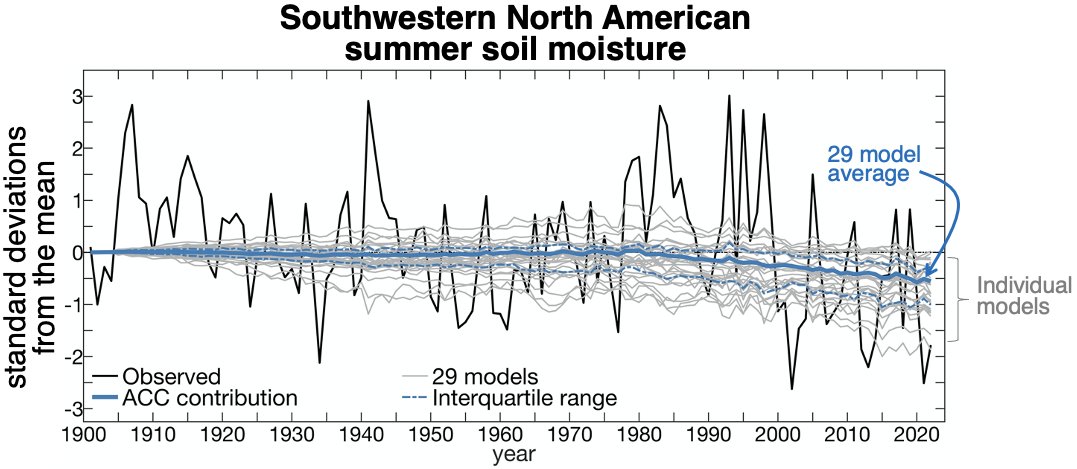
11/11 This thread is an update a study published with Ben Cook (@DustyBowl) and Jason Smerdon from @LamontEarth earlier this year (https://t.co/DHGbelbEqX), which was itself an update of a study we published with other friends in 2020 (https://t.co/LrYmD2XMUF).
1/ With August now over, the ongoing soil-moisture drought in southwestern North America has now, at 23 years old and counting, matched the duration, and probably exceeded the severity, of the “megadrought” that struck the region from 1571–1593.
10/ The exact magnitude of the human-caused contribution is highly uncertain, mostly due to model disagreement on precipitation trends. Here, grey lines show how our calculation of the human-caused climate change trend would differ if we considered any single climate model.