Working on democratic AI governance at AI & Democracy Foundation. Governance Innovation Advisor @Meta.
Formerly: @GovAIOrg @FLForg @oiioxford and @B_I_Team
@alexolegimas hopes AI does commodities, humans do the relational work (care, connection). but markets at scale sometimes sell us cheap stand-ins for experience goods (where relational work often lives) due to incomplete contracting.
some thoughts on the limits of competition:
"The influence an AI system has on a user’s views should resemble the influence that user would have experienced if they’d participated in a deliberative poll on the same topic."
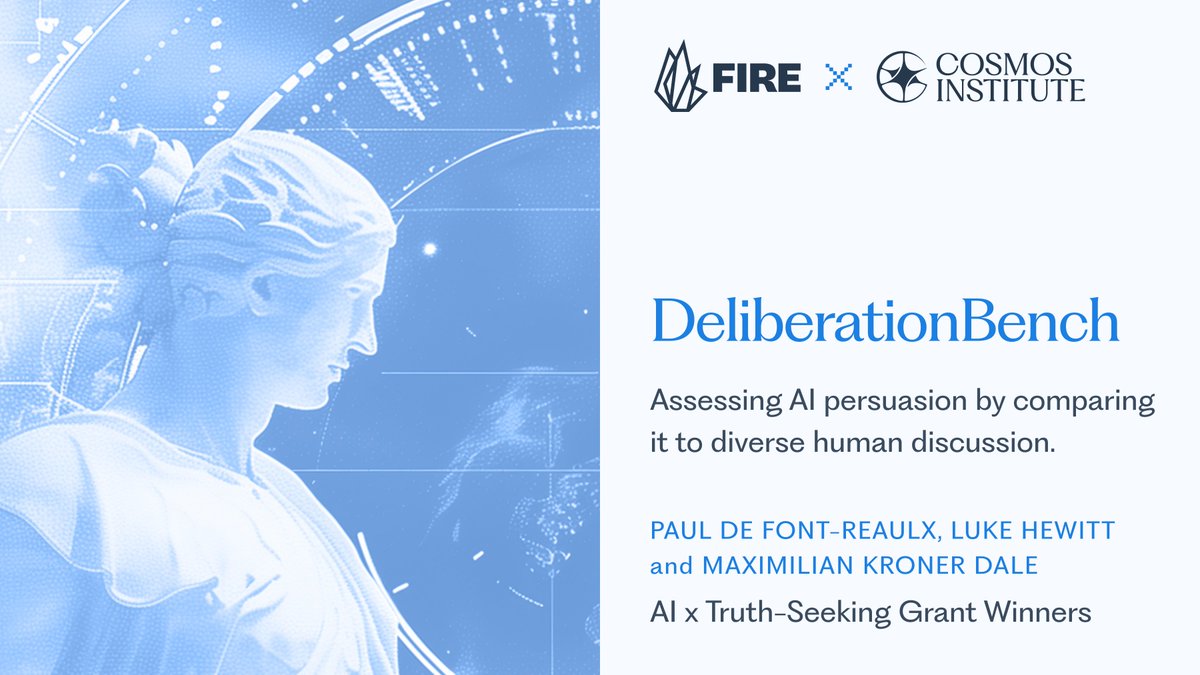
@MaxKronerDale, @PReaulx, and @lukebeehewitt introduce DeliberationBench – a project we backed in partnership with
@TheFIREorg. 👇
The current optimistic story about AGI and labor is something like: machines do the commodities, humans do the relational stuff (care, connection, hosting).
I think this misses something about how relational labor works in markets at scale.
Wrote an essay about it 👇
A common dynamic I observe with AI: it feels most impressive when you don’t know much about the subject, don’t care or don’t have a clear idea of what the you want.
This applies across design, code, legal, and more. If I don’t know code very well, every piece of code it writes feels very impressive.
Once you know what something should feel or look like, it becomes almost impossible to guide AI there. And you definitely can’t one-shot it.
This FT article went way too viral...
The study used no real humans. The simulations of humans are basic---LLMs prompted with political beliefs. They assume the synthetic human updates their political beliefs as a weighted average of their original position and the chatbot's response.
I'd like to highlight some more exciting work by @MaxKronerDale@PReaulx@lukebeehewitt on "DeliberationBench" https://t.co/1M5uIVYIAj
Chatbots will inevitably influence people. The question is whether that influence is procedurally legitimate. A useful comparison is deliberation: a process which we consider to produce procedurally legitimate opinion change, e.g., https://t.co/GunLiirtOK
In the "DeliberationBench" paper, they find that after talking to a chatbot, people on average, change their opinions similarly to how they would if they participated in a deliberation on the same topic. This provides some evidence that models may be producing epistemically desirable changes because they move people in the same direction that a process with procedural legitimacy does.
Note that this doesn't directly answer whether the process the _model_ used was legitimate. A model could lie to the user but still get them to the deliberative outcome. To address that, we should try to directly align models with the deliberative ideals which give deliberation procedural legitimacy in the first place, something I argued for in my IASEAI'25 talk https://t.co/cO7FIdObUL
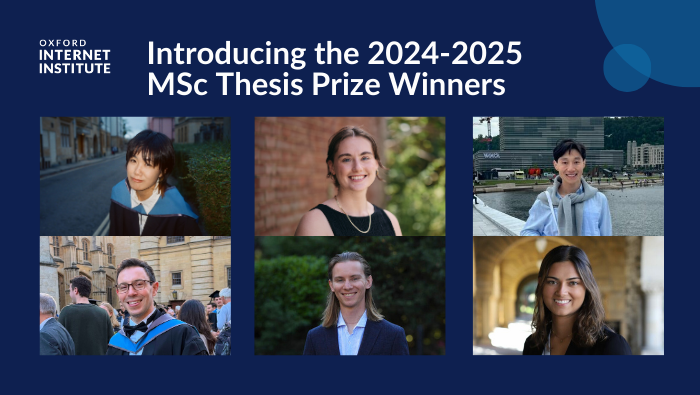
We are delighted to announce the winners of the 2025 OII MSc Thesis Prizes. Congrats to @RyanOthKearns, Jie Zhao, @MaxKronerDale and Sophie Lloyd-Hurwitz, and highly commended students @yasmeena_khan and @wzc0331.
Read more: https://t.co/IEWg2YSaed
We know that #LLMs are persuasive. Given this, how can we distinguish desirable opinion change from undesirable manipulation due to LLMs?
@PReaulx@lukebeehewitt, and I make a pass at this with DeliberationBench.
Thank you @cosmos_inst@TheFIREorg for this grant. More to come
When AIs change our minds, are we being informed or manipulated? Me, @MaxKronerDale, and @lukebeehewitt were recently awarded a FIRE x Cosmos grant for our work on assessing the influence of AI models on people's political views. @cosmos_inst@TheFIREorg
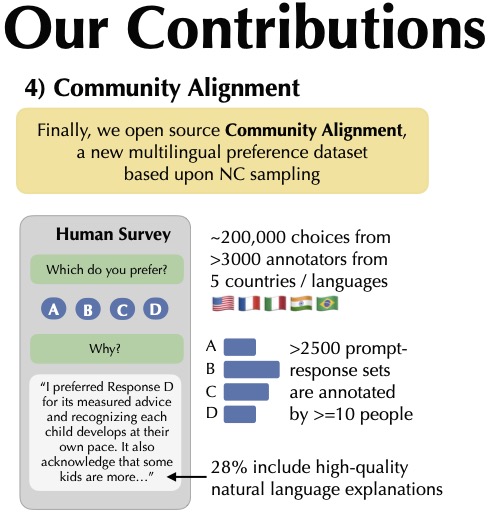
Finally, based on these insights we collect Community Alignment (CA). Features include:
- NC-sampled candidate responses
- Multilingual
- >2500 prompts are annotated by >= 10 people
- Natural language explanations for > 1/4 of choices
and more!
I was glad to serve as an external advisor on this Community Alignment initiative. Culture has been a relatively neglected dimension of alignment research. This is an important step toward producing AI systems that can reflect pluralistic values.
Today we're releasing Community Alignment - the largest open-source dataset of human preferences for LLMs, containing ~200k comparisons from >3000 annotators in 5 countries / languages!
There was a lot of research that went into this... 🧵
Interested in technology, AI governance, and #DeliberativeDemocracy?
Join me and Meta’s Governance Innovation Director, Kris Rose, tomorrow at 10:30 AM Pacific for a discussion of these topics and more.
https://t.co/y80YrjqXbs
#AI#SocialMedia#Policy
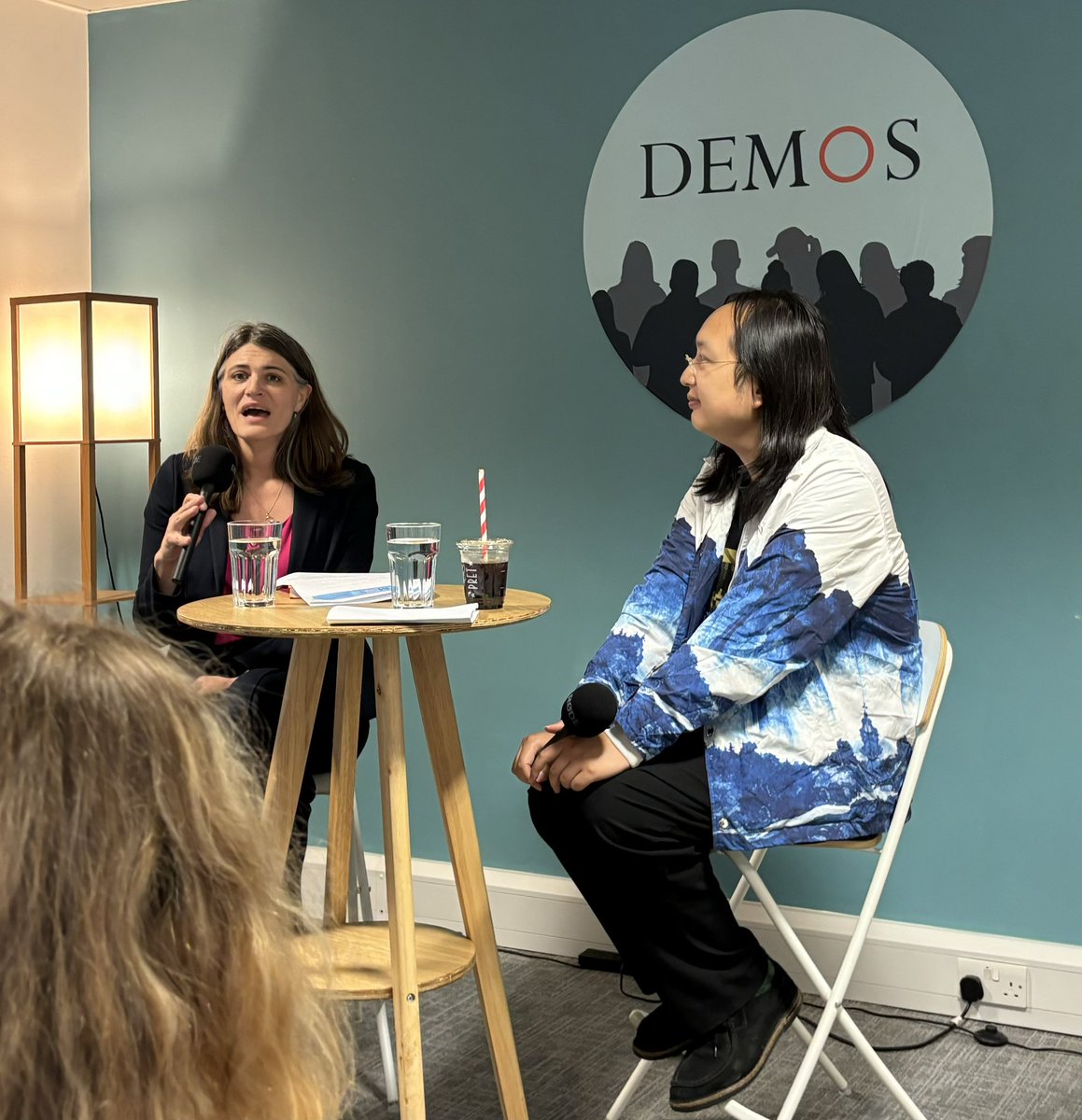
@audreyt did a superb job answering all sorts of challenging questions (including mine) in her talk at @Demos the other day.
There is certainly a lot of excitement in the air around innovative tools for #DigitalDemocracy and #DeliberativeDemocracy.
My copy of Thinking Fast & Slow has more annotations than nearly any other book I own. Daniel Kahneman’s research, which I stumbled across just before college, was a huge influence in my choice of career path. We’re lucky so much of his work lives on.
RIP Daniel Kahneman.
You can find the paper here: "An evaluation of a Vision Zero traffic-calming intervention, an urban transportation safety policy" https://t.co/8meqgPu246
Really excited to announce that these exciting results are now peer-reviewed and published in @JUAurban! Extending the initial work, a conservative cost-benefit analysis found that the intervention was a positive return on investment. #ChoiceArchitecture#VisionZero
I am delighted to share the results of our project (@BITAmericas) with @sfmta_muni. Using rigorous methods, we found that speed bumps & delineator posts causally reduced the speed of left-turning cars by 17% https://t.co/Dpzdiq9wZd (1/3)
Regulators need to understand the effects of #darkpatterns and #deceptivedesign on consumers if they want to protect them. In this blog post, @mhallsworth and I describe why this topic is important and how understanding #behavioraleconomics can help.
https://t.co/b9biAHrWp2
More on Meta’s Global Community Forum. If all goes well, I think this could be a big leap in #PlatformDemocracy (h/t @metaviv). There’s also plenty to learn about how to make such processes work effectively. Maybe of interest to @CaseyNewton
🤔Our work with @Meta is showing the power of deliberative democracy in empowering users to help shape the rules of platforms
Wisdom really can come from crowds 💡
https://t.co/haiDC0phaZ
@DavidHalpernCEO @Lis_Costa_@mhallsworth