Every builder's first duty is philosophical: to decide what they should build for.
AI is beginning to decide what ideas reach your mind—your next action, your next job, your next relationship. It will tempt you to outsource your thinking in ways you’ve never been tempted before.
Left unchecked, this becomes autocomplete for life.
200 years ago, when mechanization was starting to transform the world, the German philosopher Wilhelm von Humboldt warned of this very dynamic: To flourish as humans, we have to be self-directed. We are the architects of our own becoming.
But if we offload our thinking—if we let AI automate what we once pursued with intention—is it still our life to live?
To build AI that advances human flourishing, we need technologists who combine technical ability with moral vision.
Silicon Valley once embodied this: Jobs and Wozniak asked what kind of creative life personal computers should enable; ARPANET's pioneers envisioned what kind of connected society networks should foster.
But today, we now see three dominant archetypes:
1. The puzzle-absorbed: Solving technical challenges without reflecting on broader ends
2. The reductionists: Collapsing morality into math
3. The dismissers: Waving off philosophy as irrelevant to progress
All three abdicate the fundamental question: What should we build for?
This is where philosophy is essential. Because the job of a builder isn’t just to ship. It’s to shape a shared world.
We need a new kind of technologist—one who builds with human flourishing in mind. Who resists centralized control. Who strengthens autonomy instead of mining attention.
We call them Philosopher-Builders.
@cosmos_inst exists to train and support them—people who translate deep thinking into systems, institutions, and infrastructure that serve human ends.
If you believe the future of AI should expand human freedom and lift human potential, read the full essay.
“We cannot risk neglecting solutions human society has devised over the millennia.”
Guest essay from @silicoase founder @Connacher_ on why markets, courts, and reputation, which already align self-interested people, could align AI agents.
https://t.co/DqAaEppBHB
Séb Krier (@sebkrier) is very "AGI-pilled" but rejects many popular narratives about the AI revolution, from godlike superintelligence to explosive self-improvement. Henry and I ask him about "Sand Gods", foom, and what is wrong with p(doom). (2/5) https://t.co/6eAIOthga4
“Most AI evaluations still judge an assistant by the quality of its answers and the satisfaction of its users rather than what is happening to the person.”
@Brendan_McCord in @Microsoft’s Humanist Review on why labs need to evaluate how AI changes users.
https://t.co/hWcJN1dHDR
"AI has opened a new continent – we're setting foot on its shores."
@Brendan_McCord on @MTSlive discussing why this is the greatest moment since the American founding for institution-builders.
Welcome to the Unending RSI Discourse Era! In addition to such niche up-and-comers as @dwarkesh_sp , @alexolegimas, and @lugaricano, I also have a new piece on this matter.
Rather than providing specific quantitative forecasts, I've tried to clarify the conceptual structure of "recursive self-improvement". Yudkowsky's original picture, downstream of his own model of intelligence, was of a mind becoming intelligent enough to improve its own cognitive machinery, then using its improved intelligence to make further improvements.
Although that particular model has been superseded by AI advances, I think we retain lots of its conceptual baggage — for instance, the expectation of a sudden FOOM with little warning or opportunity to intervene. I try to retain what's useful in Yudkowsky's framework, while reworking it to analyse the feedback mechanisms actually driving progress in deep learning.
I disaggregate RSI into its three components — recursiveness, self-directedness, and actual improvement — and show why the regimes where we have any two are quite different from a regime in which we have all three. The most distinctive feature of the current paradigm is that the "self" is not a single model improving itself; it's a broader AI development system whose outputs feed back into its own inputs.
The reason is that deep learning blurs Yudkowsky's distinction between cognitive algorithms and cognitive content: a neural network's knowledge and its reasoning procedures are learned together, and embodied in the same weights. Improving cognition, then, isn't a matter of rewriting those algorithms; it's about discovering better knowledge and procedures through training. So the machinery producing cognition is the training process itself, including algorithms, data, and compute.
This takes my earlier judgement that Carl Shulman won the FOOM debate by "getting the unit of recursion right", and develops it into a more systematic account of what he got right, and what feedback mechanisms drive AI progress.
The fact that the "self" is an AI development system, rather than either an individual seed AI or the entire global economy, explains why Yudkowsky's "returns on cognitive reinvestment" model is insufficient. We instead need a model where the system feeds back through two main channels: algorithmic progress and hardware spending. I argue that the reason AI progress has often been underestimated is that each of these raises the returns to the other — and since they've been doing so for years, there's no threshold where RSI "begins".
Instead, this structure explains why we keep seeing "one-time speed-ups"; under certain parameter assumptions, that trend of accelerating AI research can continue until it explodes, with kinks in the graph but no outright discontinuity. It doesn't even need to keep accelerating: even without "Sustained Strong Recursion", a sufficiently large speed-up that doesn't compound can still take AI beyond human intelligence.
Listening to Jane Street's panel discussion on whether the Singularity is coming, it's striking how thinkers with such different expectations as @Jsevillamol, @EgeErdil2, @RyanGreenblatt, and @DKokotajlo are all working from basically the same model — they just disagree about parameters. I think the structure I lay out explains why so many people trying to think seriously about AI progress often converge, especially when they try to write down a formal model.
However, the broader discourse is much looser. Fast-timelines people sometimes speak of RSI as a discrete, identifiable threshold that might suddenly be crossed. And sceptics deride the notion of an intelligence explosion altogether, taking the tight correlation between compute scaling and algorithmic progress to mean that compute is the sole driving force of progress, and so returns to cognitive labour must be low — neglecting the fact that those returns are the reason the compute scale-up was worthwhile in the first place.
Finally, I briefly consider the implications of the revised model for Yudkowskian concerns about alignment, loss of control, and concentration of power.
Read it! https://t.co/Y9l508apZT
"The deep learning paradigm forces us to reconsider what counts as the 'self' undergoing improvement."
@_AashishReddy on why there is no single moment when recursive self-improvement “begins,” and what that means for human control.
https://t.co/n42i0jqmuj
James Madison believed ambition must be made to counteract ambition to create societies that are both safe and free. For Noema, @benbariach and I wrote about how to engineer environments to make that happen in a world with powerful agents
https://t.co/UNCIX8Lfzn
We need "a vision of human possibility that can change everything in the way that Franklin giving people a book changed everything."
On @MTSLive, @Brendan_McCord discussed how philosopher-builders like @jliemandt transform their convictions into enduring institutions.
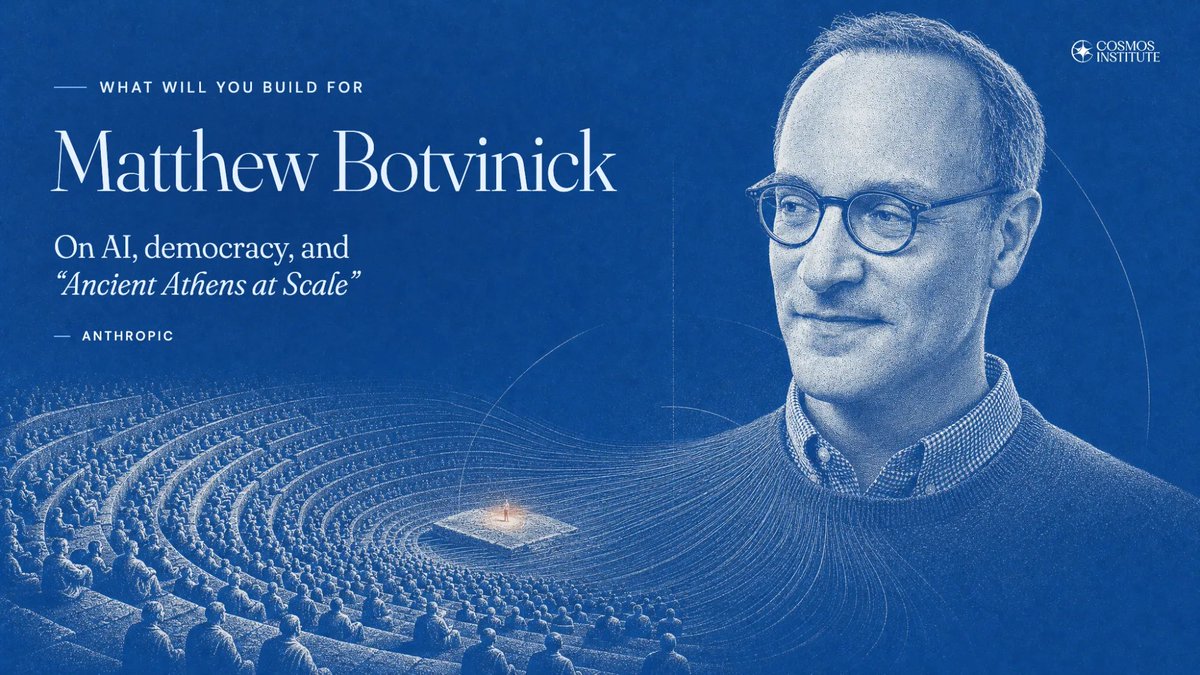
What are the big authoritarian risks of the 21st century? Does AI have democratic potential? And what can we learn from Ancient Athens?
We put these questions and more to @mattbotvinick, author of AI and Political Freedom.
https://t.co/2SPaf53JpH
What are the big authoritarian risks of the 21st century? Does AI have democratic potential? And what can we learn from Ancient Athens?
We put these questions and more to @mattbotvinick, author of AI and Political Freedom.
https://t.co/2SPaf53JpH
Make your agents ask better questions.
Agentic search needs a new frontier. Humans have always noticed connections in the world in ways that agents cannot search.
I've built the hardest personal dataset for agents to navigate, patterned by two decades of journaling. Enzyme is a retrieval layer for agents that adapts to your local workspace, designed around how half-formed ideas resurface a dozen different ways.
In agentic retrieval, it saves up to 40% of tokens over plain grep. But you never pore over old journals to find known facts. Nostalgia often leaves you inspired. Over 2 years of daily use, this is what Enzyme does best.
Enzyme is now open source. Go build some great harnesses with it.
We hosted our first-ever webinar for people interested applying to lead reading groups exploring philosophy, AI, and human autonomy, with support from Cosmos.
We had an awesome turnout, with attendees from Stanford, Columbia, Berkeley, Cornell, St John’s College, & many more!
10 articles and papers we read in October 🍂📚
1) How AI agents shape experts’ judgment calls - @amacinho, @HaileyJoren, @AlexTamkin
https://t.co/FouwnBumhh
New Anthropic research: How AI agents shape experts' judgment calls
When experts delegate work to an agent, do they still make the key decisions? We tested this in a randomized trial with 50 professional data analysts.